
Electric vehicles remain the largest market for rechargeable batteries, but they are no longer the only force shaping battery technology.
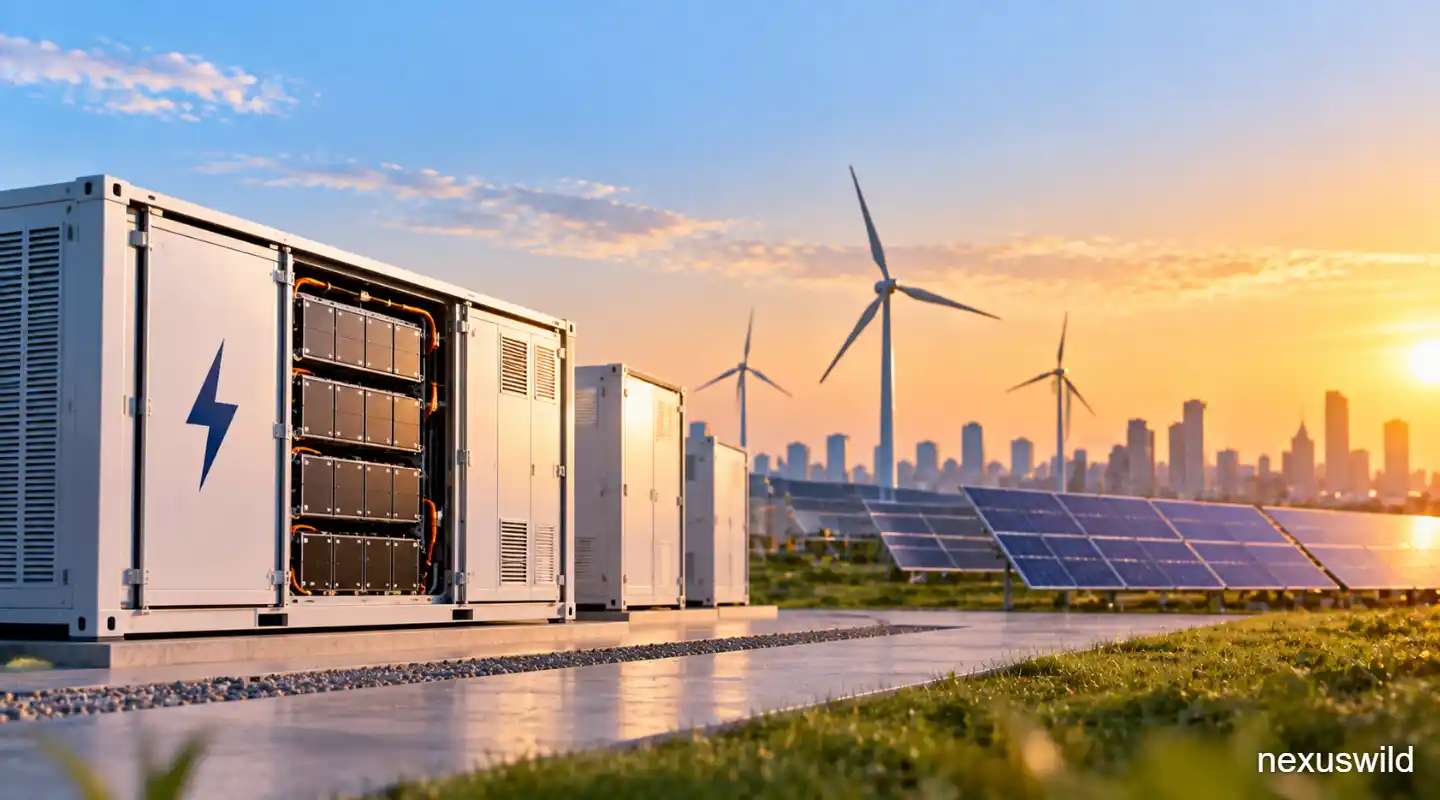
Electricity grids need faster and longer-duration storage as wind and solar generation expands. AI data centers require increasingly large backup-power systems. Consumer electronics companies want more energy without making devices larger. Industrial sites and microgrids are looking for alternatives to diesel generators.
Those applications do not all need the same battery.
A smartphone benefits from high energy density. A grid battery may care more about cost, cycle life and safety. A data center needs extremely fast response for some applications but potentially multi-day backup for others.
That is pushing the battery industry beyond a single chemistry and toward a wider mix of technologies including lithium iron phosphate, sodium-ion, solid-state, lithium-metal, iron-air and flow batteries.
The International Energy Agency says 108 GW of new battery-storage capacity was installed globally in 2025, 40% more than in 2024. About 80% of those additions were utility-scale systems, making battery storage one of the fastest-growing areas of the power sector.
Today's Grid Battery Is Still Mostly Lithium-Ion
Despite intense research into new chemistries, conventional lithium-ion remains the foundation of the current storage market.
About 90% of battery-storage deployments now use lithium iron phosphate, or LFP, according to the IEA.
LFP has become particularly attractive for stationary systems because it generally costs less than nickel-rich lithium-ion chemistries and performs well under repeated cycling.
In 2025, LFP battery packs were more than 40% cheaper per kilowatt-hour than nickel-manganese-cobalt, or NMC, packs on average, although part of that price difference reflects the different applications in which the technologies are used.
For grid operators, the lower energy density of LFP matters less than it does inside a car because a stationary battery does not need to minimise every kilogram.
That makes today's storage market very different from the race for maximum EV driving range.
Renewable Energy Is Creating a Larger Storage Market
Solar and wind generation fluctuate with weather and time of day.
Batteries allow electricity produced during periods of high renewable output to be shifted into periods when demand is stronger or renewable generation is lower.
They can also respond within seconds to changes in grid conditions, provide frequency support and help relieve congestion.
The IEA says battery project costs fell about 40% in 2024 to around $150 per kilowatt-hour, helping accelerate deployment.
Most utility batteries still provide roughly two hours of storage, although four-hour and longer systems are becoming more common.
That leaves room for technologies designed for much longer periods.
The US Department of Energy defines long-duration energy storage as systems able to provide electricity for 10 hours or more and is funding demonstrations involving flow batteries, zinc systems and other technologies aimed at maintaining power during extended outages or renewable-energy shortages.
Sodium-Ion Is Moving From Research Into Commercial Deployment
Sodium-ion has become one of the most important alternatives to conventional lithium-ion because sodium is abundant and the chemistry avoids lithium.
The trade-off is energy density.
The IEA says the newest sodium-ion cells can reach about 175 Wh/kg, compared with roughly 205 Wh/kg for leading LFP cells and 265 Wh/kg for NMC.
That disadvantage is much less important in a stationary battery than in a long-range vehicle.
Commercialisation is now accelerating.
In June 2026, CATL introduced its TENER Sodium stationary-storage system and said Chinese deliveries would begin in September, with cumulative shipments expected to reach 1 GWh by the end of 2026. International deliveries are planned for June 2027.
CATL and energy-storage integrator HyperStrong have also signed a three-year agreement covering 60 GWh of sodium-ion batteries, while CATL and European energy company Alfen announced a separate 5 GWh cooperation programme.
Those commitments show that sodium-ion is no longer solely a laboratory technology.
But lithium-ion still has advantages in cost, manufacturing scale and energy density. Sodium-ion may need further technical improvement or different commodity-price conditions to compete broadly with today's low-cost LFP systems.
Solid-State Batteries Promise Higher Density, but Scale Is Not Yet Proven
Solid-state batteries replace the liquid electrolyte used in conventional lithium-ion cells with a solid material.
In principle, this can enable designs with higher energy density and potentially improve safety by reducing dependence on flammable liquid electrolytes.
But commercial scale remains the central challenge.
QuantumScape opened its Eagle Line pilot facility in February 2026 to produce solid-state cells for customer testing, demonstrations and product-integration work.
Its QSE-5 lithium-metal solid-state sample is specified by the company at about 844 Wh/L and less than 15 minutes for charging from 10% to 80%. Those are company-reported cell specifications from low-volume samples, not performance from mass-produced commercial battery packs.
Samsung SDI is also developing solid-state batteries. In March it displayed a pouch-format solid-state sample aimed at robotics and says it is targeting mass production in the second half of 2027.
That date remains a company target.
As of October 2026, solid-state batteries have moved into pilot lines and customer samples, but they have not displaced conventional lithium-ion as a mass-market storage technology.
Lithium-Metal Could Matter Where Weight Is Critical
Lithium-metal batteries pursue a related goal: replacing the graphite-based anode used in conventional lithium-ion cells with lithium metal.
The attraction is much higher potential energy density.
SES AI, for example, lists a lithium-metal drone cell at 375 Wh/kg and says its larger automotive technology is designed around approximately 400 Wh/kg.
The company has progressed to automotive sample-development programmes, but lithium-metal is not yet a mainstream mass-produced battery chemistry.
Its most obvious early applications may therefore be products in which weight carries unusually high economic value, including drones, aircraft, robotics and potentially premium vehicles.
For stationary energy storage, where physical weight is less important, lithium-metal's energy-density advantage may be less valuable than cheap materials and very long cycle life.
Iron-Air Batteries Target Storage Measured in Days
For the electricity grid, the next breakthrough may look very different from a high-density EV battery.
Form Energy is commercialising an iron-air battery designed to store energy for up to 100 hours. The chemistry uses iron, water and air rather than lithium, nickel or cobalt.
The company deployed its first commercial demonstration system with Great River Energy in Minnesota and says it now has a large pipeline of utility projects.
In March 2026, Form Energy and AI-infrastructure company Crusoe announced an agreement covering 12 GWh of iron-air storage for data centers, with deliveries planned to begin in 2027.
A separate planned project in Ireland would provide 10 MW of power and 1,000 MWh of energy, equivalent to 100 hours at full output, and is expected to enter service in 2029.
Those projects remain either demonstrations or future deployments. Iron-air has not yet reached the deployment scale of lithium-ion.
Its value proposition is different: storing large amounts of relatively low-cost electricity for several days rather than providing maximum energy density.
Flow Batteries Offer Another Route to Long-Duration Storage
Flow batteries store energy in liquid electrolytes held in external tanks.
Because power-generating equipment and stored energy can be scaled partly independently, they can be attractive for long-duration applications.
In Arizona, Salt River Project is working with ESS and Google on a 5 MW, 50 MWh iron-flow battery designed for 10 hours of storage.
The US Department of Energy is also testing vanadium-flow technology capable of operating for 24 hours in long-duration storage demonstrations.
Flow batteries generally have lower energy density than lithium-ion, which limits their usefulness in phones or vehicles.
But land-based grid projects can tolerate larger systems in exchange for long life, fire characteristics and long-duration operation.
Data Centers Are Becoming a Major Battery Market
The AI infrastructure boom is creating another large storage application.
Data centers require uninterruptible power supplies that can take over almost instantly when the grid fails, bridging the gap until longer-duration backup systems start.
The IEA estimates battery-based UPS capacity, primarily associated with data centers, increased by about 30% to reach 45 GW in 2025.
Most UPS batteries provide short-duration backup, not hours or days of operation.
But the industry's growing electricity needs are creating interest in combining short-duration lithium-ion systems with longer-duration technologies.
The Form Energy-Crusoe agreement illustrates that shift. A future data center could potentially use one battery system for millisecond-scale backup and another for multi-day energy security.
Consumer Electronics Are Already Using New Battery Materials
Battery innovation beyond vehicles is also appearing in devices people can buy today.
Smartphone makers have increasingly adopted silicon-carbon anodes, which allow more lithium to be stored than traditional graphite-heavy designs.
OPPO's Find X9s and Find X9 Ultra, announced for India in May 2026, use batteries exceeding 7,000 mAh built with silicon-carbon technology.
Silicon-carbon batteries are still fundamentally lithium-ion rather than an entirely new chemistry.
Their significance is that battery innovation does not always require replacing the whole cell architecture. Changes to anodes, cathodes, electrolytes and packaging can produce meaningful gains while preserving existing manufacturing systems.
Similar improvements could become important in wearables, robotics and other devices where physical space is limited.
Safety Is Driving Chemistry Choices
Energy density is only one measure of battery quality.
Stationary batteries may operate close to homes, factories and data centers, making fire prevention and thermal management critical.
LFP has gained market share partly because it is generally more thermally stable than nickel-rich lithium-ion chemistries.
Sodium-ion developers also argue that their systems offer strong low-temperature and safety performance, though claims still need to be assessed across large fleets and long operating periods.
Solid-state developers similarly expect solid electrolytes to improve safety, but many claimed benefits still need to be demonstrated in large-scale, realistically manufactured battery packs.
The safest chemistry can also vary by application, battery-management system and pack design.
Raw Materials Remain a Strategic Constraint
Batteries do not eliminate supply-chain risk.
Demand for lithium, graphite, nickel and other materials has expanded rapidly as EV and storage deployment grows.
China dominates important parts of battery-material processing and manufacturing, while mining and refining of several battery minerals remain concentrated in a relatively small number of countries.
Alternative chemistries can reduce some of those dependencies.
Sodium-ion avoids lithium. Iron-air relies on abundant iron. LFP avoids nickel and cobalt.
But no chemistry is completely independent of industrial supply chains, processing capacity and specialised manufacturing equipment.
Even sodium-ion cells can require materials such as nickel and manganese depending on the cathode design.
Recycling Has to Grow With Deployment
The scale of battery deployment also creates a future waste and materials challenge.
Lithium-ion deployment across all applications increased more than sixfold between 2020 and 2025, while recycling today still relies heavily on manufacturing scrap rather than end-of-life batteries because many batteries installed in recent years remain in service.
Europe has begun imposing stricter recovery requirements.
EU rules require at least 65% recycling efficiency by weight for lithium-based batteries from the end of 2025, rising to 70% by 2030. Material-recovery targets for 2027 include 90% for cobalt, copper, lead and nickel and 50% for lithium.
Recycling could eventually reduce pressure on mining, although secondary materials currently supply only a limited share of battery-mineral demand.
The Future Is Likely to Use Several Battery Chemistries
The idea of one breakthrough battery replacing every existing technology is increasingly unrealistic.
A grid storing solar power for four hours has different requirements from a smartphone, a humanoid robot or a data center trying to withstand a multi-day disruption.
LFP is currently winning much of the stationary market because of its cost and maturity.
Sodium-ion is beginning commercial deployment where low cost, cold-weather performance and reduced lithium dependence matter.
Solid-state and lithium-metal offer potentially higher energy density but remain earlier in industrialisation.
Iron-air and flow batteries are targeting long-duration applications in which physical size matters less than cost and operating time.
Each is solving a different part of the storage problem.
Conclusion
Advanced batteries could reshape energy storage well beyond electric vehicles because the world's need for storage is becoming more diverse.
The grid requires large quantities of relatively inexpensive storage to integrate renewable generation. Data centers need both instantaneous backup and potentially much longer-duration power. Consumer electronics and robotics value compact, energy-dense cells. Industrial facilities and microgrids need technologies capable of operating reliably through extended disruptions.
Today's market is still dominated by lithium-ion, particularly LFP, and its cost, supply chain and manufacturing scale give it a major advantage.
But the alternatives are becoming more credible.
Sodium-ion systems are entering commercial deployment. Solid-state cells are moving through pilot manufacturing. Lithium-metal is being tested in applications where weight matters. Iron-air and flow batteries are moving into grid and data-center demonstrations designed to provide storage lasting many hours or even days.
The transformation, therefore, is unlikely to come from a single universal battery.
It is more likely to come from a broader battery ecosystem in which different chemistries are matched to the applications they can serve most effectively.
Nexuswild welcomes factual corrections. Email contact@nexuswild.com with evidence and the article URL.