
In the densely packed urban corridors of Indian cities, moving a small, time-sensitive package from one point to another is a logistical challenge defined by gridlock. When that package contains human blood, tissue, or diagnostic samples, delays are not just an inconvenience—they are a critical bottleneck in the healthcare system.
While tech giants have spent billions attempting to make drone delivery viable for retail, a quiet shift is happening in specialized logistics. At the centre of this shift is Airbound, a Bengaluru-based aerospace startup that is proving the viability of autonomous flight through the demanding lens of healthcare. Founded by a young engineer who spent his teenage years building robots during the pandemic lockdown, Airbound has quickly evolved from a garage project into one of India’s most heavily funded transportation hardware companies.
Naman Pushp and the Story Behind Airbound
The origin of Airbound is deeply rooted in early engineering curiosity. Naman Pushp’s introduction to robotics began in elementary school, where he built simple sensor-based robots. When the COVID-19 pandemic forced global lockdowns, Pushp—then in high school—used the isolation to aggressively expand his skill set. He taught himself advanced computer-aided design (CAD) and mechanical engineering concepts, shifting from assembling standard robotics kits to fabricating composite components from scratch.
That hands-on hardware obsession eventually translated into a clear business thesis. Observing the massive capital burn and high operating costs that plagued early drone delivery companies, Pushp hypothesized that making aerial logistics successful required fundamentally rethinking the aircraft's weight-to-payload ratio. The result of that engineering journey is Airbound.
Airbound’s $37 Million Funding Round
Airbound’s unconventional approach to aerospace hardware recently caught the attention of major global investors. In August 2026, the company announced it had raised $37 million in a Series A funding round.
Led by Greenoaks, the round also saw participation from prominent venture capital firms including Lightspeed Venture Partners, Humba Ventures, and strategic backers like DoorDash and Lachy Groom. Coming less than a year after an $8.65 million seed round, this latest capital injection brings Airbound’s total funding to nearly $50 million. In the context of the Indian startup ecosystem—which historically favors software and e-commerce over capital-intensive hardware—this stands as one of the largest early-stage transportation deals on record.
How Airbound’s Delivery Drones Work
The key to Airbound’s operational economics lies in the design of its current aircraft, known as the TRT. Rather than using the traditional heavy quadcopter design favored by early drone pioneers, Airbound developed a carbon-fibre, blended-wing body.
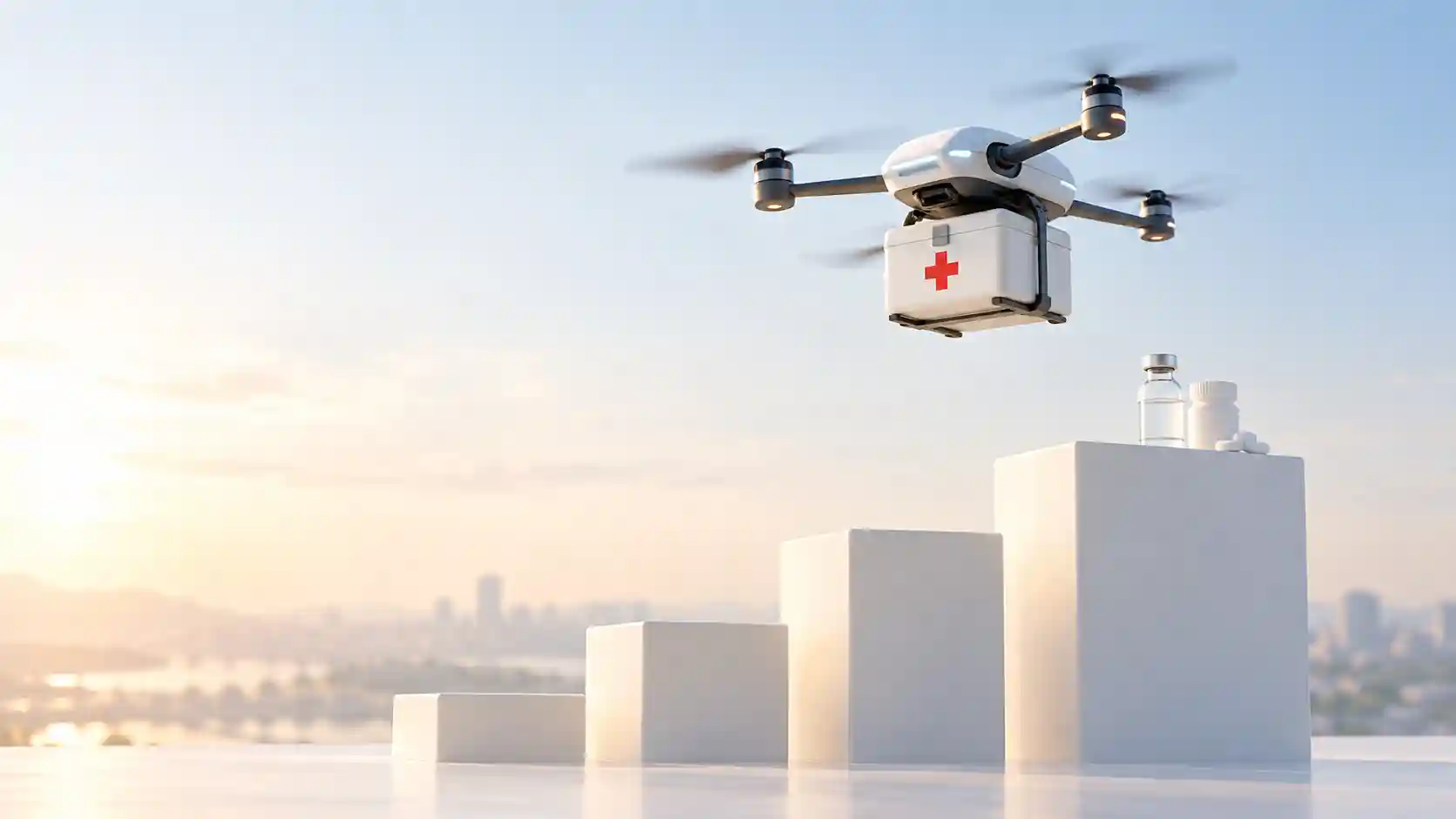
The aircraft operates as a "tail-sitter." It takes off and lands vertically (VTOL) using minimal space, and then transitions into a horizontal, rocket-like flight path once in the air. This aerodynamic efficiency allows the current TRT model to weigh just 3.3 pounds while carrying a payload of roughly 2.2 pounds. By ensuring that the drone itself is not excessively heavy, Airbound drastically reduces battery consumption and manufacturing costs, pushing the economics of drone flight closer to those of a standard two-wheeler delivery.
Medical Deliveries With Narayana Health
Airbound has proven its technology not just in controlled testing environments, but in live commercial operations. The startup has already completed more than 13,000 autonomous flights across Bengaluru and Guntur.
The most compelling application of this technology has been the company’s partnership with Narayana Health, a major Indian hospital network. Airbound has executed over 1,000 flights for the healthcare provider, specifically tasked with transporting diagnostic samples between medical facilities. According to operational data, the drones are covering a 2.5-mile route in approximately seven minutes. In congested urban traffic, the same journey for a courier truck or van could take anywhere from three to five hours.
Why Drone Logistics Can Matter for Healthcare
For the healthcare sector, this speed is a logistical breakthrough. When a patient undergoes a biopsy or an urgent blood test, the samples often need to be transported from a small satellite clinic to a central testing laboratory.
Blood and tissue samples have a limited window of viability and often require strict temperature control. By moving these payloads through the air, hospitals bypass unpredictable road congestion. This allows central laboratories to receive samples in a predictable, continuous flow rather than waiting for bulk deliveries delayed by traffic. The resulting efficiency helps medical professionals return diagnostic results faster, optimizing hospital operations and reducing anxiety for patients awaiting diagnoses.
Airbound’s Expansion Beyond Healthcare
While medical logistics offer a high-value entry point, Airbound’s ambitions are much broader. The ultimate goal of the startup is to disrupt conventional ground logistics across multiple sectors, including e-commerce, quick commerce, and general last-mile delivery.
"We want to build towards a world where everything has cost parity with trucking," Pushp noted following the Series A announcement.
If an autonomous drone can carry a lightweight package at a fraction of the cost of a road-bound courier—without the associated emissions or infrastructure wear—it opens the door to massively scalable, on-demand logistics for everything from electronics to urgent spare parts.
Regulation and Scaling Challenges
Despite the technical success of its pilot programs, scaling an aviation company involves severe hurdles. The primary barrier to widespread drone delivery startup India operations is regulation. Flying automated aircraft beyond the visual line of sight (BVLOS) requires complex airspace approvals from the Directorate General of Civil Aviation (DGCA). Authorities must ensure that delivery drones can safely integrate into urban airspace without posing risks to commercial aircraft, helicopters, or people on the ground.
Additionally, Airbound faces physical scaling challenges. Operating 1,000 flights is vastly different from managing tens of thousands of flights daily. The company must navigate unpredictable weather patterns, battery-degradation cycles, the setup of launch and recovery infrastructure, and strict safety redundancies.
Investor, Founder and Industry Views
The $37 million investment signals a shift in venture capital sentiment. For years, investors viewed drone delivery as an expensive science experiment. However, the backing of firms like Greenoaks and Lightspeed indicates a belief that Airbound’s hardware redesign has solved the core economic problem.
Investors are betting that by stripping out unnecessary weight and maximizing aerodynamic efficiency, Airbound can finally compete on cost, rather than relying solely on the premium novelty of speed. Drone-industry experts note that if Airbound can maintain its current safety record while driving down the cost-per-delivery, it will put significant pressure on existing Indian logistics competitors, including Skye Air Mobility and TSAW Drones.
What Comes Next for Airbound
With its war chest secured, Airbound is shifting its focus to manufacturing scale and product iteration. A larger version of its delivery aircraft is already in development. This upcoming model is expected to weigh roughly 6.6 pounds but carry up to 11 pounds of cargo, drastically expanding the types of goods it can transport.
The funds will also be used to expand its engineering teams, scale up its manufacturing footprint, and work closely with regulators to open new, longer-distance flight corridors across the country.
Conclusion
The journey of the Airbound Naman Pushp drone startup from a lockdown robotics project to a heavily funded aviation company illustrates the changing face of Indian deep tech. By successfully integrating autonomous delivery drones into the daily operations of Narayana Health, Airbound has proven that aerial logistics can solve immediate, critical bottlenecks in the physical world. While the path to replacing conventional trucking and e-commerce delivery is paved with regulatory and manufacturing challenges, the company has firmly established itself as a frontrunner in the race to conquer the last mile of the sky.
Further reading and useful links
Reader questions
Frequently asked questions
Who founded Airbound?
Airbound was founded by Naman Pushp, who started building robots and aerospace hardware during the pandemic lockdown.
How much funding has Airbound raised in its Series A round?
Airbound raised $37 million in a Series A funding round led by Greenoaks, bringing its total funding to nearly $50 million.
Which major healthcare provider is partnering with Airbound?
Airbound has partnered with Narayana Health to transport diagnostic samples between medical facilities via autonomous drone flights.
What design makes Airbound's drones efficient?
Airbound uses a carbon-fibre, blended-wing body tail-sitter design that takes off vertically and transitions into horizontal flight, achieving extreme weight-to-payload efficiency.
Nexuswild welcomes factual corrections. Email contact@nexuswild.com with evidence and the article URL.