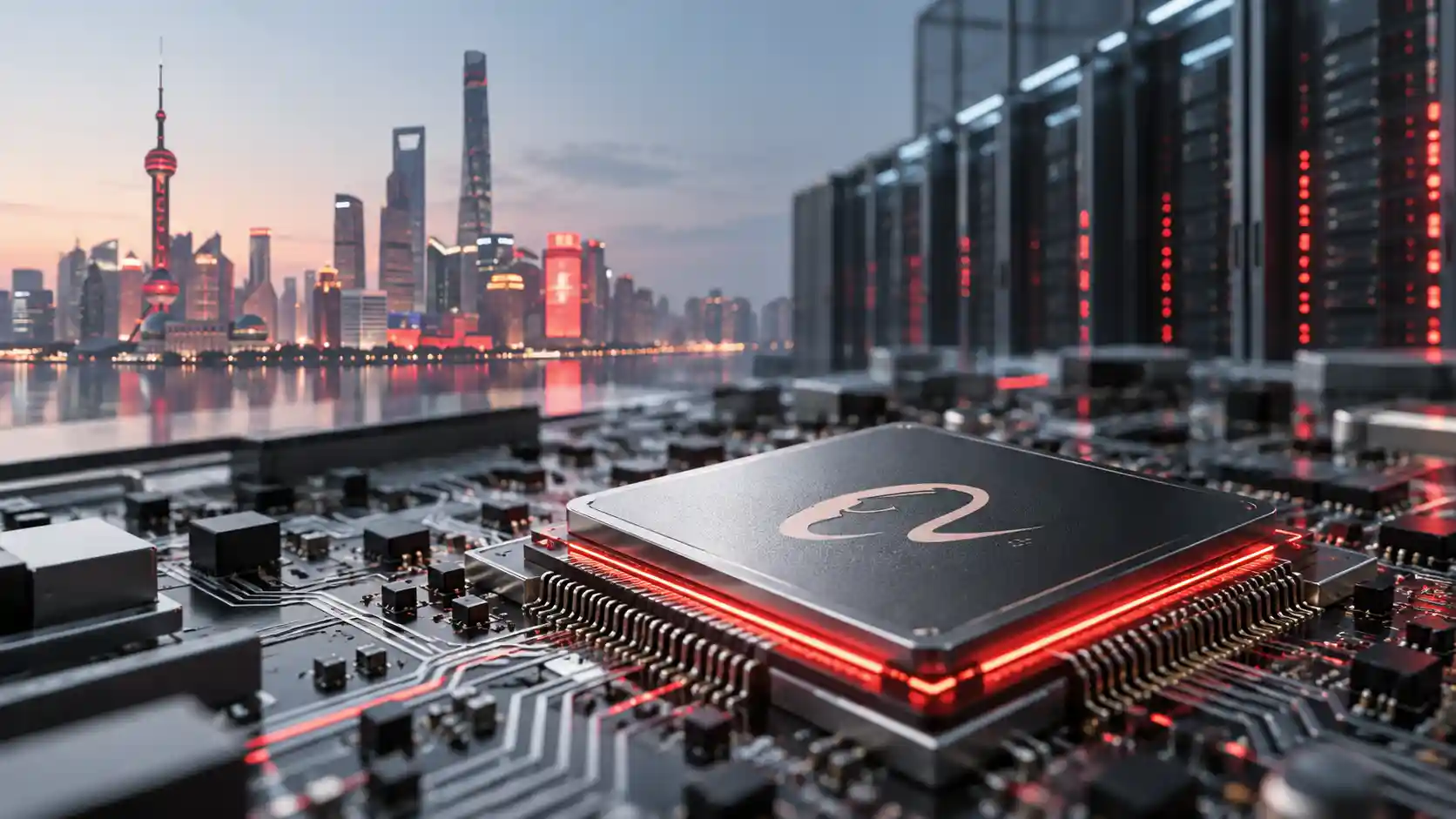

As global technology giants race to dominate artificial intelligence, the battle over the silicon that powers it is intensifying. On September 22, 2026, Alibaba Group unveiled its next-generation artificial intelligence processor at its annual Apsara Conference in Hangzhou. Developed by the company’s T-Head semiconductor division, the Zhenwu V900 AI accelerator chip marks a critical milestone in China’s ongoing effort to build a self-reliant domestic computing ecosystem.
Alibaba’s New AI Chip
While the Zhenwu V900 has now been officially announced, it is currently in the pre-production phase. Alibaba confirmed that mass production and commercial availability are targeted for the first quarter of 2027. This timeline is crucial for investors and industry watchers, clearly distinguishing the newly unveiled Alibaba AI chip from commercially deployed hardware like the company’s preceding Zhenwu M890, which launched in May 2026.
What the Chip Is Designed to Do
The V900 is engineered to handle both the training of massive frontier models and the running of live user queries, a process known as inference. Alibaba CEO Eddie Wu revealed that the company intends to use the hardware to train future generations of its Qwen large language models, which are projected to scale between 5 trillion and 10 trillion parameters. To support workloads of this magnitude, Alibaba noted an engineering ambition to eventually deploy the V900 in interconnected supernode clusters containing up to 500,000 accelerators.
Technology and Key Specifications
Technologically, the new processor represents a substantial upgrade. Alibaba claims the new Alibaba semiconductor delivers three times the overall performance of the M890. According to reported specifications, the V900 features 216 gigabytes (GB) of on-chip memory, a significant jump from the M890’s 144 GB. This allows the China AI chip to store larger portions of an AI model locally, reducing lag. Furthermore, its inter-chip bandwidth has been increased to 1,200 GB per second, enabling thousands of chips to communicate seamlessly when a model is too large for a single processor.
Alibaba’s AI and Cloud Computing Strategy
This semiconductor development is deeply integrated with Alibaba Cloud’s broader infrastructure roadmap. By designing custom silicon, Alibaba aims to tightly control the cost of AI compute tasks. Wu announced that Alibaba Cloud AI operations are targeting a global data-centre capacity of more than 20 gigawatts (GW) by 2032. Deploying proprietary chips internally helps improve cloud margins and secures a reliable hardware supply for its rapidly expanding AI services.
China’s Push for Domestic Computing
Alibaba’s efforts sit at the heart of a nationwide push to advance the China semiconductor industry. With strict U.S. export controls limiting access to advanced processors from American manufacturers, Chinese tech companies are prioritizing an independent Chinese AI semiconductor alternative. Developing local AI computing infrastructure is vital for insulating China’s data centres, cloud platforms, and tech enterprises from geopolitical supply chain shocks.
Impact and Global AI-Chip Competition
While Nvidia remains the undisputed leader in the global AI chip market - reporting massive data-centre revenues and boasting a deeply entrenched software ecosystem - the Zhenwu V900 represents a credible strategic alternative within mainland China. If successfully manufactured at scale, it provides Chinese cloud providers with a native hardware stack capable of sustaining domestic computing China initiatives without relying entirely on foreign imports.
Expert and Industry Views
Despite the impressive specifications, industry analysts caution that unveiling a chip architecture is only the first step. "The V900's ability to compete in China will turn on four practical tests. First is manufacturing: can T-Head get enough usable chips, advanced memory and packaging at a competitive cost?" noted a recent financial market analysis by INDmoney.
Challenges and Next Steps
Manufacturing constraints, wafer yields, and building a developer-friendly software ecosystem remain significant hurdles ahead of the Q1 2027 production target. A reliable AI chip China ecosystem requires years of software optimization to rival established global frameworks.
Conclusion
The announcement of the Alibaba new AI chip highlights a pivotal shift in the technology landscape. By advancing its proprietary silicon capabilities, Alibaba is not just upgrading its cloud infrastructure; it is actively fortifying the foundation of the country's AI economy. As the industry watches for the chip's commercial rollout in 2027, the true test will be its performance, cost-efficiency, and scalability in live data centres.
Further reading and useful links
Reader questions
Frequently asked questions
What is the Alibaba Zhenwu V900?
The Zhenwu V900 is Alibaba's next-generation artificial intelligence accelerator chip developed by its T-Head semiconductor division, unveiled at the Apsara Conference in September 2026.
When is the Zhenwu V900 expected to enter mass production?
Alibaba has targeted mass production and commercial availability for the Zhenwu V900 in the first quarter of 2027.
What are the key technical specifications of the V900?
The V900 offers triple the performance of its predecessor (the M890), features 216 GB of on-chip memory, and provides an inter-chip bandwidth of 1,200 GB per second.
What is the primary purpose of the Zhenwu V900?
It is engineered to handle massive frontier model training and live user inference, specifically supporting future generations of Alibaba's Qwen large language models.
Nexuswild welcomes factual corrections. Email [email protected] with evidence and the article URL.