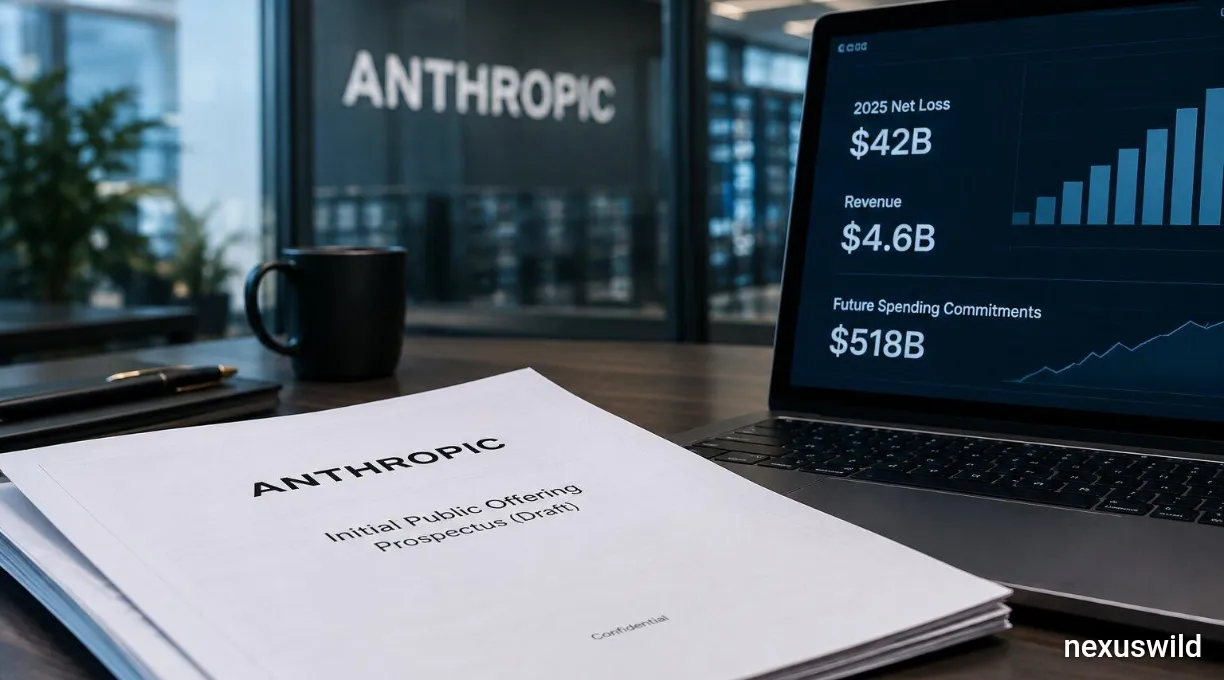

Anthropic Prices $81.34 Billion IPO at $83 Per Share, Reaching $1.5 Trillion Fully Diluted Valuation A landmark public offering for the frontier AI industry Anthropic, the artificial intelligence company behind the Claude family of models, has priced its initial public offering at $83 per share, setting up one of the largest public-market debuts in financial history. The final offering price exceeds the company's previously marketed range of $70 to $78 per share and follows an increase in the number of shares offered to investors. The final pricing document filed with the US Securities and Exchange Commission confirms that Anthropic is offering 980 million shares of Class A common stock. Of these, 956,351,354 shares are being sold by the company itself, while 23,648,646 shares are being sold by existing shareholders. At the final offer price, the base offering has a gross value of $81.34 billion. The company is also arranging a separate $26 billion private placement of non-voting Class N common stock to seven strategic investors. Together, the public offering and the private placement represent approximately $107.34 billion in gross transaction value. Anthropic is scheduled to begin trading on the Nasdaq Global Select Market on November 19, 2026, under the ticker symbol ANT. The offering is expected to settle on November 20, subject to customary closing conditions. The scale of the transaction makes it a significant event for the technology and capital-markets industries. It creates a public-market valuation benchmark for a company whose business is centred on frontier AI models, enterprise software, coding tools and large-scale computing infrastructure. However, the size of the offering is only one part of the story. Investors must also assess the company's unusually rapid revenue growth, its accounting losses, the scale of its infrastructure commitments and the governance structure that will remain in place after the listing. How the $81.34 billion IPO is structured The final pricing document confirms a total base offering of 980 million Class A shares at $83 each. The largest component consists of 956.35 million primary shares issued by Anthropic. These shares generate approximately $79.38 billion in gross proceeds for the company before applicable underwriting discounts and offering expenses. The remaining 23.65 million shares are secondary shares sold by existing shareholders. Their gross value is approximately $1.96 billion. Anthropic will not receive proceeds from these secondary sales. This distinction matters because the headline IPO size is not equivalent to the amount of new capital entering the company's balance sheet. The public offering includes both newly issued shares and stock sold by existing holders. The company has also granted its underwriters a 30-day option to purchase up to an additional 147 million Class A shares. These option shares are designated as primary shares. If the option is exercised in full, the company could raise up to approximately $12.20 billion in additional gross proceeds at the IPO price. Goldman Sachs and Morgan Stanley are the lead bookrunning managers. The wider underwriting syndicate includes several major international investment banks. The final IPO price of $83 is above the initial marketed range of $70 to $78. The increase in both the offer price and the base share count indicates that the transaction was expanded before pricing. Reuters described the deal as the largest stock-market debut on record. The offering should nevertheless be evaluated using its individual components. The $81.34 billion figure represents the gross value of the public share offering, while the amount Anthropic receives from primary shares is lower after underwriting discounts and expenses. The secondary component is paid to selling shareholders rather than the issuer. A separate $26 billion investment from strategic technology partners Alongside the public offering, Anthropic has arranged a $26 billion private placement involving seven companies associated with cloud computing, semiconductor manufacturing and AI infrastructure. The final prospectus identifies the investors and their respective commitments: Google: approximately $10 billion. Nvidia: approximately $10 billion. Advanced Micro Devices: approximately $2.5 billion. Broadcom: approximately $1 billion. Micron Technology: approximately $1 billion. Microsoft: approximately $1 billion. TSMC Partners: approximately $500 million. The investors have agreed separately, rather than jointly, to purchase the Class N shares at the IPO price. The placement is scheduled to close immediately after completion of the public offering, subject to specified conditions. Class N shares carry economic rights equivalent to Class A shares but do not carry voting rights. They are therefore different from the publicly traded Class A stock, even though their economic rights are linked to the same company. The participation of cloud and semiconductor companies is strategically significant. Anthropic requires substantial computing resources to train and operate its models, while its partners have commercial interests in the infrastructure and components used to deliver AI services. Google and Microsoft are major cloud infrastructure providers. Nvidia and AMD supply AI processors, while Broadcom and Micron operate in important parts of the semiconductor and memory ecosystem. TSMC is associated with advanced semiconductor manufacturing. The investment structure creates financial relationships between Anthropic and several companies that also operate within its supply chain. These relationships may support capital availability and strategic cooperation, but they should not automatically be interpreted as exclusive commercial agreements or guaranteed future purchasing arrangements. The $26 billion placement is also not part of the publicly traded Class A IPO share count. It is a separate issuance of Class N stock. Combining the base public offering and the private placement produces approximately $107.34 billion in gross transaction value. The company's final prospectus estimates that net proceeds from its primary public offering shares and the concurrent private placement will be approximately $104.8 billion after applicable discounts and estimated offering expenses. The company does not receive proceeds from secondary shares sold by existing shareholders. Anthropic's valuation reaches approximately $1.5 trillion on a fully diluted basis At $83 per share, Reuters reports that Anthropic's valuation is approximately $1.5 trillion on a fully diluted basis. On a non-diluted basis, the valuation is approximately $1.1 trillion. The difference is important. A fully diluted valuation takes into account securities that could become common shares, including relevant stock options, restricted stock units and convertible securities. It therefore provides a broader estimate of the company's equity value than a calculation based only on currently issued shares. The two valuation figures should not be treated as interchangeable. The $1.5 trillion figure is the appropriate headline valuation when explicitly labelled fully diluted. It is not the same as the company's immediate public-market trading capitalisation calculated using only currently outstanding Class A shares. The pricing also establishes a major benchmark for the private and public valuations of frontier AI businesses. Investors will compare Anthropic's valuation with its revenue growth, margins, infrastructure spending, customer concentration, competitive position and future financing requirements. Using the company's approximately $81 billion annualized revenue run rate reported for October, the fully diluted valuation represents roughly 18.5 times that run-rate figure. This is an illustrative valuation-to-run-rate comparison, not a conventional price-to-earnings ratio or a multiple based on audited full-year revenue. The run-rate measure also requires caution. It annualizes a relatively short period of business activity. Anthropic's own prospectus explains that run-rate revenue is not a substitute for GAAP revenue and is not a forecast of future revenue. Changes in customer usage, model pricing, competition and seasonality can cause actual revenue to differ materially. The public listing will therefore expose the company to a more continuous market assessment. Investors will have to determine whether the valuation is justified by durable revenue generation and whether the company can convert rapid adoption into sustainable operating performance. Revenue grows 1,206% in the first nine months of 2026 Anthropic's SEC filing reveals an extraordinary increase in recognised revenue. For the nine months ended September 30, 2026, the company reported revenue of $33.242 billion. That compares with $2.545 billion in the corresponding nine-month period of 2025, representing year-over-year growth of 1,206%. Full-year 2025 revenue was approximately $4.585 billion. The nine-month 2026 result therefore exceeded the previous full-year figure by a substantial margin. The growth reflects increasing use of Claude across enterprise and developer markets. Anthropic has developed a business that includes consumption-based API revenue, subscriptions and products designed for professional software development and organisational workflows. Consumption-based revenue represented approximately $26.3 billion, or 79% of total revenue, during the first nine months of 2026. Subscription-based revenue contributed approximately $6.9 billion, or 21%. This composition is important because it shows that the company's revenue is heavily linked to customer usage of its models and services. When organisations expand their workloads, revenue can increase rapidly. However, usage can also fluctuate if customers reduce consumption, change providers, move to less expensive models or adjust their AI budgets. The prospectus also reports approximately 11,900 customers generating at least $100,000 in trailing 12-month revenue as of September 30, 2026. This compares with more than 950 such customers at the end of September 2025. Anthropic's reported net revenue retention was approximately 900% as of September 30, 2026. The measure reflects expansion, contraction and churn among qualifying customers. It indicates substantial expansion in customer spending, but it should be understood as a company-defined operating metric rather than a guarantee that revenue from existing customers will continue increasing at the same pace. The company itself cautions that its recent growth may reflect early adoption dynamics and rapid initial customer expansion. It does not expect revenue to continue growing at comparable rates and cannot guarantee that growth will continue. That warning is important for public-market investors. Growth rates can decline sharply as a company expands its revenue base, even if absolute revenue continues to increase. Claude Code and enterprise adoption support the growth story Claude Code has become an important part of Anthropic's commercial strategy. The coding-focused product allows developers to use AI systems in software engineering workflows, including code generation, repository analysis and related development tasks. Its adoption illustrates how frontier models can generate revenue beyond conventional chatbot subscriptions. Developers and organisations can integrate AI into recurring business processes, creating usage-based demand for model inference and supporting infrastructure. Enterprise adoption is another important component. Organisations increasingly evaluate AI systems for software development, customer support, internal knowledge management, research, automation and other business functions. The economic value of these applications depends on whether they improve productivity, reduce costs or enable new services. But the cost of providing AI services also matters. High model usage can create significant compute expenses, and the financial benefit to a customer does not necessarily translate into a high margin for the model provider. Anthropic's business model therefore faces a dual challenge: maintaining model competitiveness while managing the cost of serving customers at scale. Its prospectus notes that consumption-based revenue represents the substantial majority of its business. That makes the company's performance sensitive to customer usage patterns, pricing changes and the availability of sufficient computing capacity. The public-market test will involve more than headline revenue growth. Investors will also examine customer retention, customer concentration, usage quality, infrastructure efficiency and the relationship between revenue expansion and operating costs. The $104.039 billion net loss requires careful interpretation One of the most striking figures in Anthropic's financial statements is its reported net loss of $104.039 billion for the nine months ended September 30, 2026. The figure appears dramatically out of proportion to the company's $33.242 billion in revenue. However, it is essential to understand the accounting items behind the result. Anthropic's filing identifies approximately $94.3 billion in changes in the fair value of convertible promissory notes, derivative liabilities and simple agreements for future equity, or SAFEs, during the nine-month period. The company says these changes were primarily driven by increases in the fair value of outstanding convertible promissory notes as its enterprise valuation increased. These accounting adjustments are not equivalent to an ordinary cash operating expense. They reflect how certain financial instruments are measured as the company's valuation changes. The effect can create substantial reported accounting losses even when the company has not paid an equivalent amount of cash during the period. However, that does not mean the financial losses can simply be dismissed. The reported net loss remains a GAAP accounting result and is relevant to shareholders assessing the company's financial position. It is also important to distinguish the net loss from the operating result. Anthropic reported an operating loss of approximately $1.3 billion for the first nine months of 2026, compared with an operating loss of approximately $5.2 billion in the corresponding period of 2025. This indicates that its operating result improved despite the sharp increase in the reported net loss. The quarterly trend was less uniform. The company reported operating income of approximately $974 million in the second quarter of 2026, followed by an operating loss of approximately $567 million in the third quarter. The company attributed pressure on the third-quarter operating result partly to higher compute-related expenses. Its reported financial statements therefore show a business with rapidly growing revenue, a narrower nine-month operating loss, substantial infrastructure spending and a very large non-operating accounting charge. Investors should examine these measures separately rather than using the headline net-loss number as a standalone indicator of the company's operating cash requirements. Compute commitments of approximately $900.9 billion Anthropic's infrastructure requirements represent one of the most consequential risks disclosed in its prospectus. The company reported approximately $900.9 billion in aggregate committed spending associated with purchase commitments and lease agreements, including short-term commitments and leases that had not yet commenced. Substantially all of the commitments relate to compute and infrastructure. The figure is not a single immediate payment obligation, nor should it be described as a conventional debt balance. It covers contractual commitments with different schedules, conditions and expected delivery periods. Anthropic expects approximately $451.6 billion of the commitments to be incurred before December 31, 2030. Most of the remaining amount is expected between 2031 and 2045. Approximately $70.7 billion is due in the 12 months following September 30, 2026. The scale reflects the capital-intensive nature of frontier AI development. Training increasingly capable models and serving them to large numbers of customers requires access to accelerators, data centres, networking systems, electricity, cooling and supporting infrastructure. Securing computing capacity can be strategically important because insufficient infrastructure may constrain model development and customer service. Long-term agreements can provide greater visibility over capacity, but they also create financial exposure. Anthropic's prospectus warns that some infrastructure partners depend on third-party financing and credit support to acquire chips and construct capacity. If that financing becomes unavailable or more expensive, contracted computing capacity could be delayed, repriced, reduced or not delivered. This creates a risk that extends beyond Anthropic itself. The company's ability to execute its growth plans depends partly on the financial strength and delivery capabilities of its infrastructure providers. The commitments also raise questions about future utilisation. If demand grows more slowly than expected, Anthropic may have to carry substantial infrastructure costs without generating corresponding revenue. For public shareholders, this is one of the most important issues to monitor after the listing. Strong revenue growth does not eliminate the risk associated with long-term fixed commitments. Public benefit governance and founder voting power Anthropic is incorporated as a Delaware Public Benefit Corporation. Its corporate structure is designed to balance shareholder interests with a stated public-benefit purpose involving the responsible development and maintenance of advanced AI. Its governance arrangements include the Long-Term Benefit Trust, or LTBT. According to the prospectus, the trust generally has the power to elect and remove a majority of the company's authorised board members. The trust is intended to provide independent oversight of the company's public-benefit mission and its approach to balancing commercial objectives with broader societal considerations. A separate Founder LLC structure gives the seven co-founders substantial voting influence through Class F common stock. The prospectus states that, after the offering, the founders collectively are expected to hold approximately 61.3% of total voting power on general stockholder matters when their interests through the Founder LLC are included. These governance mechanisms operate differently. The LTBT has board-election and removal powers, while the Founder LLC structure governs voting through the founders' special share arrangement. The result is a governance model that differs from a conventional corporation in which voting power is primarily determined by economic ownership. For public investors, this structure has both potential advantages and risks. It may help preserve the company's long-term public-benefit mission despite short-term market pressures. At the same time, it limits the influence that ordinary public shareholders may exercise over certain governance decisions. The company's future strategic decisions will therefore be shaped by a combination of public-market expectations, board oversight, founder voting rights and the trust's responsibilities. What the IPO means for the wider AI industry Anthropic's listing creates a major reference point for the economics of frontier AI companies. The company is entering public markets with substantial revenue growth, a large enterprise customer base and significant strategic relationships across the technology supply chain. Its offering also comes at a time when investors are evaluating whether the enormous capital expenditures associated with AI infrastructure can generate durable financial returns. For semiconductor manufacturers and cloud p
Nexuswild welcomes factual corrections. Email contact@nexuswild.com with evidence and the article URL.