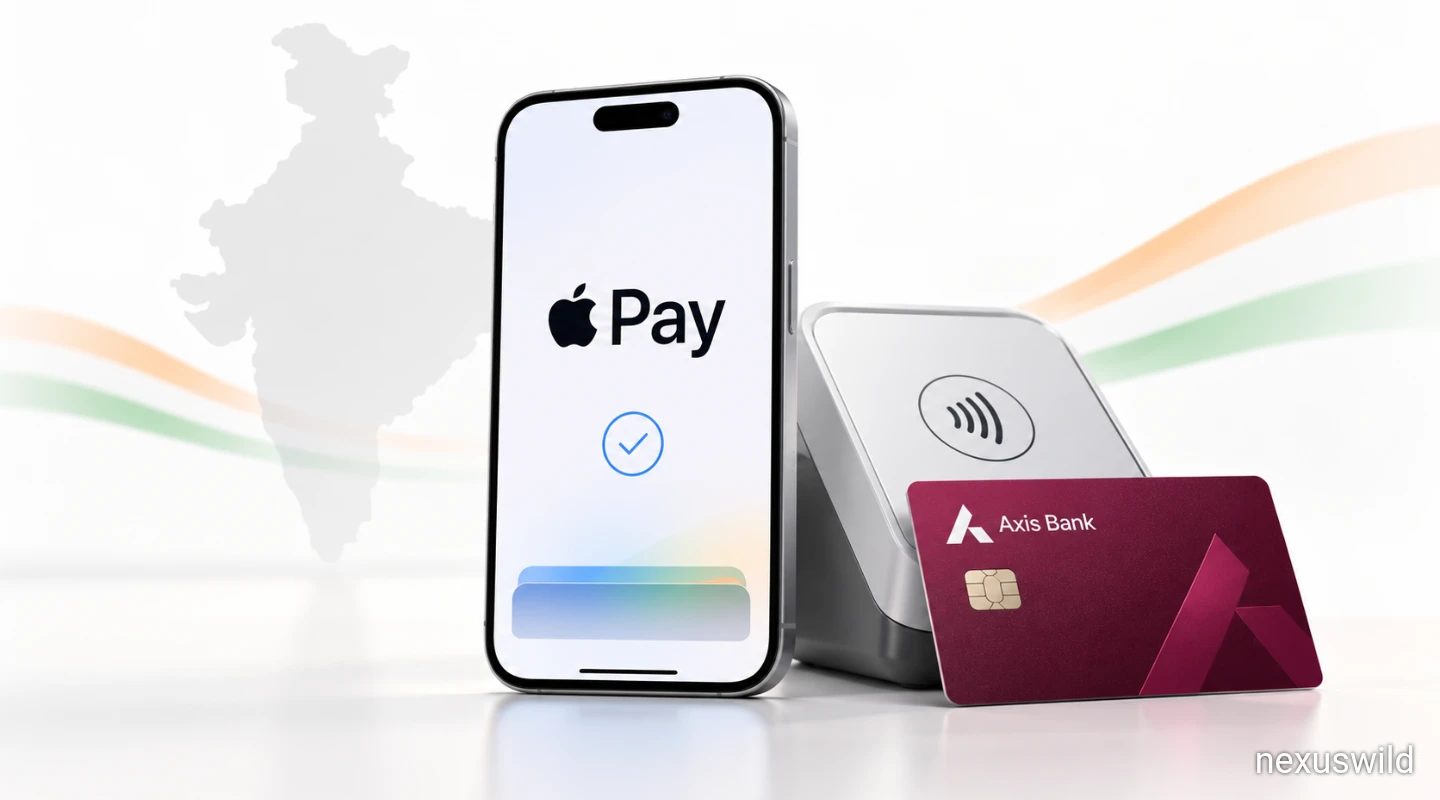

Apple Pay Finally Launches in India With Axis Bank years of waiting, Apple Pay has officially arrived in India.
Apple’s mobile payment service launched in the country on September 30, 2026, with Axis Bank becoming its first banking partner. The initial rollout allows eligible Axis Bank customers with Visa and Mastercard credit cards to add their cards to Apple Wallet and make contactless payments using compatible Apple devices.
For Apple users, the arrival is significant. India has become one of the world’s largest digital-payment markets, but Apple Pay had remained one of the major Apple services unavailable locally. Its launch now gives iPhone, Apple Watch and iPad users another way to pay at supported merchants.
Axis Bank Leads the Initial Rollout
Axis Bank has confirmed that its Visa and Mastercard credit-card customers can add eligible cards to Apple Wallet either through the Axis Bank mobile banking application or directly through Apple Wallet. Payments will be available across participating physical stores, apps and websites, while support for Mac is expected to follow.
The first phase is deliberately limited. Reuters reports that RuPay cards are not supported at launch, while Apple Pay's broader banking availability is expected to expand over time. Apple’s support materials also note that participation depends on individual banks, card issuers and supported cards.
That means the launch is important, but it does not immediately transform how every Indian iPhone owner pays.
Apple Pay Versus India’s UPI Ecosystem
Apple Pay enters a market very different from the one it found in the United States when the service launched in 2014.
India’s payment ecosystem is dominated by UPI, which enables bank-to-bank transactions through apps and QR codes. Apple Pay, by contrast, is fundamentally built around adding eligible payment cards to a digital wallet.
That distinction is important. Apple Pay is not replacing UPI with this launch; instead, it adds a card-based contactless payment layer to Apple’s ecosystem.
Reuters reported that UPI accounted for 84% of digital payments in India, highlighting the scale of the domestic payment infrastructure Apple is entering.
The timing is also notable. NPCI recently introduced a tap-and-pay capability for UPI, allowing compatible smartphones to make contactless payments through NFC-enabled terminals. That means consumers are now seeing more payment options built around the same tap-to-pay behaviour.
How Apple Pay Works in India
For an eligible customer, setting up Apple Pay starts with adding a supported card to the Wallet application.
Apple says users need a compatible device, a participating card issuer and a device secured with Face ID, Touch ID or a passcode. Once a card is added, users can authenticate a transaction and hold their device near a compatible contactless payment terminal.
The experience is designed to remove the need to repeatedly enter card details during supported transactions. Apple also emphasises that payments are designed around security and privacy, with the card information used for transactions protected through Apple’s payment architecture.
A New Opportunity for Merchants
The launch could also matter for Indian businesses and digital merchants.
Apple Pay support can provide another checkout option for customers who prefer using their Apple devices and linked cards. PayU has also integrated Apple Pay into its merchant network, according to reporting from The Indian Express, potentially helping participating businesses accept the service with existing payment infrastructure.
For retailers, restaurants, ecommerce companies and app developers, the wider availability of Apple Pay could become another consideration when designing checkout experiences.
What Comes Next for Apple Pay India?
The biggest question now is how quickly Apple expands beyond the initial Axis Bank partnership.
India has a large credit-card market, with more than 124 million credit cards in use, according to Reserve Bank of India data cited by The Indian Express. Axis Bank itself had about 16.29 million credit cards as of August 2026.
Other major banks could therefore become important to Apple Pay’s next phase. Reuters reported that Apple has been in discussions with banks including HDFC Bank and ICICI Bank, although agreements had not been finalised at the time of its report.
For now, Apple Pay’s Indian debut is a carefully limited entry rather than a full-scale replacement for the country’s established digital-payment system. But after years outside the market, Apple has finally established a foothold.
The next phase will depend on how quickly more banks, cards, merchants and payment features join the ecosystem—and whether Apple can turn its large installed base of devices in India into meaningful payment adoption.
Nexuswild welcomes factual corrections. Email contact@nexuswild.com with evidence and the article URL.