
Solar and wind have a timing problem. They produce power when the sun shines and the wind blows, not necessarily when people need it. Batteries address that mismatch, and the data now shows them moving from a niche add-on to a working part of the grid.
How fast storage is growing
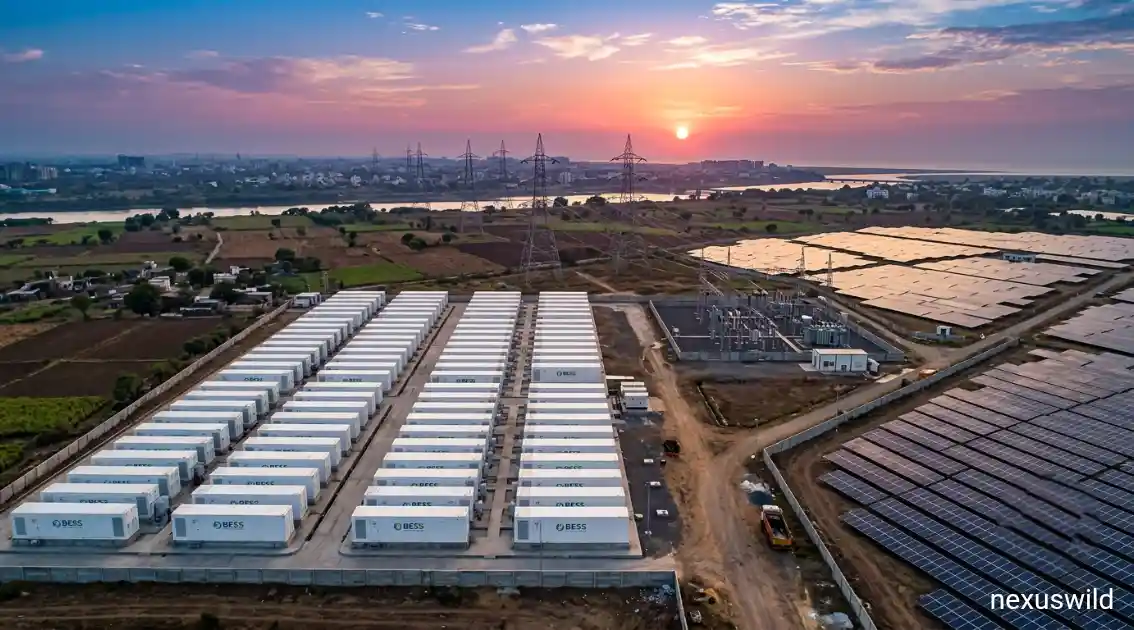
The International Energy Agency (IEA) estimates the world added about 108 gigawatts (GW) of battery storage in 2025, roughly 40% more than in 2024. Utility-scale projects made up around four-fifths of the total. BloombergNEF (BNEF), using its own methods, counted 112 GW and 307 gigawatt-hours (GWh), a record that beat its earlier forecast.
The two units measure different things. Gigawatts show how much power a battery can deliver at once. Gigawatt-hours show how much energy it holds, and so how long it can keep delivering.
China and the United States account for most of the growth. BNEF put them at roughly 70% of 2025 deployments. The IEA reports China added just over 63 GW and the US 19 GW. Australia is the standout among smaller markets, with nearly 8 GW added, almost nine times its 2024 level, per the IEA. Europe added about 6.2 GW, slightly below 2024.
For 2026, BNEF forecasts 158 GW and 459 GWh of new deployments. That is a forecast, and BNEF noted it had not updated its projections for the Iran war because of uncertainty about long-term effects.
What batteries do on the grid
Batteries are mainly used to move energy through time. The IEA says energy shifting rose from about 40% of new projects in 2015 to over 90% in 2025, while projects built mainly for ancillary services fell from about 45% to roughly 7%. Average project duration also rose from about two hours in 2023 to three hours in 2025.
California shows the effect. IEA data shows its battery capacity grew from under 1 GW in 2019 to over 17 GW, and batteries covered more than 40% of load on the evening of March 29, 2026. Batteries contributed over 40% of hourly ramping in Texas's ERCOT grid in April.
Australia offers the clearest price evidence. The Australian Energy Market Operator (AEMO) reported that batteries set the price in 32% of trading intervals in the national market in the first quarter, more than any other technology. The average wholesale price was AU$73 per megawatt-hour, down 12% year on year, with evening peak prices falling.
Why the economics improved
Cost is a major reason. BNEF's December 2025 survey found stationary storage battery packs averaged US$70 per kilowatt-hour in 2025, 45% lower than in 2024, the sharpest fall of any segment. The IEA says battery costs have fallen more than 90% between 2010 and 2025.
Speed also helps. The IEA puts median construction time for utility-scale batteries at about 275 days, against over two years for gas and over six for nuclear.
The catch: success can erode returns
Storage earns money mostly by buying cheap power and selling it when prices are high. When many batteries do the same thing, those price gaps shrink.
AEMO's data shows it. Battery price spreads in Australia fell from AU$183 to AU$121 per megawatt-hour year on year, although battery revenue still more than doubled to AU$96.9 million because there were far more batteries. About 97% of that revenue came from arbitrage, the practice of buying low and selling high.
That suggests early projects may earn more than later ones in saturated markets. It also gives developers a reason to seek additional revenue, such as grid services or longer-duration systems.
Risks to watch
- Permitting and grid connection: The IEA says delays outside construction often account for more than half of project timelines.
- Policy change: BNEF noted that both the US and China have recently changed policies affecting solar and wind, which storage often supports.
- Supply chain concentration: BNEF describes the battery supply chain as China-dominated, which limits some exposure to Middle East disruption but concentrates supply risk elsewhere.
- Safety: The IEA describes risks as low relative to the scale of deployment, though individual incidents carry real consequences for local approval.
What the shift means
Battery storage is becoming part of how electricity markets set prices, not just how they store energy. The strongest case rests on observed grid effects in California, Texas and Australia, plus falling costs. The caution is that returns depend on market design, and early arbitrage profits may not last.
Investors and policymakers will watch whether storage prices keep falling, whether markets pay for longer-duration systems, and whether grid connections arrive fast enough to match demand.
Nexuswild welcomes factual corrections. Email contact@nexuswild.com with evidence and the article URL.