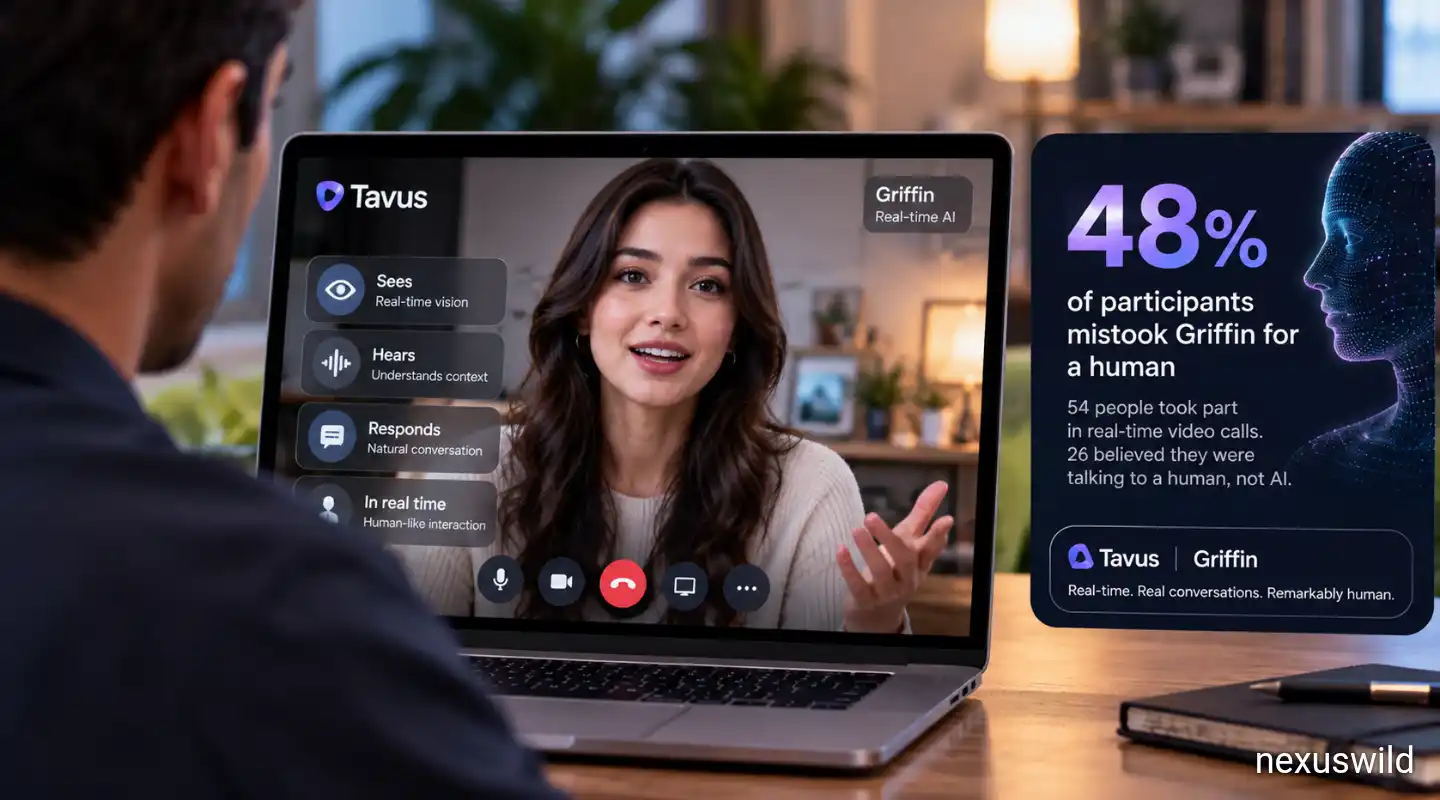

AI company Tavus says its new Griffin-Lite model reached an unusual milestone in real-time video interaction: nearly half the people who spoke with it during a short video call believed they had been talking to another human.
In a study published on October 1, 2026, Tavus said 26 of 54 participants, or 48%, identified their AI conversation partner as a real person after a one-minute live video call.
The company describes the result as the first successful real-time video Turing test.
That description, however, should be treated as Tavus's own framing. The experiment was run by the company using its own methodology, involved a relatively small sample and has not been established as a standardized independent test of whether AI is generally indistinguishable from humans.
What Griffin Actually Does
Griffin is Tavus's latest attempt to create an AI system capable of interacting through video in a way that more closely resembles a face-to-face conversation.
The company describes Griffin as a Human Interaction Model, or HIM.
Unlike systems that separately process speech, generate an answer and then animate an avatar, Griffin-Lite is designed as a full-duplex video-to-video model. Tavus says it can watch and listen while it is speaking, allowing it to react to facial expressions, pauses, interruptions and other conversational signals in real time.
That can include small behaviours people normally expect during conversation, such as pausing when interrupted, responding without a long delay or acknowledging someone while they are still speaking.
Tavus says Griffin generates the AI character's face, voice and responses during the interaction rather than playing back a prerecorded video.
How Tavus Ran the Test
Participants from the United States and Europe were recruited through what Tavus describes as an independent research platform.
They were told they would be matched with another participant for a one-minute video conversation about what they were looking forward to during the year.
Their conversation partner was actually an AI character powered by Griffin-Lite.
After the call, participants answered questions about the interaction, including whether they believed their partner was a real person.
Of the 54 people tested, 26 said yes.
That produced the headline figure of 48%.
Tavus also reported that participants who believed the AI was human expressed an average confidence level of 79%, while those who identified it as AI averaged 81% confidence in their judgment.
People who became suspicious generally did so within the first 20 seconds of the call, according to the company's results.
Griffin Performed Far Better Than Tavus's Earlier System
Tavus compared Griffin-Lite's result with a previous version of its conversational video system.
In an earlier study using the same basic one-minute protocol, only one of 41 participants, or 2.4%, believed the older system was a real person.
That earlier setup combined several Tavus technologies rather than using Griffin's unified model architecture.
The difference suggests that Griffin's approach produced a noticeably more convincing interaction under Tavus's test conditions.
However, the two groups contained different participants, so the results should not be interpreted as a controlled head-to-head experiment involving the same people.
Did Griffin Really Pass the Turing Test?
This is where the headline needs context.
The original Turing Test, proposed by mathematician Alan Turing in 1950, was intended as a way of asking whether a machine could communicate convincingly enough that a human evaluator could not reliably distinguish it from another person.
There is no single universally accepted modern standard for what percentage constitutes a “pass,” particularly for live video.
Tavus created its own face-to-face testing methodology and says Griffin is the first model to pass what it calls a video Turing test.
The narrower and more defensible conclusion is that 48% of participants in Tavus's one-minute experiment believed Griffin-Lite was human.
The study does not demonstrate that the system would fool the same proportion of people during a 10-minute conversation, repeated interactions or situations where participants knew in advance that one partner might be an AI.
It also has not yet been independently replicated.
Griffin Is Not Yet Generally Available
Despite the result, Tavus is not immediately releasing Griffin-Lite as a general customer product.
The company currently describes it as a research preview available to selected testers.
Tavus says systems capable of being mistaken for humans create obvious safety concerns, particularly around impersonation, disclosure and deception. The company says it is working on disclosure mechanisms and additional safety measures before a broader release.
That issue becomes more important as generated video moves from scripted avatars toward systems capable of carrying out natural, unscripted conversations.
A realistic face and voice are one part of the problem. A system that can also respond to what a person says, sees and does in real time can make the boundary between automated and human communication less obvious.
Why the Experiment Matters
The result is notable less because it definitively proves that AI has “passed” a universal test and more because of what it shows about the direction of multimodal AI.
Generative systems are moving beyond text boxes and voice assistants toward models that can process visual behaviour, speech and conversational timing at the same time.
That could eventually support applications including tutoring, customer assistance, training, remote guidance and conversational agents that can understand something being shown through a camera.
But those applications also make transparent disclosure increasingly important.
If an AI system becomes better at appearing human, users need clearer ways of knowing when they are interacting with software rather than another person.
Conclusion
Tavus's Griffin-Lite produced an eye-catching result: 26 of 54 people believed they had spoken with a real human after a one-minute video conversation with the AI.
The model can process video and audio while generating its own face, voice and conversational responses in real time, bringing several previously separate AI capabilities into one system.
But the claim that Griffin has “passed the video Turing Test” should remain properly attributed to Tavus.
The experiment was short, company-run and based on a limited sample, and the result has not yet been independently replicated.
What the test does provide is evidence that real-time AI video interaction is becoming considerably more convincing, while raising an equally important question: as machines become harder to distinguish from people on a screen, how clearly should they be required to identify themselves?
Nexuswild welcomes factual corrections. Email contact@nexuswild.com with evidence and the article URL.