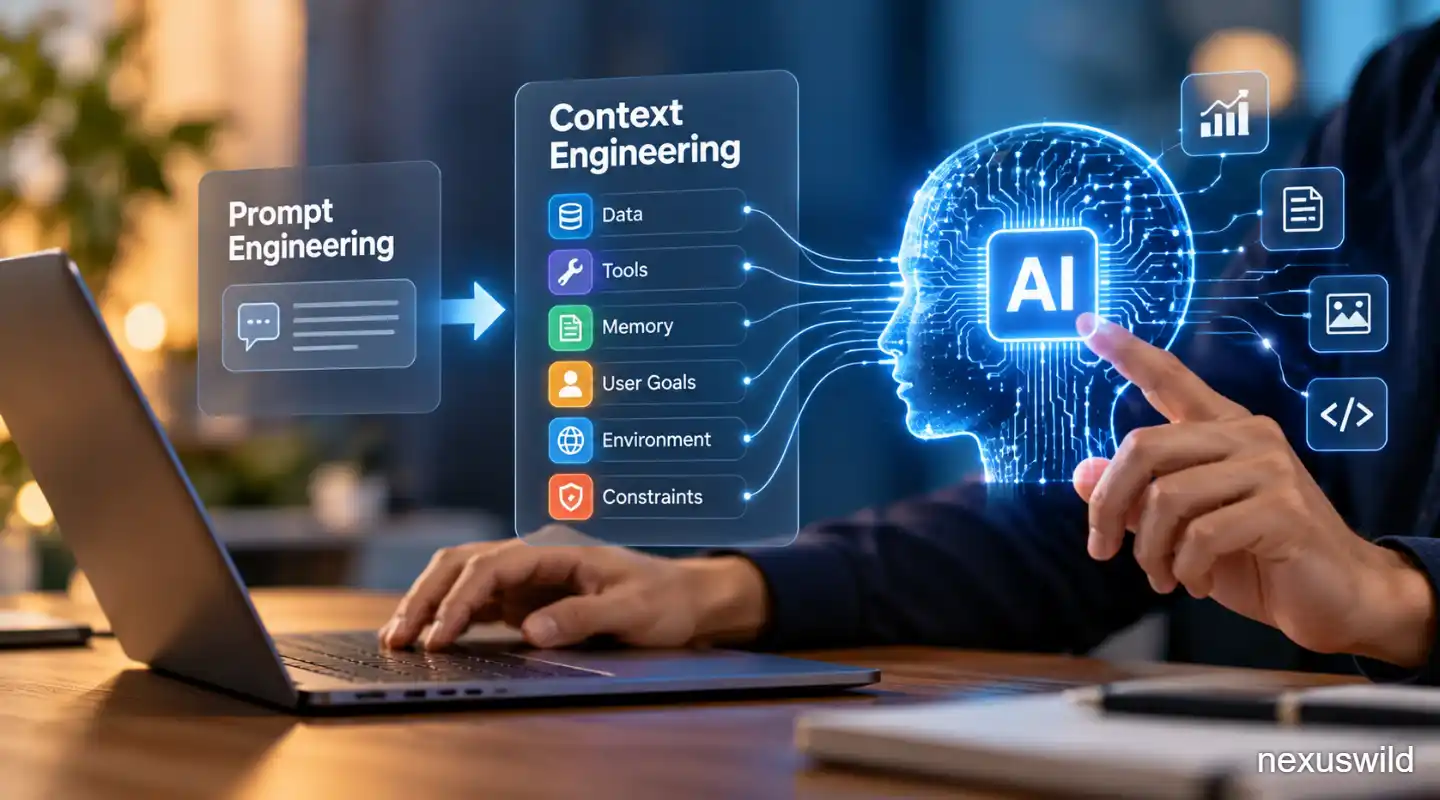

For much of the generative AI boom, one skill dominated discussions about getting better results from artificial intelligence: prompt engineering.
Developers experimented with instructions, examples, formatting rules and carefully chosen words to guide large language models toward the desired response. That work remains important. But as AI systems move beyond simple question-and-answer interactions into agents, coding assistants and enterprise workflows, the engineering problem is becoming considerably broader.
Increasingly, developers must decide not only what to tell an AI model, but also what information the model should have available when it makes a decision.
That wider discipline is becoming known as context engineering.
The term does not describe the replacement of prompt engineering. Instead, it reflects a shift toward designing the complete information environment surrounding a model: system instructions, conversation history, retrieved documents, memory, tools, tool results, application state and other external knowledge.
Major AI developers have begun discussing context management explicitly. Anthropic described context engineering in 2025 as the process of curating and maintaining the optimal information available to a model during inference. OpenAI has published guidance on short-term and long-term context management, while Google's developer organization has described context as a central architectural problem for production multi-agent systems.
The result is an important change in how sophisticated AI applications are being designed.
Prompt Engineering Is Still Fundamental
Prompt engineering focuses primarily on the instructions sent to an AI model.
A well-designed prompt can define the model's role, specify a task, establish constraints, provide examples and explain the required output format. OpenAI's current developer documentation continues to describe prompt engineering as the process of writing instructions that help models consistently produce outputs matching an application's requirements.
For example, a financial-analysis system might instruct a model to summarize quarterly results, distinguish reported figures from forecasts and return the answer in a particular structure.
Those instructions matter.
Modern prompt engineering also involves more than clever wording. Production applications increasingly version prompts, evaluate their behavior and test changes against representative examples. OpenAI's current guidance recommends managing production prompts alongside application code and using evaluations when prompts or models change.
But instructions represent only part of what determines an AI system's behavior.
Imagine asking an AI assistant to evaluate a contract. Even an excellent prompt may be insufficient if the model receives the wrong contract version, outdated company policies or irrelevant documents retrieved from an internal database.
The prompt may be correct while the surrounding context is wrong.
Context engineering addresses that larger problem.
What Context Engineering Changes
At its simplest, context engineering asks:
What information should this model receive at this particular moment to perform this particular task?
That context can include:
- system and developer instructions;
- the user's current request;
- selected portions of conversation history;
- retrieved documents or database records;
- stored memories and preferences;
- available tool descriptions;
- results returned by those tools;
- workflow state and previous actions;
- application permissions and constraints;
- relevant files, code or environmental information.
The important distinction is that context engineering is not simply about putting more information into a prompt.
It is about selecting, organizing, updating and sometimes removing information.
Anthropic has described the problem as managing the limited set of tokens available to an AI model while an agent continuously generates new information. That can require summarizing old interactions, removing obsolete tool results, storing useful information outside the active context and retrieving it again when necessary.
In other words, context becomes a managed resource rather than an ever-growing transcript.
Why AI Agents Make Context Management More Important
A traditional chatbot might answer one question using a few paragraphs of conversation history.
An AI agent may operate very differently.
It can search documents, call software tools, inspect files, write code, interact with applications and continue working through many stages of a task. Every step can create more information that could potentially be included in the next model request.
Over time, that produces a difficult engineering question: what should the agent remember?
Keeping everything may appear safest, but research suggests that simply increasing the amount of available context does not guarantee better performance.
The influential Lost in the Middle study found that language models could perform differently depending on where relevant information appeared within a long context. Models in the study were often better at using information near the beginning or end than information buried in the middle. Later research has continued to examine difficulties involving information spread across long inputs.
That means a very large context window is not equivalent to perfect memory or perfect retrieval.
The architecture surrounding the model still matters.
Context Engineering Is Becoming Part of Agent Infrastructure
Recent AI infrastructure illustrates this shift.
OpenAI's Agents API, introduced in public beta on September 10, 2026, includes automatic context compaction for long-running sessions. As an agent approaches its available context limit, earlier information can be compacted so that useful state can persist across longer workflows.
The same system includes tool search, which can load relevant tool definitions when needed rather than placing every possible tool into the model's context from the beginning. Programmatic tool calling can also process or filter information before returning only relevant results to the model.
These capabilities illustrate an important context-engineering principle: the model does not necessarily need every piece of information available to the application.
It needs the right information at the right stage.
OpenAI's earlier Agents SDK guidance similarly discusses trimming and compressing conversation histories to prevent long-running agents from becoming overwhelmed by redundant history or tool results.
Google has also described production multi-agent systems in terms of context architecture, arguing that simply relying on increasingly large context windows is insufficient for long-running workflows.
These examples do not mean the industry has settled on a single definition or architecture. Context engineering remains an emerging discipline, and implementations vary substantially.
Enterprise AI Makes Context Selection Critical
Context engineering becomes particularly important inside organizations because enterprise AI rarely works from public model knowledge alone.
A corporate assistant might need access to internal policies, product documentation, customer records, analytics or operational databases.
Retrieval-augmented generation, or RAG, is one established method for supplying external knowledge.
The original RAG research combined a generative model with retrieval from an external knowledge source, allowing generation to be conditioned on retrieved information rather than relying entirely on information encoded within model parameters.
Modern enterprise implementations extend this idea substantially.
Before answering a question, an application might determine the user's permissions, search several internal repositories, rank candidate documents, remove duplicates, select relevant passages and insert only those passages into the model's active context.
The quality of the final answer can therefore depend as much on retrieval and context construction as on the prompt itself.
Poor retrieval can introduce outdated or irrelevant information. Excessive retrieval can bury the useful evidence in noise.
Good context engineering attempts to balance recall with relevance.
Memory Adds Another Layer
AI memory creates a similar challenge.
An assistant that remembers previous interactions can potentially provide greater continuity and personalization. But retaining information and knowing when to use it are different problems.
Research such as LongMemEval has examined how conversational AI systems retrieve information from long histories and found that long-term memory remains technically challenging. The benchmark evaluates abilities including information extraction, multi-session reasoning, temporal reasoning, knowledge updates and determining when the system should abstain because relevant information is unavailable.
Newer work has extended this idea to agent memory in environments where an AI system may need to remember workflows, interface behavior and previous failures.
This points toward a more sophisticated model of AI memory.
Instead of permanently inserting entire conversation histories into every request, systems can maintain external memories and retrieve selected information when it becomes relevant.
Context engineering determines what enters that active working context.
Why Coding Assistants Are a Natural Use Case
Software engineering makes the value of context particularly visible.
A coding assistant may need to understand far more than a developer's immediate request.
Relevant context could include repository structure, existing implementation patterns, configuration files, test failures, API documentation, coding standards, previous edits and the contents of files connected to the current problem.
Sending an entire large repository to a model for every request would often be inefficient.
Instead, coding agents can search for relevant files, inspect specific sections, run tools and preserve intermediate state as work progresses.
OpenAI's current developer resources for Codex and agentic coding explicitly include context engineering as part of coding-agent workflows, while its newer agent infrastructure combines persistent working environments, files, tools, context management and subagents for longer tasks.
For coding systems, context engineering therefore resembles traditional software architecture as much as prompt writing.
The Potential Benefits of Better Context
When implemented carefully, context engineering can improve several parts of an AI application.
Accuracy can improve when the system retrieves authoritative information relevant to the question rather than forcing the model to depend solely on training data.
Consistency can improve when stable system instructions, structured workflows and validated information remain available across multiple steps.
Personalization can improve when relevant preferences or previous decisions are retrieved from memory instead of making users repeatedly provide the same information.
Task performance can improve when agents can access tools, application state and previous actions required to complete multi-stage work.
There can also be economic benefits.
Sending unnecessary context consumes tokens and can increase latency and inference cost. Selective retrieval, prompt caching, context compression and tool filtering can reduce the amount of repeated information processed during complex workflows. Current agent systems increasingly expose infrastructure specifically designed around these considerations.
None of these benefits is automatic, however.
A poorly designed context system can make an AI application worse.
Context Overload and Irrelevant Information
One of the biggest misconceptions about long-context AI is that more information must produce better answers.
That is not necessarily true.
Irrelevant documents can distract the model. Repeated tool outputs can consume valuable tokens. Old instructions can conflict with newer information. A compressed conversation summary can accidentally remove an important detail.
Even when a model technically supports a large context window, developers must consider how effectively it uses information within that window.
Context engineering therefore involves deletion as well as addition.
Old tool outputs may be discarded after their important results have been recorded. Lengthy histories can be summarized. Large document collections can be searched before only the most relevant passages are passed to the model.
The objective is not maximum context.
It is maximum useful context.
Privacy and Security Create Harder Problems
Giving AI systems more external information also expands their security responsibilities.
An enterprise agent may have access to email, company documents, customer information or application tools. Context can therefore contain sensitive information as well as malicious content.
Prompt injection is a particularly important risk.
NIST has documented indirect prompt injection as a threat in systems where external data such as documents or web pages is dynamically inserted into a model's context. Malicious instructions placed in those external sources may influence the model after retrieval.
OpenAI has similarly described prompt injection as an evolving security challenge for agents that browse, retrieve information and perform actions. Its guidance emphasizes limiting an agent's access to only the information and capabilities required for its task and applying layered safeguards around consequential actions.
Context engineering therefore cannot be separated from authorization, data governance and security engineering.
Retrieval systems must consider not only which document is relevant, but also whether the user and the model should be allowed to access it.
Established Practice Versus Emerging Ideas
It is useful to distinguish mature techniques from newer terminology.
Several components associated with context engineering are already well established: retrieval-augmented generation, structured system instructions, tool calling, access-controlled data retrieval, conversation-state management and prompt evaluation.
What's newer is treating these components collectively as a dedicated architectural discipline.
Automatic context compaction, dynamic tool selection, persistent agent memory, selective long-term recall and multi-agent context isolation are developing quickly, but best practices are still evolving.
Even the phrase “context engineering” should not be interpreted as evidence that prompt engineering has become obsolete.
Prompts remain part of context.
Clear instructions are still necessary to define goals, constraints and expected behavior. Context engineering simply expands the design problem from crafting those instructions to managing the entire information environment in which those instructions operate.
Conclusion
The transition from prompt engineering toward context engineering reflects the changing nature of AI applications.
When AI systems primarily answered isolated questions, improving the prompt could solve a large part of the problem.
Agents, enterprise assistants and coding systems operate differently. They may work across long sessions, retrieve private information, use tools, remember earlier decisions and interact with changing environments.
For those systems, success increasingly depends on deciding what the model should know at each step.
That means selecting relevant documents, maintaining useful memory, removing obsolete information, controlling tools, preserving workflow state and protecting sensitive data, while still providing clear prompts.
Context engineering is therefore best understood not as the successor that eliminates prompt engineering, but as a broader systems discipline built around it.
As models continue to gain longer context windows and more agentic capabilities, developers are likely to spend less time asking how much information a model can technically accept and more time deciding which information actually deserves to be there.
Nexuswild welcomes factual corrections. Email contact@nexuswild.com with evidence and the article URL.