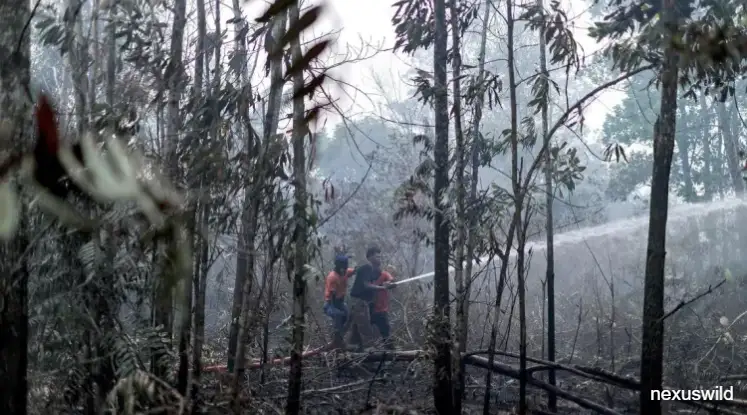

# Borneo Peatland Fires Push Kuala Lumpur and Singapore Into Severe Haze
A familiar grey veil has returned to parts of Southeast Asia.
Smoke from hundreds of forest and peatland fires across Indonesian Borneo and Sumatra has spread across national borders, worsening air quality in Kuala Lumpur, Singapore and other parts of Malaysia as one of the region's most persistent environmental problems resurfaces.
Malaysia's Department of Environment said satellite monitoring identified 327 hotspots across Kalimantan, the Indonesian portion of Borneo, and another 191 in Sumatra on September 29. Moderate transboundary haze was detected across parts of Peninsular Malaysia, Singapore and northwestern Borneo.
The deterioration was already visible in official air-quality measurements.
In Kuala Lumpur, the Cheras monitoring station recorded an Air Pollutant Index reading of 172 on September 30, placing it firmly in Malaysia's "unhealthy" category. Twenty-nine areas across the country were recording unhealthy readings that morning.
Singapore has faced similar conditions.
On September 29, its National Environment Agency reported 24-hour Pollutant Standards Index readings between 107 and 157, classified as unhealthy. The agency said moderate to dense smoke from fires in Kalimantan was continuing to drift toward the city-state, alongside haze generated by fires in southern Sumatra.
Why peatland fires are so difficult to stop
Not all wildfires behave the same way.
Peatlands consist of layers of partly decomposed organic material that have accumulated over long periods in waterlogged conditions. When these landscapes are drained and become unusually dry, the peat itself can ignite.
Unlike an ordinary surface fire, a peat fire can burn beneath the ground.
That makes it exceptionally difficult to detect and extinguish. Firefighters may suppress visible flames only for underground sections to continue smouldering and later ignite vegetation elsewhere.
The smoke is also particularly damaging because prolonged peat combustion can release large quantities of fine particulate matter and greenhouse gases.
Indonesia has been battling major fires across forests and peatlands during an exceptionally dry period. Reuters reported in September that wildfire emissions from the country had climbed to the highest level globally at the time, with large fires affecting Borneo and Sumatra.
The Indonesian government has warned that the situation may not disappear quickly. Forestry Minister Raja Juli Antoni said the fires could continue until early November because the rainy season was expected to arrive later than usual.
Smoke does not respect national borders
The haze crisis is regional because the atmosphere connects areas separated by hundreds of kilometres.
When prevailing winds align with major fire zones in Kalimantan or Sumatra, smoke can travel across the South China Sea and Strait of Malacca toward Malaysia and Singapore.
That means a fire burning in one country can affect schools, businesses, airports and public health far beyond its origin.
Singapore's environmental authorities had warned months earlier that warmer and drier conditions associated with El Niño, combined with a potentially positive Indian Ocean Dipole, could increase the risk of vegetation and peat fires during 2026.
Dry conditions reduce moisture in forests and peatlands, making fires easier to start and significantly harder to contain.
By late September, those risks were translating into measurable deterioration in urban air.
A health problem as much as an environmental one
The most immediate concern is fine particulate pollution.
Tiny airborne particles can penetrate deeply into the respiratory system, making prolonged exposure particularly concerning for children, older people and those with existing heart or lung conditions.
In Indonesian Borneo, the impact has been especially direct.
Pontianak in West Kalimantan endured weeks of dense wildfire haze that disrupted outdoor activity and contributed to thousands of reported respiratory cases in the surrounding region. Schools were also forced to close before rainfall provided some temporary relief.
Singapore's NEA advises residents to use real-time PM2.5 readings when deciding on immediate outdoor activity and its 24-hour PSI forecast when planning activities for the following day.
Governments are under renewed pressure
Indonesia has deployed firefighting resources while trying to prevent new burns, but the geography creates enormous difficulties.
Officials have acknowledged that the vast areas involved and the characteristics of peatland fires make suppression particularly challenging.
President Prabowo Subianto has also called for tougher action against illegal slash-and-burn land clearing as authorities attempt to prevent deliberately started fires from worsening an already dangerous dry season.
Malaysia, meanwhile, has activated measures under its National Haze Action Plan and increased monitoring of local peatlands, landfill sites and other fire-prone areas while tracking incoming transboundary smoke.
For Southeast Asia, the return of widespread haze is another reminder that the problem cannot be contained by national borders.
Rain and shifting winds may provide temporary relief to Kuala Lumpur or Singapore. But as long as extensive peatlands remain dry and fires continue burning across the region, the underlying threat remains.
The sky may clear for a day.
The fire beneath it can keep burning.
Nexuswild welcomes factual corrections. Email contact@nexuswild.com with evidence and the article URL.