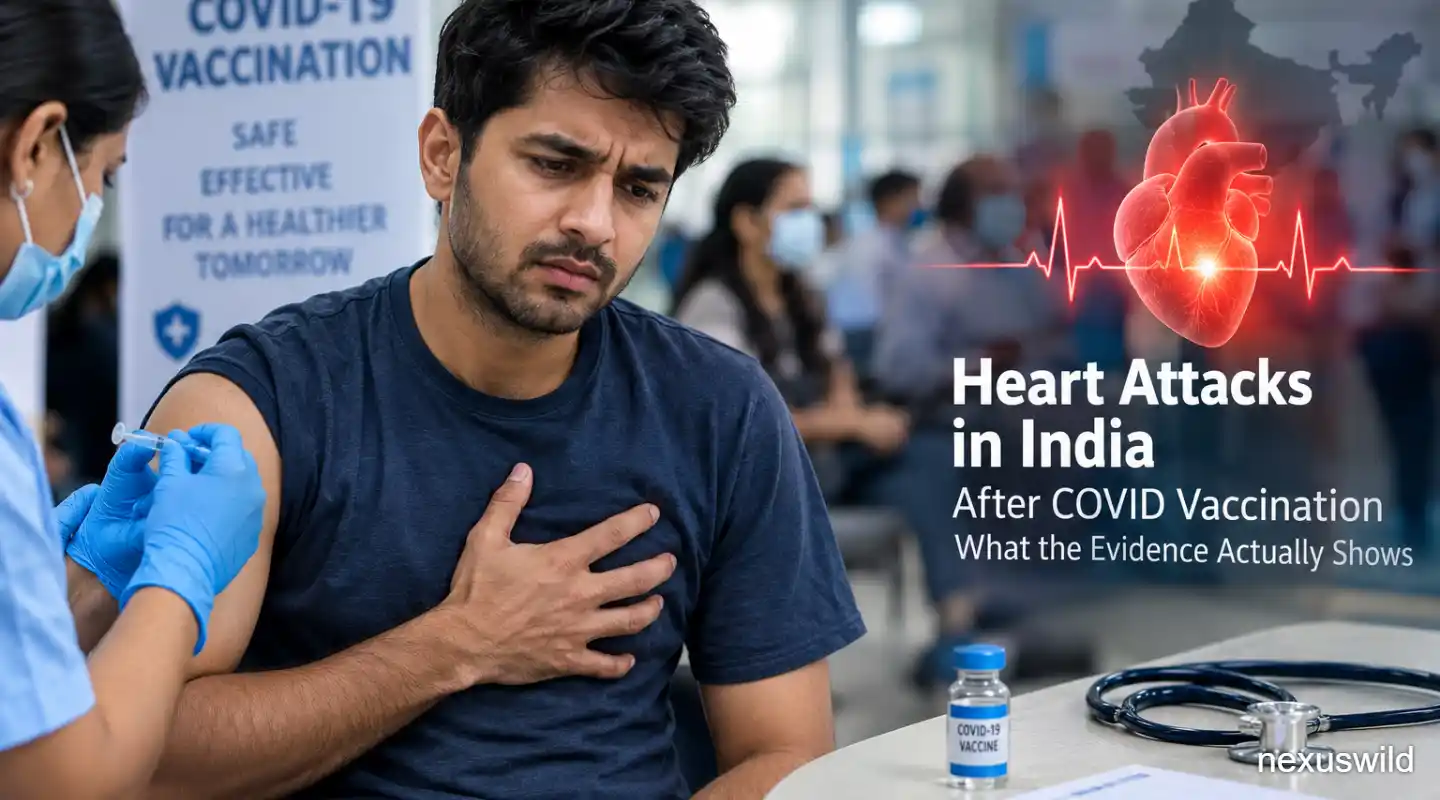

When a person in their thirties collapses without warning, the shock travels far beyond one home. Relatives look for an explanation. Friends search old messages for clues. Soon, a social media post may offer a simple answer: the COVID-19 vaccine was responsible. In a moment of grief, that claim can feel convincing because it gives a frightening event a clear cause. But timing alone cannot establish what caused a death.
The fear behind these conversations deserves to be taken seriously. So does the evidence. Research by Indian medical institutions has examined sudden deaths among younger adults, including the suspicion that COVID-19 vaccination was responsible. The published findings have not shown that vaccination increased the risk of unexplained sudden death in young adults. That does not mean every individual case has an easy answer, or that medicines and vaccines can never cause rare serious side effects. It means the broad claim that COVID vaccination is driving heart attacks across India is not supported by the studies available.
The distinction matters because India has a substantial heart-disease burden, and families need accurate information about what can reduce risk.
The question behind the headlines
Heart attacks and sudden cardiac deaths are often discussed as if they mean the same thing. They do not. A heart attack usually happens when blood flow to part of the heart muscle is blocked, often after a clot forms in a coronary artery. Sudden cardiac death describes a person dying unexpectedly, often because of a dangerous heart rhythm or another serious condition. A heart attack can trigger cardiac arrest, but not every sudden death is a heart attack and not every heart attack causes sudden death. The World Health Organization explains the difference and warns that suspected heart attack symptoms need urgent medical attention.
That distinction is important when family accounts, online videos or news reports describe someone as having died of a heart attack without a medical report or post-mortem examination. A public discussion can quickly turn an uncertain cause into a confident conclusion.
What the ICMR study found
One of the most relevant Indian studies was published in the Indian Journal of Medical Research in 2023. Researchers from the Indian Council of Medical Research's National Institute of Epidemiology worked with 47 tertiary-care hospitals across India. They compared 729 apparently healthy people aged 18 to 45 who died suddenly between October 2021 and March 2023 with 2,916 matched controls. Investigators examined vaccination history alongside COVID-19 illness, family history and several lifestyle factors.
The study did not find that COVID-19 vaccination increased the risk of unexplained sudden death. In the adjusted analysis, people who had received at least one dose had lower odds of unexplained sudden death than the comparison group. That result should not be turned into the separate claim that vaccination prevents every kind of cardiac death. It is an observational study of a specific outcome, and its strongest relevant conclusion is that it found no increased risk linked to vaccination.
The researchers did identify other associations. A history of hospitalisation for COVID-19, a family history of sudden death, binge drinking shortly before the event, recreational drug use and vigorous-intensity physical activity in the two days before the event were associated with higher odds in the study. These results do not prove that one factor caused an individual death. They do show why investigations need to look beyond vaccination status and consider medical history, inherited risks and circumstances around the event. Regular, appropriately paced exercise remains important for heart health. The finding about vigorous activity was tied to a narrow time window in this study and should not be read as advice to avoid exercise.
A second study adds context, but not a nationwide trend line
A later autopsy-based study from the All India Institute of Medical Sciences in New Delhi, published in the Indian Journal of Medical Research in 2025, examined sudden deaths recorded at one tertiary-care centre over a year. Among the younger cases included in the analysis, cardiovascular conditions were the most common cause identified. The investigators did not find a significant association between COVID-19 vaccination status and sudden death.
This study matters because autopsy and tissue examination can reveal disease that was never diagnosed during life. But it also has limits. It examined cases brought to one centre, not a representative sample of everyone in India. It can describe the causes among those cases; it cannot by itself tell us whether the national heart-attack rate rose after vaccination.
In July 2025, India's Ministry of Health and Family Welfare cited the ICMR study and early findings from the AIIMS investigation when responding to claims that vaccines were responsible for sudden deaths among younger adults. The AIIMS research has since appeared in a peer-reviewed journal. These findings support a careful conclusion: current Indian studies do not show a population-level link between COVID-19 vaccination and unexplained sudden death among young adults. Continued safety monitoring and investigation of specific cases remain important.
Are heart attacks actually increasing among young Indians?
The concern is real, but the available evidence needs to be described accurately. Heart disease is a major cause of death in India. WHO's country data list ischaemic heart disease among the country's leading causes of death. That long-running burden deserves far more attention than a social media argument about one possible cause.
However, the two sudden-death studies discussed here were not designed to measure year-by-year changes in the national incidence of heart attacks. One was a matched case-control study of unexplained deaths in people aged 18 to 45. The other analysed autopsies at a single hospital. Neither can establish that heart attacks have increased nationwide after vaccination. A genuine trend analysis would need comparable data over time, reliable information on the cause of death, age-specific rates, and adjustment for changes in population size, age, diagnosis and reporting. Viral clips and personal stories cannot supply that denominator.
Why heart risk deserves attention regardless
A heart attack usually develops when fatty deposits build up in the coronary arteries and a plaque ruptures, allowing a clot to restrict blood flow. Risk can accumulate quietly. High blood pressure, high LDL cholesterol, diabetes, tobacco use, excess weight, low physical activity, family history and some patterns of alcohol or drug use can all matter. People may feel healthy while one or more of these risks remain undetected.
There is no single profile for a person who has a heart attack. A younger adult can have an inherited heart condition or coronary artery disease. Another person may have undiagnosed hypertension or diabetes. Smoking, poor sleep, chronic stress, diet and missed medical checks can compound risks, although none of these factors should be assumed to explain a death without evidence. COVID-19 illness can also be followed by health complications in some people, so medical history should include infection as well as vaccination.
A balanced account must also acknowledge that serious vaccine side effects are possible, even when rare. India's 2024 adverse-event surveillance guidance notes that thrombosis with thrombocytopenia syndrome has been observed at a frequency of less than one in 100,000 recipients following adenovirus-vector COVID-19 vaccines used in India, and lists several events that require continued monitoring. A rare, recognised adverse event is not the same as proof that vaccination is causing a broad rise in heart attacks. The correct response to a suspected adverse reaction is medical assessment and formal reporting, not a blanket conclusion drawn from timing alone.
What families can do now
The most useful response to heart-health fears is not to guess at the cause after a tragedy. It is to identify risks early and respond quickly to symptoms. Adults should know their blood pressure, blood sugar and cholesterol levels, discuss family history with a clinician, avoid tobacco, and seek tailored advice about exercise, food, weight and alcohol. People with chest symptoms or known medical conditions should not rely on a general article to decide whether they are safe.
Possible heart attack symptoms include pressure, heaviness or pain in the chest, discomfort spreading to an arm, shoulder, back, neck or jaw, shortness of breath, cold sweating, nausea or light-headedness. Symptoms can differ from person to person, and some people, including those with diabetes, may have less typical warning signs. Do not wait for symptoms to become severe or try to settle the cause through an online search. Call India's emergency number 112 or seek emergency medical care immediately.
The conclusion is not that every concern should be dismissed. It is that concern should lead to better investigation. Families deserve answers, clinicians need complete histories, and public agencies should continue to monitor vaccine safety transparently. But the evidence currently available from Indian studies does not support blaming COVID-19 vaccination for a nationwide rise in heart attacks. The more useful public-health question is how to detect heart disease sooner, make emergency care faster, and help more people manage risks they may not know they have.
Reader questions
Frequently asked questions
Can COVID-19 vaccination cause heart attacks in India?
The Indian studies discussed here did not find that COVID-19 vaccination increased unexplained sudden-death risk among adults aged 18 to 45. Rare serious vaccine side effects are recognised and monitored, but the available evidence does not support blaming vaccination for a nationwide rise in heart attacks. An individual suspected reaction needs medical assessment.
Are heart attacks increasing among young Indians after vaccination?
The cited ICMR and AIIMS studies were not designed to measure a nationwide change in heart-attack incidence over time. They therefore cannot establish that heart attacks increased after vaccination. Reliable trend analysis requires comparable records across years, age-specific rates and confirmed causes of death.
What raises heart attack risk in younger adults?
Risk factors can include high blood pressure, high LDL cholesterol, diabetes, tobacco use, excess weight, low physical activity, family history and some patterns of alcohol or recreational drug use. Risk varies by person, so a clinician can help assess individual history and screening needs.
What should I do if I suspect a heart attack?
Treat chest pressure or pain, pain spreading to the arm, shoulder, back, neck or jaw, shortness of breath, cold sweating, nausea or light-headedness as urgent warning signs. Call India's emergency number 112 or seek emergency medical care immediately. Do not wait for symptoms to pass.
Nexuswild welcomes factual corrections. Email contact@nexuswild.com with evidence and the article URL.