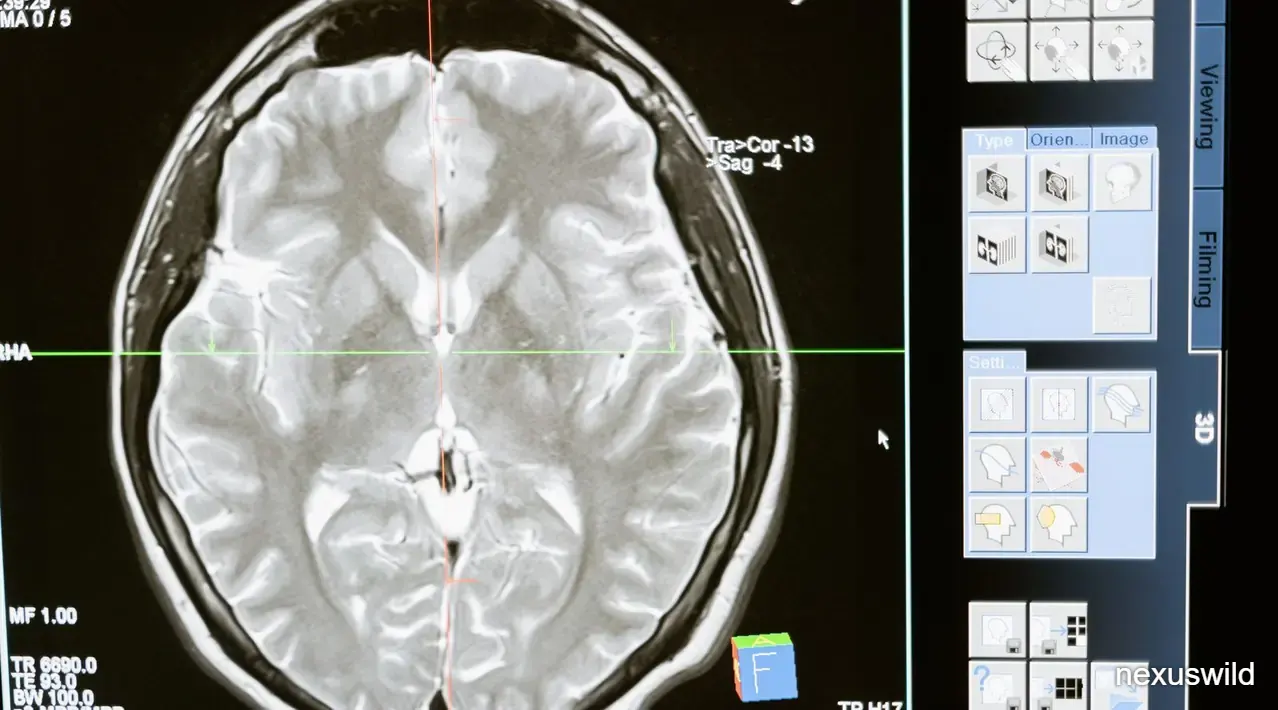

A new brain-recording study suggests that the mental machinery behind a freely chosen option and a forced one may look surprisingly similar. Researchers asked people to pick between coloured balloons in some trials and to select the only available balloon in others, while measuring electrical activity in the brain. In both situations, a signal associated with building toward a decision rose gradually and reached the same level just before the person pressed a button. It climbed faster when decisions were quick and more slowly when people took longer. The result, published in Imaging Neuroscience, does not show that free will is an illusion. The authors argue that the brain may use a common process to accumulate evidence, while the content of that evidence comes from an individual's preferences, values, goals and experience. Their conclusion reframes an old debate: rather than asking only whether a choice is free, it may be more useful to ask what makes it yours. That shift turns a long philosophical puzzle into a testable question about the information a person brings to the moment of choice.
Why This Question Matters
Imagine standing in a bakery, choosing between a doughnut and a tart. You compare the two, decide you prefer the doughnut, and move to the counter. By the time you arrive, only tarts remain, so you choose one instead. The two decisions feel very different. The first seems to express something about you: your tastes, your goals for the morning and the pleasure you expect from each pastry. The second is simply a response to what is available. This contrast is the starting point for the new study, written by the researchers themselves in an explainer published by The Conversation and summarised by ScienceDaily. If free and forced choices involve such different experiences, neuroscientists have long asked whether the brain treats them differently too. The question is not purely abstract. It touches on how people understand responsibility, preference and self-control. A choice that expresses personal values seems to say something about the person who made it, while a forced response seems to say only something about the situation. By comparing the two in a controlled task, the researchers could ask whether that intuitive divide corresponds to a measurable difference in the brain's decision process. The bakery example is therefore more than an illustration; it captures the distinction the experiment was designed to test. It also keeps the task close to ordinary life rather than relying on an abstract laboratory rule that participants might interpret in unexpected ways.
Defining a Free Choice
In the study's terminology, a free decision is one in which several options exist and the person weighs them before committing. The basis for that commitment is internal: preferences, values and goals. A forced decision has only one possible outcome. The task is to recognise the available option and take it. This distinction is not about how difficult a choice feels. A person might find a forced task effortful if the correct option is hard to identify, and a free choice might be easy if one preference is strong. What matters is the structure of the situation. Free decisions offer alternatives whose relative appeal must be assessed; forced decisions present a single target. The researchers wanted to know whether that difference appears in the way brain activity unfolds in the moments before a response. Their definition follows ordinary usage closely enough that the experiment maps onto everyday experience. When only one option is possible, selecting it can still require attention and recognition, but there is nothing to trade off. When several options are present, the person must weigh what each offers. Keeping that distinction clear matters because a similar brain signal in the two conditions could otherwise be misinterpreted as evidence that the options themselves were equivalent. The experiment was not built to show that people experience the two trials identically, only to compare one measurable stage of decision formation.
What Earlier Brain Studies Suggested
Neuroscientists have often assumed that free choices depend on different brain processes from forced ones. Some brain-imaging studies have reported different spatial patterns of activity for the two kinds of decision. That evidence supports the idea that freely chosen actions recruit distributed networks differently from simple, constrained responses. But the authors point out an important limitation. Knowing where in the brain free choices happen says relatively little about how the decision is formed. A scan can identify regions that are more active during one task than another without revealing the step-by-step process by which competing options are evaluated. The new study therefore shifts attention from location to dynamics: how electrical signals change over time as a person moves from uncertainty to a committed choice. This is a change in both method and question. Rather than asking which brain areas distinguish free from forced decisions, the authors ask whether the trajectory of activity follows the same shape. A trajectory can look similar even if the underlying networks differ, just as two different routes can produce a similar rise and fall in traffic volume. By focusing on the pattern over time, the researchers were able to compare the two decision types on common ground. Their result therefore speaks to the form of the process, not to a complete map of every region that might contribute to choosing.
Evidence Accumulation Explained
Decades of decision research have shown that the brain often gathers evidence for competing options gradually. The researchers use the analogy of a judge evaluating the facts of a case. As support for one side builds, the eventual verdict becomes more likely. For some simple decisions, this process unfolds over hundreds of milliseconds, so quickly that the choice feels as if it appeared fully formed. Researchers have identified an electrical brain signal that tracks this accumulation during straightforward tasks, such as judging whether a traffic light is red or green. Like a loading bar approaching 100 per cent, the signal rises toward a particular level before the decision is made. Because neurons are noisy, the rise is not perfectly smooth; the signal can fluctuate back and forth between alternatives before one wins out. The framework has been developed mainly through tasks with a clear correct answer, where evidence can be counted in favour of one option or another. The new study asks whether it also applies when there is no externally correct answer and the evidence comes from personal preference. That extension is not trivial. In a perceptual task, the relevant evidence is supplied by the stimulus. In a free choice between equally available balloons, the evidence must be supplied by the person. Showing a similar accumulating signal in both cases is what makes the result interesting to decision researchers. It suggests that the framework can be extended, cautiously, beyond tasks where the correct answer is defined by an experimenter.
The Balloon Experiment
To test whether the same pattern appears in more open-ended choices, the team recorded brain activity while participants viewed coloured balloons. In some trials, two balloons of different colours appeared, and participants were free to choose between them. In others, only one balloon appeared, so the response was forced. Participants pressed a button as soon as they had made their choice, giving the researchers a precise moment to work backwards from. The design let the team compare free and forced trials under similar response conditions while changing the decision structure. It also allowed them to examine how the signal behaved when people responded quickly versus slowly. Using the same basic response in both conditions helps isolate the decision itself from the mechanics of pressing a button. If one task had required a different movement or a more complicated instruction, differences in brain activity might have reflected those features instead. The balloon task is simple, but that simplicity is deliberate. It gives researchers a clean way to observe a process that usually unfolds too quickly for introspection, and it can be repeated across many trials to see how the signal changes from one decision to the next. The colour of the balloon acts as the relevant feature to identify or prefer, keeping the choice readable for participants.
A Similar Signal in Both Conditions
The central finding was that brain activity unfolded in a very similar way for free and forced decisions. In both conditions, the signal climbs like a loading bar and reached the same peak level just before the choice was registered. When participants decided quickly, the signal increased faster. When they took longer, it rose more slowly. That relationship is what researchers would expect if the brain were tracking and weighing evidence over time rather than waiting until the last moment to react. A purely reactive account would predict a signal that appears only near the response, with little advance build-up. The observed rise instead resembles a gradual commitment. The peak level was comparable across the two kinds of choice, despite the different task demands. For the authors, this pattern suggests that a common decision-forming process can operate whether the alternatives are externally constrained or drawn from personal preference. The finding does not make the choices identical; it identifies a shared step in reaching them. That step could still be embedded in wider processes that differ between free and forced decisions, which the present comparison does not rule out.
What the Result Does Not Prove
It is tempting to conclude that free choices must therefore be automatic in the same way as forced ones. The authors resist that inference. A similar neural process does not tell us where the evidence came from, what it meant to the person or whether the choice reflected that person's values. The study shows a common pattern in how a decision builds; it does not settle the philosophical question of free will. This caution is important because brain measurements are often drawn into large claims about human agency. Headlines about free will can turn a careful experiment into a verdict on moral responsibility, but the data do not support that leap. The researchers describe the work as revealing a universal process in the brain, not as demonstrating that personal choice is an illusion. Their argument is about mechanism and content: the mechanics may be shared, while the information feeding the mechanism can differ profoundly between people and situations. Recognising that distinction allows the result to be taken seriously without being exaggerated. It also shows why the researchers chose to write a public explainer themselves, since the most common misreading was likely to concern the meaning of free will.
The Libet Comparison
The finding echoes famous experiments by neuroscientist Benjamin Libet in the 1980s. Libet and colleagues reported that brain activity began ramping up before participants were consciously aware of their intention to act. That result has been cited for decades in debates about free will, because it suggests the brain starts preparing an action before the person consciously notices deciding. The new study does not repeat Libet's exact task, and the authors do not claim to have resolved the issue he raised. Instead, they say their result has a similar flavour: a decision process can be automatic in its timing and still depend on who the person is. Libet's work concerned the timing of an intention to move, while this experiment compared the buildup of activity before two different kinds of choice. The resemblance lies in the discovery of preparation that begins before conscious awareness of the final decision. The comparison helps explain why the study attracted attention beyond specialist journals, while also showing why a careful reading is needed. Timing evidence and meaning evidence are different things. A signal that begins early can tell us when a process starts, but not whether the person endorses the action or identifies with the reasons behind it.
Where the Evidence Comes From
The researchers' key point is that the process may be automatic while the evidence is deeply personal. In a free choice, the brain is accumulating information drawn from preferences, goals, values and past experiences. A person choosing a doughnut over a tart may be responding to a long history of taste, a current desire, a dietary goal or a memory of both. Another person in the same bakery may weigh the same options differently. Both may show the same rising neural signal and press the same button, yet arrive at their decisions for quite different reasons. This is why the authors do not equate a shared mechanism with sameness of choice. A loading bar can fill from different sources, and the shape of the fill tells us little about what is being loaded. In the bakery case, one person's evidence might be a strong memory of how a doughnut tastes, while another's might be a plan to avoid sugar. The form of the decision process can be general while its content remains individual. That point is central to the researchers' interpretation and is easy to miss if the result is reduced to a claim that free choices are forced. Shared machinery can still serve personally meaningful ends, just as a common language can express very different lives.
Noise and Inconsistent Choices
The loading-bar analogy also helps explain a familiar feature of human behaviour. Even when preferences are fairly stable, people do not always choose the same thing. One day the tart wins; another day the doughnut does. The researchers point to the noisy activity of neurons as part of the explanation. Because the accumulating signal fluctuates rather than following a perfectly smooth path, the outcome can vary across repeated decisions. This does not mean preferences are meaningless or that choices are random. It means that small variations in the evidence-gathering process can tip a close decision one way or the other. When two options are nearly equally attractive, the outcome may depend on moment-to-moment fluctuations rather than a large shift in underlying taste. The finding connects the fine-grained physics of brain signals with everyday experience, showing how a quantitative pattern can correspond to something people recognise from their own lives. It also suggests a reason the same person can make different choices in similar situations without those choices being irrational or disconnected from preference. Preferences may set the range of acceptable options while momentary noise helps decide which one wins.
A Better Question to Ask
Rather than asking whether choices are truly free, the authors suggest asking what it means for a choice to be yours. That question keeps the focus on the source of the evidence that drives a decision. If the evidence reflects your preferences, goals and experience, the fact that the brain accumulates it through a shared mechanism does not by itself erase ownership. The paper, Tracing the Neural Trajectories of Evidence Accumulation and Motor Preparation Processes During Voluntary Decisions, lists six authors and appears in volume 4 of Imaging Neuroscience. It builds on a long research tradition and cites earlier imaging work that reported different patterns for free and forced choices. The new result complicates that picture without closing the debate. It also leaves room for future experiments to examine which personal factors shape the evidence that accumulates, and how those factors change across situations. For anyone waiting in line at a bakery, the practical lesson is modest but memorable: the brain may begin gathering evidence before we notice we have decided. That does not make the choice less personal, only less instantaneous than it feels. The study's lasting contribution may be to separate the speed and shape of a decision from the question of whose decision it is.
Nexuswild welcomes factual corrections. Email contact@nexuswild.com with evidence and the article URL.