
A flame is a signal as much as a source of heat. For anyone standing near a cooktop, the visible glow is a quick, unconscious confirmation that fuel is burning where it should be and that the appliance is behaving normally. Hydrogen, widely discussed as a lower-emissions substitute for natural gas in homes, does not always provide that signal reliably. Researchers at Adelaide University have now shown why: the colour and brightness of a hydrogen flame depend heavily on what is floating in the air around it, especially tiny particles of sodium. Their work, published in the journal Next Energy, found that the same burner can look strikingly different from one day to the next without any change in its settings. That matters for safety engineering, because it means flame appearance cannot be treated as a stable property of the fuel or the appliance. The study does not argue against household hydrogen. It argues for designing household hydrogen equipment with a clear understanding of how the fuel actually behaves outside a controlled laboratory. As interest grows in hydrogen stoves, ovens and pilot systems, the result offers a practical reminder that even familiar things, such as the visible flame on a hob, need to be re-examined when the fuel changes.
Why a flame you can see still matters
In a domestic kitchen, people rarely analyse a flame in a scientific way. They glance at it. A steady blue or orange glow from a gas burner tells a cook that the appliance has lit, that the flame has not been blown out and that the fuel is being consumed as expected. That informal check sits alongside more formal safety systems, but it remains part of how people judge whether a cooktop is working. Engineers who design combustion appliances have therefore long paid attention to flame appearance, even though modern devices also use thermocouples, flame-failure devices and other detection hardware.
Hydrogen complicates this picture because it burns differently from the hydrocarbon gases that domestic burners were originally built to handle. It has a wide flammability range, a low ignition energy and a flame speed that differs markedly from methane. Those properties bring benefits and challenges. They can make ignition easier and combustion more complete, but they also require careful control of air-fuel mixing and burner geometry. A hydrogen flame can be pale, and in some lighting conditions it can be surprisingly difficult to see. That is not merely an aesthetic issue. If an operator relies on sight to confirm that a burner is operating, a faint flame could be mistaken for an extinguished one, or a small flame could go unnoticed near the edge of a pan.
The Adelaide study and its central question
The research is titled The role of sodium on hydrogen flame visibility in domestic settings. It was led by Professor Paul Medwell of the School of Electrical and Mechanical Engineering at Adelaide University, with co-authors including Jordan Kildare, Yilong Yin, Qing Nian Chan, Michael Evans, Neil Smith, Peter Ashman and Douglas Proud. The paper appeared in Next Energy, an Elsevier journal, with the DOI 10.1016/j.nxener.2026.100962. Bibliographic indexes record the article as volume 13, article number 100962, with online publication in September 2026. Adelaide University issued a public explanation of the findings on 18 November 2026, and ScienceDaily reported the work the following day.
The central question was practical. The team wanted to know why hydrogen flames can appear bright orange on some occasions and much harder to see on others, even when the burner is operating under apparently identical conditions. This is not a question that can be answered by looking only at the chemistry inside the flame. Hydrogen combustion itself produces very little visible light, because the main products are water and, under certain conditions, small amounts of reactive species whose emission is weak in the visible part of the spectrum. If a hydrogen flame looks orange, something else must be supplying that colour.
Sodium carried on the wind
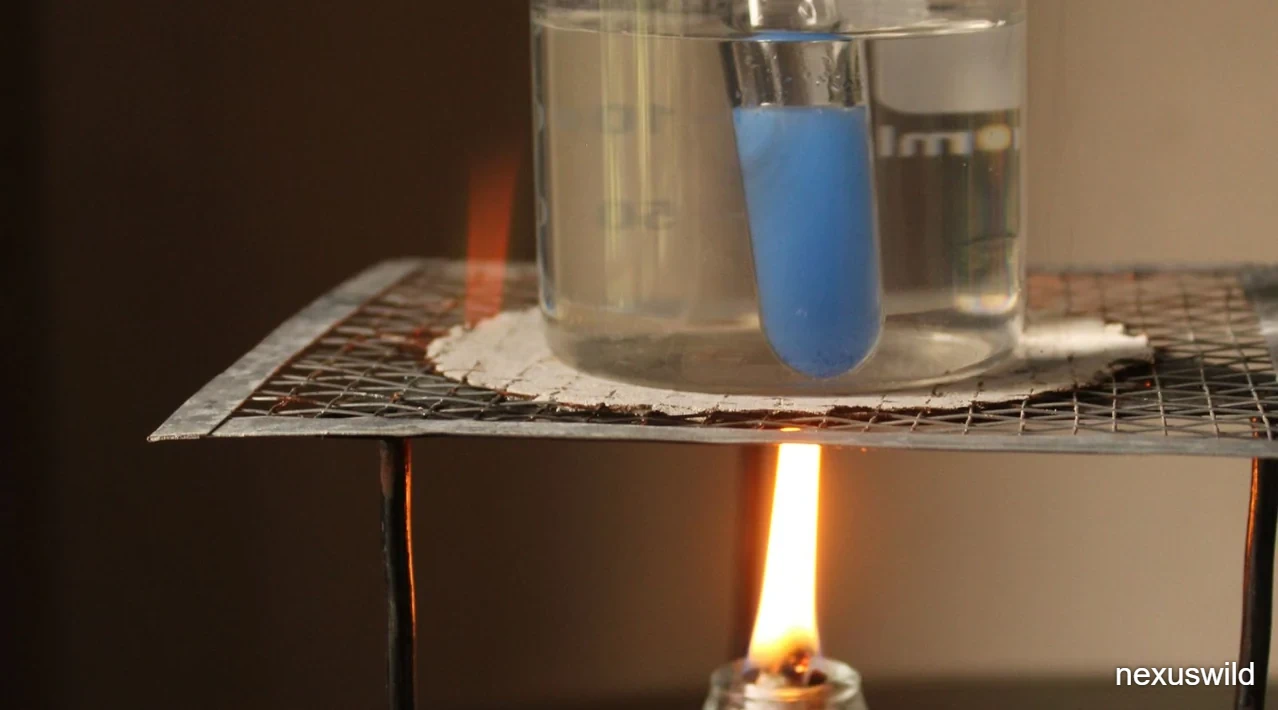
The mechanism described by the researchers is straightforward but easily overlooked. Sodium-containing particles in the air pass through or near the flame. When they are heated, sodium atoms emit light strongly in the yellow-orange part of the spectrum. Even a small quantity can produce a visible tint. When the air carries more of these particles, the flame looks brighter and more orange. When the airborne sodium concentration falls, the same flame loses that colour and becomes much fainter. The fuel flow and burner settings may be unchanged; what has changed is the environment.
Sea salt is highlighted as one source because it is abundant and readily transported. Wind moving across the ocean can lift droplets and salt particles into the air, and that marine aerosol can travel inland. A burner supplied with air that has recently passed over the sea may therefore see more sodium than one supplied with air that has travelled over dry land. The study reports that winds that had travelled over the sea generally produced brighter orange flames, while air carrying less sodium produced much fainter ones. This links flame appearance to meteorological conditions in a way that appliance designers would not normally consider.
Measuring a flame that keeps changing
To make the measurements meaningful, the researchers had to separate changes caused by the flame from changes caused by the surroundings. They monitored light emissions from hydrogen flames over a two-week period while keeping burner settings constant. That constraint is central to the result. If the fuel flow, air mixture or burner geometry had been adjusted between readings, any change in colour might have had a mundane explanation. Holding those variables fixed meant that variations in the optical signal could be traced to the air reaching the burner.
The team tracked the sodium-related light signal specifically, rather than simply recording overall brightness. This allowed them to distinguish the sodium contribution from other emissions, including faint blue and red light produced by hydrogen combustion itself. They also examined how the flame behaved as weather patterns shifted and as the air reaching the burner changed. The outdoor work was carried out around Adelaide, a coastal city where marine air can plausibly play a role, making it a suitable location for testing the sea-salt hypothesis.
The 28-fold swing in a two-week trial
The most eye-catching number in the study is the variation in the sodium-related light signal. Over two weeks of monitoring, with burner settings unchanged, the measured signal varied by more than a factor of 28 between its lowest and highest recorded values. A 28-fold change is not a subtle shift. It is the difference between a flame that reads clearly and one that is barely distinguishable from its background.
This figure should be interpreted carefully. It refers to the measured sodium-related emission signal, not necessarily to a 28-fold change in the human perception of brightness. Human vision is nonlinear and responds to contrast, adaptation and surrounding illumination. A flame that is 28 times weaker in one spectral component may still be noticeable in a dark room and invisible in bright daylight. The number is nonetheless a strong indication that the environment can dominate the visual appearance of a hydrogen flame.
The result also shows why the word "constant" needs qualification in appliance discussions. Engineers often describe a burner as operating under fixed conditions when fuel pressure, flow rate and mixture are held steady. The Adelaide work shows that fixed burner conditions do not guarantee a fixed flame appearance. The surrounding air is an input to the system, even though it is not represented on a control panel. For a domestic appliance, that input is entirely outside the user's control.
How hydrogen compares with natural gas in the kitchen
The Adelaide team also compared hydrogen flames with those from a conventional natural gas cooktop. This comparison is directly relevant to households considering a switch, because expectations are shaped by years of experience with gas appliances. Natural gas flames are accustomed visual cues: most people know roughly what a lit burner should look like. Hydrogen does not automatically provide the same cue.
The researchers found that hydrogen flames emitted less visible light on average than natural gas flames, even when atmospheric conditions favoured a brighter hydrogen flame. This is a separate finding from the sodium variability. Even on a good day, when marine air has boosted the orange glow, the hydrogen flame remains comparatively faint. The two effects compound. A fuel that is intrinsically less visible in the visible spectrum is also subject to large environmental swings in the small amount of colour it does display.
That difference matters for retrofit discussions. A hydrogen-ready cooktop may be mechanically similar to a natural gas model, but the way users interact with it will not be identical. If a cook expects a familiar bright blue flame and instead sees a pale or intermittent-looking glow, the appliance may feel less trustworthy even when it is operating correctly. Trust is not a minor factor in adoption. People are unlikely to embrace a new energy technology in their kitchen if they are uncertain about whether it is working.
Blue, red and the limits of colour as a signal
Hydrogen combustion can produce faint blue and red light in addition to the sodium-driven orange glow. The researchers examined these colours and found that they were most readily detected in darkened surroundings. Under ordinary kitchen lighting, they were much less useful as indicators. This detail matters because it rules out an easy solution to the visibility problem. One might imagine that even if the orange glow fades, the intrinsic blue and red emission would still reveal the flame. The data suggest otherwise.
The practical implication is that colour should not be the primary confirmation that a burner is operating. The authors point instead to dedicated detection technologies. Ultraviolet flame detectors can sense radiation emitted by a flame outside the visible range, while infrared detectors can identify thermal signatures. Temperature sensors offer another route, confirming that the expected heating is taking place. None of these approaches depends on the human eye noticing a particular shade of orange.
This recommendation reflects a broader principle in safety engineering: critical states should be indicated by signals that remain robust across the expected operating environment. Relying on a visual property that changes by more than an order of magnitude with the weather would be a poor design choice, even if the phenomenon were harmless in itself. The study gives engineers a specific reason to choose sensors that are insensitive to airborne sodium.
From observation to appliance engineering
The transition from measurement to engineering is where the study becomes most useful. The researchers have identified an environmental input, quantified its effect and named a class of technologies that could remove the dependency. That sequence is characteristic of applied combustion science. The work does not deliver a finished stove, but it removes a hidden uncertainty from the design process.
One consequence is for test protocols. If a manufacturer wants to demonstrate that a flame-detection system works, the test needs to include low-sodium conditions as well as high-sodium ones. It is the low-sodium case that produces the faintest flame and therefore the hardest detection problem. A test conducted only on a day with onshore winds could give an overly optimistic picture. Conversely, a detector that works in clean air will generally continue to work when sodium adds extra light, provided it is not confused by the colour change.
Another consequence is for installation. The source of combustion air could influence how much particulate sodium reaches the flame. Homes in coastal regions, or homes with air intake positions that draw in marine aerosol more readily, might see more orange glow than inland homes. That does not mean different appliances are required in different places, but it does suggest that a single visual expectation cannot be applied universally. Designers can respond by specifying detection methods that work across locations rather than relying on local flame appearance.
What the paper adds to combustion science
Beyond its immediate appliance relevance, the paper contributes to a growing body of work on real-world combustion. Much combustion research is conducted in carefully controlled environments where fuel composition, temperature, pressure and airflow are known precisely. That approach is essential for understanding fundamental mechanisms. But domestic burning happens in kitchens, where air is not filtered, lighting is not standardised and weather leaves a mark. The Adelaide study shows that an environmental trace species can dominate the visible signature of a flame.
This is a reminder that combustion diagnostics cannot be separated from the medium in which combustion occurs. Optical techniques are widely used to study flames because they can probe temperature, species concentrations and flow fields without disturbing the process. But if ambient particles introduce strong emission lines, those measurements need to account for them. The sodium effect may be a nuisance for someone trying to measure hydrogen's intrinsic emission, yet it is exactly the effect the team set out to explain.
The work also illustrates a productive relationship between fundamental spectroscopy and applied engineering. The underlying fact that sodium emits strongly when heated is textbook chemistry. Recognising that this fact determines domestic flame visibility required asking a question that textbook demonstrations do not usually pose: what happens when sodium is present only as airborne contamination, at ambient levels, over days and weeks? The answer emerged from combining laboratory control with long-duration outdoor observation.
The hydrogen-home context and its caveats
Adelaide University's release places the study in the context of a real-world hydrogen milestone. In 2023, the Australian Gas Infrastructure Group unveiled what it described as Australia's first 100 percent hydrogen-powered home in Victoria. The demonstration showed that household gas appliances could operate entirely on hydrogen, and it was presented at the time as a significant step for the sector. The new research does not undermine that achievement. It refines it by pointing to an appliance-level detail that needs attention if such homes are to be replicated.
It is important to keep the result in proportion. The study concerns flame visibility, not the overall safety record of hydrogen appliances, not the economics of hydrogen production and not the carbon intensity of supply chains. Hydrogen's climate benefits depend on how it is made, and its suitability for homes depends on infrastructure, cost and regulation. A paper about sodium and flame colour does not settle any of those larger questions. What it does is remove one small but genuine obstacle to informed design.
The word "domestic" in the paper title is significant. Industrial hydrogen burners operate in very different environments, often with controlled air supplies and trained operators. Domestic appliances are used by people who expect simple, legible feedback. The gap between those settings is precisely why visibility deserves study. A phenomenon that would be a minor curiosity in a plant room can matter much more on a kitchen hob.
What happens next for safer hydrogen appliances
The immediate next step is to translate the finding into design guidance. The authors have already suggested ultraviolet and infrared flame detectors and temperature sensors as alternatives to colour-based confirmation. Each option would need to be evaluated for cost, reliability and resistance to false readings in a kitchen environment. A temperature sensor, for example, must distinguish a correctly burning flame from a hot pan or a neighbouring burner. An optical detector must ignore sunlight and cooking light. These are ordinary engineering problems, but they need to be solved with the sodium variability in mind.
Testing regimes are another likely focus. A robust protocol would deliberately expose appliances to low-sodium air, because that is the condition in which the flame is hardest to see. It would also consider airflow paths and the location of air intakes. If a manufacturer can demonstrate reliable detection across the measured range of conditions, the 28-fold swing becomes a test specification rather than a worry.
Further research could examine other environments. Adelaide's coastal setting makes marine aerosol especially relevant. Inland cities, industrial areas or homes near roads may have different particulate profiles. It would be valuable to know whether the same mechanism dominates elsewhere or whether other compounds produce comparable optical effects. The answer would help determine whether hydrogen appliance standards need regional provisions or a single general requirement.
Nexuswild welcomes factual corrections. Email contact@nexuswild.com with evidence and the article URL.