
Researchers at the University of Arkansas have demonstrated a small but significant step toward building with Moon dust: they have 3D-printed interlocking blocks from simulated lunar regolith without adding a binder. The objects are only a few centimetres wide, shaped like crosses and the letter H so they can be fitted together in a LEGO-like manner. They are made by laser powder bed fusion, a process that spreads fine powder across a bed and uses light to fuse particles layer by layer. Published in npj Advanced Manufacturing, the study is the first to show that lunar regolith simulant can be sintered directly into reconfigurable construction blocks using a relatively low-power light source. The result is promising because binders would have to be sent from Earth, while regolith is already present on the Moon. The team is careful about the limits. The binder-free blocks are more porous and weaker than objects made with binders, and the researchers say they are not yet ready to support other loads. The study is best read as a materials demonstration that connects an unusual feedstock with a practical design idea, not as a claim that lunar construction is solved.
Why Build From Local Material
Any plan for a lasting human presence on the Moon must confront the cost and difficulty of moving mass off Earth. Every kilogram of structure, shielding or tools delivered from home competes with other cargo. Using materials already at the destination, often described as in-situ resource utilisation, is therefore a recurring theme in lunar exploration planning. NASA's own Moon programme emphasises sustained presence and the use of local resources. The University of Arkansas study fits into that tradition by asking whether the loose material covering the lunar surface can be turned into useful building components. The idea is not to print a finished habitat in one operation. It is to show that a basic construction unit could be made from regolith alone, then combined with other units into larger forms. That modest goal is what makes the experiment testable in a laboratory today. The team did not need a lunar lander, a vacuum chamber the size of a habitat or tonnes of imported equipment to ask a well-defined question: can simulated Moon dust be fused directly into a shape that can be joined to another shape? The answer was yes, within clear mechanical limits. That kind of incremental result is typical of early construction research. Before engineers can design walls or foundations, they must establish what a single unit can be made from, how it behaves and which variables deserve attention in the next round of experiments.
What Lunar Regolith Is
Lunar regolith is the layer of loose, fragmented material that covers the Moon's bedrock. It is not soil in the terrestrial sense. It contains no organic matter and consists of sharp, jagged particles produced over billions of years as asteroids, micrometeorites and other debris struck the surface. This steady bombardment, sometimes called impact gardening, breaks rocks into smaller pieces and mixes the upper layer. Apollo astronauts returned samples that remain central to understanding the material, and those samples provide the reference point for commercial simulants used in engineering experiments. The Arkansas team used Lunar Highlands Regolith Simulant, known as LHS-1, which is designed to mimic the dusty material collected during the Apollo missions in the 1960s and early 1970s. A simulant is never identical to the real substance, but it allows researchers to test processes before access to large quantities of lunar material is available. The choice of a highlands simulant reflects the broader question of where future settlements might be located and what kind of dust they would encounter. Different lunar terrains have different compositions, and a material that sinters well in one case might behave differently in another. The study does not compare multiple simulants, so it cannot say how broadly the method applies across the Moon. What it does show is that a commercially available analogue can be processed into interlocking shapes without added binder, giving later experiments a concrete starting point.
The Printing Process
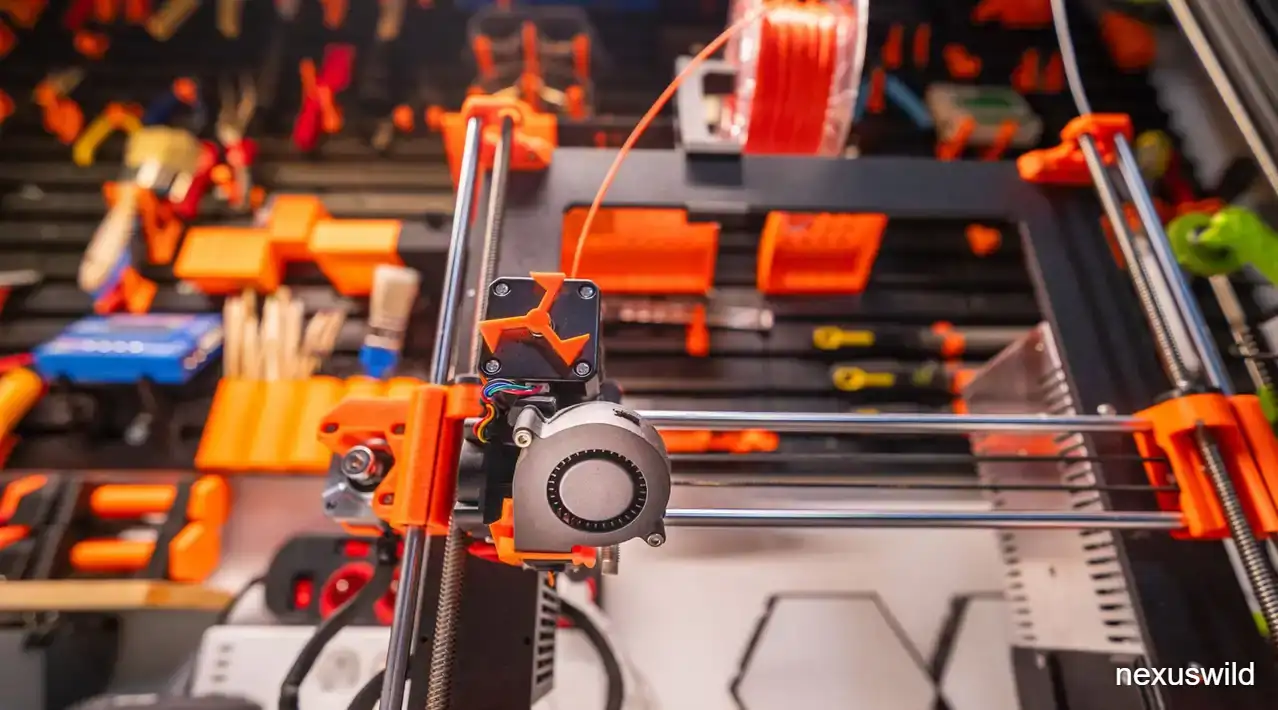
The team used a form of 3D printing called laser powder bed fusion. In this method, a fine layer of powder is spread across a flat bed. A light source, commonly a laser, then fuses selected regions of the powder through sintering, in which particles are heated enough to bond without fully melting into a solid pool. The bed is lowered, another layer of powder is spread, and the next cross-section is created. Repeating the cycle builds an object from a digital model. The Arkansas researchers reported that their approach used a comparatively low-power light source. That detail matters for any future implementation on the Moon, where power would be limited and equipment would need to be reliable. A lower-power system may be easier to operate and maintain, although the study does not evaluate a flight-ready printer. The process produced small, stackable blocks, each formed from powder that had been fused directly rather than held together by an added adhesive. Printing also allows the shape to be changed in the digital model without making a new mould, which is useful when experimenting with interlocking geometries.
Printing Without a Binder
Other research groups have printed objects using lunar regolith mixed with binding agents. Those binders can make the resulting material easier to print and stronger, but they introduce a logistical problem: the binder would need to be transported from Earth. For a remote construction system, that requirement reduces the advantage of using local dust. The Arkansas team reported that it was the first to demonstrate direct sintering of lunar regolith simulant into reconfigurable blocks without a binder. As first author Cole McCallum put it, there was nothing else binding the material; the regolith powder was binding to itself. That simplicity is the central appeal of the method. A system that uses only powder and energy would have fewer supplies to ship, fewer consumables to manage and fewer chemical interactions to account for than a binder-based process. The trade-off is that the particles must fuse well on their own, which depends on how the light source couples to the material and how heat spreads through the powder bed. The team's result shows that this is possible with the simulant and settings they tested. It does not establish that every regolith composition would behave the same way, nor that the resulting blocks would meet construction standards. Those questions remain open, but the basic feasibility of binder-free printing has now been demonstrated.
Shapes That Fit Together
The printed objects were a few centimetres wide and came in two representative shapes: crosses and the letter H. Their geometry was chosen so that individual blocks could be fitted together like LEGO pieces. This interlocking design is as important as the material itself. A pile of loose bricks is less useful than units that can locate one another, resist sliding and be rearranged into different configurations. The researchers describe the result as reconfigurable building blocks for construction, meaning that the same basic units could in principle be assembled into different forms. The tests remained at the scale of small samples, so the work is a proof of concept rather than a demonstration of a lunar building system. Still, showing that the shapes can be printed from binder-free simulant establishes a starting point for designing larger interlocking components. The two shapes were described as representative, meaning they illustrate a design principle rather than a finished catalogue of parts. Future designs could vary the geometry to improve how loads pass between blocks, provided the printer can still fuse the fine features. That step would bring together materials behaviour and structural design, which are often treated separately in early printing experiments.
The Mechanical Trade-Off
The most important caveat is mechanical performance. Objects printed from pure regolith were more porous and structurally weaker than objects printed with binders. Porosity means that small voids remain between fused particles, reducing the amount of solid material that can carry a load. McCallum said the structures the team made could support themselves, but he would be hesitant to claim the process could yet be used for something supporting other loads. That distinction is crucial for interpreting the result. A block that holds its own shape after printing is a meaningful achievement, but a wall, roof or platform would face forces from compression, impact and uneven settlement. The authors do not claim to have solved those engineering problems. Instead, they identify mechanical optimisation as a necessary next step before the approach could become practically useful in a lunar settlement. Porosity can be reduced by changing printing parameters, but doing so may require more energy or slower processing, creating another trade-off. The paper's value lies in making that trade-off visible in a real printed object. Researchers can now compare binder-free and binder-assisted blocks under the same tests and decide which properties matter most for a particular application. In a settlement, not every component would need the same strength; some might serve as paving, shielding or temporary formwork rather than as primary structure.
The People Behind the Study
The work was led by Cole McCallum, who was an undergraduate at the University of Arkansas at the time of the research, and by senior author Wan Shou, an assistant professor of mechanical engineering. The paper itself, titled Additive Manufacturing of Lunar Regolith for Reconfigurable Building Blocks Toward Lunar Habitation, lists seven authors and appeared in npj Advanced Manufacturing. McCallum began working in Shou's lab early in his studies after being encouraged by Shou's belief that undergraduates should become involved in research. He graduated in May with degrees in mechanical engineering and physics. He later received an inaugural Lafayette Fellowship, selected from more than 3,400 applicants to pursue a master's degree in France, and is studying aerospace engineering at ISAE-SUPAERO in Toulouse. His move away from additive manufacturing does not change the study's findings, but it illustrates how early laboratory work can shape a research career. McCallum said the project taught him to refine and overcome the problems that arise in research, including mistakes made during the first attempt. The paper's authorship also reflects how engineering projects are often organised, with an undergraduate carrying out detailed experimental work under the guidance of a senior researcher. The reported study was published under a DOI that can be checked through Crossref and OpenAlex, and the journal is an open-access Nature Portfolio publication. Those details matter for readers who want to examine the underlying data and methods rather than rely only on the university summary.
Why a Simulant Is Necessary
The experiments were conducted on LHS-1 rather than on material collected from the Moon. That choice reflects a practical reality: Apollo samples are precious, limited and carefully curated, and no facility has large quantities of fresh lunar dust available for trial printing. Simulants are designed to reproduce important physical and chemical characteristics of real regolith, such as particle shape and mineral composition, so that equipment can be tested under controlled conditions. They also let researchers repeat experiments and vary parameters without consuming irreplaceable samples. The limitation is that a simulant cannot capture every property of lunar dust, including the effects of billions of years of space weathering and the extremely fine, reactive nature of some grains. The Arkansas study therefore demonstrates a process on a stand-in material. Further work with real lunar samples, or with improved simulants, would be needed before applying the same settings on the Moon. That limitation is not unique to this study, but it is worth stating plainly when reporting laboratory results about lunar construction. Simulants allow repeated tests, controlled comparisons and rapid iteration, all of which are difficult with scarce returned material. They also make it possible to print multiple shapes and adjust settings without worrying about consuming a finite reference collection. At the same time, the real lunar surface has a particle size distribution, glass content and surface chemistry shaped by impacts and space weathering. Until those variables are tested, the printed blocks should be understood as analogues rather than prototypes for a specific mission.
Conditions Still to Be Tested
A laboratory printer on Earth operates under conditions very different from the lunar surface. The Arkansas team used a relatively low-power light source to sinter the simulant, but the behaviour of powder and molten or softened particles can change in vacuum and low gravity. Powders may spread differently, dust may move farther, and heat may dissipate differently without an atmosphere. Senior author Wan Shou said more research is needed to understand the process in microgravity and vacuum environments. Mechanical performance also has to be optimised if the blocks are to be practically useful. These are not minor technical details. A construction method that works on a bench in Fayetteville may behave very differently inside a habitat airlock or on an exposed lunar plain. The study establishes a feasible route for direct sintering, but it does not claim that the route has been validated in the environment where it would ultimately be used. A future test programme would need to examine not only whether the blocks can be printed, but whether the printer can handle dust in a way that is safe and repeatable. Fine regolith is abrasive and may cling to surfaces, and the absence of an atmosphere changes how loose particles move. None of these issues was measured in the reported experiments. They are the natural next questions after a successful bench-scale demonstration, and the authors explicitly point toward microgravity, vacuum and mechanical optimisation rather than presenting the current blocks as flight hardware.
A Broader View of Additive Manufacturing
The experiment belongs to the wider field of additive manufacturing, in which objects are built layer by layer from a digital design. Powder-bed techniques are especially attractive for complex shapes because the powder surrounding each layer can support the part as it forms. That property could be useful for making interlocking geometries that would be difficult to machine from a solid block. In the lunar case, the feedstock itself is the challenge. Terrestrial printers often use metals or polymers with carefully controlled particle sizes and flow behaviour. Lunar regolith is irregular, sharp and chemically unlike those materials. Showing that it can be fused directly, without a separate binding phase, broadens the range of feedstocks that additive manufacturing might handle. The work also connects materials science with mission architecture: the fewer inputs a construction system needs from Earth, the more plausible it becomes for sustained use far away. A binder-free printer still needs equipment, energy, spare parts and human or robotic operation, so local regolith is not a complete solution by itself. It is one part of a system. The study's contribution is to show that the feedstock can be used directly for a shape that has a clear assembly logic. That combination reduces the number of unsolved problems at the earliest stage of design and gives engineers something concrete to improve.
A Step, Not a Settlement
It would be easy to overstate the result. The blocks are small, the material is a simulant, and the strength is not yet adequate for demanding structural roles. The researchers themselves use cautious language. McCallum said the team would be hesitant to claim that the process could support other loads at this stage, and Shou emphasised the need for work in vacuum and microgravity. Those caveats place the study in perspective. It is a materials demonstration, not a construction plan for a lunar base. At the same time, the combination of binder-free sintering and interlocking geometry addresses two practical problems at once: what to build from and how to assemble it. If future experiments can improve strength and reproduce the process under lunar conditions, the same approach could become one component of a larger construction toolkit. For now, the paper shows that Moon dust can at least be coaxed into useful shapes without bringing glue from Earth. The next test will be whether those shapes can be made stronger, reproduced under lunar conditions and assembled into something that carries more than its own weight. Until then, the result stands as an early but carefully qualified example of how laboratory manufacturing research can contribute to long-term exploration plans.
Nexuswild welcomes factual corrections. Email contact@nexuswild.com with evidence and the article URL.