
A robot built by Caltech has assembled a structure in orbit without astronaut help, marking what the research team describes as the first autonomous construction of a structure in space. The demonstration is part of the Autonomous In-Space Tensioned Reflector Assembly project, known as ASTRA, and was funded through the Defense Advanced Research Projects Agency's NOM4D program.
The achievement is real but bounded. ASTRA did not complete the full antenna it was designed to build. It assembled an initial section of a truss intended to support a reflector measuring 1.4 meters across. The mission is expected to end in December, before all 11 planned bays are put together. Even so, the test showed that a robot in space can retrieve structural pieces from dispensers and join them into a repeating framework without a person guiding each step.
The experiment launched on March 30, 2026, from Vandenberg Space Force Base in California on a SpaceX Transporter-16 mission. It rode aboard Momentus Inc.'s Vigoride 7 orbital vehicle, which carried 10 payloads into low Earth orbit. The entire ASTRA system occupied about one cubic meter, containing both the construction machinery and the materials it needed.
A first worth defining carefully
The claim at the center of the report is specific. Caltech and DARPA describe ASTRA as the first time a structure has been autonomously constructed in space. The key words are autonomously constructed and structure. The robot did not simply unfold a preassembled object, and it did not rely on astronauts to connect pieces during a spacewalk. It selected components and assembled them into a truss section on its own.
That distinction matters because space hardware is usually designed to survive launch. Large antennas, telescopes and power systems would be easier to use if they could be built after launch, but current rockets impose strict limits on size and shape. Folding structures can help, yet folding also creates mechanical complexity and performance compromises. A robot that builds a framework in orbit suggests a different path.
The word structure also needs a boundary. ASTRA's completed work was a section of a truss, not a finished operational antenna. The full design called for 11 connected bays with reflective nets attached. The flight achieved the initial stage of that plan. The significance lies in demonstrating the assembly process in the real space environment, not in delivering a complete reflector.
Sergio Pellegrino, a Caltech aerospace and civil engineering professor and senior research scientist at JPL, led the ASTRA team. His role is described in the Caltech release and his institutional faculty profile. The project was developed with funding from DARPA's Novel Orbital and Moon Manufacturing, Materials, and Mass-efficient Design program, usually shortened to NOM4D.
The result should be read as a milestone in automated assembly. It shows that the core mechanical idea works away from Earth. It does not show that large space structures are now routine.
What ASTRA was built to make
The target of the demonstration was a reflector antenna measuring 1.4 meters across. Such an antenna is modest by the standards of proposed space systems, but it was large enough to require a supporting framework that could not be treated as a simple rigid box. The design combined composite fiber tubes, aluminum connectors and a lightweight reflective surface made from Kapton, a polymer film used in spacecraft.
The supporting framework is a truss made from repeating sections called bays. A truss is a structure built from connected members that form a stiff framework while using relatively little material. In this case, the robot was designed to place tubes and joints into a repeating pattern. Each completed bay would extend the framework and help hold the reflective surface in the intended shape.
The reflective part was not a conventional metallic mesh. The source material describes a perforated film developed through collaboration between Caltech and the University of Pennsylvania. The Pennsylvania team was led by Igor Bargatin. Unlike a knitted metallic mesh, the perforated film was said to require less tension to hold its shape. Lower tension means the supporting structure can be lighter.
That connection between film and frame is central to the project. A reflector must maintain a precise surface. If the surface needs heavy support to stay shaped, the advantages of building it in space shrink. Caltech's design tried to reduce that burden by pairing a lightweight film with a truss that could be assembled from small parts.
The demonstration focused on the robot and the truss. The full 1.4-meter reflector was not completed. The initial section proved that the assembly method could operate in orbit, while the remaining bays would have tested a more complete structure.
How the robot built the truss
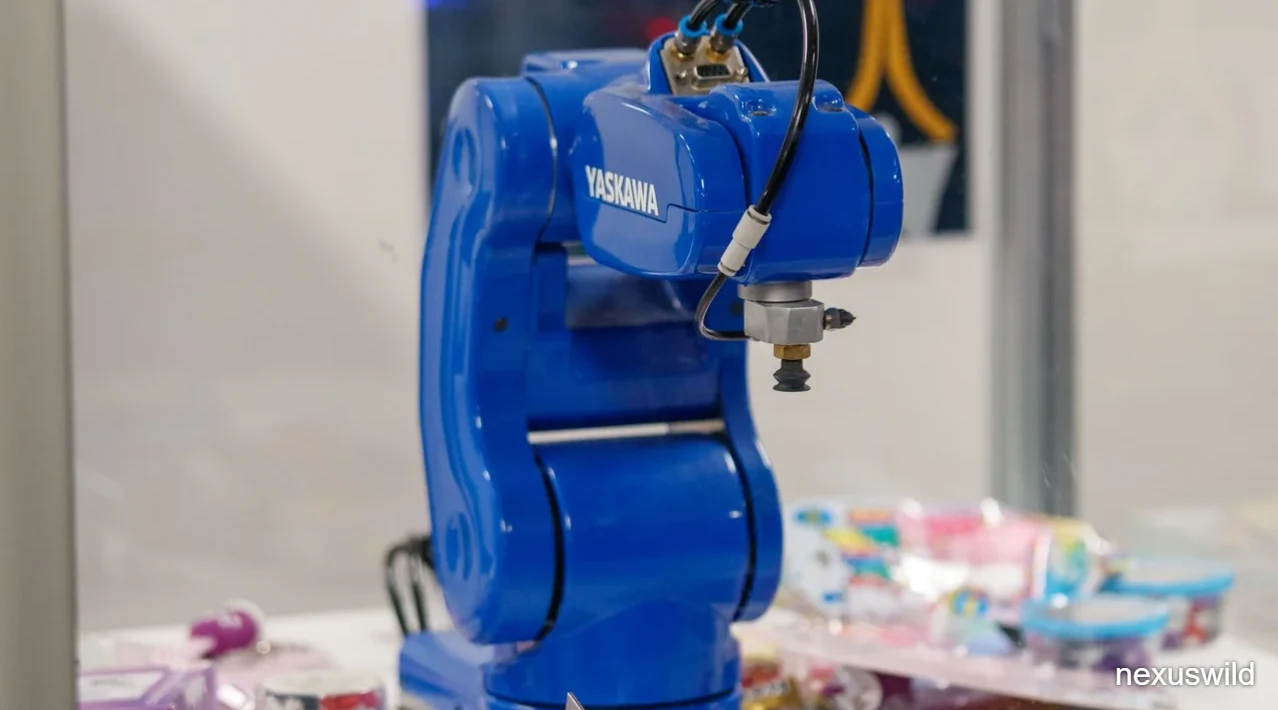
ASTRA's robot used an automated arm to pick up structural tubes and connecting joints from nearby dispensers. The dispensers held the raw pieces in a compact arrangement during launch. Once in orbit, the robot retrieved a tube, positioned a joint and repeated the operation to form a bay. The process was designed around repetition: the same basic actions could be performed again and again to extend the truss.
This is different from deploying a hinged structure. A deployable object is packed in one configuration and opens into another. Its possible shapes are limited by how it was folded. An assembly robot can, in principle, add pieces in different sequences and build structures larger than anything that could fit in a launcher. The ASTRA test used a predetermined repeating pattern, but that pattern was created in space.
The robot had to handle parts that were not already connected. It needed to grasp them, align them and secure them. Those tasks are difficult on Earth and harder in orbit, where objects can move differently and there is no simple way to brace a structure against the ground. The flight demonstration showed that the hardware could carry out these operations outside a laboratory.
The initial section was described as the first bay or the first third of the intended assembly. That terminology reflects the modular design. Each bay is a unit of the larger truss. Completing one proves the mechanical cycle. Completing all 11 would have shown sustained construction over a larger structure.
The robot did not work instantaneously. It spent months in orbit attempting the assembly sequence. That timescale is typical of complex space demonstrations, where commands are limited and each action must be checked.
The launch and the spacecraft host
ASTRA began its journey on March 30, 2026, when a SpaceX Transporter-16 mission lifted off from Vandenberg Space Force Base. The mission carried multiple small payloads, and ASTRA traveled on Momentus Inc.'s Vigoride 7 orbital vehicle. Momentus's own service page describes Vigoride as an orbital vehicle, and the ScienceDaily account says the host carried 10 payloads into low Earth orbit.
The size of the payload is notable. ASTRA occupied approximately one cubic meter. That volume included the robot, dispensers, structural materials and reflective film. A compact launch package is part of the appeal of in-space assembly. If a much larger reflector can be built from one cubic meter of hardware, the approach could avoid some of the constraints imposed by rocket fairings.
The orbital setting also created the conditions for the test. Low Earth orbit provides microgravity and a vacuum environment, but it is not a benign workshop. Temperature changes, radiation, limited communications and the absence of manual intervention all affect what a robot can do. A ground demonstration cannot fully reproduce those conditions.
The team had less than 12 months to manufacture, test and deliver the space hardware to Momentus after earlier laboratory phases. That detail from the Caltech release helps explain why the flight system was compact and why the team kept a ground copy for troubleshooting.
The launch was a means to an end. The important event came later, when the robot began using its dispensers and arm to build in orbit.
Working through short communication windows
One of the practical difficulties was communicating with ASTRA. The team could contact the spacecraft only during approximately seven or eight brief periods each day. Each window lasted about 15 minutes. That schedule imposed a slow rhythm on the experiment. Commands could not be sent continuously, and engineers could not watch every action as it happened.
Limited communication changes how a space robot must be designed. It needs to perform sequences with a degree of autonomy because waiting for constant human input is impossible. It also needs to report enough information during each contact for engineers to understand what happened. The ASTRA demonstration therefore tested not only mechanical assembly, but a way of operating with intermittent supervision.
The short windows made troubleshooting especially challenging. If something went wrong, the team had to wait for the next opportunity to inspect the state of the system and send a response. That is very different from a laboratory, where a stopped machine can be examined immediately.
The project was the third stage of the DARPA research program. In the first two stages, Caltech researchers developed the construction concept, worked out the engineering design and verified operation in laboratory experiments on Earth. The flight stage moved the same basic idea into orbit, where the constraints were harsher.
This progression is typical of space technology. A concept is proven on the ground, then sent to orbit for a limited demonstration. The goal is not to solve every problem at once, but to expose the design to the parts of the environment that cannot be simulated perfectly.
Why the ground spare mattered
Engineers kept a second ASTRA system in Sergio Pellegrino's laboratory at Caltech. This backup unit, called a flight spare, allowed the team to recreate difficulties encountered by the spaceborne robot and test possible solutions. The Caltech release says the spare was used to diagnose problems in orbit.
A flight spare is a standard but essential tool for complex missions. When a spacecraft behaves unexpectedly, engineers need to know whether the cause is software, hardware, geometry or an assumption about the space environment. Reproducing the problem on the ground can separate those possibilities. The spare gave the team a way to experiment without risking the flight hardware.
In ASTRA's case, the spare was especially useful because communication windows were short. The team could not spend an hour adjusting the orbital robot in real time. They could reproduce a fault in the laboratory, try a fix and then send a revised sequence during a later contact window.
The use of the spare also shows that autonomy does not mean a system is left alone. The robot assembled components without astronauts, but engineers on Earth supported it through planning, diagnosis and updated instructions. Autonomous construction in this sense still depends on a human team behind the scenes.
That is an important distinction for interpreting the milestone. The achievement was not that people stopped participating. It was that people did not physically assemble the structure in space. The robot did the construction, while the team guided and troubleshot from the ground.
Why only part of the antenna was completed
Despite demonstrating the construction technique, the researchers did not expect ASTRA to finish all 11 bays before the mission ended in December. The public accounts are clear on this point. The flight produced an initial section of the truss, not the entire reflector structure.
There are several reasons why a partial result can still be decisive. First, the hard part of a repeating assembly process is often proving that the first cycle works. If one bay can be built from dispensed parts, then additional bays are repetitions of the same operation. The remaining steps are still engineering challenges, but the core unknown has been addressed.
Second, orbital missions operate under time and power constraints. A robot needs time to move, align and secure components. With limited communications and a finite mission lifetime, completing every bay may not be realistic even when the method works. The December endpoint set a hard boundary.
Third, the purpose of a demonstration is to answer targeted questions. ASTRA was designed to show autonomous truss assembly in space. It did not need to deploy a full operational antenna to do that. A complete 1.4-meter reflector would have added separate questions about film handling, tensioning and surface accuracy.
The source material does not overstate the outcome. It describes a successful demonstration of construction and explicitly notes that all 11 bays were not expected to be finished. That honesty makes the result easier to evaluate. The milestone is the first autonomous construction event, not the completion of the full design.
The reflective film problem
A major part of ASTRA's design work concerned the reflective surface. The team used a perforated film rather than the knitted metallic mesh commonly associated with foldable reflectors. The film was jointly invented by researchers at Caltech and the University of Pennsylvania, where Igor Bargatin led the collaborating group.
The advantage of the film is tension. A knitted mesh generally needs significant tension to maintain a precise shape. That tension must be supplied by the supporting structure, which adds mass and stiffness requirements. The perforated film was described as needing less tension to hold its shape. If that reduces the load on the truss, the full reflector could be lighter.
This matters because launch mass and stowed volume are central constraints in spacecraft design. A lighter supporting structure leaves more room for instruments, power systems or fuel. It may also allow a larger reflector for the same launch. The film is therefore not a decorative detail; it is tied to the reason for assembling the structure in space in the first place.
The film was made from Kapton, a durable polymer film used in spacecraft. The source material describes the planned reflector as combining the film with composite fiber tubes and aluminum connectors. The robot's job was to build the framework that would hold the reflective surface.
Because the flight did not complete all 11 bays, the full behavior of the reflector surface was not demonstrated. The film's development still formed an important part of the project, and the lower-tension idea explains how the team hoped to make the overall assembly efficient.
What NOM4D is trying to achieve
ASTRA was funded through DARPA's NOM4D program, which began in 2022. The program's full name is Novel Orbital and Moon Manufacturing, Materials, and Mass-efficient Design. Its official page describes work on space manufacturing and mass-efficient design, while the 2026 DARPA news item explains the larger ambition.
DARPA's stated objective is to enable efficient, scalable construction of very large structures in space. The agency defines very large as hundreds of meters or kilometers in scale. It also says that nothing approaching that scale can be achieved today.
That framing puts ASTRA in context. A 1.4-meter reflector is not close to the program's long-term vision. It is a test of the method that might eventually be scaled. The jump from one bay to hundreds of meters would require many advances: faster assembly, more robust materials, greater autonomy, reliable power and repeated operations over long periods.
The program also includes the Moon in its name and broader manufacturing ambitions. The flight demonstration, however, took place in low Earth orbit. It should not be presented as lunar manufacturing. It is an orbital test supported by a program that also considers future lunar needs.
The DARPA news release and program page confirm that ASTRA was not an isolated university experiment. It was one stage in a government research effort aimed at changing how large space systems are made. The 2016 Caltech work on modular telescope assembly and later space solar power research show that the underlying idea has a longer history.
What this test does not establish
The first autonomous construction of a space structure is a genuine milestone, but it is not the same as a mature capability. ASTRA built a limited section of a truss from prepared parts in a controlled mission. It did not build a large antenna, repair a spacecraft or manufacture raw materials from space resources.
The public sources do not claim that the robot can build arbitrary objects. It was designed for a repeating truss using specific tubes, joints and dispensers. That specialization is appropriate for a first demonstration. A general-purpose space construction robot would be a much harder system.
The mission also did not complete the full reflector. Eleven bays were planned, and December would end the mission before the whole structure could be assembled. Any account that says the robot built the full 1.4-meter antenna would go beyond the evidence.
Autonomy also has limits in this context. The robot assembled without astronauts, but engineers on Earth planned the sequences and used a ground spare to solve problems. The achievement was remote robotic assembly with limited communication, not a machine acting independently of human direction.
Finally, size matters. One cubic meter of hardware and a 1.4-meter design are modest compared with the hundreds-of-meters or kilometer-scale structures discussed by DARPA. The flight supports the concept; it does not prove that scaling will be simple.
The path toward larger space structures
The importance of ASTRA lies in the direction it points. Spacecraft are currently constrained by what can be launched inside a rocket fairing and survive launch forces. If structures can be assembled after launch, those constraints change. Large reflectors, antennas and power systems could be built from compact packages.
Caltech's earlier work on space solar power and modular space telescopes provides context for this ambition. A 2022 Caltech article described research into beaming clean energy from space, and a 2016 article discussed a modular space telescope that could be assembled by robot. The 2024 conclusion of Caltech's first Space Solar Power Project in-space mission added further experience with operating hardware in orbit.
ASTRA brings those threads together around a specific assembly process. It uses a robot, a modular truss and a lightweight film. It tests the mechanical act, the operational constraints and the engineering logic of building rather than deploying.
The next steps would involve more bays, larger structures and better autonomy. Engineers would need to show that repeated assembly remains reliable over many cycles. They would also need to test the reflective surface at full scale and confirm that a completed antenna performs as intended.
For now, the mission has answered a narrow question in a convincing way. A robot can take prepared pieces in space and assemble the first section of a structure without astronaut help. That is a small piece of construction by terrestrial standards, but it is a meaningful first step toward a different way of building in orbit.
Nexuswild welcomes factual corrections. Email contact@nexuswild.com with evidence and the article URL.