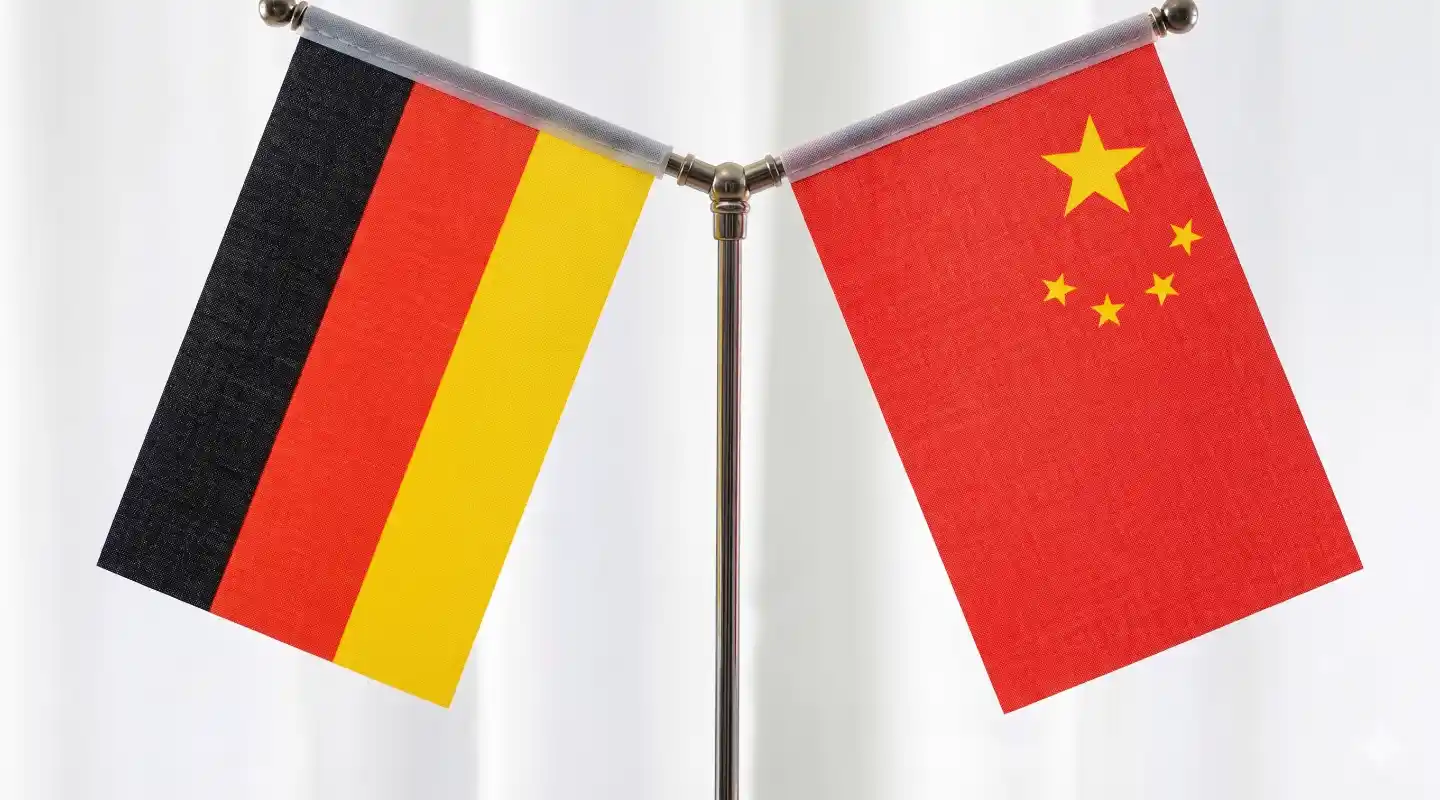

International business relationships are becoming more complicated as governments introduce tariffs strengthen manufacturing policies and reconsider their dependence on overseas suppliers. Companies that previously prioritised access to production and large consumer markets must now consider political stability, regulatory restrictions and supply‑chain security.
The relationship between China and Germany illustrates this changing business environment.
For decades German manufacturers have depended on China as a market for industrial machinery, automobiles, chemicals and advanced technology. German companies have also benefited from manufacturing capabilities, supplier networks and access to a large consumer market.
China meanwhile has gained access to engineering expertise, industrial equipment, premium automotive technology and investment.
However the economic relationship is increasingly influenced by competition. Chinese manufacturers have strengthened their positions in vehicles, machinery and other advanced industries while German businesses face greater pressure from local Chinese companies and changing international trade conditions.
According to Germanys Federal Statistical Office bilateral goods trade reached €251.8 billion in 2025 making China Germanys trading partner again after the United States held that position in 2024.
The figures reveal a growing imbalance. German imports from China increased while exports to the market declined.
Despite these challenges both governments continue to pursue dialogue and commercial cooperation. The question is no longer whether the two countries have reasons to do business together. It is whether they can establish a balanced relationship while protecting their industrial interests in an increasingly protectionist global economy.
Trade Relations Remain Strong. The Economic Balance Is Changing
The scale of China‑Germany trade demonstrates why a complete separation would be commercially difficult.
Germanys trade turnover with China reached €251.8 billion in 2025 compared with €240.5 billion with the United States. This made China Germanys trading partner for the first time since 2023.
However the composition of trade raises concerns for manufacturers.
Germany exported goods worth €81.3 billion to China in 2025 representing a 9.7% decline from the previous year. Imports from China reached €170.6 billion increasing by 8.8%.
Consequently Germanys trade deficit with China expanded to €89.3 billion.
This development highlights a challenge for German businesses. While Chinese products continue to enter the market in significant quantities German exporters are finding it more difficult to maintain their previous sales positions in China.
The automotive and machinery industries are particularly exposed. Chinese companies have improved their manufacturing capabilities expanded their offerings and become increasingly competitive in sectors where German companies previously enjoyed strong advantages.
For China the trade relationship provides access to European industrial markets and advanced manufacturing partnerships. For Germany China remains a source of components, industrial products and business opportunities.
The relationship therefore continues to offer commercial value but Germany wants greater reciprocity in market access and stronger opportunities for its exporters.
Political Dialogue Is Creating a New Opening for Business Cooperation
Recent diplomatic developments suggest that both governments recognise the importance of maintaining relations despite their differences.
German Chancellor Friedrich Merz visited China on February 25 and 26 2026 accompanied by a business delegation representing 30 major German companies. The delegation included representatives from the chemicals, pharmaceutical and machinery industries.
The visit focused on strengthening cooperation while addressing concerns about trade imbalances, market access and industrial competition.
Than 10 business agreements were signed by companies from the two countries during the visit covering areas including automobiles, machinery, energy, logistics and finance according to Chinas Ministry of Commerce.
The discussions were important because they demonstrated that commercial cooperation was continuing even as both governments recognised the difficulties affecting their relationship.
Another significant development occurred on June 28 when German Economy Minister Katherina Reiche met Chinese Commerce Minister Wang Wentao in Brussels. The two sides agreed to restart the China‑Germany Joint Economic Committee.
The arrangement includes working groups focusing on trade and investment and industrial cooperation. Their purpose is to improve communication between governments and businesses address disagreements and identify new areas of cooperation.
The next ministerial‑level meeting is expected in 2027.
These mechanisms cannot automatically eliminate tariffs or regulatory disputes. However they provide a channel through which companies can raise concerns, about market access, investment conditions and supply‑chain restrictions.
Sources: Federal Government: Chancellor Merzs China visit and Chinas Ministry of Commerce: Restarting the Joint Economic Committee.
The Automotive Industry Faces the Biggest Competitive Challenge
The automotive sector remains one of the important areas of China‑Germany economic cooperation but it is also among the most competitive.
German manufacturers have built international businesses through engineering, vehicle quality and premium brand positioning. China has historically been a sales market for companies such as Volkswagen, BMW and Mercedes‑Benz.
However the growth of electric‑vehicle manufacturers has changed the competitive environment.
Chinese companies have expanded their capabilities in battery technology, vehicle software, electric powertrains and cost‑efficient production. Domestic manufacturers have also gained a position in their home market making it more difficult for German brands to maintain previous market shares.
According to Germany Trade & Invest figures reported by Reuters on October 28 German automotive exports to the Asia‑Pacific region declined substantially during the seven months of 2026. Automotive exports to China were down 30% while machinery exports to China fell 18%.
These developments create pressure for German manufacturers to reconsider their business strategies.
Than relying exclusively on exporting vehicles from Germany companies may increasingly develop products, partnerships and manufacturing capabilities within China. Local production can reduce some logistical. Market‑access barriers while allowing manufacturers to respond more quickly to Chinese consumer preferences.
However localisation also introduces challenges involving property, technology sharing, competition and investment security.
The future relationship may therefore depend on whether German and Chinese automotive businesses can cooperate in areas such as batteries, software, mobility technology and manufacturing without increasing dependencies.
Artificial Intelligence, Pharmaceuticals and Green Technology Offer New Opportunities
Although automotive manufacturing dominates much of the discussion the relationship has opportunities in other industries.
Artificial intelligence is becoming an area for industrial cooperation. German manufacturers are interested in AI applications for factory automation, engineering, industrial robotics and supply‑chain management. Chinese companies are developing capabilities in AI applications, digital manufacturing and connected industrial systems.
Partnerships could help companies combine engineering experience with Chinas growing technology ecosystem. However collaboration will depend on data security, intellectual property protection and the ability to operate within regulatory environments.
Pharmaceuticals and biotechnology also offer opportunities. Germany has an established pharmaceutical and research sector while China has been expanding investment in biotechnology, healthcare innovation and pharmaceutical manufacturing.
Cooperation could involve research partnerships, production capabilities, medical technology and development of treatments. Companies will still need to manage product approvals, data regulations and intellectual property rights.
The energy transition offers another area for development. Battery technology, energy, industrial efficiency and recycling could support cooperation between German engineering companies and Chinese manufacturers.
Both economies have incentives to reduce emissions and improve resource efficiency. Joint projects in these areas could create business opportunities while supporting climate and energy objectives.
However the commercial potential will depend on how market access both sides provide and whether companies can protect their technology and investments.
Growing Trade Protectionism Is Changing Investment Decisions
The expansion of trade protectionism is one of the obstacles to stronger economic relations.
Governments increasingly use tariffs, subsidies, export controls and industrial policies to protect industries or reduce dependence on overseas suppliers.
For China and Germany these policies create uncertainty because their industrial sectors are deeply connected.
The European Union has raised concerns about industrial subsidies, manufacturing overcapacity, market‑access restrictions and export controls on critical raw materials.
China meanwhile has argued that trade restrictions and discriminatory industrial policies undermine competition and create unnecessary barriers for businesses.
The electric‑vehicle industry has become an example.
The EU introduced countervailing duties on battery electric vehicles imported from China in October 2024 following an investigation into Chinese subsidies. These measures created pressure on European and Chinese automotive businesses.
In October 2026 the EU and China reached understandings covering trade issues, including Chinese hybrid‑vehicle exports, improved access for some European industrial and agricultural products and more predictable export licensing, for rare earths and permanent magnets.
The discussions represent progress in managing trade tensions. They do not mean that all restrictions have disappeared. Existing EU duties on battery electric vehicles remain an important part of the trade environment.
For manufacturers the uncertainty surrounding tariffs and export regulations can influence production locations, supplier relationships and investment decisions.
Businesses must increasingly prepare for changes in trade rules than assuming that international supply chains will remain unaffected by political developments.
Sources: European Commission: EU-China trade consultations, October 2026 and European Commission: EU trade relations with China.
German Companies Still See Investment Opportunities in China
Despite disagreements and trade uncertainty many German businesses continue to view China as an important market for future investment.
A survey published by the German Chamber of Commerce in China in May 2026 provides insight into this position.
The survey covered 216 companies operating in China. 61% Said they planned to increase investment in the country over the following two years compared with 53% in the previous years survey.
37% expected Chinas economy to improve over the next six months while 42% anticipated an increase in company turnover by the end of 2026.
These findings suggest that German businesses are not abandoning the market even as they face substantial geopolitical and commercial risks.
At the time the survey showed that trade tensions remain a serious concern. 69% Of respondents reported an impact from US-China tensions while 59% said EU-China tensions affected their business.
The findings also highlight a distinction between maintaining a presence in China and increasing dependence on it.
Companies may continue investing in production facilities to serve local customers while diversifying suppliers and production networks elsewhere.
This approach allows businesses to retain access to a market without relying entirely on one country for manufacturing, components or revenue.
For Germany this form of investment strategy is increasingly consistent with its stated policy of reducing dependencies rather than ending economic relations altogether.
Supply-Chain Security Is Becoming as Important as Cost Efficiency
For years international manufacturers designed their supply chains around cost, production efficiency and access to specialised suppliers.
Geopolitical tensions have made resilience another consideration.
German industries depend on suppliers for a range of industrial components and materials. China in turn benefits from machinery, manufacturing technology and access to European customers.
However disruptions in raw materials semiconductor supply chains and industrial components can expose businesses to significant risks.
Chinas export controls on critical materials have increased concerns among European manufacturers particularly where alternative suppliers are difficult to identify or develop.
Germany is therefore exploring supply relationships with countries in Asia while maintaining its commercial engagement with China.
This does not necessarily mean companies intend to eliminate suppliers. Instead many are looking to reduce concentration by developing alternative sources and improving supply-chain visibility.
The approach creates opportunities for partnerships in recycling, battery materials, advanced manufacturing and industrial technology.
Companies that can combine sourcing with access to Chinas manufacturing ecosystem may be better positioned to manage disruptions.
However maintaining suppliers can increase costs require additional investment and make procurement more complex.
Businesses must therefore balance efficiency with the ability to operate during periods of instability.
Germanys De-Risking Strategy Does Not Mean Ending Business With China
Germanys approach to China has increasingly focused on reducing vulnerabilities while continuing important commercial relationships.
The German government describes China as a partner, competitor and systemic rival. This reflects the roles the country plays in Germanys economy and international policy.
The objective is not necessarily to stop trading with China. Instead Germany wants to avoid situations where critical industries depend excessively on a supplier, market or technology source.
This approach is also consistent with the European Unions policy of de-risking rather than decoupling.
For businesses de-risking can involve diversifying suppliers, protecting technologies improving access to alternative raw materials and reviewing investment exposure.
However the policy must be implemented carefully. A rapid withdrawal from markets could create financial costs for German businesses and reduce their access to important customers.
Chinas manufacturing capabilities and position, in global supply chains mean that replacing every existing commercial relationship would be difficult and expensive.
The challenge for policymakers is to keep an open trading relationship while protecting key industries and ensuring fair competition.
The balance between those goals will shape how future business deals are made.
Recent Diplomatic Developments Show That Both Sides Want Cooperation
The latest talks show that neither country wants a full breakdown in trade.
On October 28 Chinese officials responded to German Chancellor Merz’s comments about reducing one‑sided ties by calling for rational dialogue and cooperation on trade and supply‑chain stability.
On October 29 German President Frank‑Walter Steinmeier raised concerns about trade imbalances, market access and the risk of one‑sided benefits during his visit to China.
The day Chinese Premier Li Qiang told Steinmeier that China was willing to import more high‑quality German products.
These statements show a continued interest in economic cooperation but they do not represent binding purchasing commitments or a resolution of trade disputes.
The talks happen amid a debate about protectionism, industrial security and the future of global trade.
Merz has also mentioned the possibility of cooperation with Asian partners to support rules‑based international trade and improve market access amid growing restrictions.
For China and Germany keeping dialogue open may be important not for their bilateral ties but also for broader commercial stability between China and the European Union.
What Global Companies Should Watch Next
The future of China‑Germany business cooperation will depend on whether diplomatic talks turn into improvements for companies.
The restart of the Joint Economic Committee offers a chance to tackle market‑access concerns, investment restrictions and industrial cooperation. Its expected ministerial meeting in 2027 will test whether both governments can deliver measurable commercial progress.
Businesses will also observe EU‑China trade talks, about electric vehicles, critical raw materials and export licensing.
For manufacturers the main priorities will be:
- keeping access to Chinese customers,
- protecting intellectual property
- improving cost competitiveness and
- diversifying suppliers that are strategically important.
Chinese firms looking to grow in Germany will need to navigate investment screening, regulatory rules, local competition and access to procurement.
The sustainable partnerships will likely involve long‑term investment, locally developed products, shared research and clear commercial responsibilities rather than relying only on cross‑border exports.
###
China and Germany have reasons to grow their business ties despite rising global trade protectionism. Their economies stay closely linked through manufacturing, machinery, automobiles, chemicals, industrial technology and emerging sectors.
Yet the relationship is getting more complex. Germany faces a widening trade deficit with China competition in traditional industries and worries about supply‑chain dependencies. China seeks access to European markets while facing growing scrutiny, over subsidies, export controls and market conditions.
Recent meetings and the restart of the Joint Economic Committee show that both sides still see value in cooperation.
The future may not bring back the globalisation of earlier decades. Instead China and Germany could move toward a selective business relationship built on strategic investment, industrial partnerships, technology cooperation and balanced market access.
For companies the opportunity remains large but success will increasingly depend on understanding trade policy managing geopolitical risk and building supply chains that can adapt to changing international conditions.
Nexuswild welcomes factual corrections. Email contact@nexuswild.com with evidence and the article URL.