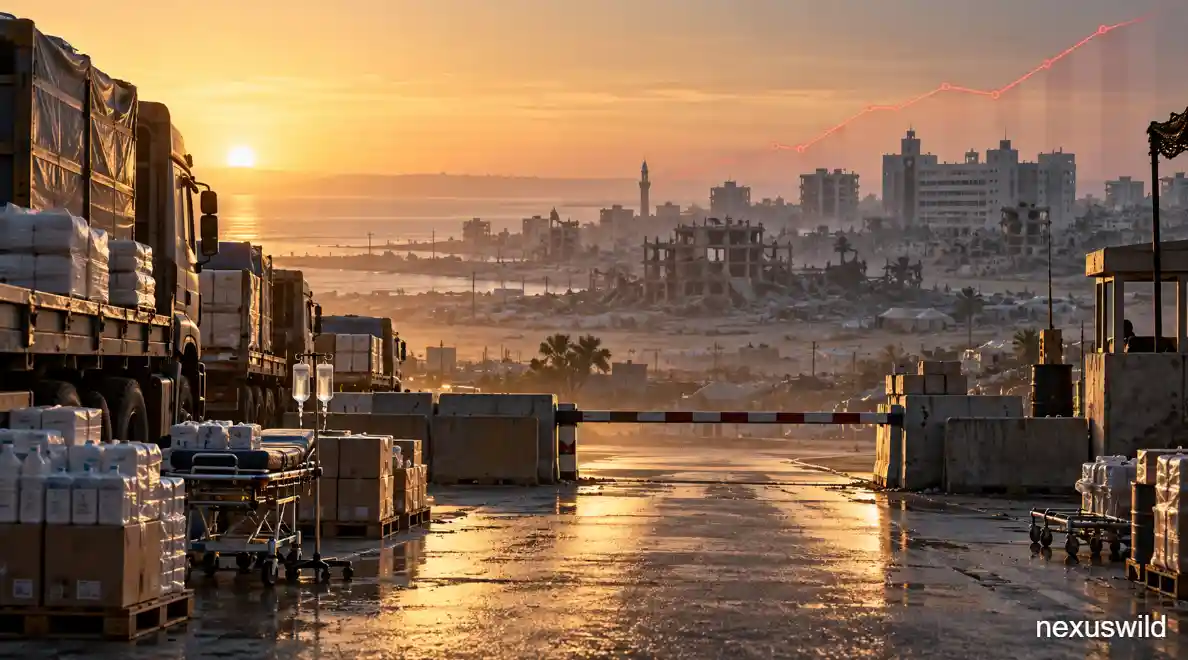

The World Health Organization is warning that delays in getting medicines, medical equipment and other humanitarian supplies into Gaza could deepen an already severe health crisis as hospitals operate with limited capacity and winter approaches.
On October 2, 2026, WHO said repeated clearance delays were affecting lifesaving supplies including medicines, prosthetics and assistive equipment. The agency’s representative in the occupied Palestinian territory, Reinhilde Van De Weerdt, said reliable access matters not only in terms of the volume of aid entering Gaza but also whether the right items reach hospitals and patients in time.
WHO said large medical shipments face a median clearance wait of 74 days. It also reported that one shipment containing prosthetics and assistive devices had been rejected four times over the previous six months. Medicines generally moved more successfully, with WHO saying almost 87% were approved and just over 1% rejected, but equipment classified as having potential “dual-use” applications remained a major source of delay.
The warning comes nearly a year after the October 2025 ceasefire reduced the intensity of fighting but did not restore Gaza’s health system or humanitarian infrastructure to normal operation.
Gaza Has No Fully Functioning Hospital
WHO Director-General Tedros Adhanom Ghebreyesus said on September 24 that only 19 of Gaza’s 36 hospitals were functioning even partially, with none fully operational. Essential medicines, diagnostic equipment, fuel and specialist services remained in critically short supply.
The effects reach across routine and emergency care.
WHO said shortages are affecting cancer treatment, dialysis, maternal and newborn services, rehabilitation and care for chronic conditions. Gaza also has thousands of people living with severe injuries and amputations who require long-term treatment that the current system cannot adequately provide.
OCHA reported in late September that shortages of chemotherapy and radiotherapy supplies, dialysis cartridges, insulin and generator engine oil were disrupting or threatening essential services. Mammography and CT services at Al-Ahli Hospital had been suspended, further limiting diagnostic capacity in Gaza City.
Aid Is Entering, but Access Remains Unreliable
The humanitarian picture is not one in which no assistance enters Gaza.
UN agencies and other humanitarian organisations continue to bring in food, medical supplies and essential goods. The problem identified by WHO and OCHA is that access remains inconsistent, restricted and difficult to plan around.
OCHA said the proportion of authorised UN and partner truckloads successfully offloaded at Kerem Shalom fell to 52% during September 14-20, from 70% the previous week and 86% at the end of August. Kerem Shalom has remained the only operational cargo crossing since the Zikim crossing closed on May 24.
WHO has called for a multiple-crossing system and predictable access so health facilities can plan treatment rather than operate around uncertain deliveries.
Israel’s Coordinator of Government Activities in the Territories, or COGAT, says Israel facilitates medical assistance, works with international organisations and imposes no general limit on medical aid. It says medical supplies and patient evacuations continue to be coordinated through Israeli-controlled crossings and security procedures.
WHO and OCHA, however, continue to report delays linked to clearance requirements and restrictions on items designated as potentially dual-use.
Food Assistance Has Also Been Affected
Supply interruptions can quickly affect food programmes.
OCHA reported that reduced offloading through the Egyptian aid corridor forced humanitarian partners to suspend production of about 50,000 meals on September 16 and cut a further 25,000 meals the following day. Production was expected to recover after additional supplies entered, but the agency warned that inconsistent flows continued to create a risk of further reductions.
As of September 20, humanitarian partners had provided food assistance to more than 730,000 people during the monthly distribution cycle.
Because stocks were limited, each family received one food parcel and one 25-kilogram bag of flour, estimated by humanitarian agencies to cover only about half of minimum caloric needs.
These figures describe humanitarian distributions, not the total food available across Gaza, which also includes commercial supplies.
Water and Sanitation Remain Major Health Risks
Access to safe water is another concern.
OCHA said in September that 91% of assessed households faced moderate to high water insecurity. Infrastructure failures, fuel shortages and restrictions on spare parts have left many communities dependent on water trucking and partially functioning desalination and pumping systems.
Water-quality monitoring has also identified significant problems.
Of 938 samples tested across Gaza in August, more than 73% failed to meet WHO-recommended levels for residual chlorine, while 18% showed microbiological contamination, according to OCHA.
The agency said shortages of generators, parts, engine oil and treatment supplies were threatening water and sewage systems.
WHO has warned that those conditions, combined with overcrowding and inadequate shelter, increase the risk of preventable disease outbreaks. Acute watery diarrhoea cases have risen sharply during 2026, while damaged laboratories limit the ability of health authorities to identify outbreaks quickly.
Displacement Continues to Put Pressure on Health Services
Around 1.7 million people remained displaced as of late September, according to WHO, with many living in overcrowded temporary shelters where access to clean water and sanitation is limited.
Winter is increasing concern about those conditions.
OCHA identified 451 displacement sites at high risk of flooding, hosting an estimated 464,402 people. Separately, 94% of Gaza’s population was assessed as needing urgent shelter and basic household assistance, with 65% of households living in tents or makeshift structures.
WHO says the combination of cold weather, flooding, sanitation problems and shortages of medical supplies could place further pressure on already overstretched clinics and hospitals.
Thousands Still Need Treatment Outside Gaza
Medical evacuation remains another major gap.
WHO said on September 24 that approximately 12,400 patients had been medically evacuated from Gaza since October 2023, but tens of thousands more still required specialised care that was unavailable locally.
OCHA reported that 270 patients were evacuated during the first half of September alone, accompanied by 299 caregivers.
WHO has called for medical evacuations to continue and expand, as well as for referral routes to hospitals in East Jerusalem and the West Bank to be restored.
Humanitarian Conditions Remain Severe Despite the Ceasefire
The October 2025 ceasefire reduced the intensity of hostilities and enabled some health services and humanitarian operations to resume.
It did not end violence entirely.
OCHA, citing Gaza’s Ministry of Health, reported 1,402 deaths and 4,881 injuries since the ceasefire announcement through September 23, while noting that those figures come from the ministry operating under Gaza’s de facto authorities. Another 85 fatalities were later added retrospectively after identification details were approved.
WHO has separately documented extensive damage to Gaza’s health system since October 2023, including hundreds of attacks affecting healthcare facilities, staff and transport.
These figures should be distinguished from independent casualty verification, which remains difficult during an active conflict.
Conclusion
WHO’s latest warning focuses on a practical problem with immediate health consequences: humanitarian assistance is only effective when essential supplies arrive in the right quantities and at the right time.
Gaza still has no fully functioning hospital, according to WHO. Medical facilities are operating with shortages of medicines, diagnostics, fuel and specialist equipment, while large numbers of displaced people face problems obtaining adequate shelter, clean water and sanitation.
Aid continues to enter Gaza, and Israel says it is facilitating medical assistance through established security and coordination procedures. At the same time, WHO and other UN agencies report that clearance delays, restricted items and reliance on a limited number of crossings are preventing supplies from reaching humanitarian services consistently enough to meet current needs.
The immediate health concern is therefore not only how much assistance is available outside Gaza, but whether hospitals, clinics, water systems and aid organisations can obtain essential supplies predictably enough to keep services running.
Nexuswild welcomes factual corrections. Email contact@nexuswild.com with evidence and the article URL.