
Canada and the European Union are seeking to deepen their economic and strategic ties at a summit in Montreal on October 29–30, as negotiators refine the language of a proposed long-term partnership. A draft joint declaration has dropped the phrase “associate membership” and instead refers to “ever closer association,” following concerns among EU member states about the legal meaning of the earlier proposal.
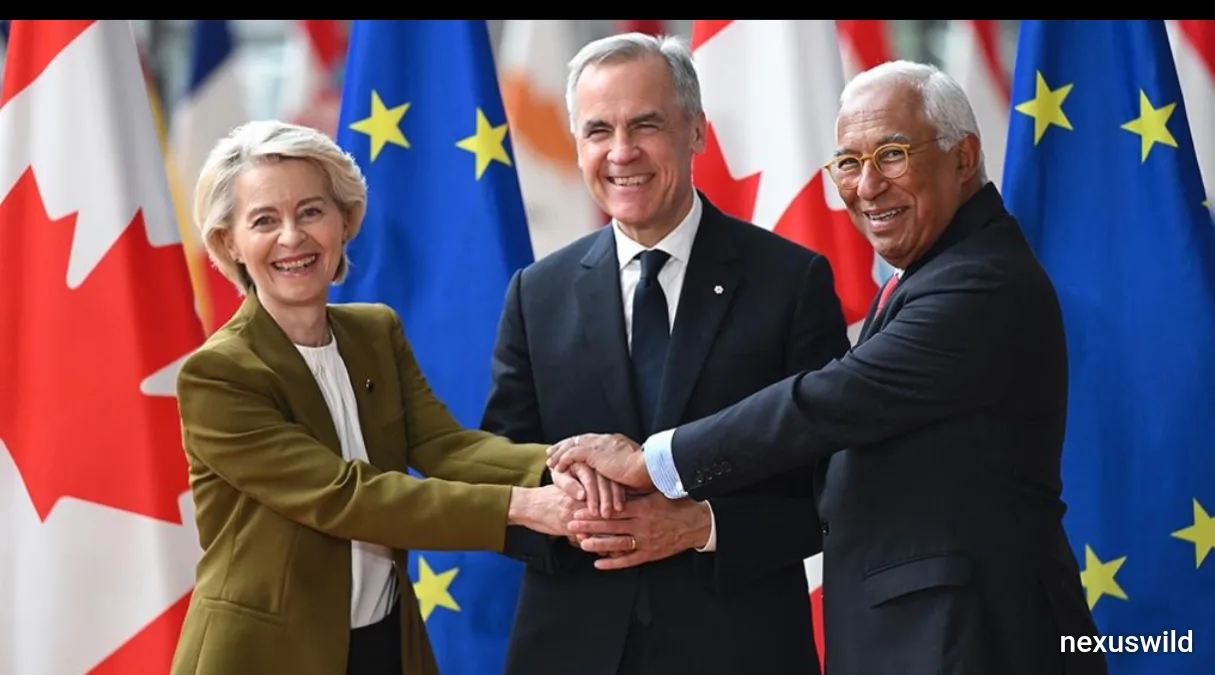
Canadian Prime Minister Mark Carney is hosting European Commission President Ursula von der Leyen and European Council President António Costa at the 21st Canada–EU Summit. The leaders are expected to discuss trade, critical raw materials, defence and security, digital cooperation, energy and research.
The summit builds on the existing Canada–EU relationship, including the Comprehensive Economic and Trade Agreement (CETA) and the security and defence partnership signed in 2025. "Canadian government summit announcement" (https://www.pm.gc.ca/en/news/news-releases/2026/10/25/prime-minister-carney-host-canada-european-union-summit-montreal)
Draft wording shifts from associate membership
The proposal for Canada to become an EU “associate member” was raised by von der Leyen in September as a possible way to build a closer relationship. The concept prompted debate among EU governments because associate membership is not a defined status under the EU treaties.
According to Reuters, the latest draft declaration replaces the term with “ever closer association.” The declaration is expected to commit both sides to continuing negotiations on the future relationship through the next summit in 2027.
The wording change does not amount to Canada seeking full EU membership. Carney has said that the goal is a more integrated partnership that brings practical benefits while respecting Canada’s sovereignty and existing political arrangements.
The draft framework is expected to be described as an “Alliance for the Future,” focused on shared prosperity and economic security. The final language and any new initiatives will depend on the leaders’ concluding statement.
Trade and economic security at the centre of talks
The EU and Canada already have substantial economic ties. The European Council says bilateral trade in goods and services reached around €130 billion in 2025, an increase of more than 80% compared with 2016.
CETA provides the foundation for much of this trade by reducing barriers and improving market access. The summit is expected to focus on ways to make the agreement work more effectively, strengthen economic security and improve connections between businesses and supply chains.
Canada is also pursuing trade diversification as it faces uncertainty in its relationship with the United States, its largest trading partner. European markets offer a potential alternative destination for some Canadian exports, while Canadian energy, minerals and technology could help meet European demand.
The scale of any diversification should not be overstated. The EU cannot replace the US market overnight, and trade growth will depend on commercial conditions, infrastructure, regulatory alignment and investment.
Critical minerals and clean-energy cooperation
Critical raw materials are a major area of shared interest. Canada has mineral resources and expertise that could support European supply chains for batteries, clean technology and industrial manufacturing. The EU, meanwhile, has capital, manufacturing capacity and demand for materials used in its energy transition.
The summit agenda includes critical raw materials and energy cooperation. The broader policy goal is to reduce vulnerabilities in supply chains and expand reliable sourcing. But the summit agenda itself does not confirm that specific mineral offtake contracts, mining investments or new export corridors have been signed.
Energy cooperation could also include discussions of Canadian liquefied natural gas, hydrogen and clean-energy infrastructure. Any proposed LNG or hydrogen export route would require commercial agreements, infrastructure investment, regulatory approvals and assessment of market demand. It should not be presented as an operational corridor unless those steps have been completed.
Defence procurement ties have already advanced
The partnership also has a concrete defence-industrial dimension. Canada signed an agreement in February 2026 to participate in the EU’s Security Action for Europe (SAFE) instrument, and the EU formally concluded the agreement in June.
SAFE is a €150 billion EU loan facility designed to support defence investment and joint procurement. Canada’s participation allows eligible Canadian companies and products to participate in procurement under the agreed conditions. Canada is the first non-European country to participate in the instrument.
The summit may provide an opportunity to build on that arrangement, but the existing SAFE agreement should be distinguished from any new summit commitments. Participation does not automatically guarantee Canadian companies contracts or unrestricted access to every EU defence procurement programme.
Digital policy and AI cooperation
Digital cooperation is another focus of the summit, including artificial intelligence and technology governance. Canada and the EU have both developed regulatory frameworks for digital markets and AI, though their legal approaches and implementation differ.
Closer coordination could make it easier for businesses to navigate rules across markets and could support research and innovation partnerships. The leaders are expected to discuss digital cooperation, but specific commitments on AI governance should be attributed to the final summit declaration or separately announced agreements.
What to watch after the summit
The main outcome to watch is the joint statement and any accompanying agreements or roadmaps. These documents will determine whether the proposed “Alliance for the Future” leads to defined workstreams, deadlines and mechanisms for cooperation—or remains a broad political framework.
For businesses, the practical questions include whether trade barriers will be addressed, how critical-mineral supply arrangements will be supported, what additional opportunities emerge under SAFE and whether energy or technology projects receive concrete backing.
The Montreal summit reflects a wider effort by Canada and the EU to strengthen ties amid geopolitical and trade uncertainty. Its significance will depend less on the terminology used to describe the relationship than on whether the leaders turn the proposed closer association into measurable progress for companies, workers and supply chains.
Nexuswild welcomes factual corrections. Email contact@nexuswild.com with evidence and the article URL.