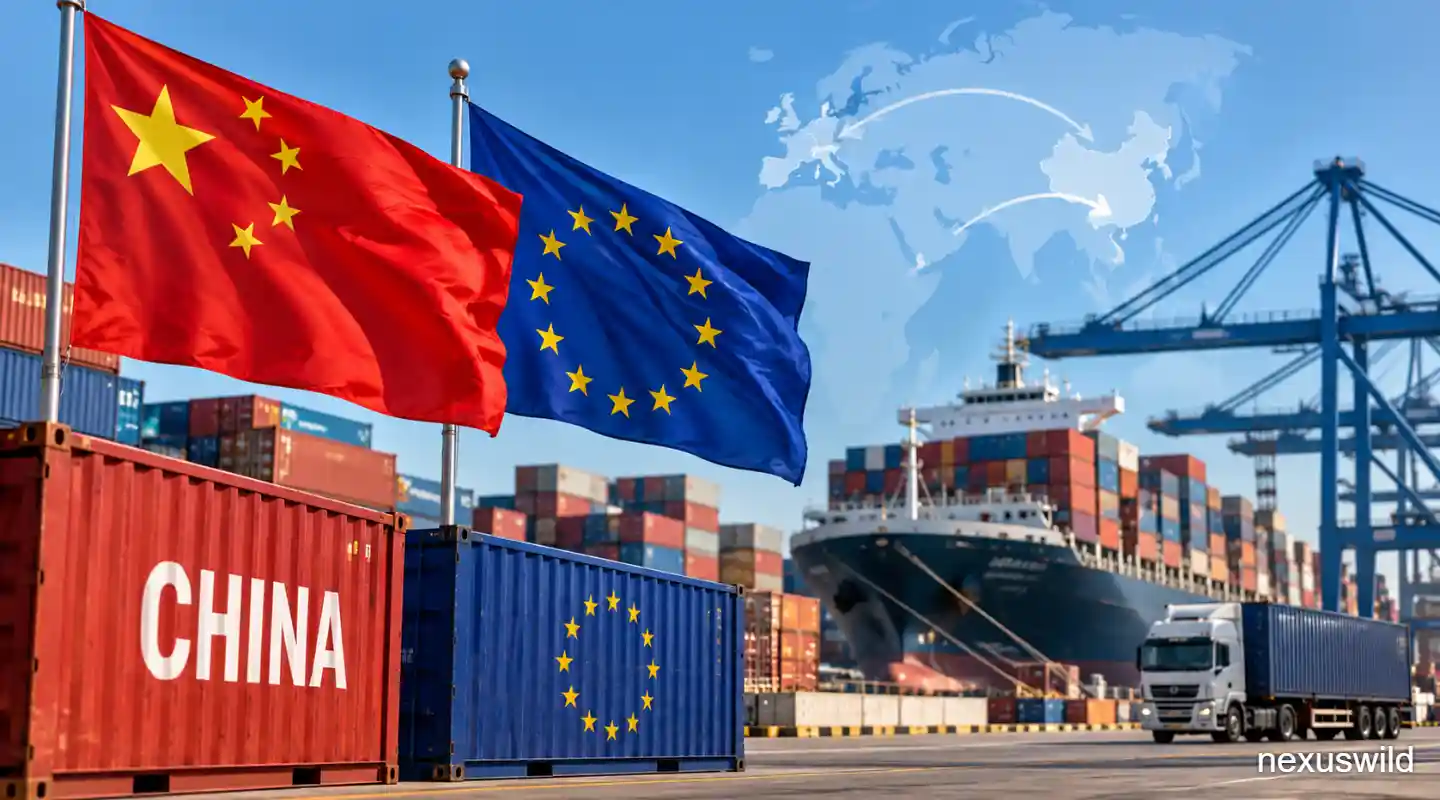

China’s drive to reduce dependence on foreign technology and industrial inputs is reshaping its economic relationship with Europe, weakening demand for some European exports while increasing competitive pressure from Chinese manufacturers inside the European Union.
The shift is visible in official trade data.
In 2025, the EU exported €199.6 billion of goods to China, down 6.5% from the previous year, while imports from China increased 6.4% to €559.4 billion. That left the EU with a goods trade deficit of approximately €359.8 billion.
The imbalance has continued to widen in 2026. Reuters reported that the EU-China deficit increased another 9% in the first half of the year, while European officials have become increasingly concerned that Chinese industrial policy is simultaneously reducing import demand at home and increasing manufactured exports abroad.
China Wants to Produce More of What It Previously Imported
Beijing has spent years promoting greater technological and industrial self-sufficiency.
The strategy spans semiconductors, industrial machinery, electric vehicles, batteries, chemicals, renewable-energy equipment and other strategically important sectors.
The goal is not necessarily to eliminate foreign trade altogether. Instead, Chinese policy increasingly prioritizes domestic production of critical goods and technologies that were previously dependent on foreign suppliers.
For European companies, that creates a structural challenge.
Many of Europe’s strongest exports to China have historically been precisely the high-value manufactured products China is now trying to produce domestically.
Machinery Has Been One of Europe’s Biggest Exports to China
Machinery remains at the heart of the trading relationship.
Eurostat data show that machinery, mechanical appliances and components were the EU’s largest individual export category to China in 2025, worth €45.3 billion, or 22.7% of total EU goods exports to the country. Electrical machinery added another €29 billion, while vehicles contributed €16.4 billion.
These sectors include some of Europe’s most competitive industrial companies, particularly from Germany, France, Italy and the Netherlands.
But Chinese manufacturers have increasingly developed domestic alternatives across many of these categories.
That process can reduce the amount of European equipment China needs to import while creating Chinese competitors capable of selling similar products overseas.
The Trade Relationship Is Becoming More Asymmetric
The divergence between imports and exports is becoming difficult for European policymakers to ignore.
China remained the EU’s largest source of imported goods in the second quarter of 2026, supplying €153.6 billion, equivalent to 21.9% of all extra-EU imports. Imports from China were 7.9% higher than a year earlier.
At the same time, the EU’s bilateral trade deficit with China reached €103 billion in the second quarter alone, its largest quarterly deficit since 2022.
European officials increasingly describe the trend as unsustainable if it continues indefinitely.
EU Trade Deficit Exceeds €1 Billion a Day
European Trade Commissioner Maroš Šefčovič traveled to Beijing in October for talks focused heavily on the growing imbalance.
Reuters reported that the EU’s trade deficit with China now exceeds €1 billion per day.
European Commission President Ursula von der Leyen has warned that the relationship is approaching what she called a “tipping point” unless market-access problems and industrial imbalances are addressed.
Those statements represent the European Commission’s assessment.
China rejects the argument that its trade performance is inherently unfair and says European complaints increasingly reflect protectionist pressure.
Chinese Exports Are Rising Across Several European Industries
The issue is no longer concentrated in solar panels or electric vehicles.
European officials say Chinese imports are increasing rapidly in:
- machinery;
- textiles;
- chemicals;
- basic metals;
- batteries;
- plastics; and
- automotive products.
The European Commission’s chief trade enforcement officer, Denis Redonnet, said Chinese imports into the EU reached about €571 billion in 2025, while industry requests for trade-defense action have increased sharply.
The Commission opened 32 new trade-defense cases in 2025 and another 27 during 2026 by the beginning of October.
More than one-third of recent investigations involved chemicals.
Cars Have Become a Symbol of the Shift
The automotive sector illustrates the broader transformation.
European carmakers once viewed China primarily as an export market and a major source of future growth.
Now Chinese manufacturers are becoming increasingly significant competitors inside Europe itself.
Reuters reported that EU imports of Chinese battery-electric vehicles increased about 40% over the past year, while imports of plug-in hybrids rose approximately 86%.
Europe has already imposed additional tariffs on certain China-made electric vehicles following an anti-subsidy investigation.
The EU is also examining whether other vehicle categories require additional trade measures.
China’s Domestic Substitution Reduces European Opportunities
The pressure operates in both directions.
China is exporting more manufactured goods while also becoming less dependent on some foreign inputs.
That means European companies can face lower demand inside China at the same time as they encounter stronger Chinese competition at home and in third-country markets.
The effect is particularly visible in industries where China has built large-scale domestic capacity.
Electric vehicles and batteries are examples, but similar dynamics are developing in industrial machinery, chemicals, renewable-energy equipment and parts of the technology supply chain.
Germany Is Particularly Exposed
Germany has historically benefited more than most European countries from Chinese demand for machinery, vehicles and industrial technology.
That model is now under pressure.
Germany’s BGA trade association said on October 7 that exports to China remain weak even as overall German exports have improved in 2026.
The group called for greater access to the Chinese market but cautioned that European efforts to reduce risk should not become complete economic separation.
That distinction reflects a broader European debate.
Few major European governments advocate full economic decoupling from China. The more common policy is “de-risking,” meaning reducing excessive dependencies while preserving trade where possible.
Europe Is Responding With More Trade Defenses
The EU is becoming more willing to use tariffs, procurement restrictions and other trade tools.
France and Germany recently proposed a new rapid-response mechanism that would allow Brussels to react more quickly to market distortions such as dumping, subsidies and concentrated import dependence.
The proposal would also create tools to reduce reliance on single foreign suppliers for strategically important products.
China is not formally named as the sole target, but Reuters reported that Chinese industrial practices are a central concern behind the proposal.
Medical Devices Show How Market Access Has Become Politicized
European frustration is not limited to imports.
The European Commission has also challenged restrictions faced by European companies inside China.
In medical devices, Brussels opened an investigation into Chinese public-procurement practices after concluding that European manufacturers faced serious and recurring barriers in government purchasing.
The dispute highlights a central European complaint: Chinese firms often retain broad access to the EU market while European businesses face tighter conditions in some Chinese sectors.
China disputes the characterization and says many European measures unfairly discriminate against Chinese firms.
Europe Is Also Pursuing Its Own Strategic Autonomy
China is not the only side seeking greater self-reliance.
European governments are increasingly investing in domestic capacity for semiconductors, AI infrastructure, batteries, critical raw materials and defense technologies.
For example, Europe is investing billions of euros in sovereign high-performance computing and AI infrastructure as part of an effort to reduce dependence on both U.S. and Chinese technology suppliers.
That creates a more complicated global trading environment in which both China and Europe are seeking stronger control over critical parts of their supply chains.
Self-Reliance Does Not Mean China Is Closing Its Economy
It would be misleading to interpret China’s strategy as complete withdrawal from global trade.
China remains deeply integrated into international supply chains and depends on foreign markets for a significant share of its manufactured exports.
European companies also continue to sell large volumes of machinery, vehicles, chemicals and luxury products into China.
The change is that Beijing increasingly wants domestic suppliers to control strategically important technologies and manufacturing processes.
That can gradually reduce opportunities for foreign producers even without an explicit import ban.
European Companies Face a Different Kind of China Market
For many European companies, China was once primarily a market for selling products made in Europe.
Increasingly, it is becoming a market where they must compete with highly capable Chinese companies that benefit from large domestic scale.
Some European businesses have responded by producing more inside China through local partnerships and factories.
That approach can preserve market access but may also reduce exports from European plants.
As a result, European corporate activity in China can remain significant even while Europe’s direct exports weaken.
Critical Raw Materials Add Another Source of Dependence
Europe is also concerned about its reliance on China for strategic materials.
China is a major processor and supplier of rare earths and other inputs used in electric vehicles, electronics, wind turbines and defense equipment.
European officials have criticized Chinese export controls on rare earth products and certain mature-generation semiconductor technologies.
Those restrictions have strengthened calls inside Europe to diversify suppliers and build more domestic processing capability.
The result is a two-way self-reliance race: China wants less dependence on Western technology, while Europe wants less dependence on Chinese industrial inputs.
Brussels Wants China to Address the Imbalance
During October talks in Beijing, the EU pressed China to provide concrete measures that could reduce the trade deficit.
Reuters reported that Brussels has discussed options including better market access for European companies and Chinese measures to manage exports in sectors where shipments are rising rapidly.
EU leaders are expected to discuss the relationship again at their October 15-16 summit.
No broad agreement resolving the imbalance had been announced at the time of reporting.
Beijing Rejects Claims of Industrial Overcapacity
China has repeatedly rejected European and U.S. accusations that subsidies and excessive industrial capacity are distorting global markets.
Chinese officials argue that the competitiveness of Chinese exports reflects efficient production, technological investment and market demand.
They have also criticized EU tariffs and trade investigations as protectionist.
That disagreement is fundamental.
European policymakers increasingly see parts of China’s industrial model as creating structural distortions, while Beijing views many European countermeasures as attempts to constrain successful Chinese industries.
Complete Decoupling Would Carry Significant Costs
Despite rising tensions, Europe and China remain deeply economically connected.
China is the EU’s largest source of goods imports and one of its largest export markets.
European businesses also maintain hundreds of billions of euros of investment in China. The EU’s direct investment stock there stood at about €239.3 billion in 2024.
A rapid separation would therefore disrupt manufacturers, suppliers and consumers on both sides.
For that reason, European policy continues to emphasize de-risking rather than full decoupling.
Conclusion
China’s push for greater industrial and technological self-reliance is changing the structure of its trade relationship with Europe.
EU exports to China fell 6.5% to €199.6 billion in 2025, while imports from China increased 6.4% to €559.4 billion, producing a deficit of almost €360 billion.
The imbalance has continued in 2026, with the bilateral deficit reaching €103 billion in the second quarter alone.
The underlying shift is broader than those headline numbers.
China is increasingly producing domestically many of the manufactured goods and technologies it once imported, while its own companies are expanding exports into Europe in vehicles, machinery, chemicals and other industries.
Europe is responding with trade-defense investigations, tighter procurement rules and its own policies aimed at strategic autonomy.
Neither side is moving toward complete economic separation. But the relationship is becoming less centered on complementary trade and increasingly shaped by competition, industrial policy and efforts on both sides to reduce strategic dependence.
Nexuswild welcomes factual corrections. Email contact@nexuswild.com with evidence and the article URL.