
AMD has found a way to win some of the largest AI chip orders in the market: give its customers the right to buy a piece of the company. The strategy is working commercially. It is also starting to show up in AMD's results, and it raises a question the company has acknowledged but not yet answered in full: how much will existing shareholders be diluted?
What AMD has agreed to
In October 2025, AMD issued a warrant to OpenAI. In February 2026 it issued a similar one to Meta Platforms. Each allows the holder to buy up to 160 million AMD shares at an exercise price of one cent per share, according to AMD's quarterly filing with U.S. regulators. A warrant is a right to buy stock at a fixed price, and at one cent per share the price is nearly zero.
The Meta arrangement is tied to a deal to supply up to $60 billion of AI chips over five years, Reuters reported. The OpenAI deal followed a similar structure last year. Reuters says each could let the customer own roughly 10 percent of AMD if all conditions are met.
AMD has also agreed a chip purchase arrangement with Anthropic, though in that case AMD committed to invest in Anthropic instead of issuing warrants, according to Reuters.
The conditions are the story
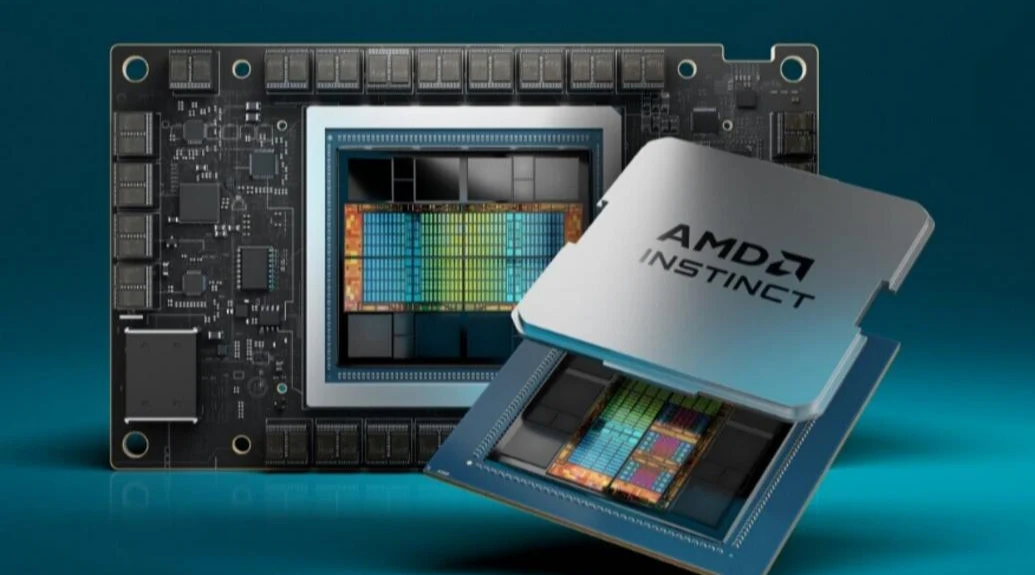
Neither customer gets the shares simply by signing. The warrants vest in tranches, based on milestones for purchases of AMD's Instinct AI processors and on AMD share-price targets. OpenAI's warrant includes stock-performance thresholds; Meta's does not, Reuters said. A third-party summary of the filings says OpenAI's schedule includes a $600 share-price milestone; check the filing for the exact terms. Each vested tranche must also meet further technical and commercial conditions before it can be exercised.
The warrants run for years: OpenAI's is exercisable through October 5, 2030 and Meta's through February 23, 2031. As of March 28, 2026, none of the shares had vested.
Now it shows up in earnings
The first financial effect arrived in the third quarter, which ended September 26, 2026. AMD recorded a $1.07 billion non-cash charge, or 66 cents a share, to account for the warrants as shipments begin to ramp, Reuters reported on November 3. The charge reflects changes in AMD's share price and the estimated likelihood that customers meet the terms, according to Chief Financial Officer Jean Hu, and it did not affect cash flow. Including it, AMD reported GAAP earnings of $1.46 per share.
The warrants are being treated as a liability until certain conditions for equity classification are met, AMD said in its filing. The charge reduces reported revenue as an accounting matter, so it is a way of showing that the shares AMD may hand over are effectively a discount on chip sales.
AMD's shares rose about 8 percent in after-hours trading after the report, because the company forecast faster-than-expected 2027 growth from data-center sales, Reuters said.
How big could the dilution be?
Hu said the warrants will begin diluting shareholders once OpenAI and Meta satisfy the vesting and exercise conditions, and AMD expects to give more guidance in 2027 on when that could happen.
The arithmetic gives a sense of scale. Two warrants of 160 million shares each total up to 320 million shares. The $1.07 billion charge at 66 cents a share implies roughly 1.6 billion AMD shares outstanding, my own calculation from the reported figures. On that basis, 320 million shares would be about 20 percent of today's share count, or around 16 percent of the enlarged total. That is an upper bound if every tranche vests and is exercised, not an estimate of what will happen.
Two things work against reading it as a straight loss for shareholders. First, shares only vest if customers actually buy large volumes of AMD chips, which is revenue AMD wants. Second, for the OpenAI warrant, some tranches also require AMD's share price to rise, so existing holders would own a smaller slice of a more valuable company. The ultimate value of the warrants depends on AMD's share price when they are exercised, Reuters noted.
Why AMD is doing it
The reasoning is competitive. AMD is trying to win business from a market dominated by Nvidia, and large, long-term commitments help justify the investment in new products. Reuters described the warrants as part of a growing use of equity incentives by chip and AI cloud companies to secure large long-term purchases from a small group of AI customers.
That also exposes the criticism. Reuters called it the circular nature of the AI boom, where companies can be customers, suppliers and investors in one another at the same time. If AI spending slows, the same arrangement that helped win orders could leave AMD with discounted sales and fewer shipments.
The accounting, in plain terms
The charge can look like a loss, but it is not cash leaving the company. When AMD sells chips to a customer that also holds warrants, accounting rules treat the value of those warrants as a reduction of the price the customer pays. That is why Reuters described the $1.07 billion as a contra-revenue charge: it lowers reported revenue and earnings without any money going out the door.
It will also move around. The warrants are valued each quarter using AMD's share price and the likelihood that customers meet the conditions. If AMD's stock rises or shipments accelerate, the charge can grow. If conditions look less likely to be met, it can shrink. Investors comparing quarters will need to separate this from AMD's underlying results.
Scenarios, not forecasts
Because the warrants vest in tranches, dilution does not have to be all or nothing. Using the same rough arithmetic, every 80 million shares would equal about 5 percent of today's share count. A partial outcome, where one customer reaches some milestones and not others, would produce a smaller increase than the 20 percent upper bound.
The two warrants also differ in an important way. Meta's has no share-price thresholds, according to Reuters, so its vesting depends on purchase milestones and the other conditions. OpenAI's adds share-price targets, which means that part of its stake only arrives if AMD stock performs well. Neither detail tells us the likely outcome; they only show the range of possibilities.
What shareholders can and cannot know yet
Several things are known: the size of each warrant, the exercise price, the expiry dates, the third-quarter charge, and the fact that no shares had vested as of March 28, 2026. Several are not: how many tranches have since vested, when conditions might be met, and how AMD's share count will look in 2027 and beyond. Hu said guidance on timing will come in 2027, and the company's filings are the place to track it.
Reuters also noted that other chip and AI cloud companies have entered similar equity-linked deals with major customers. That suggests the practice is becoming an industry norm, but it does not make the dilution question go away for AMD holders. It only means they are not alone.
What to watch
- Vesting disclosures. Filings that show how many tranches have vested and become exercisable.
- Guidance in 2027. Hu said AMD will provide more detail then.
- Accounting charges. Whether the quarterly warrant charge grows as shipments rise.
- Share count. Any increase in diluted shares as warrants are exercised.
Nexuswild welcomes factual corrections. Email contact@nexuswild.com with evidence and the article URL.