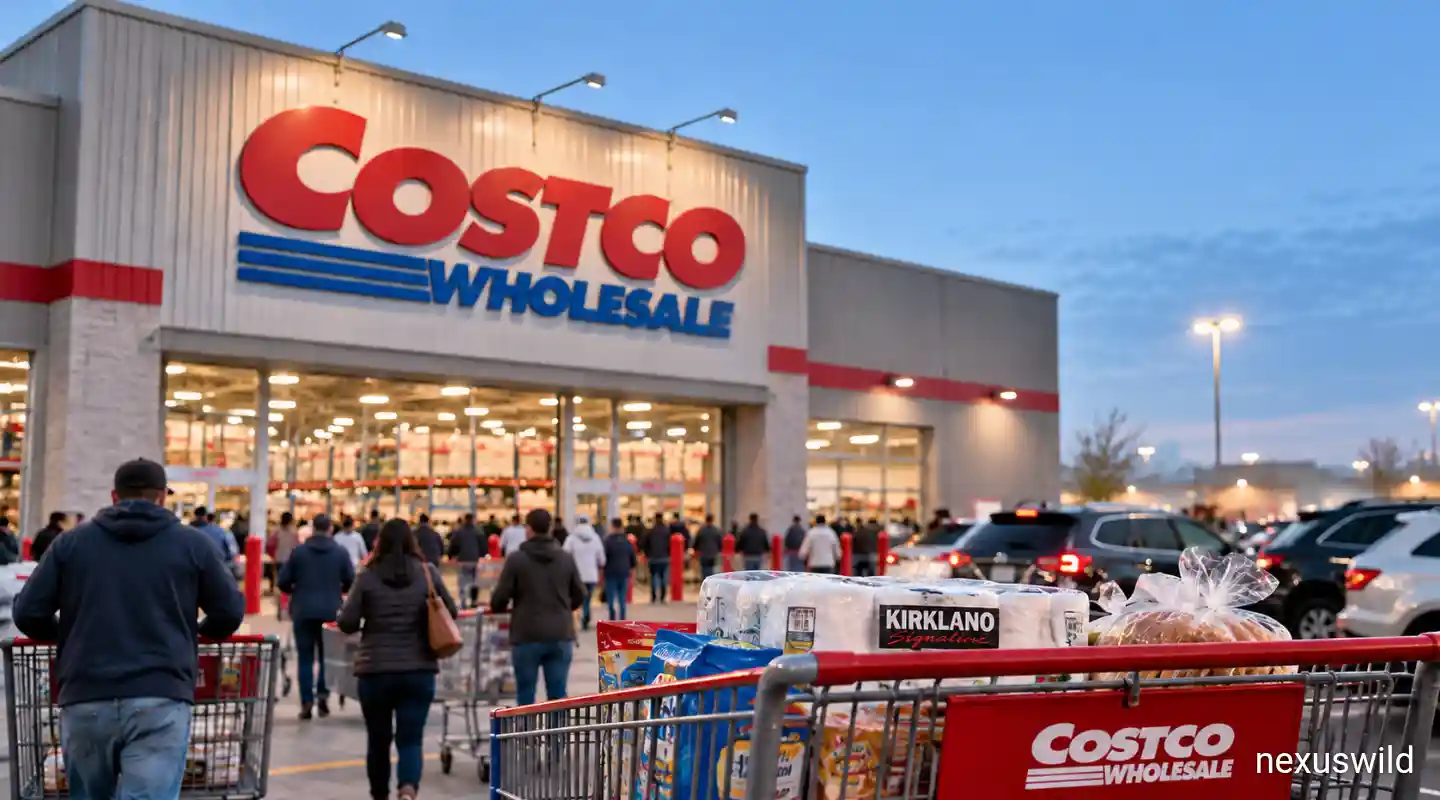

Costco Wholesale is confronting an unusual problem for a retailer: business remains strong, customers continue filling its warehouses and annual sales are approaching $300 billion, yet its stock has fallen significantly from its 2026 peak.
Costco shares recently traded around the low-$900s, roughly 15% below their 52-week high of $1,096.50, even after the company reported double-digit annual sales growth and record profits.
The divergence does not necessarily signal deterioration in Costco’s underlying business.
Instead, it reflects the much higher standard investors apply to a stock trading at a premium valuation.
For Costco, strong results are often no longer enough. Investors increasingly expect exceptional results.
Costco Sales Rose Above $297 Billion
Costco finished fiscal 2026 with $297.2 billion in net sales, up 10.1% from $269.9 billion a year earlier.
Total revenue, including membership fees, reached $303.15 billion.
Fourth-quarter net sales increased 11.2% to $93.9 billion, while net income climbed to $2.998 billion, or $6.75 per diluted share.
For the full fiscal year, net income reached $9.226 billion, up from $8.099 billion in fiscal 2025.
Those figures show that Costco is not dealing with a traditional sales slump.
Its core warehouse model continues to generate substantial growth.
Comparable Sales Remain Healthy
Comparable sales also remained solid.
For the 16-week fourth quarter, total comparable sales increased 9.4%.
When gasoline-price and foreign-exchange movements are excluded, comparable sales grew 6.7%.
In the United States, comparable sales rose 10.7% on a reported basis and 7.2% after adjusting for gasoline and currency effects.
For the full fiscal year, adjusted comparable sales increased 6.6% across the company.
That level of growth would generally be considered strong for a mature retailer with Costco’s scale.
Digital Sales Are Growing Much Faster
Costco’s digitally enabled business is expanding substantially faster than its physical-store sales.
Digitally enabled comparable sales jumped 19.5% in the fourth quarter and 20.9% for the full fiscal year.
After currency adjustments, full-year digital growth remained about 20.7%.
That performance is significant because Costco was historically more dependent on warehouse traffic than many other major retailers.
Its online growth suggests that the company is extending its membership model beyond traditional in-store shopping.
The Warehouses Are Still Busy
The crowded parking lots and long checkout lines familiar to Costco shoppers are consistent with the company’s continuing sales strength.
Business Insider noted that heavy customer traffic at Costco locations appears difficult to reconcile with the stock’s decline at first glance.
Yet stock prices do not measure how crowded stores look.
They reflect expectations about future earnings relative to the price investors are already paying.
That distinction explains much of Costco’s current market puzzle.
Costco’s Valuation Is Still Extremely High
Costco trades at roughly 47 times trailing earnings, based on the latest market data.
That is an unusually rich valuation for a mature retailer.
Earlier this year, Costco was trading around 46 to 47 times forward earnings, more than twice the valuation of many traditional retail companies.
A high multiple means investors have already priced in substantial future growth.
When that happens, merely reporting good results may not be enough to push the stock higher.
The company may need to beat already elevated expectations.
High Expectations Leave Little Room for Error
This valuation dynamic became particularly visible during the summer.
Costco reported June sales growth of 10.6%, but its shares still fell more than 4% after investors focused on a slowdown from the unusually strong growth recorded in May.
June comparable sales rose 8.8%, down from 12.5% in May.
The business was still growing strongly.
The issue was the direction of growth.
Investors were concerned that some of the exceptional momentum supporting Costco’s valuation was beginning to normalize.
May Had Set an Extremely High Bar
Costco’s May numbers were particularly strong.
Net sales reached $24.01 billion, up 14.5% from a year earlier.
Companywide comparable sales increased 12.5%, while U.S. comparable sales climbed 13.7%.
After stripping out gasoline-price and currency effects, comparable sales still rose 8%.
Following such strong numbers, even healthy subsequent growth could appear disappointing by comparison.
That is one of the central problems facing Costco’s stock.
The company is competing not only against rivals, but also against its own exceptional recent performance.
August Sales Still Rose Nearly 10%
The slowdown narrative also requires context.
Costco reported August net sales of $23.70 billion, up 9.9% year over year.
Reported U.S. comparable sales increased 9%.
Adjusted companywide comparable sales rose 5.4%, while digitally enabled sales increased 17.9%.
Costco said the later timing of Labor Day reduced August sales growth by slightly less than 0.75 percentage points.
The numbers therefore remained healthy despite some moderation.
Profit Growth Is Also Strong
Costco’s earnings tell a similar story.
Fiscal 2026 net income increased approximately 14% to $9.23 billion.
Fourth-quarter operating income rose to $3.80 billion, compared with $3.34 billion a year earlier.
The quarter did receive a one-time benefit worth approximately 15 cents per diluted share from refunds related to U.S. tariffs.
Costco said some of those refunds were reinvested in greater value for members.
The presence of that one-off benefit is one reason investors may look beyond headline earnings growth when judging the quarter.
Membership Fees Remain a Major Strength
Membership income continues to provide Costco with a highly valuable recurring revenue stream.
Membership fees rose to $5.91 billion in fiscal 2026, compared with $5.32 billion the previous year.
Unlike merchandise sales, membership fees carry very high margins.
That recurring income allows Costco to operate its retail business with extremely competitive product pricing while still producing attractive profitability.
It is one of the main reasons investors have historically awarded Costco a premium valuation.
Expansion Continues
Costco is also continuing to add warehouses.
The company operated 939 warehouses at the end of August, including 647 in the United States and Puerto Rico.
Earlier in the year, it had 928 locations, meaning the company continued expanding its physical footprint through fiscal 2026.
New locations can support long-term membership and sales growth, although expansion from Costco’s current scale naturally has a smaller proportional impact than it did when the company was younger.
Why the Stock Has Fallen
There is no single explanation for Costco’s stock decline.
Several factors have contributed.
The most important is valuation.
A retailer trading at more than 40 times earnings is valued more like a high-growth company than a traditional supermarket or warehouse operator.
Investors therefore become extremely sensitive to any sign that comparable-sales growth, membership additions or margins are slowing.
Business Insider also noted that defensive retailers such as Costco attracted heavy investor interest earlier in 2026 as consumers and markets worried about economic uncertainty.
As some of those fears eased, money rotated toward faster-growing areas of the market, particularly technology and AI-related stocks.
Costco Is Competing With AI Stocks for Investor Attention
The broader stock market has become increasingly concentrated around technology.
The S&P 500 and Nasdaq reached record highs on October 6, supported by another rally in AI-related companies including Nvidia, AMD and Marvell.
That matters for Costco.
Investors deciding where to allocate capital are comparing Costco’s expected growth with much faster earnings expansion from parts of the technology sector.
A premium-priced retailer can therefore become less attractive even if its business remains healthy.
The stock can decline because the relative opportunity elsewhere becomes more compelling.
Falling Gasoline Prices Changed Part of the Story
Gasoline has also affected Costco’s reported numbers.
Higher fuel prices earlier in the year boosted headline sales because Costco operates large gasoline businesses at many of its warehouses.
As fuel prices fell, that tailwind diminished.
That contributed to the gap between reported comparable sales and adjusted sales growth.
For example, Costco’s fourth-quarter reported comparable sales increased 9.4%, while the adjusted figure excluding gasoline prices and currency movements was 6.7%.
The adjusted figure provides a clearer measure of underlying merchandise demand.
A Great Business Can Still Have an Expensive Stock
This is the key distinction in Costco’s current situation.
A company can have:
strong sales,
loyal customers,
rising profits,
expanding digital sales,
busy stores,
and a durable competitive advantage,
while its shares still fall.
That happens when the valuation investors previously assigned to the company becomes difficult to justify relative to expected future growth.
Costco’s recent performance illustrates the difference between evaluating a business and evaluating its stock price.
September Sales Could Be the Next Test
Costco is scheduled to publish its September sales results on October 7.
The release will give investors another indication of whether comparable-sales momentum is stabilizing or continuing to moderate.
Because Costco publishes sales every month, investors receive unusually frequent information about its operating performance.
That transparency can also make the stock more sensitive to relatively small month-to-month changes.
A modest variation in comparable-sales growth can therefore create a significant stock reaction when expectations are already high.
What Investors Are Watching
The next phase of Costco’s stock performance is likely to depend less on whether its warehouses remain busy and more on whether earnings can grow fast enough to justify the premium valuation.
Investors will be watching several areas closely:
comparable-sales growth excluding gasoline and currency effects;
customer traffic;
membership growth and renewal rates;
e-commerce growth;
operating margins;
new warehouse openings; and
the pace of earnings growth.
None of those metrics individually determines where the stock will trade.
Together, however, they influence whether investors remain willing to pay a large premium for Costco’s consistency.
Conclusion
Costco’s current stock-market conundrum is not primarily a story about weak retail demand.
The company generated $297.2 billion in fiscal 2026 net sales, up 10.1%, while annual net income climbed to $9.23 billion. Comparable sales and digital activity also continued to grow.
Yet Costco shares remain roughly 15% below their 2026 peak.
The disconnect largely reflects valuation and expectations.
At close to 47 times earnings, Costco is priced for sustained, unusually strong performance. When growth moderates even slightly, investors can respond negatively despite crowded warehouses and rising revenue.
That does not necessarily mean Costco’s business is weakening.
It means the stock market is asking a different question: not whether Costco is performing well, but whether it is performing well enough to justify one of the richest valuations in retail.
Nexuswild welcomes factual corrections. Email contact@nexuswild.com with evidence and the article URL.