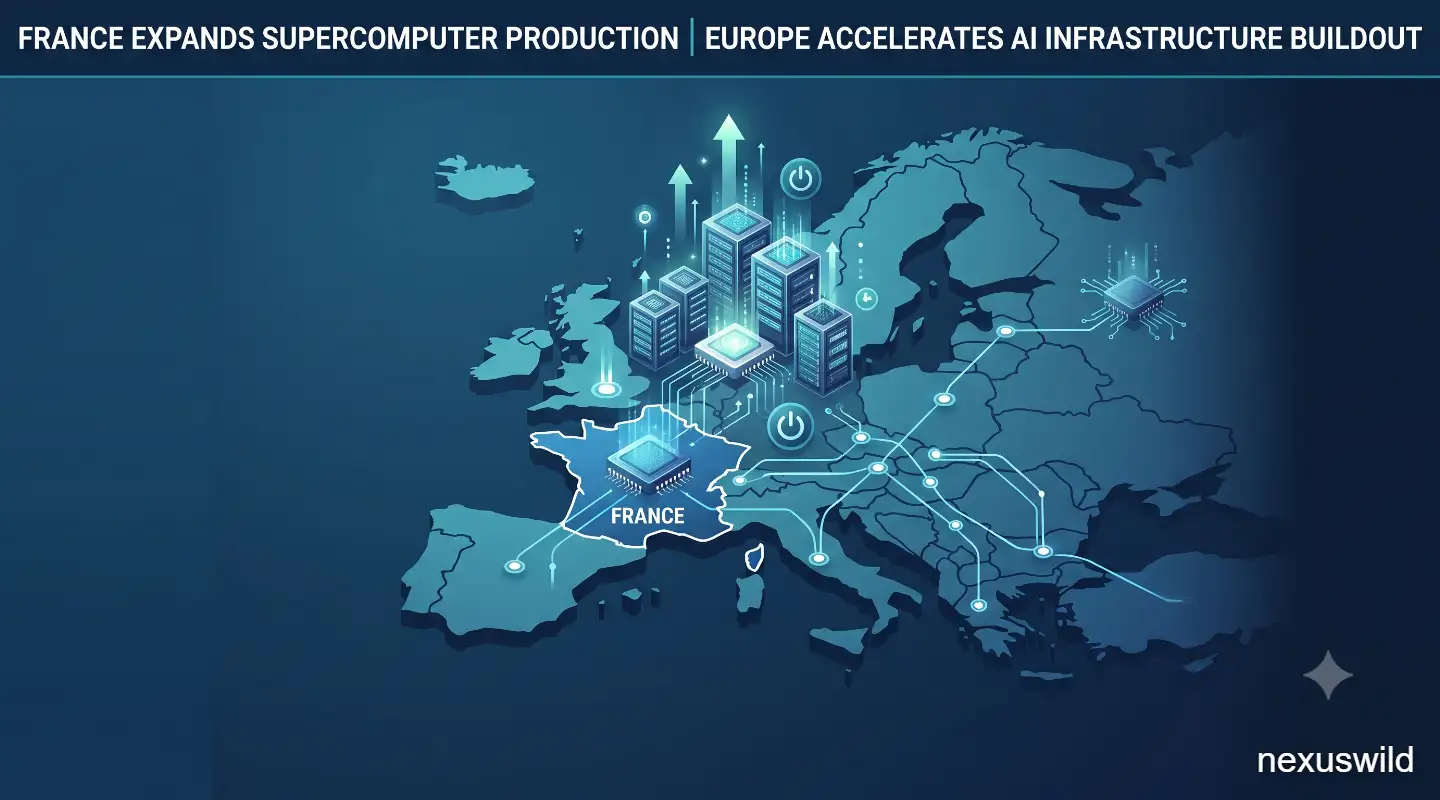

Europe’s push to strengthen its artificial intelligence infrastructure is beginning to reshape the region’s high-performance computing industry, with French supercomputer manufacturer Bull expanding production capacity to meet rising demand.
Bull has doubled the output capacity of its Angers factory in western France, increasing production from six to 12 supercomputer racks a month. The company expects the facility could eventually produce as many as 24 racks per month next year as demand for advanced computing systems continues to grow.
The expansion represents an €80 million investment and comes at a time when European governments and technology companies are placing greater emphasis on domestic computing infrastructure. AI development increasingly depends on access to powerful data centres and supercomputers capable of processing enormous volumes of information.
Bull scales up production in Angers
The Angers facility is becoming an important part of Bull’s strategy to support Europe’s growing requirements for high-performance computing.
By doubling its current production capacity, the company is positioning itself to handle larger orders while reducing some of the supply constraints that can emerge when demand for advanced computing hardware rises sharply.
The potential increase to 24 racks per month next year would represent another significant step up from the factory’s previous production level. For Europe’s AI ambitions, additional manufacturing capacity matters because large-scale AI systems require increasingly sophisticated computing infrastructure, from processors and networking equipment to complete supercomputer systems.
Bull’s expansion also highlights a broader shift in the technology sector. Supercomputers were traditionally associated with scientific research, weather modelling and industrial simulations. Today, the same underlying infrastructure is becoming increasingly important for AI model development, scientific discovery and other data-intensive applications.
Europe increases focus on AI infrastructure
European countries have been increasing investments in computing infrastructure as they seek to expand their AI capabilities and build greater technological capacity within the region.
The strategy reflects the growing importance of compute power in the global AI race. Training and operating advanced AI systems can require enormous amounts of processing power, making access to high-performance computing an increasingly important economic and strategic consideration.
For European technology companies, that creates an opportunity to participate in a market that extends beyond traditional supercomputing.
Bull is already involved in several major European projects. One of the most significant is the LUMI-AI supercomputer in Finland, a €387.8 million system designed to support artificial intelligence and high-performance computing workloads.
The project illustrates the scale of investment now flowing into European computing infrastructure. Large systems such as LUMI-AI can provide researchers and businesses with access to computing resources that would otherwise be difficult or expensive to build independently.
From supercomputing to AI
The expansion of Bull’s production capacity comes as the boundaries between supercomputing and AI infrastructure continue to narrow.
Modern AI systems require specialised computing environments capable of handling massive datasets and complex calculations. Supercomputing technology provides much of the foundation needed for these workloads, while advances in processors, memory, networking and cooling are changing how these systems are designed.
That evolution is also creating new requirements for manufacturers.
Rather than simply producing individual machines, companies such as Bull increasingly need to deliver integrated computing systems capable of operating inside large data-centre environments. The ability to manufacture and deploy these systems at scale could become increasingly important as AI investment expands.
A larger European computing market
Bull’s factory expansion is therefore more than an increase in manufacturing output. It reflects the emergence of a larger European market for advanced computing infrastructure.
The company’s ability to increase production from six to 12 racks per month, with a potential further increase next year, gives it greater capacity to respond to large-scale projects.
For Europe, expanding local production could also support efforts to develop a stronger regional technology ecosystem around AI and high-performance computing.
The demand, however, is part of a much broader global trend. Technology companies and governments worldwide are committing substantial resources to computing infrastructure as AI adoption accelerates.
Europe’s challenge will be to convert those investments into long-term computing capacity, research capabilities and commercially viable AI applications.
Bull’s investment in Angers shows how that transition is already reaching the manufacturing floor. As Europe builds out the infrastructure required for the next generation of AI, the ability to produce the underlying computing systems at scale is becoming an increasingly important part of the equation.
Nexuswild welcomes factual corrections. Email contact@nexuswild.com with evidence and the article URL.