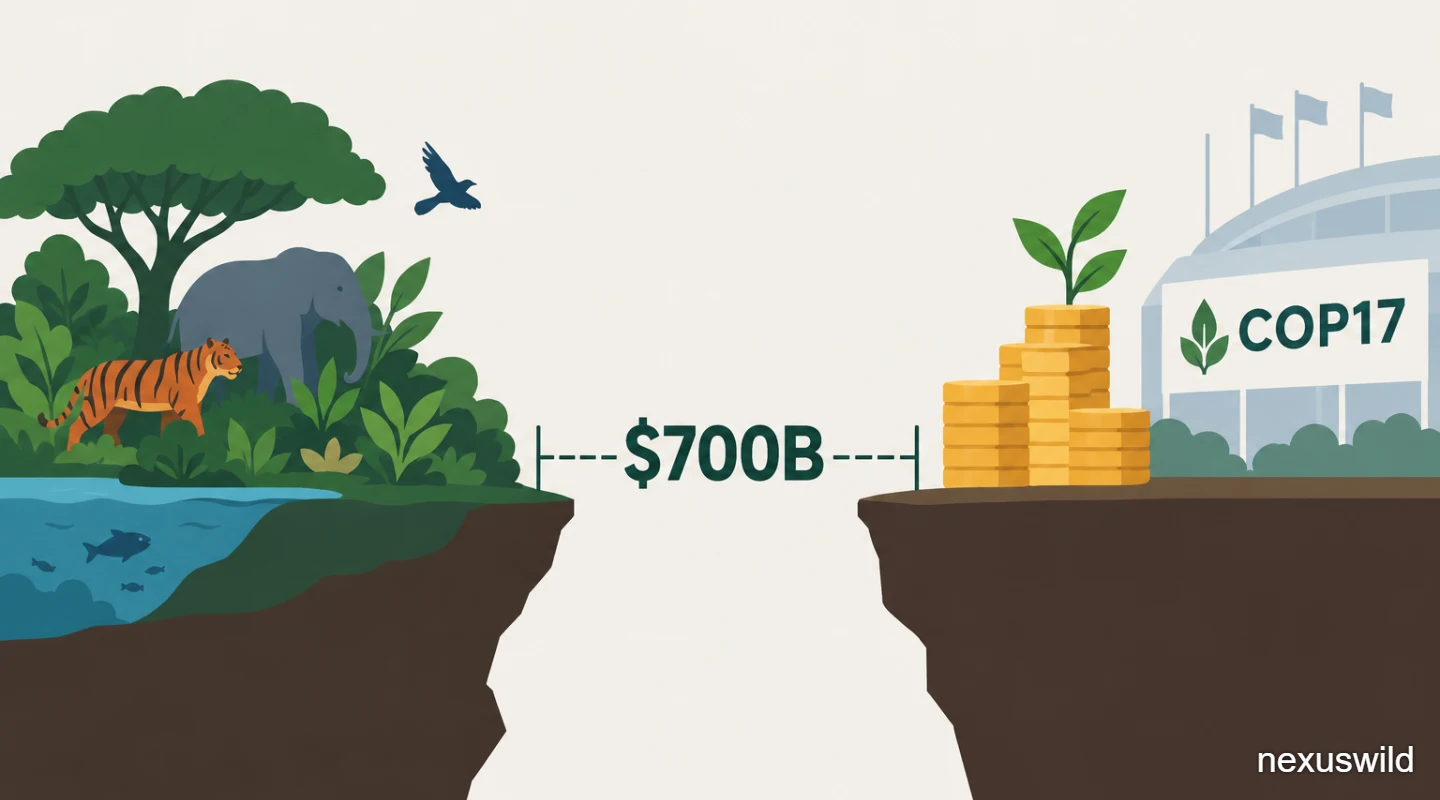

As delegates from nearly 200 nations gather in Yerevan, Armenia, from October 19 to 30, 2026, for the 17th United Nations Biodiversity Conference (COP17), the central obstacle to halting ecological decline is no longer a lack of scientific consensus, but a stark misalignment of global capital. Halfway through the critical decade to 2030, international financial systems continue to direct trillions of dollars toward activities that deplete forests, soils, and oceans, while leaving conservation and restoration programs severely underfunded.
Opening the summit in Yerevan on October 19, UN Secretary-General António Guterres warned world leaders that humanity’s unrelenting "war on nature" threatens the livability of the planet, adding: "Halfway to 2030, Yerevan is our moment of accountability." Hosted under the theme *Taking Action for Nature*, COP17 marks the first formal global stocktake of the Kunming-Montreal Global Biodiversity Framework (KMGBF), testing whether governments and financial institutions can convert paper pledges into transparent, funded implementation plans.
The $700 Billion Funding Gap and Montreal Commitments
Adopted in December 2022 at COP15, the Kunming-Montreal Global Biodiversity Framework established four overarching goals for 2050 and 23 action targets for 2030—most notably Target 3, the "30x30" pledge to conserve at least 30% of the world’s land, inland waters, and oceans by the end of the decade.
To make those conservation targets viable, Goal D of the framework calls for progressively closing an estimated $700 billion annual biodiversity finance gap. Rather than relying on new spending alone, the agreement splits this $700 billion obligation into two distinct financial targets to be achieved by 2030:
- Target 18 (Subsidy Reform): Identify by 2025 and eliminate, phase out, or reform incentives and subsidies harmful to biodiversity by at least $500 billion per year by 2030.
- Target 19 (Resource Mobilization): Mobilize at least $200 billion per year for biodiversity from all sources—domestic, international, public, and private—including at least $30 billion annually in international financial flows from developed to developing countries by 2030.
While governments have made measurable headway on spatial mapping—placing roughly 27.5% of terrestrial areas under designated protection—a pre-COP17 assessment concluded that signatory nations remain off track on all 23 targets, largely because financial mobilization and subsidy reform have stalled.
Where the Money Goes: A 30-to-1 Imbalance
The scale of the financial contradiction is detailed in UNEP’s flagship State of Finance for Nature 2026 report, released in January 2026. While the KMGBF tracks the $700 billion gap required specifically for biodiversity conservation, UNEP evaluates a distinct, broader metric: global capital flows directed toward Nature-based Solutions (NbS)—actions that protect, restore, and sustainably manage ecosystems across climate, biodiversity, and land-degradation goals—versus nature-negative finance.
UNEP’s 2026 assessment reveals that for every $1 invested in protecting and restoring nature, $30 is spent on activities that actively degrade it.
| Financial Metric / Category | Verified Annual Value | What the Metric Measures | Source & Benchmark |
|---|---|---|---|
| Total Nature-Negative Finance | $7.3 Trillion (2023) | Combined private and public capital flowing directly into activities that degrade ecosystems (~7% of global GDP). | UNEP State of Finance for Nature 2026 |
| Private Nature-Negative Flows | $4.9 Trillion (2023) | Private lending and investment concentrated in high-impact utilities, industrials, energy, and basic materials. | UNEP State of Finance for Nature 2026 |
| Environmentally Harmful Subsidies | $2.4 Trillion (2023) | Annual public subsidies supporting fossil fuels ($1.13T), input-intensive agriculture, water overuse, and fisheries. | UNEP State of Finance for Nature 2026 |
| Total Current NbS Finance | $220 Billion (2023) | Combined public (~$197B / 90%) and private ($23B / 10%) expenditure on Nature-based Solutions. | UNEP State of Finance for Nature 2026 |
| Required NbS Investment | $571 Billion / year (by 2030) | Annual capital needed (a 2.5x increase) to meet global climate, biodiversity, and land-restoration targets. | UNEP State of Finance for Nature 2026 |
| KMGBF Biodiversity Finance Gap | $700 Billion / year (by 2030) | Shortfall targeted via $500B in subsidy reductions (Target 18) and $200B in biodiversity funding (Target 19). | UN Convention on Biological Diversity |
Although private investment in the most environmentally damaging sectors—such as oil and gas—fell by 48% between 2020 and 2023 (dropping from $990 billion to $519 billion), and total NbS spending rose 5% in 2023 to reach $220 billion, positive flows remain fiscally marginal against the $7.3 trillion driving ecological depletion.
Why Traditional Funding Falls Short
Public domestic expenditure currently shoulders roughly 90% ($190 billion to $197 billion) of all financing for Nature-based Solutions. However, national treasuries cannot bridge the gap alone due to several structural barriers:
- Fiscal Strain and Competing Priorities: Governments face tight sovereign budgets, geopolitical instability, and energy security pressures. In the Global South, states are forced to spend heavily on immediate disaster relief—such as the 2026 floods in Nepal—leaving limited fiscal space for preventive ecosystem restoration.
- The Subsidy Paradox: Public finance frequently works against itself. By channeling $2.4 trillion annually into environmentally harmful subsidies—such as chemical fertilizer support and underpriced agricultural electricity that depletes groundwater—governments artificially lower the cost of environmental destruction, overwhelming the smaller budgets allocated to environment ministries.
- Measurement and Due Diligence Hurdles: Unlike climate mitigation, which uses a single standardized metric (tons of carbon dioxide equivalent), biodiversity is local, multi-dimensional, and complex to quantify. Bespoke ecological assessments drive up due diligence and transaction costs, deterring institutional investors.
- Liquidity and Sovereign Risk Mismatches: Ecological restoration projects typically require 10- to 20-year horizons and lack liquid secondary markets, clashing with private equity timelines of three to five years. Furthermore, while most financial capital resides in the Global North, the most critical biodiversity hotspots are located in developing nations, exposing private investors to currency and sovereign risks.
New Financial Models and Their Limitations
To draw private capital beyond its current $23 billion contribution to NbS, financial institutions and conservation groups have introduced specialized market instruments, including green bonds, blended finance, payments for ecosystem services, debt-for-nature swaps, and biodiversity credits.
Some mechanisms have demonstrated measurable progress. Between 2021 and 2024, eight sovereign debt restructuring agreements—commonly known as debt-for-nature swaps—in nations including Ecuador, Belize, and Gabon successfully unlocked long-term domestic funding for marine and terrestrial protection.
However, market-based instruments face sharp verification challenges and integrity risks:
- Offset Credibility and Market Pullbacks: In 2023, the value of nature-based carbon offsets in voluntary markets plunged by 57% as corporate buyers retreated over flawed accounting methodologies and questionable ecological permanence.
- Ecological Equivalence Failures: Biodiversity offsets often struggle to replicate complex habitats. For example, India’s Compensatory Afforestation Fund Management and Planning Authority (CAMPA)—one of the world’s largest offset mechanisms at roughly $0.86 billion—has faced scrutiny for funding monoculture plantations rather than restoring native biodiversity.
- Greenwashing and Philanthropic Volatility: Without rigorous green taxonomies, financial institutions risk categorizing damaging infrastructure as sustainable. Meanwhile, private philanthropy for NbS fell by roughly 60% from a peak of $692 million in 2021 to $271 million in 2023—underscoring UNEP’s warning that catalytic grants cannot substitute for systemic financial reform.
The Business Case: Nature Risk as Financial Risk
For the corporate sector, biodiversity loss is transitioning from a reputational concern into a material balance-sheet liability. According to UNEP, at least 50% of global GDP is moderately or highly dependent on nature and its ecosystem services.
When pollinators decline, watersheds dry up, or coastal mangroves disappear, the economic shockwaves hit multiple industries simultaneously:
- Agriculture and Food Supply Chains: Soil degradation, pollinator collapse, and erratic water tables directly reduce crop yields and create commodity price volatility. In economies like India, where over half the workforce is tied to agriculture, ecosystem degradation poses a systemic macroeconomic threat.
- Insurance and Infrastructure: Healthy wetlands, forests, and reefs act as natural buffers against floods, landslides, and storm surges. As ecosystems erode—evidenced by severe European wildfires and South Asian flooding in 2026—insurers face escalating underwriting losses and physical infrastructure suffers costly damage.
Corporate awareness is beginning to reflect these realities. The Taskforce on Nature-related Financial Disclosures (TNFD) 2026 status report notes that more than 730 organizations globally now track nature-related dependencies, with 56% of surveyed investors actively exploring or deploying capital into nature-related opportunities and 74% expecting such financing to increase two to five times over the next five years.
Global Policy Implications: The "Nature Transition X-Curve"
To correct the 30-to-1 financing imbalance, UNEP’s 2026 report proposes a "Nature Transition X-Curve"—a coordinated policy framework that simultaneously phases out nature-negative capital flows while scaling up regenerative investments.
Key policy levers under discussion include:
- Repurposing Harmful Subsidies: Redirecting the $2.4 trillion in annual environmentally harmful subsidies toward regenerative agriculture, clean energy, and watershed restoration so fiscal policy no longer rewards ecological depletion.
- Mandatory Corporate Disclosures: Enacting national regulations aligned with KMGBF Target 15 and the TNFD framework, compelling large corporations and financial institutions to audit and report their nature impacts and dependencies to shareholders.
- Mainstreaming Nature in Fiscal Planning: Integrating National Biodiversity Finance Plans across ministries of finance, agriculture, and energy, while safeguarding the land tenure and governance rights of Indigenous Peoples and local communities, who serve as primary custodians of global biodiversity.
What Happens Next: Accountability at COP17 in Yerevan
Whether governments can translate these policy blueprints into binding budgetary commitments is the central test of COP17 in Yerevan. Following the contentious conclusion of COP16 in Cali, Colombia—where negotiations ran out of time and required follow-up sessions in Rome to resolve finance disputes—ministers in Armenia are under intense pressure to prove the Kunming-Montreal pact remains credible.
As Armenian Prime Minister Nikol Pashinyan acknowledged at the summit’s opening, countries "must honestly admit that collectively, we are not yet on track as needed." Over the two-week conference, contact groups are reviewing lessons from National Biodiversity Finance Plans and debating how developed nations will fulfill their $30 billion international funding pledge to developing countries.
Conclusion
Closing the global biodiversity funding gap requires more than raising new conservation grants; it demands dismantling the financial incentives that make destroying ecosystems more profitable than preserving them. With $7.3 trillion flowing annually into nature-negative activities against just $220 billion for Nature-based Solutions, incremental growth in green finance will not be enough to meet the 2030 targets. For the delegates in Yerevan, as well as global central banks and institutional investors, the path forward hinges on decisive subsidy reform, mandatory nature-risk disclosures, and treating natural ecosystems as foundational economic infrastructure.
Nexuswild welcomes factual corrections. Email contact@nexuswild.com with evidence and the article URL.