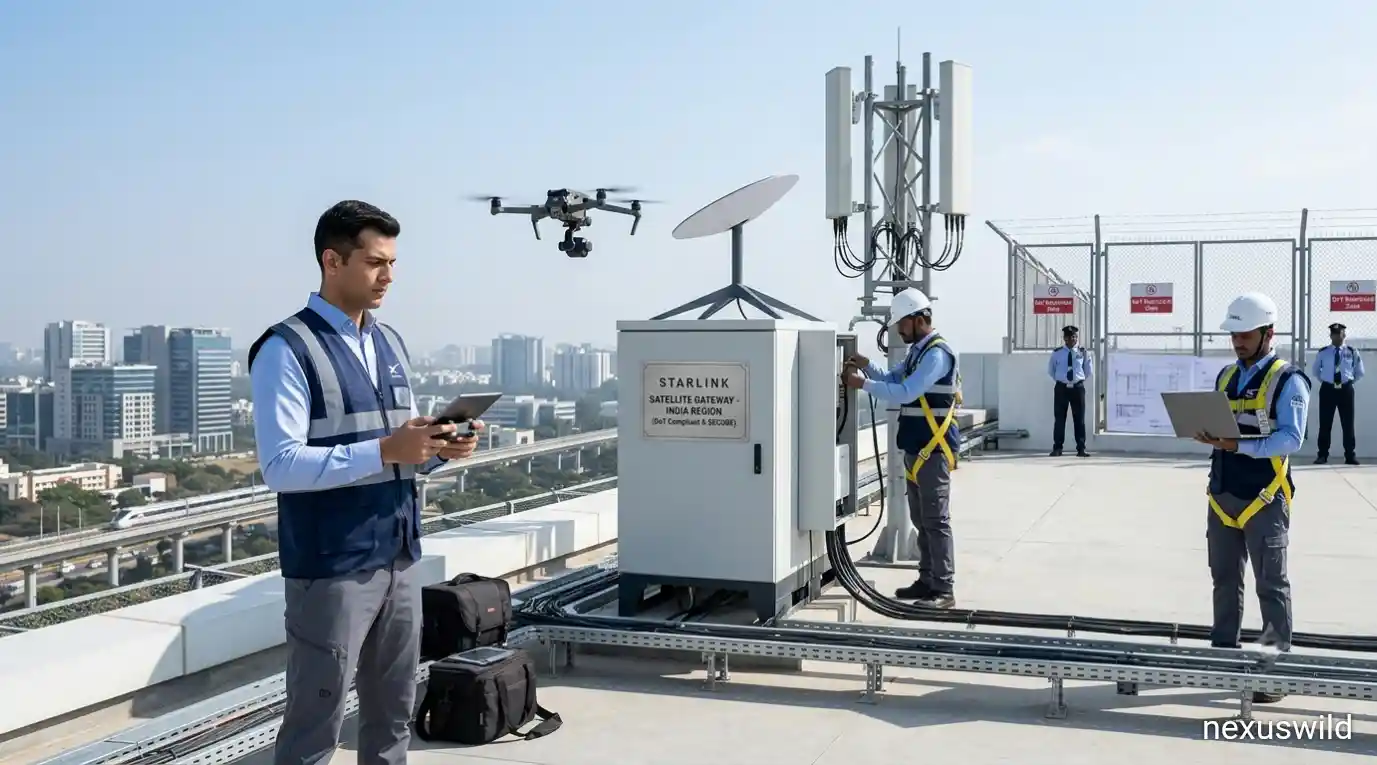

Elon Musk's Starlink is facing renewed scrutiny in India as national security concerns complicate the satellite internet provider's plans to enter one of the world's largest digital markets. The debate centres on data sovereignty, government oversight, lawful interception and the extent to which Indian authorities could enforce domestic regulations on a satellite network operated by a foreign company.
On October 13, 2026, the Swadeshi Jagran Manch (SJM), an organisation associated with India's broader economic self-reliance movement, urged the government to block Starlink's entry, arguing that the technology could create challenges for national security and regulatory control.
The demand comes as Indian authorities continue assessing satellite communications providers, including Starlink, Reliance Jio and Bharti Airtel. The government has rejected allegations that the approval process is biased, saying the companies remain subject to security and regulatory requirements.
The dispute highlights a broader policy question: how can India expand high-speed internet access through satellite technology while retaining effective control over communications infrastructure operating within its borders?
Why Starlink's Technology Raises Security Questions
Starlink, operated by SpaceX, delivers broadband internet through a constellation of satellites in low Earth orbit. Unlike conventional fixed-line networks, which rely on cables and terrestrial infrastructure, satellite internet can connect users in remote locations through satellite terminals and associated ground infrastructure.
This architecture can help extend connectivity to areas where fibre-optic networks and mobile towers are expensive or difficult to deploy. However, it also creates regulatory challenges because network operations can involve satellites, ground stations, international links and technology infrastructure across different jurisdictions.
Indian authorities have reportedly examined how Starlink's network would handle Indian user data, comply with lawful interception requirements and respond to government directions during emergencies.
A particular point of concern is the use of laser-based inter-satellite links, which allow satellites to transmit data directly to one another rather than routing every connection through a nearby ground station. Security officials have reportedly questioned whether this architecture could make it harder to ensure that certain data flows remain within India's jurisdiction.
These concerns do not establish that Starlink is improperly handling Indian data. They reflect questions about how the company would demonstrate compliance with Indian law and how regulators could verify that compliance in practice.
Data Sovereignty and Lawful Interception
Data sovereignty refers to a country's ability to govern information under its jurisdiction through its laws and regulatory institutions. For telecommunications providers, this can involve rules covering data handling, security cooperation, interception under lawful authority and access by authorised agencies.
For India, the central issue is whether a foreign-operated satellite network can reliably meet these requirements while delivering services across a large and geographically diverse market.
Authorities need clarity about how user information is processed, what records are available to investigators under applicable law and how quickly the operator can respond to lawful requests. They must also assess whether network design and overseas infrastructure could complicate enforcement.
The government has not publicly established that Starlink has violated Indian data-protection or national security laws. Instead, the outstanding review concerns the safeguards required before commercial services can begin.
Starlink has said it is engaging with Indian authorities and has developed an operating model tailored to India's regulatory and security requirements. The company has also maintained that it is prepared to launch once the necessary approvals are completed.
Government Control During Emergencies
Another issue is the ability to enforce restrictions on communications during a security emergency.
Satellite connectivity can be particularly valuable when terrestrial networks are unavailable, including in remote regions and areas affected by natural disasters. Yet the same independence from local infrastructure can complicate enforcement if authorities need an operator to restrict or suspend service in a specific area.
The SJM has argued that India's ability to regulate internet access during emergencies could be weakened if it cannot exercise sufficient control over the satellite network. Such claims represent the group's concerns and should not be treated as proof that Indian authorities would be unable to enforce the law.
The policy challenge is to establish clear technical and legal arrangements covering emergency directions, lawful interception, service restrictions and accountability.
Any framework would need to balance national security requirements with legitimate connectivity needs, including access for communities that have limited alternatives to satellite broadband.
Starlink's India Launch Remains Pending
Starlink has spent several years preparing to enter India and has secured important preliminary permissions, including a Global Mobile Personal Communications by Satellite services licence and authorisation from the Indian National Space Promotion and Authorisation Centre.
However, those approvals do not by themselves permit the company to begin commercial service. As of October 13, the launch remained pending further security and investment-related clearances, along with the final arrangements required for commercial spectrum access.
The regulatory delay has become more contentious after Musk publicly criticised India's approval process and alleged that powerful business interests were obstructing Starlink's entry. The government rejected the accusations, saying the process was non-discriminatory and that competing satellite communications providers were undergoing comparable scrutiny.
The disagreement has brought national security, competition and the role of foreign technology companies into the same debate. Nevertheless, the outstanding approvals remain a regulatory matter, and allegations of commercial interference should be distinguished from verified government decisions.
Competition in India's Satellite Internet Market
Starlink's proposed entry comes as Indian telecommunications companies also seek to expand satellite-based connectivity. Reliance Jio and Bharti Airtel have been developing their own satellite communications strategies, while other operators are pursuing opportunities in the sector.
Satellite broadband could provide additional options for businesses, households and public services in areas that are underserved by terrestrial networks. It may also support connectivity for remote infrastructure, emergency response and operations in locations where conventional networks are difficult to maintain.
For consumers, the eventual impact will depend on service availability, equipment costs, subscription prices and competition among providers.
However, security and regulatory requirements will shape how quickly these services become available. Companies will need to demonstrate that their technical systems can meet India's requirements before commercial operations can proceed.
Balancing Connectivity With National Security
The debate over Starlink illustrates the challenge governments face when regulating digital infrastructure that crosses national borders. Satellite internet can expand access and improve resilience, but regulators must also consider control over network operations, data protection and the enforceability of domestic laws.
For India, the immediate question is whether Starlink can satisfy the outstanding requirements and whether regulators consider its proposed safeguards sufficient. The wider policy challenge is to establish rules that apply consistently to satellite operators while protecting national security and encouraging competition.
Until the necessary approvals are completed, Starlink's commercial launch in India remains uncertain. The outcome will influence not only the company's prospects in the market but also how India regulates foreign-operated satellite networks in the years ahead.
Nexuswild welcomes factual corrections. Email contact@nexuswild.com with evidence and the article URL.