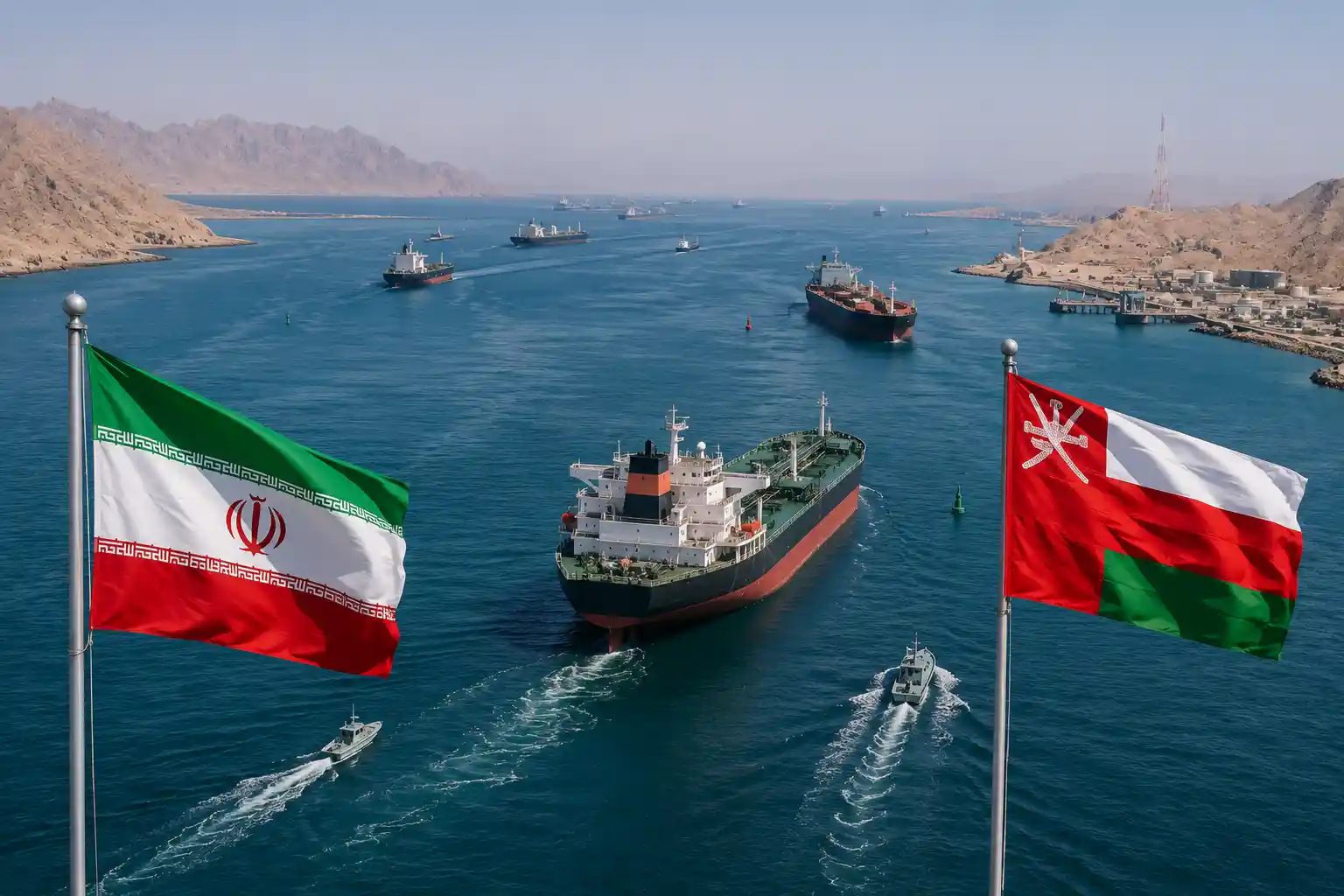

TEHRAN — Iran and Oman are working on a temporary navigational corridor through the Strait of Hormuz, but the proposed route has not yet been formally announced or confirmed as operational.
Following talks in Tehran on August 25, the two countries said they had discussed a phased framework intended to restore safe navigation. An official Omani statement said the proposal included a jointly managed temporary corridor and an agreement to implement a mine-clearing project.
Ongoing Negotiations
Technical negotiations are expected to continue over a permanent corridor, maritime traffic management, information sharing and security services. Omani Foreign Minister Badr Albusaidi said he hoped the temporary arrangement would be announced soon, confirming that it remained under development.
A spokesperson for Iran’s Islamic Revolutionary Guard Corps subsequently claimed that understandings had been reached over territorial and revenue issues. However, a senior Iranian source told Reuters that no final agreement had been completed. There was also no verified evidence that joint mine-clearing operations had begun.
Commercial Impact and Restrictions
Commercial traffic remains sharply restricted. Preliminary Kpler data showed that only five commodity vessels crossed the strait on August 25, compared with a 10-day average of 15. Four vessels transited the previous day. The figures may be revised because some ships switch off their tracking transponders, Reuters reported.
Normal shipping has been disrupted by attacks on vessels, mines, competing Iranian and U.S. restrictions and concerns over detention or cargo seizure. Iran recently blacklisted 45 vessels that it accused of violating its maritime rules, prompting some energy companies to reconsider using them.
Tehran says broader reopening depends on the United States ending its blockade of Iranian ports, removing sanctions and providing compensation under a collapsed interim agreement. Washington has instead threatened further economic pressure, although it previously said its blockade could be lifted after an agreement restoring unimpeded commercial navigation.
Global Energy Markets
Oman has acted as an intermediary while also seeking arrangements that respect coastal-state sovereignty and international navigation rights.
The strait carried about 20 million barrels of oil a day in 2024, equivalent to roughly 20% of global petroleum consumption, according to the U.S. Energy Information Administration. Around one-fifth of global LNG trade also passed through it.
Oil prices fell as the talks raised expectations of improved flows. At 1448 GMT on August 26, Brent was down 0.8% at $87.87 a barrel, while WTI had declined 0.58% to $81.88.
Traffic is unlikely to return closer to normal until the corridor is formally agreed, mines and other security risks are addressed, maritime operators accept the route and Iran and the United States resolve their competing restrictions.
Further reading and useful links
Reader questions
Frequently asked questions
What are Iran and Oman discussing regarding the Strait of Hormuz?
Iran and Oman are negotiating a phased framework that includes a jointly managed temporary navigational corridor and a mine-clearing project to safely restore shipping through the strait.
Why is shipping restricted in the Strait of Hormuz?
Shipping has been sharply curtailed due to attacks on vessels, naval mines, competing restrictions from Iran and the U.S., and Iran's recent blacklisting of 45 vessels for allegedly violating its maritime rules.
How important is the Strait of Hormuz to the global economy?
The strait is a critical global chokepoint. In 2024, it carried about 20 million barrels of oil per day (roughly 20% of global petroleum consumption) and approximately one-fifth of the global LNG trade.
Nexuswild welcomes factual corrections. Email contact@nexuswild.com with evidence and the article URL.