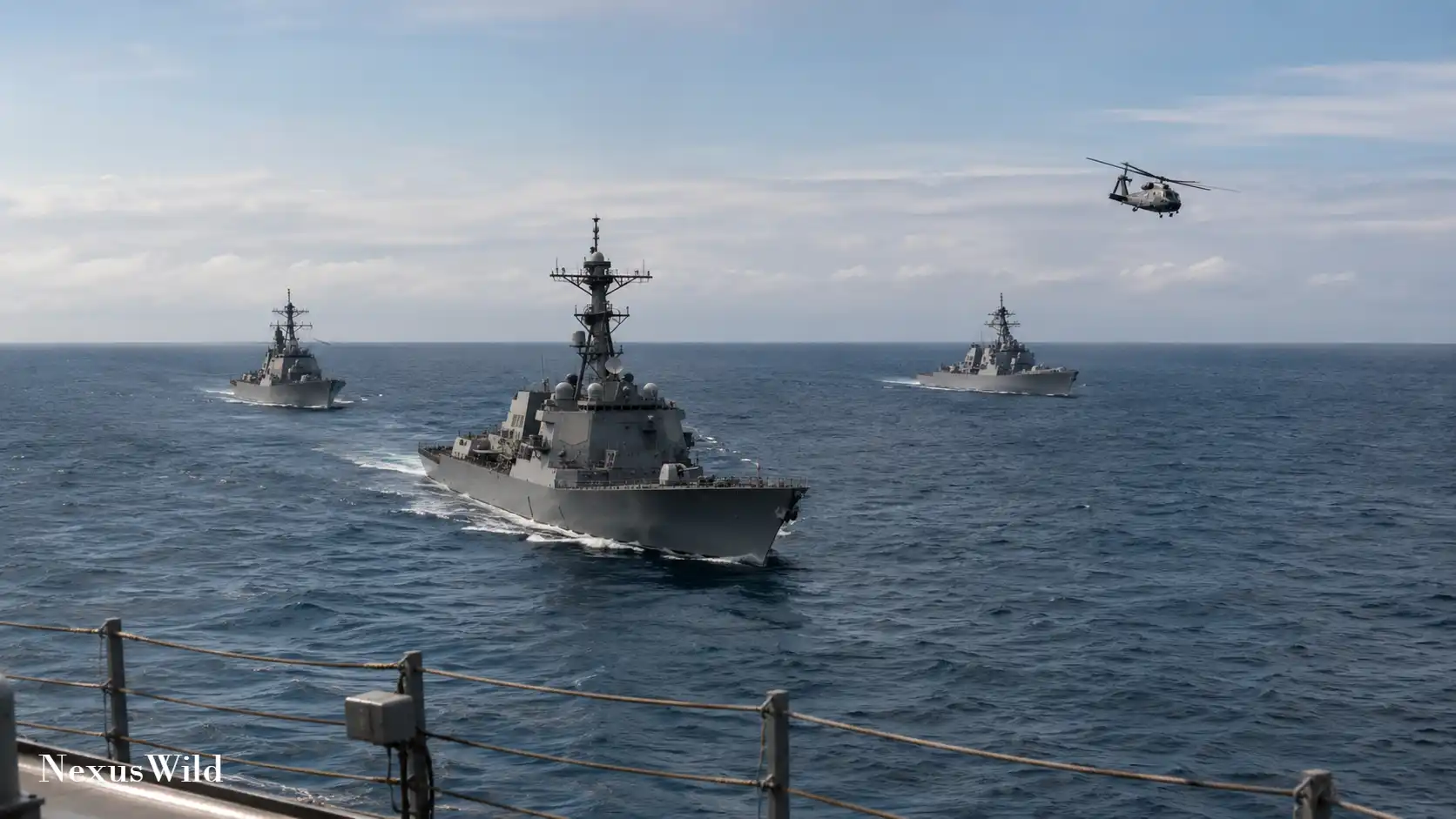

SEOUL — South Korea, the United States and Japan will hold their trilateral Freedom Edge military exercise from September 7 to 11 in international waters east and south of Jeju Island, Seoul's Joint Chiefs of Staff announced Friday. "This exercise is a defensive drill conducted annually by the three countries to respond to North Korea's nuclear and missile threats and safeguard peace and stability in the region," the JCS said in a statement.
Scope of the Multi-Domain Exercise
The multi-domain exercise is expected to include maritime and aviation operations, enhanced air-defense scenarios, missile defense and maritime interdiction training, according to Yonhap News Agency. Previous rounds have also featured anti-submarine warfare, medical evacuation drills and cyber defense. US Pacific Command said this year's iteration will expand trilateral interoperability through enhanced real-time data sharing and synchronized coordination among the three militaries.
A JCS official told reporters the scale and scope would be roughly on par with previous years, though neither the JCS nor US Pacific Command has detailed the specific units, ships or aircraft involved. Whether a US aircraft carrier will take part has not been officially confirmed; South Korean media have reported a carrier may be unavailable given ongoing US deployments tied to the Middle East conflict.
Distinctions from Bilateral Drills
Freedom Edge is distinct from Ulchi Freedom Shield, the separate US-South Korea bilateral exercise that Washington and Seoul reduced by roughly half in length and scale this year after President Donald Trump ordered the Pentagon to scale back the drills, calling them potentially an "inappropriate and hostile" message to Pyongyang. The US also canceled a separate joint Marine Corps exercise planned for next month, with Trump citing Seoul's refusal to assist in the Iran war.
Freedom Edge, first launched in June 2024 following the August 2023 Camp David trilateral summit, will mark its fourth iteration, after prior exercises in June 2024, November 2024 and September 2025.
Diplomatic Context and North Korea's Reaction
Trump has renewed efforts to arrange a new summit with North Korean leader Kim Jong Un, whom he met in 2018 and 2019. North Korea's response has been mixed: Kim Yo Jong, Kim Jong Un's sister, described the Trump-Kim relationship as "excellent" but said the scaled-back Ulchi Freedom Shield had not changed what Pyongyang views as Washington's hostile policy.
North Korea fired around 10 short-range ballistic missiles around August 20. Pyongyang has previously denounced past Freedom Edge rounds as a "reckless show of strength" reflecting a confrontational stance by its adversaries; it had not issued a direct statement on this year's announcement as of publication.
Despite the reductions to other exercises, Freedom Edge proceeding as planned underscores its role in institutionalizing trilateral security cooperation established at Camp David in 2023.
Further reading and useful links
Reader questions
Frequently asked questions
When and where will the 2026 Freedom Edge exercise take place?
The exercise will be held from September 7 to 11, 2026, in international waters east and south of South Korea's Jeju Island.
How does Freedom Edge differ from Ulchi Freedom Shield?
Freedom Edge is a trilateral multi-domain exercise involving the US, South Korea, and Japan. Ulchi Freedom Shield is a bilateral US-South Korea drill, which was recently scaled back by roughly half in length and scale.
What is the purpose of the Freedom Edge drills?
The drills are designed to enhance real-time data sharing, synchronized coordination, and interoperability among the three militaries to respond to North Korea's nuclear and missile threats and safeguard regional stability.
Nexuswild welcomes factual corrections. Email contact@nexuswild.com with evidence and the article URL.