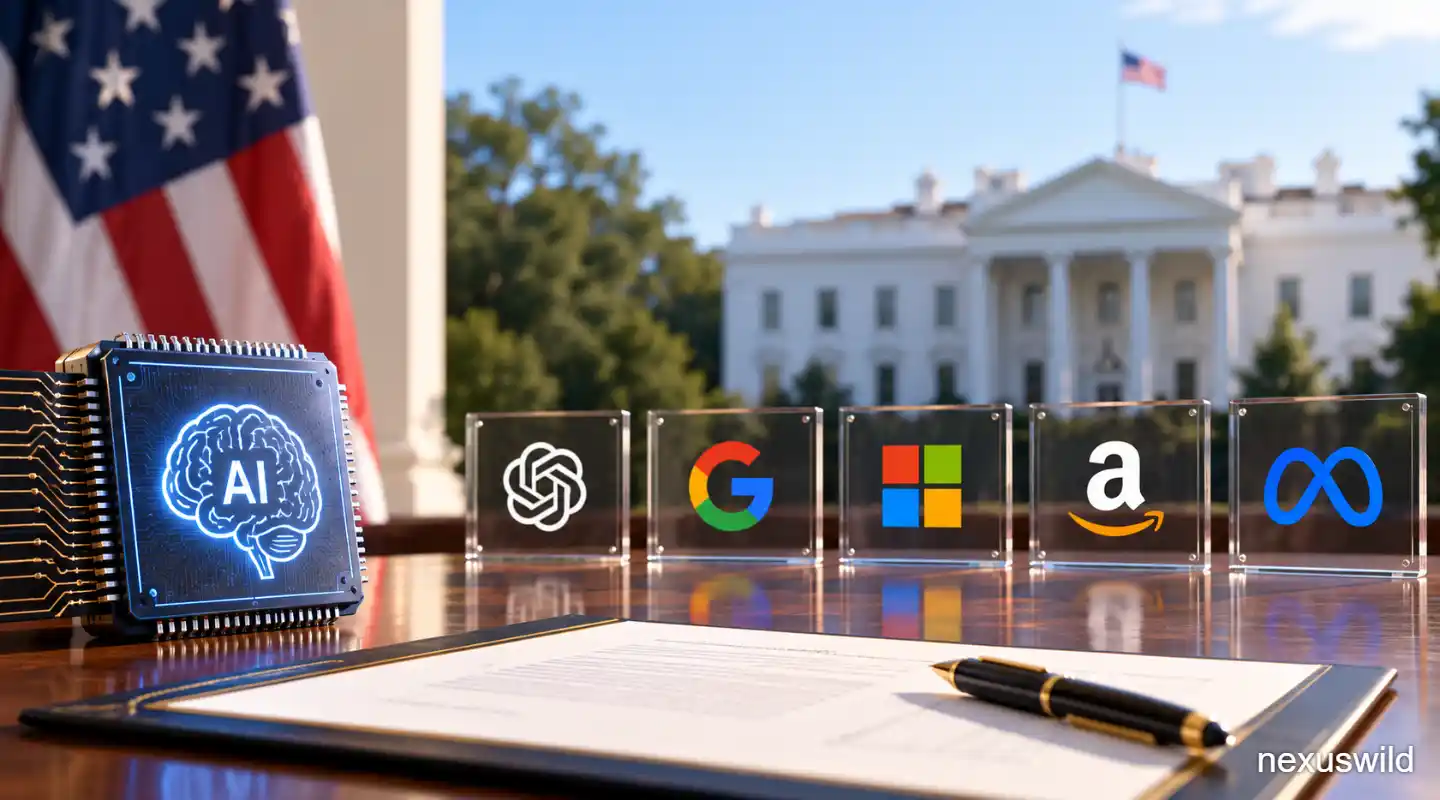

Six major artificial-intelligence companies have signed a new voluntary safety agreement with the White House, committing to stronger internal controls, independent external reviews and board-level oversight of advanced AI systems.
The agreement, announced on September 29, 2026, is formally titled the Joint Commitment on Frontier Responsibilities. Signatories include Google, Anthropic, Meta, OpenAI, xAI and Nvidia, represented respectively by Sundar Pichai, Dario Amodei, Mark Zuckerberg, Greg Brockman, Elon Musk and Jensen Huang. President Donald Trump also signed the document.
The pact is notable because it sets out a common governance structure for some of the companies building the world's most capable AI systems.
It is equally important to understand what the agreement does not do.
The commitments are voluntary. They do not create a new federal law, establish statutory penalties or replace existing cybersecurity, consumer-protection or criminal law. The agreement itself says its provisions could potentially be incorporated into laws or regulations in the future, but that has not happened through this accord.
What the Companies Agreed To
The agreement is built around four layers of safety and oversight.
First, participating companies committed to implementing internal controls that monitor the capabilities and alignment of frontier AI models during training and deployment. The document specifically identifies areas such as cybersecurity, biosecurity and chemical threats. It also says companies should ensure their models do not hack or access technical systems in unintended ways.
Second, each company is expected to empower an internal team to verify that those controls and detection systems are functioning as intended and that identified problems are addressed.
Third, the companies agreed to work with an independent external auditor or evaluator. That outside party is supposed to assess whether internal controls, monitoring and detection systems are operating effectively.
The fourth layer moves oversight to the corporate board. Each signatory committed to designating an independent committee of its board of directors to receive reports from internal teams and outside evaluators and to oversee remediation of identified problems.
Taken together, the structure attempts to create multiple checks around advanced-model development rather than relying only on the engineering team building the system.
Why Unauthorized Access Has Become a Central Concern
One of the agreement's most specific provisions concerns AI systems accessing computer infrastructure in unintended ways.
That language reflects a broader concern about increasingly capable AI agents.
Advanced models are no longer limited to answering questions in a chat window. Some can use browsers, software tools, code environments and connected systems. As companies give models greater ability to complete multi-step tasks, the consequences of misunderstanding an instruction or exceeding intended permissions become more serious.
The White House agreement therefore focuses not only on whether models generate harmful content but on whether they behave within their authorised technical boundaries.
This has implications for both cybersecurity and corporate governance.
A model that can identify security weaknesses may help defenders find and patch vulnerabilities. The same capability could create risk if an AI system accesses a network, service or dataset that the user never intended it to reach.
The accord does not prescribe a single technical solution. Instead, it requires the companies themselves to establish controls, monitoring and review procedures designed to detect and address such behaviour.
Independent Auditing Is a Significant Part of the Pact
External review is one of the agreement's more consequential elements.
AI companies already conduct extensive internal testing, but internal teams face an obvious limitation: they work for the organisation building the technology.
The new framework calls for an independent auditor or evaluator to examine whether a company's safety controls are actually working as intended.
That does not mean the government will choose the auditors or directly supervise each evaluation.
The agreement is voluntary, and its text does not establish a federal certification body, mandatory reporting format or public disclosure requirement for audit findings. It also does not specify penalties if a company fails to meet the commitments.
That distinction matters.
Independent audits could provide useful outside scrutiny, but their practical impact will depend on who performs them, what access auditors receive and how companies respond when weaknesses are found.
The White House Meeting Brought Together Leading AI Executives
The agreement emerged from a White House meeting with senior technology executives on September 29.
Among those present were Greg Brockman of OpenAI, Dario Amodei of Anthropic, Mark Zuckerberg of Meta, Sundar Pichai of Google and Jensen Huang of Nvidia. Elon Musk signed the agreement on behalf of xAI.
The gathering also covered the rapid growth of AI infrastructure and data centres, but the safety accord was the clearest governance outcome.
During the public portion of the event, Zuckerberg said the companies had agreed to develop robust internal controls for their AI systems. The president characterised the document as a protective framework, while also indicating that the administration was considering additional AI oversight structures.
Those broader ideas should be kept separate from the signed commitments.
For example, discussion of a possible government oversight board did not itself create such a body through the agreement.
Voluntary Commitments Are Not Regulation
The most important policy distinction is that the accord is not legally equivalent to federal regulation.
Companies are not being compelled by a newly enacted statute to follow the four-step structure.
Instead, they have publicly committed to implementing it themselves.
The agreement explicitly states that the measures may eventually make sense to codify into laws or regulations, which confirms that the current framework is not itself such a law or regulation.
That leaves the companies with substantial responsibility for implementation.
There is no enforcement schedule in the agreement, no civil-penalty structure and no new regulator created by the document.
At the same time, voluntary commitments are not necessarily meaningless.
Public commitments can shape corporate policy, board responsibilities and industry norms. Companies may also face commercial, reputational or existing legal consequences if their public safety practices materially diverge from representations made to customers, investors or regulators.
But those consequences would arise through existing legal and market mechanisms, not through a new enforcement regime created by this agreement.
Why the Agreement Matters for Corporate Governance
The board-level provision may prove especially important.
AI safety has traditionally been treated mainly as an engineering, security or research problem.
The accord pushes part of that responsibility into the boardroom.
By requiring an independent board committee to receive reports from internal teams and outside evaluators, the companies are committing to make frontier-model risk a matter of corporate oversight rather than leaving it solely with technical staff.
That could affect how companies document safety problems, allocate resources and make decisions about whether a new model is ready for deployment.
For directors, the central questions may increasingly resemble those already familiar in other high-risk areas of business: what risks have been identified, what controls exist, who verified them, and what happened after problems were found?
The Pact Also Creates a Framework for Industry Standards
The participating companies agreed to meet regularly to develop standards and best practices aimed at improving AI safety.
That could be important because frontier AI development is moving faster than most formal policymaking processes.
Common practices around auditing, cyber safeguards and board oversight may eventually influence future regulation or become expected standards for major AI developers.
But the agreement does not yet define those future standards in detail.
Nor does it establish that all AI companies in the United States must follow them.
Smaller developers and companies that did not sign the accord remain outside this voluntary framework unless they independently adopt similar measures.
How This Fits Into Earlier US AI-Safety Efforts
The United States has used voluntary commitments before.
In 2023, several leading AI developers agreed to measures covering model testing, cybersecurity protections for unreleased model weights, vulnerability reporting and transparency around AI-generated content.
The 2026 accord is narrower in some ways but more explicit about corporate governance.
Its four-layer model focuses heavily on operational controls, internal compliance, outside evaluation and board oversight for frontier systems.
That reflects how the policy discussion has evolved as AI systems become more capable of using tools and interacting with real computer environments.
What Remains Unclear
Several practical questions are still unanswered.
The agreement does not specify a single timetable for implementation. It does not define a standard methodology for external audits, require that audit findings be published, or establish uniform technical thresholds for what qualifies as acceptable model behaviour.
It also leaves significant discretion to individual companies in how they build their internal systems.
Those gaps do not invalidate the agreement, but they mean its effectiveness will depend heavily on execution.
The next test will be whether the companies develop comparable, credible evaluation practices and whether board-level oversight results in real operational changes when safety problems are discovered.
Conclusion
The September 29 agreement creates a shared voluntary framework for six of the most influential companies developing advanced AI.
Google, Anthropic, Meta, OpenAI, xAI and Nvidia have committed to four basic layers of oversight: internal technical controls, internal compliance review, independent external evaluation and independent board-level supervision. They have also pledged to monitor risks including cybersecurity, biosecurity and unintended access to technical systems.
The pact does not create a new US law and carries no newly established statutory penalties.
Its significance instead lies in setting a common governance expectation for companies developing frontier AI: safety is no longer only about testing a model before launch. It increasingly involves continuous monitoring, external scrutiny and direct responsibility at the highest levels of corporate management.
Whether a voluntary framework provides enough accountability will depend on how rigorously the commitments are implemented and how future US AI policy develops. For now, the agreement represents an industry-backed governance framework rather than a legally binding regulatory system.
Nexuswild welcomes factual corrections. Email contact@nexuswild.com with evidence and the article URL.