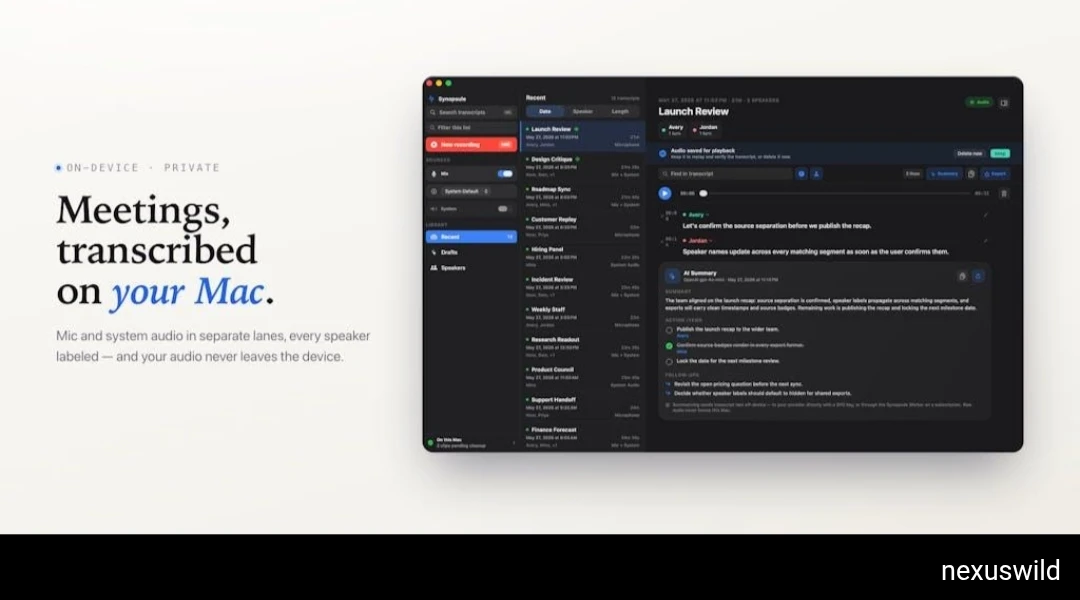

Google has released a new experimental AI application designed to help users take better meeting notes while keeping the underlying processing on their own computer.
Called Google AI Edge Foresight, the Mac application can listen to meeting audio, generate transcripts, work with user-written notes and answer questions using information available on the device.
The application is notable because Google has designed it around local-first AI processing. Rather than requiring meeting information to be continuously sent to remote servers, Foresight is built to perform its AI operations locally and can work without an internet connection.
That approach puts Foresight in the same broad category as AI meeting assistants such as Granola, but Google's emphasis is different. The company is using the application to demonstrate how increasingly capable AI models can handle useful productivity tasks directly on consumer hardware.
Foresight is powered by Google's EmbeddingGemma 2 and Gemma 4 models, combining local retrieval capabilities with generative AI functions.
Google is currently describing Foresight as an experimental application, meaning the product should be viewed as a demonstration of local AI capabilities rather than a fully established replacement for Google's mainstream productivity services.
Foresight Can Work Without an Internet Connection
The defining feature of AI Edge Foresight is its ability to operate locally.
Google says the application can work completely offline, allowing users to process meeting information even when an internet connection is unavailable.
The application can access system audio and microphone input. This means it can be used with online meetings as well as conversations taking place in the same physical room.
The local approach also means that processing does not necessarily have to depend on a cloud AI service.
For users discussing sensitive business information, confidential projects or private conversations, keeping meeting data on the computer can provide an additional privacy advantage.
However, local processing does not automatically mean that every possible privacy concern disappears. Users still need to understand how the application stores information and what permissions it has on their computer.
The important distinction is that Google's architecture is designed to keep the AI processing itself on the device.
The App Targets Apple Silicon Macs
Foresight is currently designed for macOS, with Google's implementation optimized for Apple Silicon hardware.
Apple's M-series processors have become increasingly capable of running AI models locally, making the Mac an attractive platform for demonstrating on-device generative AI.
Running AI models locally requires enough processing power and memory to handle the workload without depending on a remote server.
That makes hardware efficiency particularly important.
Google's decision to use smaller specialized models rather than relying exclusively on enormous cloud-based models reflects the broader movement toward AI systems that can run directly on consumer devices.
Foresight therefore represents both a productivity application and a technical demonstration of Google's on-device AI strategy.
Meeting Transcription Is at the Center of Foresight
Foresight can capture meeting audio and turn conversations into searchable information.
During a meeting, the application can process the conversation while users continue to write their own notes.
This creates two information streams:
- the user's own shorthand notes; and
- the AI-generated meeting context.
The combination is useful because people often cannot write down everything discussed during a meeting.
A user might type a few words such as "pricing issue" or "launch deadline" while continuing to participate in the conversation.
Foresight can then use the meeting transcript to provide additional context around those shorthand notes.
The result is intended to be more useful than a raw transcript because the AI can connect the user's notes with what was actually said during the meeting.
Users Can Ask Questions About the Meeting
Foresight is not limited to transcription.
Google has designed the application to provide contextual assistance during meetings.
Users can ask questions about information discussed in the conversation and retrieve relevant context.
For example, a participant could potentially ask about an earlier statement, a project detail or information contained in a connected knowledge source without manually searching through a long transcript.
This turns the transcript into an interactive source of information rather than simply an archive of spoken words.
The same approach can also help users after the meeting when they need to find a specific decision, statement or piece of information.
A Local Knowledge Base Adds More Context
One of the more interesting aspects of Foresight is its ability to work with additional information beyond the meeting itself.
Google says the system can use local knowledge sources to provide context for questions.
These sources can include documents and other forms of information such as:
- PDFs
- Google Docs
- Microsoft Office documents
- Plain-text files
- Markdown files
- Web bookmarks
This means the AI can potentially connect what is being discussed during a meeting with information that already exists in the user's knowledge base.
A project meeting, for example, could involve discussion about a document that has already been stored on the computer.
Instead of relying only on the words spoken during the meeting, the system can retrieve related information from the available knowledge base.
EmbeddingGemma 2 Provides the Retrieval Layer
Foresight was introduced alongside EmbeddingGemma 2, Google's new multimodal embedding model.
Google says EmbeddingGemma 2 contains 740 million parameters and is designed to support retrieval and search across different types of information.
Unlike a conventional chatbot model whose primary purpose is generating text, an embedding model converts information into numerical representations that allow related content to be identified.
EmbeddingGemma 2 is designed to work with multiple modalities, including:
- text
- code
- images
- video
- audio
That multimodal capability is important for local knowledge systems because information does not always exist in a simple text document.
A user's personal information could include documents, images, recorded audio or other media.
By representing different types of content in a shared embedding space, the model can help applications identify relevant information across those sources.
Gemma 4 Handles Generative AI Tasks
Foresight also uses Gemma 4 models.
While EmbeddingGemma 2 helps with retrieval and contextual search, Gemma 4 provides the generative capabilities needed to interact with the retrieved information.
This creates a local AI pipeline in which information can be captured, searched and then used to generate responses.
The basic concept can be represented as:
Meeting audio → transcription and context → local retrieval → Gemma processing → notes and answers
The significance is not simply that the system uses Google's Gemma models.
It demonstrates how multiple smaller AI components can be combined to create a useful productivity application without requiring every operation to be performed in the cloud.
Foresight Takes Aim at a Growing AI Meeting Market
AI-powered meeting notes have become an increasingly competitive category.
Companies such as Granola have popularized workflows in which users can write notes while AI provides additional meeting context.
Other productivity companies have also introduced AI meeting assistants, transcription services and automated summaries.
The basic promise is straightforward: people spend less time manually documenting meetings and more time participating in them.
Google's Foresight enters this market with a different selling point.
Its strongest distinction is local-first processing.
Rather than competing solely on meeting integrations or cloud-based AI capabilities, Google is demonstrating what can be done when the models and retrieval system operate directly on the user's machine.
Privacy Is a Major Part of the Local AI Argument
Meeting recordings and transcripts can contain extremely sensitive information.
Business discussions may involve:
- financial results
- product plans
- customer information
- internal strategy
- intellectual property
- employee discussions
- unreleased projects
Sending such information to an external cloud service can create additional privacy and compliance considerations.
A local AI system can reduce some of those concerns because information does not need to leave the device for every inference request.
This is one reason local AI has become an increasingly important area of development.
The approach is not limited to meeting assistants.
The same technology can be applied to personal search, document analysis, coding assistants, note-taking and other productivity applications.
Offline AI Could Change How Productivity Tools Work
The ability to operate without an internet connection also changes the potential use cases.
A conventional cloud AI assistant can become unavailable when connectivity is poor.
A local system can continue operating as long as the computer has sufficient resources.
That could be useful for travelers, people working in locations with unreliable connectivity and organizations that restrict cloud access to sensitive information.
It can also reduce dependence on network latency.
When an AI model runs locally, the application does not necessarily have to send a request to a remote server and wait for a response.
The actual speed will depend on the Mac's hardware, the size of the models and the complexity of the task, but the architecture itself removes one layer of network dependency.
Smaller AI Models Are Becoming More Important
Foresight also highlights a broader shift in artificial intelligence.
The industry initially focused heavily on increasingly large models running in massive data centers.
More recently, developers have been exploring smaller models that can perform specialized tasks directly on phones, laptops and other edge devices.
The advantage is not always raw intelligence.
A smaller model can be more practical if it is fast, efficient and capable enough for a particular task.
EmbeddingGemma 2 illustrates that approach by concentrating on retrieval rather than attempting to be a general-purpose conversational model.
Combining specialized models can allow developers to build complete AI applications without requiring a single enormous model to perform every operation.
Foresight Is Still an Experimental Product
Despite the Google name behind it, Foresight should not yet be treated as a mature Google productivity service.
Google describes it as an experimental app.
That distinction matters.
The application demonstrates what local AI can do today, but Google has not announced that Foresight will become a permanent mainstream product or that its functionality will necessarily be integrated into Gemini.
There is also no confirmed announcement of versions for Windows, Android or iPhone.
For now, its primary role appears to be demonstrating Google's AI Edge technology on Apple Silicon Macs.
The App Could Influence Google's Broader AI Strategy
The most interesting question may be what Google does with the technology next.
Google has invested heavily in cloud AI through Gemini and its large-scale data-center infrastructure.
At the same time, the company has increasingly explored AI running directly on devices.
Android smartphones already use on-device AI for a range of functions, while Google's Gemma family gives developers access to models that can be deployed locally.
Foresight extends that strategy to a more complete productivity workflow.
Instead of simply running a small AI feature locally, the application attempts to combine audio processing, retrieval, contextual understanding and generative responses into one local system.
If the approach proves effective, similar architectures could eventually appear in more consumer and enterprise applications.
Local Processing Does Not Mean Unlimited AI Performance
There are still technical limitations.
Cloud AI services have access to powerful data-center hardware that can run extremely large models.
A laptop has a much smaller hardware budget.
Local applications therefore have to balance model size, memory usage, processing speed and battery or power consumption.
That means an offline AI assistant may not always match the capabilities of the largest cloud-based models.
Google's approach with Foresight is instead to combine specialized models and optimize the workload for the hardware available.
Whether that produces a sufficiently strong experience will depend on real-world use.
Google Is Showing What AI Can Do Without the Cloud
Foresight's importance therefore extends beyond meeting notes.
The application is a practical demonstration of Google's vision for AI Edge computing.
The idea is that useful AI does not always need to send personal data to a remote server.
Instead, a growing number of AI tasks can be performed directly on the user's hardware.
Meeting transcription and note-taking are particularly suitable examples because they involve information that users may not want to upload unnecessarily.
The technology could eventually support much broader categories of private, personalized AI applications.
What Happens Next
For now, Google has not announced a major expansion plan for Foresight.
The immediate focus is the experimental Mac application and the technologies behind it.
Future developments could include additional hardware support, broader operating-system availability or integration with other Google AI products, but those possibilities remain speculative until officially announced.
The company's release of EmbeddingGemma 2 nevertheless gives developers another building block for creating local AI applications.
That may ultimately prove more significant than Foresight itself.
Developers can use the underlying model and Google AI Edge technologies to experiment with their own privacy-focused applications.
Conclusion
Google's AI Edge Foresight represents a notable experiment in local AI productivity.
The Mac application can capture meeting audio, generate transcripts, improve user-written notes and answer contextual questions while keeping its AI processing on the device.
Its combination of EmbeddingGemma 2 and Gemma 4 demonstrates how specialized models can work together to create a sophisticated AI workflow without depending entirely on cloud infrastructure.
EmbeddingGemma 2 brings multimodal retrieval capabilities, with Google describing the 740-million-parameter model as capable of working across text, code, images, video and audio.
Foresight also demonstrates why local AI is becoming increasingly relevant.
For sensitive meetings, offline work and users concerned about sending personal information to cloud services, on-device processing can offer meaningful advantages.
At the same time, the product remains experimental. Google has not announced Foresight as a replacement for Gemini or confirmed versions for Windows, Android or iOS.
Its most important contribution may therefore be as a demonstration of what modern laptops can do with smaller, specialized AI models.
As AI moves beyond cloud-only systems, applications such as Foresight could become an important part of the next stage of personal computing — where the computer itself becomes capable of understanding, searching and assisting with a user's information without constantly sending that information elsewhere.
Topics
Technology · Artificial Intelligence · Google · AI Productivity · Local AI · Mac · Software
Corrections and updates
Nexuswild welcomes factual corrections. Email contact@nexuswild.com with evidence and the article URL.
Reader feedback
Help us improve the next report. Share your experience with Nexuswild on Trustpilot.
Trustpilot: Nexuswild
Article information
Section: Technology Author: Editorial Desk Published: October 8, 2026 Last updated: October 8, 2026 Length: Approximately 1,700 words Access: Open access
Related coverage
RedMagic 12 Pro+ Design Revealed With Snapdragon 8 Elite Extreme Gen 6
Technology · 8 min
RedMagic has revealed the full design of its upcoming gaming flagship, including three transparent-inspired finishes, an under-display camera and an advanced cooling system.
Duke Mathematics Degree Tops New College Earnings Data at $297,029
Business · 8 min
New federal earnings data shows unusually high reported earnings for graduates in Duke University's mathematics field of study.
ElevenLabs Plans Hundreds of Millions of Dollars in India
Technology · 7 min
ElevenLabs is preparing a major India expansion as demand for AI voice technology and local-language applications continues to grow.
Read next
RedMagic 12 Pro+ Design Revealed With Snapdragon 8 Elite Extreme Gen 6 Technology · 8 min
Google Expands Gemma Models for On-Device AI Applications Technology · 8 min
Samsung Forecasts Record $80 Billion Profit as AI Memory Boom Surges Technology · 9 min
AI Moves From Cloud Data Centers to Personal Devices Technology · 9 min
Nexuswild
Global news, independent analysis and public-interest reporting.
About · Editorial standards · AI policy · Corrections · Authors · Contact · Submit · Advertise · Resources · Careers · Support · Premium · Privacy · Terms · Legal · Cookies · Policies · Commercial policy · Disclaimer · Brand assets · Investor relations · News videos · Today's newspaper · Games · RSS · Sitemap · Trustpilot · Privacy choices
© 2026 Nexuswild. Operated by Nexuswild Newsrooms Private Limited. All rights reserved.
contact@nexuswild.com
Nexuswild welcomes factual corrections. Email contact@nexuswild.com with evidence and the article URL.