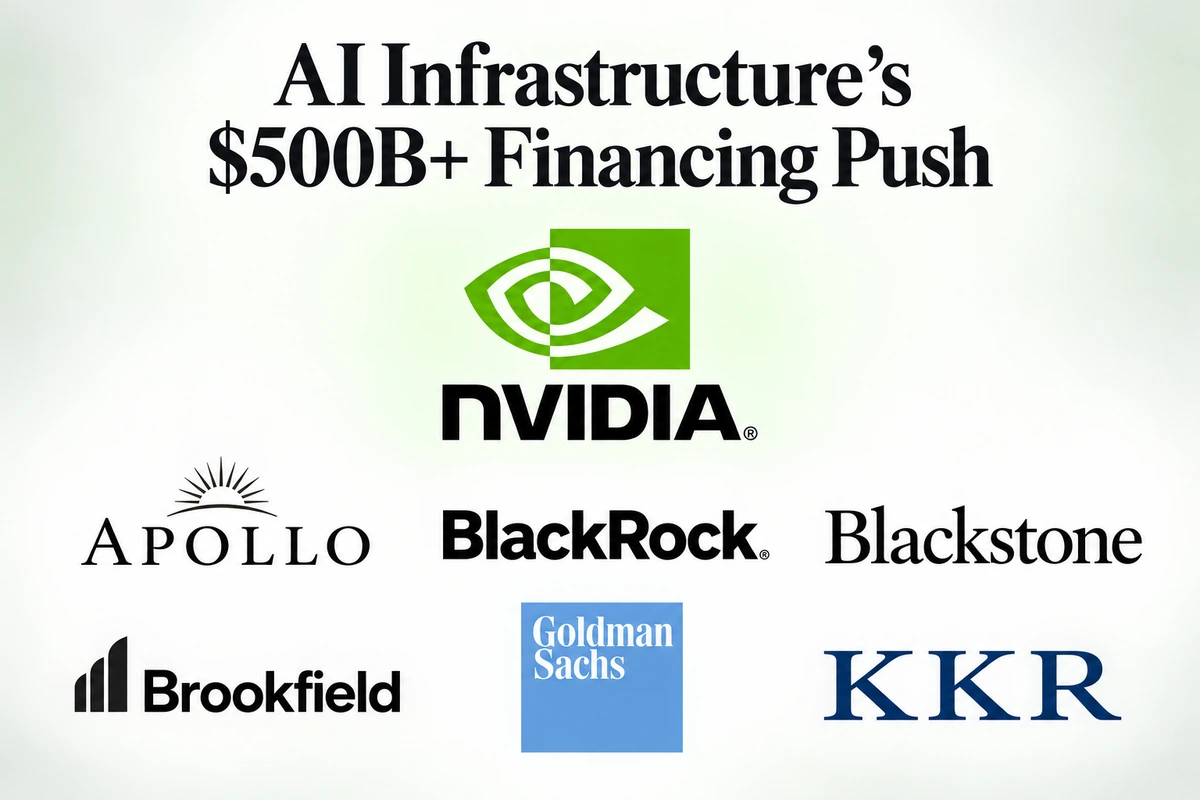

Nvidia is trying to change the way the world finances artificial intelligence.
The chipmaker has partnered with Apollo, BlackRock, Blackstone, Brookfield, Goldman Sachs and KKR to create independent financing platforms designed to mobilize more than $500 billion of third-party capital for AI infrastructure over time.
The headline number is enormous, but it needs careful interpretation.
Nvidia is not announcing that it will spend $500 billion itself. The company and six major financial institutions have signed memorandums of understanding aimed at creating dedicated pools of capital that can finance Nvidia-powered AI factories, including infrastructure used by frontier AI labs, enterprises and AI cloud providers.
The partnerships remain subject to final agreements.
That distinction is important because the announcement is not simply another data-center spending plan. Nvidia is attempting to establish AI compute as a financeable infrastructure asset that can attract insurance money, private credit, infrastructure funds, pensions and other pools of long-duration capital.
If the model works, the AI boom would become less dependent on the balance sheets of a small number of technology companies.
It would also strengthen Nvidia’s position far beyond selling GPUs.
The company would sit at the center of an ecosystem in which financial institutions fund the hardware, data centers and power systems that make Nvidia compute available to customers that may not want to spend billions of dollars upfront.
As of September 8, 2026, the financing initiative is still an architecture rather than a completed $500 billion deployment. But the direction is already clear: Wall Street is beginning to treat AI compute more like infrastructure than ordinary technology equipment.
What Nvidia actually announced
Nvidia announced the partnerships on August 10, 2026.
The company said it had signed memorandums of understanding with Apollo, BlackRock, Blackstone, Brookfield, Goldman Sachs and KKR.
The goal is to create independent compute-financing platforms capable of mobilizing more than $500 billion in third-party capital over time.
The platforms are intended to provide large pools of capital at attractive financing rates to Nvidia customers that need AI infrastructure.
The potential users include:
- frontier artificial-intelligence laboratories,
- enterprises,
- sovereign and government AI programs,
- cloud companies,
- specialized AI infrastructure providers,
- other operators building Nvidia-powered AI factories.
Nvidia describes its full-stack compute as an investable asset because the hardware can produce revenue through AI workloads and is supported by the CUDA software ecosystem.
The company argues that its compute is flexible across different models and customers, making it more transferable than highly specialized equipment tied to one application.
That claim is central to the financing model.
A lender is more willing to finance an asset when it believes another customer can use that asset if the original borrower fails.
The $500 billion number is not a single fund
The most important fact in the announcement is also the easiest to misunderstand.
There is no single $500 billion Nvidia fund sitting in a bank account.
The initiative is designed to mobilize more than $500 billion of third-party capital through multiple financing platforms over time.
That capital could come from different structures and different investors.
Infrastructure equity may fund data-center ownership.
Private credit can provide debt.
Insurance balance sheets can supply long-duration capital.
Banks can structure and distribute financing.
Asset managers can raise funds from institutional investors.
Projects may combine equity, debt, long-term leases and usage contracts.
The $500 billion figure therefore represents potential financing capacity across an ecosystem, not a completed capital commitment on day one.
Nvidia also states that the partnerships are subject to definitive agreements.
Any authoritative reading of the announcement has to keep those conditions attached to the headline number.
Why Nvidia wants Wall Street involved
AI infrastructure has become too expensive to be financed only through ordinary technology budgets.
A modern AI factory can require spending on:
GPU systems, networking, storage, land, buildings, cooling, transformers, electricity generation, grid connections, backup power, fiber infrastructure, software, operations.
The GPU is only one part of the bill.
As models become larger and inference demand rises, customers need more compute for longer periods.
That creates a financing problem.
Many AI companies can generate rapidly growing revenue while still consuming enormous amounts of cash.
A startup may have strong demand for its model but not have enough capital to buy billions of dollars of hardware upfront.
A government may want sovereign AI infrastructure but prefer to spread payments across many years.
An enterprise may want guaranteed compute capacity without owning a data center.
The financing platforms are designed to bridge that gap.
Nvidia is trying to turn GPUs into infrastructure
Historically, computer hardware has been treated as equipment.
Equipment depreciates quickly.
New generations make old machines less valuable.
That makes long-term financing difficult.
Infrastructure is different.
Power plants, airports, pipelines, telecom towers and data centers can generate contracted cash flows for years.
Nvidia wants institutional investors to think about AI factories closer to the second category.
Jensen Huang has described the shift with a simple phrase: in AI, compute is revenue.
That statement captures the economic thesis behind the financing platforms.
An AI server is not valuable only because of its resale price.
It is valuable because customers can rent its capacity and use it to train models, serve inference, run agents and generate software revenue.
If an Nvidia system can produce predictable usage income, financiers can underwrite the cash flow rather than looking only at the hardware’s depreciation schedule.
That turns the asset from a piece of technology into a productive financial instrument.
The most important concept is usage-linked revenue
The new platforms are designed around long-duration usage-linked economics.
A conventional data-center investment often begins with long-term leases.
A hyperscaler agrees to occupy capacity for years.
The landlord borrows against that contract.
AI compute can extend the model.
Instead of financing only the building, investors can finance the computing equipment inside it.
Revenue may come from customers purchasing reserved GPU capacity, cloud contracts or long-term compute offtake arrangements.
The stronger the offtake agreement, the more financeable the project becomes.
For creditors, the key questions become:
Who is paying for the compute?
How long is the contract?
How creditworthy is the customer?
Can the GPU capacity be reassigned if the customer defaults?
How fast does the hardware lose economic value?
How much revenue does each unit of compute generate?
Those questions will determine whether GPU-backed infrastructure can support cheap institutional debt.
Why Apollo matters
Apollo brings one of the world’s largest pools of private credit and long-duration capital.
As of June 30, 2026, Apollo reported approximately $1.05 trillion in assets under management.
Its business includes credit strategies ranging from investment-grade lending to more complex private financing.
That makes Apollo particularly relevant to Nvidia’s objective.
The AI buildout requires enormous debt capacity.
Technology companies can fund some spending from cash flow, but the scale of the infrastructure cycle increasingly requires capital from outside traditional bank loans and corporate bonds.
Private-credit managers can design loans around specific assets, projects and revenue contracts.
Apollo President Jim Zelter described modern compute as a scarce, mission-critical asset with long-term investment characteristics.
The statement indicates how infrastructure investors are beginning to frame the sector.
Why BlackRock matters
BlackRock gives Nvidia access to one of the largest institutional-capital networks in the world.
It also already has experience building AI infrastructure investment vehicles.
BlackRock, Global Infrastructure Partners, Microsoft and MGX created the AI Infrastructure Partnership with an initial goal of unlocking $30 billion of equity capital and mobilizing up to $100 billion when debt financing was included.
Nvidia later joined that platform while continuing as a technical adviser.
The new Nvidia financing initiative therefore builds on an existing relationship rather than starting from zero.
BlackRock CEO Larry Fink said the AI buildout would require unprecedented investment.
The financing challenge is not simply finding capital.
It is connecting long-term investors with projects that have credible power supply, customers, technology and construction plans.
Why Blackstone matters
Blackstone is one of the world’s largest alternative-asset managers, with more than $1.3 trillion in assets under management according to the Nvidia announcement.
It already invests across data centers, power, real estate, credit and digital infrastructure.
That combination is valuable because an AI factory is not a pure technology asset.
The investor may need to understand real estate, energy, construction, credit and computing at the same time.
Blackstone President and COO Jon Gray said the group is already a large investor across Nvidia’s ecosystem.
For Nvidia, that creates another channel through which capital can move from institutional portfolios into AI infrastructure.
Why Brookfield matters
Brookfield’s role is especially significant because AI compute ultimately depends on physical infrastructure and electricity.
Brookfield manages more than $1 trillion and has deep exposure to power, utilities, renewable energy, data infrastructure and real assets.
An AI data center cannot operate because GPUs exist.
It needs a site.
It needs power.
It needs grid access.
It needs cooling.
It needs construction.
It needs energy contracts that can support continuous high-density computing.
Brookfield CEO Bruce Flatt described compute as an essential infrastructure layer.
That is exactly the thesis Nvidia needs institutional investors to accept.
Why Goldman Sachs matters
Goldman Sachs can play several roles at once.
It can advise.
It can structure credit.
It can distribute debt.
It can connect projects to institutional investors.
It can help create a secondary market for financing instruments.
Goldman CEO David Solomon said the firm sees an opportunity to create a market for credit backed by Nvidia compute.
That may become one of the most important parts of the announcement.
The biggest transformation would not be one $10 billion financing.
It would be the creation of a repeatable market in which Nvidia-powered compute can be underwritten, rated, financed and traded using standardized structures.
That is how infrastructure markets scale.
Why KKR matters
KKR combines private equity, infrastructure, credit, capital markets and insurance-linked capital.
Its co-CEOs Joe Bae and Scott Nuttall emphasized that delivery, rather than ambition, is the difficult part of AI infrastructure.
That is a critical point.
Announcing a data center is easy.
Securing land, power, permits, equipment, customers and financing is much harder.
The industry is increasingly discovering that capital alone does not solve physical constraints.
This is one reason experienced infrastructure investors matter.
They are used to projects that take years to build and require coordination across regulators, utilities, contractors and customers.
Nvidia may have its own capital at risk
Reuters reported in August that Jensen Huang said Nvidia could backstop up to $125 billion, or roughly 25% of potential transactions.
The figure should be treated separately from Nvidia’s formal press release because it was reported through subsequent coverage rather than stated as a completed commitment in the announcement.
If Nvidia does provide guarantees or backstops, the strategy could accelerate financing.
A lender may accept a lower return when a financially strong technology company shares part of the risk.
But it would also change Nvidia’s financial exposure.
The company would no longer be simply a supplier paid when hardware ships.
It could become economically connected to the performance of the infrastructure financed around its products.
That raises both strategic upside and risk.
Why the model could accelerate Nvidia hardware sales
The most obvious benefit for Nvidia is demand.
Financing makes expensive equipment easier to buy.
A customer that cannot spend $5 billion upfront may still be able to commit to a long-term compute contract.
The financing platform supplies the capital.
The infrastructure company buys Nvidia hardware.
The customer pays over time through usage or lease payments.
The basic economic chain becomes:
institutional capital → AI infrastructure → Nvidia systems → compute capacity → customer payments.
Nvidia can potentially sell more hardware without requiring every customer to finance the purchase directly from its own balance sheet.
CUDA becomes a financial asset
CUDA is normally discussed as a software moat.
In this financing strategy, it also becomes part of the collateral thesis.
A GPU that supports a broad software ecosystem may be easier to redeploy than hardware tied to a narrow stack.
If one customer fails, another customer may still want the capacity.
That improves fungibility.
Financiers care about fungibility because it can improve recovery value.
A highly specialized machine with only one potential user is risky collateral.
A broadly supported compute platform with thousands of applications and many potential customers can be more attractive.
Nvidia argues that continuous CUDA software improvements can also extend the productive life of its systems.
Whether lenders ultimately assign meaningful residual value to older GPU generations will be one of the biggest tests of the model.
The central risk: AI hardware depreciates faster than traditional infrastructure
A power plant can operate for decades.
A bridge may last for generations.
GPUs exist in a much faster technology cycle.
New chips can dramatically improve performance per watt and cost per token.
That creates a mismatch.
The financing may last years while the underlying hardware can become economically less competitive much sooner.
The problem is not that an older GPU stops working.
The problem is that a newer system may generate the same number of tokens with fewer chips and less electricity.
That can reduce the price customers are willing to pay for older capacity.
Financiers will therefore focus heavily on:
contract duration, customer credit quality, depreciation assumptions, residual value, upgrade cycles, redeployment options.
The safest projects may be those where long-term customer commitments repay most of the investment before technology risk becomes severe.
September’s credit market is already showing more discipline
The timing of Nvidia’s financing push matters.
By early September, the market was beginning to scrutinize AI debt more carefully.
Reuters Breakingviews reported on September 8 that AI-related debt issuance had approached $500 billion by early August and that investors were becoming more selective as construction delays, power constraints and execution risks increased.
Creditors were demanding stronger protections.
Projects increasingly needed credible leases, permits and contractual safeguards before lenders were willing to release capital on attractive terms.
That backdrop strengthens the logic of Nvidia working with specialist financial institutions.
The next phase of AI financing will not simply reward the largest announcement.
It will reward projects that can demonstrate contracted demand and deliver physical infrastructure on schedule.
Power may matter more than capital
The $500 billion headline makes finance look like the central constraint.
It may not be.
Electricity is becoming one of the hardest bottlenecks in AI infrastructure.
A financing platform can raise money quickly.
Building generation and transmission can take years.
Data centers require grid interconnections, transformers, substations and reliable power supply.
In some regions, developers can secure land and financing long before they can secure electricity.
That creates stranded-capital risk.
A $5 billion AI campus with no power is not productive infrastructure.
This is why asset managers with energy expertise, such as Brookfield and Blackstone, are important to the Nvidia strategy.
Construction risk is another major issue
AI data centers are moving toward extremely high power density.
That changes engineering requirements.
Cooling becomes more difficult.
Electrical systems become more complex.
Networking becomes more important.
Construction schedules become harder to manage.
Supply chains for transformers and other grid equipment can create delays.
If a project begins generating revenue six months later than expected, interest costs continue while cash flow does not.
That matters enormously when billions of dollars of debt are involved.
Infrastructure investors are therefore likely to finance projects in stages rather than releasing all capital immediately.
Customer concentration could become a credit risk
The biggest AI infrastructure customers are concentrated among a small number of companies.
Frontier AI labs, hyperscalers and large cloud providers can account for enormous amounts of demand.
That creates strong contracts when the customer is financially healthy.
It also creates concentration risk.
If a data center is designed around one AI lab and that company loses market share, restructures or cannot meet its obligations, the financing structure may come under pressure.
The quality of the offtaker may become more important than the quality of the GPU.
This is familiar in infrastructure finance.
A power plant is only as valuable as the customers purchasing its electricity.
An AI factory may increasingly be judged the same way.
The Nvidia initiative could create an AI asset-backed credit market
The most ambitious possibility is that compute-backed credit becomes standardized.
Imagine a portfolio of Nvidia GPU clusters spread across multiple data centers.
Each cluster is leased to several customers under multi-year agreements.
The cash flows are pooled.
Debt is issued against the portfolio.
Institutional investors buy the debt.
If the structure performs well, more capital enters the market.
Borrowing costs fall.
More AI infrastructure becomes financeable.
This is broadly how mature asset-backed markets develop.
The important word is if.
The industry still has limited history showing how GPU assets behave across a full technology and credit cycle.
Why the financing model matters for smaller AI companies
The largest technology companies can issue bonds.
Smaller AI companies have fewer options.
They can raise venture capital.
They can sign cloud contracts.
They can borrow privately.
Or they can use infrastructure partners that own the GPUs.
Nvidia’s financing initiative could expand the last option.
An AI startup may be able to access thousands of GPUs without raising enough equity to buy them.
That can reduce dilution for founders and investors.
But it does not eliminate cost.
The infrastructure owner still expects a return.
The startup must generate enough revenue to cover long-term compute payments.
The model therefore moves capital expenditure into contracted operating commitments.
Why sovereign AI could become a major customer
Nvidia specifically refers to countries and governments as drivers of infrastructure demand.
Sovereign AI has become an important market.
Governments increasingly want domestic computing capacity for security, research, language models and public services.
But many countries cannot justify building a fully owned hyperscale AI system immediately.
Financing platforms can offer another route.
Institutional capital funds the infrastructure.
The government or a national operator signs a long-term usage agreement.
Nvidia supplies the technology.
This structure could expand AI infrastructure into markets that would otherwise struggle to fund the upfront cost.
What it means for Nvidia investors
The financing strategy potentially expands Nvidia’s addressable market.
It could accelerate system sales.
It could deepen CUDA adoption.
It could make Nvidia architecture the default standard used in long-duration infrastructure projects.
It could also create a new layer of recurring demand tied to upgrades and software.
But investors should not treat $500 billion of potential third-party capital as Nvidia revenue.
The capital funds infrastructure.
Only part of it would ultimately be spent on Nvidia products.
Other portions will go to buildings, power, networking, cooling, construction, financing costs and operations.
The initiative could support Nvidia’s ecosystem without translating dollar-for-dollar into Nvidia sales.
What it means for BlackRock, Apollo, KKR and other capital providers
For asset managers, AI infrastructure offers a new place to deploy enormous pools of capital.
The opportunity is especially attractive if projects can produce:
long-duration cash flow, contracted usage, inflation-linked pricing, strong counterparties, real asset collateral, technology-linked growth.
But the risks are unusual.
Unlike conventional infrastructure, the core computing equipment has rapid technological obsolescence.
The revenue may depend on highly competitive AI companies.
Energy markets can change.
Regulation can change.
Customers may migrate to custom chips.
Nvidia itself faces competition from AMD, Google, Amazon, Microsoft and specialized accelerator companies.
This means investors will demand returns that compensate for technology risk.
Why custom chips are a long-term threat to the financing thesis
Nvidia is dominant in accelerated computing, but large customers increasingly design their own processors.
Google has TPUs.
Amazon has Trainium and Inferentia.
Microsoft has custom AI silicon.
Other hyperscalers and AI companies are investing in their own hardware.
If custom chips become significantly cheaper for specific workloads, Nvidia GPU rental prices could face pressure.
That affects both Nvidia and the financiers lending against Nvidia-based infrastructure.
The defense is flexibility.
Nvidia argues that its platform is broadly usable across models and workloads.
Custom chips often win through specialization.
Nvidia wins when customers value general-purpose accelerated computing and software compatibility.
The financing model therefore depends partly on that flexibility remaining economically important.
BlackRock’s earlier AI infrastructure partnership shows the playbook
The Nvidia plan is not Wall Street’s first attempt to institutionalize AI infrastructure.
BlackRock, Global Infrastructure Partners, Microsoft and MGX launched an AI Infrastructure Partnership in 2024.
The platform initially sought $30 billion of equity capital and up to $100 billion of total investment potential when debt was included.
Nvidia later joined the group while remaining a technical adviser.
That earlier partnership gives the market a useful template.
The industry is gradually moving from individual data-center projects toward large financing platforms that can repeatedly fund infrastructure across multiple locations.
Nvidia’s new initiative expands the concept dramatically by connecting directly with six major financial institutions.
This is also a competitive strategy
The financing platform does more than solve a customer problem.
It can reinforce Nvidia’s competitive moat.
If a data center is financed around Nvidia hardware, uses Nvidia networking, follows Nvidia’s DSX architecture and serves customers built on CUDA, switching platforms becomes more difficult.
Capital can create ecosystem lock-in.
A company choosing an accelerator is not only choosing a chip.
It may also be choosing the financing structure, software stack and infrastructure architecture surrounding that chip.
That could make Wall Street capital a competitive weapon.
The biggest misunderstanding: finance does not eliminate AI economics
Cheap financing cannot rescue a project that does not generate useful demand.
A GPU cluster needs customers.
Those customers need revenue.
Their AI products need end users willing to pay.
If AI applications fail to generate sufficient economic value, infrastructure utilization falls.
If utilization falls, compute prices fall.
If compute prices fall below financing assumptions, debt becomes harder to service.
The entire model therefore rests on one fundamental assumption:
AI demand will grow enough to keep expensive compute productively occupied.
This is why Nvidia repeatedly emphasizes cost per token and revenue generation.
The financier ultimately cares about cash flow.
What to watch next
Several developments will determine whether Nvidia’s $500 billion ambition becomes a durable financing market.
The first is definitive agreements. The August announcement is based on memorandums of understanding.
The second is actual capital raised and deployed.
The third is the structure of Nvidia guarantees or backstops.
The fourth is borrowing cost.
If the platforms can finance AI factories materially cheaper than existing alternatives, customers will have a strong incentive to use them.
The fifth is contract quality.
Long-term usage commitments from strong counterparties can make projects far easier to finance.
The sixth is residual value.
Investors need evidence that older Nvidia systems remain productive enough to preserve meaningful value.
The seventh is power availability.
No financing structure can overcome a data center that cannot connect to the grid.
Bottom line
Nvidia’s partnership with Apollo, BlackRock, Blackstone, Brookfield, Goldman Sachs and KKR may become one of the most important financial experiments of the AI boom.
The company is trying to move AI compute from the technology budget into the infrastructure-finance market.
The objective is to mobilize more than $500 billion of third-party capital over time and make Nvidia-powered AI factories easier to finance for cloud providers, enterprises, governments and frontier AI labs.
But the headline requires discipline.
The $500 billion is not Nvidia’s own spending.
It is not fully deployed capital.
The partnerships are based on memorandums of understanding and remain subject to final agreements.
What is real is the structural shift behind the announcement.
AI infrastructure has become so capital intensive that chips can no longer be separated from finance, power, credit and long-duration investment.
Wall Street is being asked to underwrite compute the way it has historically underwritten infrastructure.
For Nvidia, that could create another moat around its platform.
For investors, it could create a new asset class.
For the financial system, it creates a new question that has not yet been tested through a full cycle:
Can an asset that becomes technologically old in a few years be financed like infrastructure designed to last for decades?
The answer will determine whether Nvidia’s $500 billion vision becomes a repeatable global market or one of the most ambitious financing experiments of the AI era.
Reader questions
Frequently asked questions
What is Nvidia’s $500 billion AI financing plan?
Nvidia is working with Apollo, BlackRock, Blackstone, Brookfield, Goldman Sachs and KKR to create independent financing platforms designed to mobilize more than $500 billion of third-party capital for AI compute infrastructure over time.
Is Nvidia investing $500 billion itself?
No. The more than $500 billion figure refers to third-party capital the proposed financing platforms aim to mobilize over time. It is not a $500 billion Nvidia capital expenditure commitment.
Has the full $500 billion already been committed?
No. Nvidia announced memorandums of understanding with the six financial institutions, and the partnerships remain subject to definitive agreements.
Which financial firms are partnering with Nvidia?
The announced partners are Apollo, BlackRock, Blackstone, Brookfield, Goldman Sachs and KKR.
Why does Nvidia call AI compute an investable asset?
Nvidia argues that its compute can generate revenue through long-term AI usage, serve multiple models and customers, and be supported by the CUDA ecosystem, potentially allowing financiers to underwrite it using infrastructure-style cash-flow models.
Will Nvidia guarantee the financing?
Reuters reported that Jensen Huang said Nvidia could backstop up to $125 billion, or around 25% of potential deals. The final structures depend on definitive agreements and individual transactions.
What are the biggest risks in GPU-backed infrastructure finance?
Major risks include rapid hardware depreciation, power and construction delays, customer concentration, lower-than-expected utilization, competition from custom chips and uncertainty over the residual value of older GPU systems.
How could the financing plan benefit Nvidia?
It could make Nvidia-powered infrastructure easier for customers to access, accelerate hardware demand, expand CUDA adoption and make Nvidia’s architecture more deeply embedded in long-duration AI infrastructure projects.
Nexuswild welcomes factual corrections. Email contact@nexuswild.com with evidence and the article URL.