
A few minutes after Apple introduced its first foldable iPhone, one of the most revealing product demonstrations of the day did not happen inside the polished keynote. It happened in front of IShowSpeed's livestream camera.
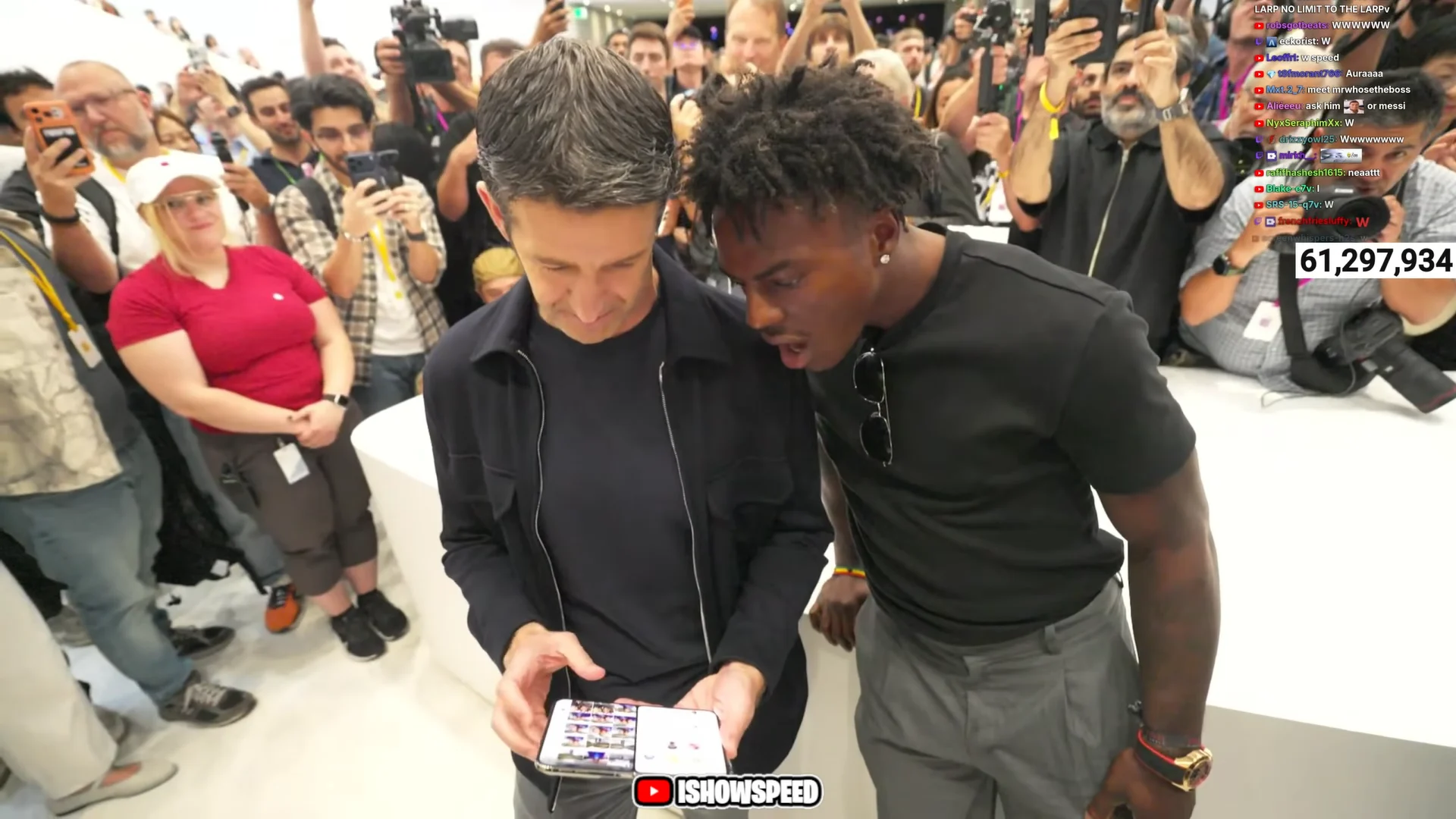
At Apple Park in Cupertino on September 9, 2026, the YouTube creator met Apple's new chief executive John Ternus in the hands-on area after the company's September product event. Ternus handed him the newly announced iPhone Duo, Apple's $1,999 foldable phone, and the encounter quickly became one of the event's most widely shared unscripted moments.
Speed reacted in his usual high-energy style. He asked to hold the device, explored the foldable screen, requested a selfie with the CEO and later performed a backflip while holding the phone. But another part of the interaction attracted a different kind of attention online.
Viewers slowed down the livestream and focused on the seconds around the selfie and a later drag-and-drop demonstration. Some interpreted Ternus's visible hand movement and facial expression as nervousness. Others pointed to a gesture that appeared not to complete on the first attempt before succeeding on a retry. Social-media posts quickly turned the moment into jokes about Apple's preference for tightly controlled, prerecorded product presentations.
The viral interpretation is entertaining. The evidence deserves more discipline.
The video does show an unscripted interaction between a newly appointed CEO, one of the internet's most unpredictable creators and hardware that will not reach customers until October. It also appears to show at least one moment in which an on-screen drag action does not complete as intended on the first try.
What the video does not establish is why Ternus's hands moved, whether he was nervous, whether a software defect caused the missed gesture, or whether the incident reveals a wider reliability problem with the iPhone Duo. Those are different claims.
That distinction is what makes the moment interesting beyond the meme.
What happened between IShowSpeed and John Ternus?
The encounter took place after Apple's September 9 launch at Apple Park.
Independent coverage from Reuters, The Independent and other outlets confirms that IShowSpeed met John Ternus in the hands-on area, handled the iPhone Duo, took a selfie with the CEO and later performed a backflip while holding the new foldable.
In Speed's livestream, the encounter begins at roughly 1:32:37. He congratulates Ternus on the iPhone Duo launch and asks to handle the device. Ternus gives him the phone, allowing Speed to fold and explore it.
Around 1:33, Speed asks for a selfie. The selfie is captured around 1:33:28 in the stream.
Seconds later, Ternus takes control of the phone and demonstrates another camera configuration. That detail is technically important because iPhone Duo is designed specifically to let users take selfies with its higher-resolution rear cameras while using the outer screen as a live preview.
Apple calls that experience Duo Preview.
So the CEO taking the device and changing the camera arrangement should not automatically be interpreted as an attempt to avoid the iPhone Duo's under-display camera. There is a legitimate product feature he had reason to demonstrate.
The camera switch has a technical explanation
The iPhone Duo contains more than one front-facing camera experience.
Apple's official specifications list a camera beneath the inner display for FaceTime. The company says the under-display unit supports 1080p video.
The phone also includes higher-resolution external cameras, including a 48-megapixel Fusion Main camera and a 48-megapixel Fusion Ultra Wide camera.
Because the phone folds, Apple can use the outer display as a viewfinder while the rear cameras face the people taking the picture. That means a user can take a higher-quality selfie using the rear camera system while still seeing the composition on the second display.
Apple specifically promotes this functionality.
In other words, when Ternus moved the phone into another camera orientation during the Speed interaction, there was a clear product reason for doing so.
Online speculation that he switched cameras because the internal camera was malfunctioning is possible as a theory, but the livestream alone does not prove it.
That is an important distinction for factual reporting.
Then viewers noticed the hands
The internet focused heavily on Ternus's body language.
Clips circulating from the encounter show visible movement in his hands while manipulating the device. Some Reddit users described him as "shaking" and interpreted the moment as nervousness.
Other commenters offered more ordinary explanations, including the pressure of demonstrating a brand-new device while surrounded by cameras and standing next to an exceptionally energetic livestreamer.
There is no factual basis for diagnosing a medical condition, drug use or any other health explanation from a short video.
Those claims circulating in comment sections are speculation and should be treated as such.
Body language is not a medical test. It is also not a reliable way to determine whether an executive believes a product is malfunctioning.
What can be reported is that viewers noticed the movement, discussed it and turned it into part of the viral narrative. Anything beyond that would be an inference.
The drag-and-drop moment is more interesting
Later in the same interaction, Ternus demonstrates software on the iPhone Duo.
At approximately 1:33:44 in the stream sequence highlighted by viewers, a drag gesture appears not to produce the intended result immediately. A subsequent attempt works.
That is the moment that has driven many of the "Apple demo bug" posts.
Posts on Reddit and X have circulated clips claiming that drag and drop failed once or more before succeeding. Some users have grouped the moment together with other alleged software glitches noticed during hands-on demonstrations of the Duo.
But one missed interaction does not establish the cause.
Touchscreen gestures can fail because a finger does not remain on the target long enough, because a drag begins from the wrong point, because software misses the gesture, because the interface is still responding to another animation, or because the operator simply attempts the action differently.
Without diagnostic logs, it is impossible to say which explanation applies here.
The safest description is simple: the first visible drag attempt did not complete as intended, and a later attempt succeeded.
Calling that a confirmed systemic iOS 27 bug would go beyond the available evidence.
That nuance will not stop the internet
The clip spread because the situation contains nearly perfect meme ingredients.
Apple is famous for controlled product presentations. John Ternus had been CEO for only days. The iPhone Duo is one of Apple's most important hardware launches in years. IShowSpeed is famous for turning normal interactions into chaotic livestream moments. Then a gesture appears not to work instantly.
For social media, the joke writes itself.
Users began asking whether moments like this explain why Apple prefers prerecorded keynotes instead of risky live demonstrations.
The joke is understandable, but the history is more complicated.
Apple has relied heavily on prerecorded iPhone keynote videos since 2020. In recent years it has invited journalists and creators to Apple Park to watch the presentation and then experience the hardware in person.
The September 2026 presentation itself was also prerecorded according to event coverage.
But the IShowSpeed encounter was not part of that polished keynote. It was a live, uncontrolled hands-on interaction afterward.
That distinction is exactly why the clip became interesting.
Apple polish met livestream culture
Traditional Apple events are built around precision.
Camera angles are selected in advance. Product shots are perfect. Animations happen at the correct second. Every executive knows the script.
Livestream culture is almost the opposite.
A creator can change direction instantly. The camera does not cut away. There is no editing. Every hesitation becomes content. Every awkward second can be clipped and distributed globally within minutes.
Speed effectively brought those two cultures together.
John Ternus was no longer demonstrating the product inside Apple's controlled production environment. He was standing inside somebody else's live broadcast.
For Apple, that creates risk. It also creates enormous reach.
Why creators matter to a company like Apple
Technology launches no longer depend only on newspaper reviews and traditional technology publications.
Creators can reach tens of millions of people directly.
IShowSpeed has one of the largest audiences in livestreaming and is particularly influential among younger viewers. His audience is not watching primarily for a benchmark chart or a camera sensor analysis. They are watching him.
That changes the way a technology company can introduce a product.
A conventional reviewer might spend ten minutes explaining hinge tolerances. Speed can create a globally shareable moment simply by folding the phone, shouting in disbelief and doing a backflip.
The result may communicate the existence of iPhone Duo to people who would never watch Apple's full keynote.
That reach is valuable even when the interaction is messy.
The backflip became the cleanest viral moment
After the selfie and product demonstration, Speed said he wanted to make history by performing a backflip while holding the iPhone Duo.
He then did it.
The moment was captured by multiple outlets and photographers at Apple Park. Reuters has a photograph of Speed in mid-backflip beside Ternus at the Steve Jobs Theater complex.
The stunt became a cleaner viral narrative than the software discussion because there is little ambiguity about what happened.
Speed held Apple's new $1,999 foldable. He performed a backflip. He did not drop it.
That is almost perfectly designed for social media even though it appears to have been spontaneous.
The bigger context: John Ternus's first iPhone event as CEO
The interaction was amplified by timing.
John Ternus became Apple CEO on September 1, succeeding Tim Cook, who moved into the executive chairman role.
Eight days later, Ternus fronted Apple's most important consumer-hardware event of the year.
The company introduced the iPhone Duo, iPhone 18 Pro and Pro Max, Apple Watch Series 12, Apple Watch Ultra 4 and AirPods 5.
The foldable was the headline product.
Apple says the Duo has a 7.6-inch inner display and a 5.4-inch outer display. The larger screen is 50% bigger than the display on iPhone 18 Pro Max.
It runs Apple's A20 Pro chip.
The phone starts at $1,999 in the United States. Preorders begin October 16, with availability scheduled for October 23.
That release date matters when interpreting hands-on footage. The product being demonstrated at Apple Park is still more than a month away from general availability.
Early hardware demonstrations are unusually exposed
The iPhone Duo has an additional problem compared with a conventional iPhone.
It introduces an entirely new form factor for Apple.
The operating system has to adapt between two screens. Apps have to resize. Content has to transition when the phone opens and closes. The camera system behaves differently depending on how the displays and lenses are positioned. Split View allows two apps to operate side by side. The outer screen can become a preview for the subject being photographed. There is an under-display inner camera. The hinge introduces multiple usable physical positions.
Every one of those additions creates another state the operating system must manage.
That does not mean bugs are acceptable in a $1,999 phone. It explains why early hands-on demonstrations matter.
Reviewers will need to test whether the polished keynote animations survive ordinary human use.
The under-display camera is already under scrutiny
The camera was likely to attract scrutiny even without Speed.
Apple has placed a FaceTime camera beneath the 7.6-inch inner screen, allowing the display to appear uninterrupted when the camera is not in use.
Under-display cameras involve an inherent engineering compromise. The display must allow enough light to reach a sensor placed beneath pixels.
Other smartphone makers have experimented with the technique, often with weaker image quality than conventional exposed cameras.
Apple appears to acknowledge that distinction through the way it positions the Duo.
The company describes the hidden inner camera primarily as a FaceTime camera. For high-quality selfies, Apple promotes the rear-camera-plus-outer-display workflow.
That helps explain why Ternus may have wanted to show Speed the second method.
It also means reviewers should evaluate those two camera experiences separately rather than treating them as interchangeable.
Did the iPhone Duo actually malfunction?
Based on the publicly circulating interaction, the responsible answer is that there is not enough evidence to make that broad claim.
There is evidence that at least one gesture did not appear to complete on the first attempt.
There are online reports and clips describing other perceived glitches during hands-on use.
There is not yet enough independent testing to conclude that iPhone Duo has a persistent drag-and-drop, camera or interface defect.
The phone is not yet shipping to customers. Full independent reviews have not established a failure rate. Apple has also not issued a statement saying the interaction represented a known software problem.
A viral clip can identify a question. It cannot by itself answer it.
Apple has been here before
There is a useful historical parallel.
At the 2017 iPhone X launch, Face ID appeared not to work during Craig Federighi's first on-stage attempt.
The moment immediately generated headlines suggesting Apple's new biometric system had failed in its debut.
Apple later explained that people handling the demo phone backstage had unintentionally triggered multiple unsuccessful Face ID authentication attempts. The device then behaved as designed by requiring a passcode.
The explanation did not prevent the original clip from becoming famous.
That episode remains a useful warning about live-demo interpretation.
Something can look like a product failure without being a product failure.
The same standard should apply to the iPhone Duo. A missed drag gesture is worth reporting. The cause should not be invented.
Why the meme may actually help Apple
There is another possibility that gets less attention.
The Speed interaction may be good marketing for Apple precisely because it was imperfect.
The company's events can feel highly engineered. Speed made the product feel real.
He grabbed it. Folded it. Took photos with it. Reacted to its screens. Held it during a backflip. A new CEO had to explain features while keeping up with him.
That is a much less controlled image of Apple than the public normally sees.
For a company entering a product category where Samsung and other manufacturers have years of experience, showing the device surviving chaotic hands-on treatment may have value.
The viral discussion also keeps "iPhone Duo" in social feeds long after the official keynote ends.
Not every meme damages a brand.
What the internet is really reacting to
The fascination with Ternus's hands is probably not fundamentally about his hands.
It is about the contrast.
Apple represents control. Speed represents unpredictability. The iPhone Duo represents a high-stakes first-generation product. Ternus represents a new CEO still being introduced to much of the public.
Put those four elements in a live video and even a one-second hesitation becomes symbolically larger than it is.
Viewers begin reading the moment as evidence about the CEO, the device and the company.
That makes compelling internet culture. It does not automatically make accurate technical analysis.
What reviewers should test before the October launch
The serious questions raised by the clip can be tested.
Reviewers should examine how reliably iOS 27 handles drag and drop across the Duo's expanded interface.
They should test transitions between the inner and outer displays repeatedly.
They should compare the under-display FaceTime camera with the Center Stage front camera and the rear-camera selfie workflow.
They should test Duo Preview.
They should look for delayed screen rotation or app-state problems after folding and unfolding.
They should evaluate third-party apps rather than only Apple's own software.
They should test the device after hours of sustained use rather than for a few minutes inside a controlled event area.
Those tests will tell us whether the viral clip captured an isolated human interaction or an early sign of software that still needs refinement.
Bottom line
IShowSpeed's encounter with John Ternus became one of Apple's most viral moments not because it revealed a catastrophic iPhone Duo failure, but because it removed Apple's usual layer of control.
The meeting happened live. Speed asked to hold the device. He requested a selfie. Ternus demonstrated the unusual rear-camera selfie system. Viewers noticed visible hand movement. A drag-and-drop action appeared not to complete on its first attempt before a later attempt worked. Then Speed performed a backflip while holding the phone in front of Apple's new CEO.
The internet did what it always does: slowed the footage down, analyzed expressions, made jokes and turned a few seconds into a theory about Apple's entire presentation strategy.
Some of that reaction is fair entertainment. It is not all fair evidence.
There is no basis to diagnose why Ternus's hands moved or to claim that his expression proves fear of a malfunction. There is also not enough evidence from one missed gesture to declare the iPhone Duo buggy as a product.
What the clip does prove is something else.
Apple has entered a product category where software has to respond to more screens, orientations, cameras and physical states than a normal iPhone. The Duo will face intense scrutiny before its October 23 release.
And Apple has entered a media environment where an unscripted ten-second interaction can become almost as important to the product narrative as an hour-long keynote.
For the first major launch of the John Ternus era, that may be the most revealing lesson of all.
Reader questions
Frequently asked questions
Did IShowSpeed meet Apple CEO John Ternus?
Yes. IShowSpeed met John Ternus at Apple Park after Apple’s September 9, 2026 event, handled the iPhone Duo and took a selfie with him during a livestream.
Did the iPhone Duo glitch during John Ternus’s demo with IShowSpeed?
A drag gesture visible in the livestream appears not to complete on its first attempt before a later attempt succeeds. The video alone does not establish whether the cause was a software bug, a missed touch input or another temporary interaction issue.
Why did John Ternus switch the iPhone Duo camera?
Apple designed iPhone Duo so users can take higher-quality selfies with the rear cameras while previewing themselves on the outer display. That provides a legitimate feature-related reason to switch from the inner camera configuration.
Was John Ternus shaking during the IShowSpeed interaction?
Some viewers described visible hand movement as shaking or nervousness, but a short video cannot establish why his hands moved and does not support medical or psychological conclusions.
Did IShowSpeed do a backflip with the iPhone Duo?
Yes. Multiple independent reports and Reuters photography document IShowSpeed performing a backflip while holding the new iPhone Duo beside John Ternus.
Where did IShowSpeed meet John Ternus?
The meeting took place at Apple Park in Cupertino, California, in the hands-on environment around Apple’s September 9 product event.
How much does iPhone Duo cost?
Apple says iPhone Duo starts at $1,999 in the United States.
When does iPhone Duo go on sale?
Apple says preorders begin October 16, 2026, with general availability starting October 23.
Nexuswild welcomes factual corrections. Email contact@nexuswild.com with evidence and the article URL.