
India’s wires and cables industry has spent years becoming one of the cleanest ways to invest in the country’s electrification, housing and infrastructure cycle.
Now it has a new problem: the Aditya Birla Group has arrived.
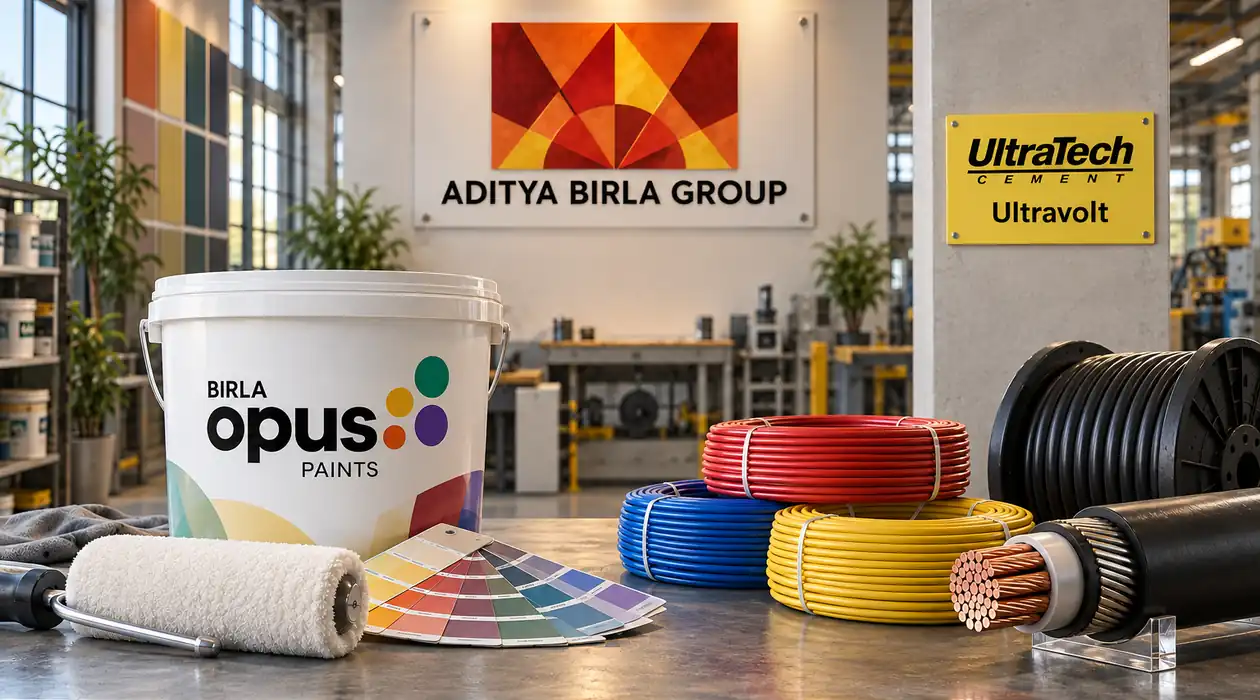
On September 3, 2026, UltraTech Cement launched Ultravolt, a new wires and cables business backed by ₹1,800 crore of investment. The company says Ultravolt is already the second-largest player in the wires segment by installed capacity at launch and wants to become one of the top two players in the market within five years.
The announcement triggered an immediate stock-market reaction. Shares of several listed wires and cables companies fell over the following sessions as investors tried to price in a new, deeply capitalized competitor with national distribution, construction-industry relationships and one of India’s strongest corporate brands.
The anxiety is understandable because the same group has already demonstrated what it can do in another entrenched building-materials category.
Birla Opus entered decorative paints with a ₹10,000 crore greenfield commitment. By FY26, Grasim said Birla Opus had reached roughly 10% standalone revenue market share in Indian decorative paints, built 1,332 million litres per annum of capacity, crossed 50,000 dealers and connected with about 4.5 lakh active contractors and painters.
That precedent is why the wires industry is paying attention.
But investors should resist the easiest conclusion.
The launch of Ultravolt does not mean Polycab, KEI, Havells, RR Kabel or Finolex suddenly lose their businesses. Wires and cables have technical, distribution, certification, manufacturing and working-capital barriers that make the category harder than simply launching a consumer brand.
The more important question is whether Birla can use the same industrial playbook it used in paints to compress incumbents’ growth rates, dealer economics and valuation multiples even before it wins large market share.
That is where the real disruption begins.
Birla is not entering a weak industry
The timing is important.
UltraTech is entering wires and cables precisely because the market is attractive.
Polycab estimates the Indian wires and cables market reached roughly ₹1 trillion in FY26, up from about ₹350 billion in FY14. The company expects industry demand to grow around 11% to 13% annually through FY30, supported by infrastructure, housing, renewable energy, data centres, mobility and manufacturing.
The organised share of the market has also increased significantly.
Polycab estimates organised companies represented about 76% of the Indian wires and cables market in FY25, up from 61% in FY14.
That formalisation creates a better market for branded national players.
GST, safety standards, building codes, customer preference and increasingly technical applications make it harder for unorganised manufacturers to compete purely on price.
The industry is therefore large, growing and formalising.
That is exactly the type of market a conglomerate wants to enter.
Why Birla’s paint entry matters to the wires industry
The wires business would be less threatening if the Aditya Birla Group had no recent record of entering entrenched consumer-building categories.
Birla Opus changed that.
When the group announced its decorative paints strategy, the Indian paints market already had deeply established brands, large dealer networks and strong incumbents led by Asian Paints.
The barriers looked formidable.
Aditya Birla Group responded with scale rather than gradual experimentation.
It committed ₹10,000 crore to the paints business and constructed six greenfield manufacturing plants.
By FY26, all six were operational and total installed capacity had reached 1,332 MLPA.
Grasim says Birla Opus achieved about 10% standalone revenue market share in the Indian decorative paints market in FY26, making it the number three player in organised decorative paints by its estimate.
Combined with Birla White putty, Grasim says its revenue market share reached the early teens.
Distribution crossed 50,000 dealers in more than 11,500 towns, supported by 146 depots and around 4.5 lakh active contractors and painters.
These numbers matter because they demonstrate that Birla can build manufacturing and distribution simultaneously.
The paint entry did not merely create a new factory.
It created a national route to market.
The Ultravolt strategy looks familiar
Ultravolt is following a recognisable pattern.
Start with serious capacity.
Use the parent group’s balance sheet.
Exploit existing relationships in construction.
Build a national distribution network quickly.
Train influencers.
Create a consumer brand.
Expand the product portfolio after establishing the core category.
UltraTech says Ultravolt will use its existing Building Solutions ecosystem, including thousands of retail outlets and a nationwide dealer network.
At launch, the company said it could reach more than 500 districts and around 6,000 pin codes.
That distribution advantage reduces one of the hardest barriers for a new electrical brand.
A startup entering wires would need years to build dealer access.
UltraTech already sells building materials into many of the same construction channels.
UltraTech is trying to own more of the home-building wallet
The strategic logic is broader than wires.
UltraTech is India’s dominant cement company.
Its Building Solutions strategy already extends into ready-mix concrete, white cement, putty and other building products.
Adding wires and cables allows the company to participate further inside the same construction project.
A customer building a house needs cement.
The same project needs electrical wires.
It needs conduits.
It needs waterproofing.
It needs paint.
It may need tiles and other materials.
Across the Aditya Birla ecosystem, the group is increasingly positioned to sell multiple products into the same construction spending pool.
This is one reason Ultravolt should not be viewed as an isolated diversification.
It is part of a larger attempt to build a building-materials platform.
The ₹1,800 crore number is significant, but not overwhelming
Ultravolt’s planned investment is ₹1,800 crore.
Compared with Birla Opus’s ₹10,000 crore paint investment, that may appear modest.
But wires and cables have a different capital structure.
The current industry leaders have built large businesses with high asset turns and substantial working-capital discipline.
Polycab, for example, reported FY26 wires and cables revenue of ₹25,178.9 crore and a segment EBIT margin of 13.8%.
Its installed wires and cables production capacity was about 6 million kilometres, with capacity utilisation around 79%.
The point is not that ₹1,800 crore automatically creates a Polycab-sized business.
It does not.
The point is that UltraTech does not need to reproduce the entire incumbent infrastructure on day one.
It can begin with high-volume retail wires and low-tension cables, use existing distribution and then add product categories over time.
Retail wires are where incumbents may feel pressure first
The immediate competitive risk is not evenly distributed across the entire cables market.
Retail building wires are easier for a large consumer-facing entrant to attack than specialized high-voltage or technically complex project cables.
Brand visibility matters.
Electrician recommendation matters.
Dealer availability matters.
Pricing and incentives matter.
UltraTech has already begun training electricians and building influencer relationships.
That is important because the person choosing a wire inside an Indian home is not always the homeowner.
Electricians, contractors, dealers and builders heavily influence purchase decisions.
Birla understands this ecosystem from paint, cement and construction materials.
This makes retail wires the most obvious first battlefield.
High-voltage cables are more insulated
At the other end of the market, specialized cables have higher entry barriers.
High-voltage, extra-high-voltage, industrial, renewable, rail, data-centre and other application-specific cables often require customer approvals, technical qualifications, testing, long operating histories and project references.
This is where incumbents have more protection.
ICRA has previously noted that new entrants need time to establish plants, obtain customer approvals and certifications and build dealer networks.
That is why a new brand can disrupt the retail narrative faster than it disrupts the entire profit pool.
The industry is not one homogeneous product category.
Polycab enters this fight from a position of strength
Polycab is the company most investors immediately compare with Ultravolt because it is the market leader.
Its FY26 performance was exceptionally strong.
Polycab reported total revenue of ₹28,883.8 crore, up 29% year on year.
EBITDA reached ₹4,005.7 crore, up 35%.
Profit after tax was ₹2,708.4 crore, up 32%.
Its wires and cables revenue reached approximately ₹25,178.9 crore.
The company estimates it controls around 30% to 31% of the organised Indian wires and cables market, gaining roughly three to four percentage points during FY26.
This is not a fragile incumbent waiting to be displaced.
Polycab has scale, manufacturing, product breadth, brand recognition, exports and distribution.
It is also planning ₹6,000 crore to ₹8,000 crore of capital expenditure over five years under Project Spring.
The company intends to grow its core wires and cables business at around 1.5 times market growth.
Birla is entering aggressively.
Polycab is responding aggressively too.
Why Polycab shares still reacted
Stock markets price future margins, not only current revenue.
A dominant company can continue growing and still see its valuation fall if investors expect competition to reduce future pricing power.
That is the real reason a Birla entry matters.
Suppose Polycab continues to gain volume but has to increase dealer incentives, advertising, electrician programmes or discounts.
Revenue can remain strong while incremental margins weaken.
The market may then assign a lower valuation multiple.
Competitive disruption often appears in valuation before it appears in reported market share.
That is what investors saw in paints.
KEI has a different exposure
KEI Industries reported FY26 turnover of ₹11,747.77 crore, up about 20.7% year on year.
Its cables and wires segment generated ₹11,220.57 crore, compared with ₹9,176.96 crore in FY25.
Net profit reached ₹918.43 crore.
KEI has built strength in both institutional cables and the retail segment.
Its ongoing strategy has included expanding retail distribution and increasing brand visibility.
That makes Ultravolt relevant because retail is one of the areas KEI wants to grow most aggressively.
However, KEI’s institutional and project business gives it some diversification from a pure retail-wire battle.
RR Kabel is also scaling quickly
RR Kabel’s FY26 wires and cables revenue reached roughly ₹8,763.7 crore, up 31% from approximately ₹6,688.8 crore in FY25.
Its segment profit before tax and interest increased to about ₹775.6 crore.
Those numbers show that the market is supporting multiple fast-growing companies.
This is an important counterargument to the disruption thesis.
The Indian wires and cables market is not a zero-growth category where every rupee won by Birla must be taken from Polycab or KEI.
The total market itself is expanding rapidly.
A new large entrant can gain billions of rupees of revenue while incumbents continue to grow.
The real conflict is about relative growth and margins.
The market is large enough for another player
India’s wires and cables market was roughly ₹90,000 crore in FY25 and is now estimated around ₹1 lakh crore.
If the market compounds at 11% to 13% annually, it could become dramatically larger by the end of the decade.
At a 12% compound growth rate, a ₹1 lakh crore market would become roughly ₹1.76 lakh crore after five years.
That is an illustrative calculation, not an industry forecast.
The point is scale.
An expanding market can absorb a new competitor more easily than a stagnant one.
This is why Jefferies has argued that the sell-off in incumbent wire stocks may overstate the immediate threat.
The brokerage expects industry growth and entry barriers to support existing leaders even as UltraTech enters.
But Birla does not need market leadership to disrupt economics
This is the most important distinction.
Birla does not need to become number one to hurt incumbent economics.
If Ultravolt captures 5% to 10% of a large market and forces incumbents to spend more on brand, distribution and trade incentives, the competitive environment changes.
The impact can appear through:
lower realization growth, higher advertising expenditure, dealer incentives, electrician loyalty programmes, working-capital support, new capacity spending, faster product launches.
That can reduce returns even if incumbent revenue keeps rising.
Competition is often more expensive than market-share statistics imply.
Dealer relationships will be a key battleground
Wires are not sold only by television advertising.
Availability matters.
Dealers need stock.
They need margins.
They need credit.
They need confidence that the manufacturer will support the brand.
Established companies have spent decades building those relationships.
Polycab’s distribution network is one of its strongest competitive assets.
Havells has a powerful consumer-electrical ecosystem.
KEI and RR Kabel have expanded dealer reach aggressively.
UltraTech’s advantage is that it already has building-material relationships.
The question is whether those relationships transfer effectively into electrical products.
A cement dealer is not automatically a wire dealer.
A contractor familiar with UltraTech is not automatically an electrician recommending Ultravolt.
Execution still matters.
Electricians may matter more than advertising
The electrical category has a unique influencer structure.
A homeowner may choose paint color personally.
The same homeowner may not know whether a particular wire specification is appropriate.
That creates influence for electricians and contractors.
UltraTech appears to understand this.
The company has begun onboarding electricians and has discussed training tens of thousands.
If Ultravolt can build trust with electricians, it can accelerate adoption without waiting years for consumer brand recognition.
But incumbents already run mature electrician and loyalty programmes.
This will become an expensive retention battle.
Copper and aluminium create another Birla advantage
The Aditya Birla Group also has experience in metals through Hindalco.
Industry analysts have noted that both Birla and Adani, which has also discussed wires and cables investment, have upstream exposure to copper or aluminium.
That creates a strategic logic of forward integration.
It does not mean raw materials will simply be transferred cheaply between group companies.
Listed companies must operate under commercial and governance constraints.
But deep knowledge of metals, procurement and commodity cycles can still be valuable.
For a wires and cables manufacturer, copper and aluminium price management is fundamental.
The data-centre boom raises the ceiling
One of the fastest-growing cable demand areas is data centres.
Polycab estimates Indian data-centre capacity could increase from roughly 900 to 950 MW in FY24 to 2,000 to 2,300 MW by FY27.
It estimates wires and cables can account for 8% to 10% of total data-centre capital expenditure.
That creates a large technical market beyond residential construction.
UltraTech has specifically highlighted digitisation and data centres among the long-term growth drivers for the sector.
This is another reason the company is willing to enter now.
The opportunity is not just household wiring.
It is the electrification of the entire economy.
Renewables and electric mobility add another demand engine
India is building solar, wind, transmission, charging and storage infrastructure at enormous scale.
Every one of these systems requires cabling.
Electric vehicles also increase the need for charging infrastructure and specialized electrical products.
Polycab points to national targets of 30% electrification for private cars and 70% to 80% for commercial vehicles by 2030, creating demand for millions of charging points.
For incumbent manufacturers, these new markets provide areas where technical capability and approvals create stronger barriers than ordinary house wires.
For Ultravolt, they represent future expansion opportunities.
What Birla learned from paints
The most important lesson from Birla Opus is not simply “spend more money.”
It is that a late entrant can compress decades of category-building into a few years if it combines five advantages.
Capacity before demand
Birla built large paint capacity before it had large market share.
This meant product availability was not the constraint.
Distribution at speed
It expanded across tens of thousands of dealers rather than waiting for organic network growth.
Influencer activation
Painters and contractors became a major part of the go-to-market strategy.
Brand investment
Birla Opus spent heavily enough to become visible quickly.
Balance-sheet patience
Grasim absorbed startup losses while the business scaled.
Ultravolt can attempt the same structure.
This is why incumbents cannot assume the new entrant will optimize for short-term profitability.
That patience may be Birla’s most powerful weapon
A standalone wires company is judged primarily on wires-company margins.
UltraTech is a giant cement company.
The Aditya Birla Group has multiple cash-generating businesses.
That allows it to tolerate a longer investment phase if the strategic objective is market share.
Grasim has already demonstrated this in paints, where the new business initially reduced standalone profitability while the group continued investing.
A competitor willing to sacrifice near-term margins can make pricing uncomfortable for incumbents that the stock market expects to protect profitability every quarter.
This is the classic conglomerate-entry advantage.
But the paint analogy has limits
Paint is not wires.
The technical consequences of product failure are different.
Electrical wires are safety-critical.
Industrial and high-voltage cables require specialized engineering.
Institutional customers require testing and approvals.
Product certification matters.
Manufacturing reliability matters.
This gives incumbents more defensibility than a simplistic Birla Opus comparison suggests.
Ultravolt must prove quality in the field, not merely awareness on television.
The real test will take years.
Why Havells may be more resilient than the headline suggests
Havells competes in cables and wires but also owns a broad consumer-electrical portfolio including switches, fans, appliances and lighting.
That diversified channel ecosystem can provide defensive strength.
A dealer relationship based on several product categories is harder to displace than a single-product relationship.
At the same time, UltraTech’s attempt to become a broader building-solutions company creates a similar strategic logic from the construction side.
The competition is therefore moving beyond wires.
It is ecosystem against ecosystem.
What would prove Ultravolt is succeeding
Investors should ignore marketing claims and monitor measurable indicators.
Dealer count is one.
Electrician activation is another.
Capacity utilisation will matter.
Revenue from wires versus cables will matter.
Retail contribution will matter.
Repeat ordering will matter.
Market share will matter.
Most importantly, margins will matter.
A company can buy market share through discounts.
That is not the same as building a durable business.
The strongest proof would be rising market share alongside improving unit economics.
What would prove incumbents are actually under pressure
Falling share prices are not enough.
Real evidence would include:
slower volume growth relative to the market, higher advertising and promotion costs, dealer incentive pressure, lower wire margins, increased working-capital days, market-share losses, higher employee or channel churn, price discounting.
Until those indicators appear, the current reaction is primarily investors repricing competitive risk.
That distinction matters.
The industry may become better because of Birla
Competition is not automatically negative for customers or the economy.
A large new entrant can accelerate safety, formalisation and product innovation.
It can push unorganised manufacturers out of sensitive electrical categories.
It can improve availability in smaller cities.
It can increase investment in electrician training.
It can force incumbents to innovate faster.
If India’s electricity consumption, housing stock and infrastructure continue expanding, higher-quality branded competition can enlarge the organised market.
The disruption may therefore hurt valuation multiples before it hurts industry growth.
The real winner could be the consumer
A market dominated by a few strong brands can produce excellent businesses.
It can also reduce the urgency to improve service.
A credible entrant changes that.
Dealers gain bargaining power.
Electricians receive more training and incentive options.
Consumers receive more products.
Builders gain another national supplier.
Incumbents are forced to defend quality and pricing.
This is exactly what competitive capitalism is supposed to do.
Bottom line
Aditya Birla Group’s entry into wires and cables is serious because the group has already shown it can enter a mature building-materials category at scale.
Birla Opus went from zero to roughly 10% standalone revenue market share in decorative paints in about two years, backed by nearly ₹10,000 crore of cumulative investment, six plants, 1,332 MLPA of capacity and more than 50,000 dealers.
Ultravolt begins with a different but familiar playbook.
It has ₹1,800 crore of investment behind it.
It launches with meaningful manufacturing capacity.
It can access UltraTech’s nationwide building-materials ecosystem.
It wants a top-two position within five years.
That ambition is enough to make the industry nervous.
But the incumbents are not weak.
Polycab controls roughly 30% to 31% of the organised market and generated more than ₹25,000 crore of wires and cables revenue in FY26.
KEI generated more than ₹11,000 crore from cables and wires.
RR Kabel generated nearly ₹8,800 crore.
All three are growing rapidly.
The ₹1 lakh crore Indian wires and cables market itself is expected to keep expanding at double-digit rates.
The most likely outcome is therefore not that Birla destroys the existing leaders.
It is that the cost of leadership rises.
Incumbents will have to spend more, innovate faster and defend dealers more aggressively.
Birla may take market share.
It may also simply make every percentage point of market share more expensive to keep.
That is why the industry is feeling the entry already.
Not because Ultravolt has yet changed the financial statements of Polycab or KEI.
Because Birla Opus showed the market what can happen when this group decides that being a late entrant is not a disadvantage, but an excuse to enter at industrial scale.
Reader questions
Frequently asked questions
What is Ultravolt?
Ultravolt is Aditya Birla Group’s new wires and cables brand housed under UltraTech Cement. It was launched in September 2026.
How much is UltraTech investing in wires and cables?
UltraTech has announced an investment of approximately ₹1,800 crore in the wires and cables business.
How large is India’s wires and cables market?
Industry estimates used by Polycab place the Indian market at roughly ₹1 lakh crore in FY26, with expected annual growth of around 11% to 13% through FY30.
Why is Birla’s entry considered a threat to Polycab and KEI?
The threat comes from Birla’s capital strength, existing construction distribution, brand-building ability and the precedent of Birla Opus rapidly building scale in paints. Retail wires could face the most immediate competition.
What market share does Polycab have?
Polycab estimates that it held approximately 30% to 31% of India’s organised wires and cables market in FY26.
Did Birla Opus actually gain meaningful paint market share?
Grasim said Birla Opus achieved approximately 10% standalone revenue market share in Indian decorative paints in FY26 and had become the number three organised decorative-paints player by its estimate.
Will Ultravolt immediately hurt all cable manufacturers?
Not equally. Retail wires are more exposed to branding and distribution competition, while specialized high-voltage and project cables have greater barriers from approvals, certification, engineering capability and customer track record.
Can the wires and cables market support another large player?
Potentially yes. The market is growing at double-digit rates and organised manufacturers continue taking share from unorganised suppliers. Birla can gain meaningful revenue without requiring the overall market to stagnate.
Nexuswild welcomes factual corrections. Email contact@nexuswild.com with evidence and the article URL.