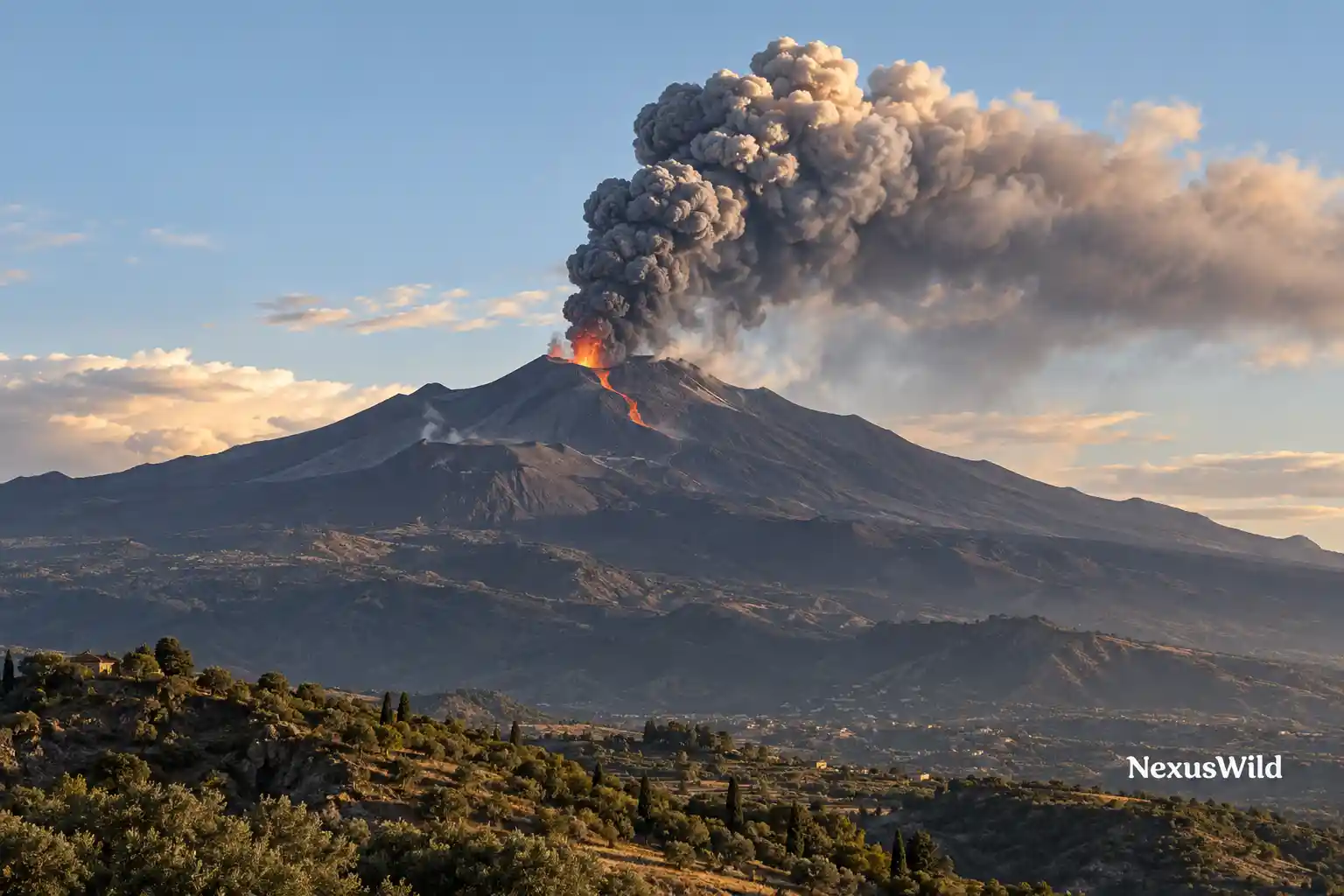

Mount Etna has erupted again, sending ash and incandescent material above its summit and once more drawing attention to one of the most active volcanic systems on Earth.
The latest eruptive phase developed across September 8 and 9, 2026. Italy’s National Institute of Geophysics and Volcanology, or INGV, raised Etna’s aviation colour code to red on September 9 as ash emission continued. Toulouse’s Volcanic Ash Advisory Centre later described a weak but ongoing eruption, with thin ash clouds moving mainly east and east-southeast from Sicily.
The renewed activity was visually dramatic, but volcanologists do not regard every Etna eruption as evidence of an extraordinary geological crisis. Repeated explosive episodes, lava fountains, ash emissions and lava flows are fundamental features of the volcano’s behaviour.
Etna is not a dormant mountain suddenly waking after centuries of silence. It is a persistently active magmatic system.
What happened during the latest eruption?
Monitoring showed renewed increases in volcanic tremor before stronger summit activity developed.
On September 9, activity was reported at the Voragine summit crater, including lava-fountain activity and an eruptive cloud spreading toward the southeast. INGV raised the Volcano Observatory Notice for Aviation, or VONA, to its highest colour level, red.
A red aviation warning does not automatically mean nearby towns must evacuate. It indicates that an eruption involving significant volcanic ash is occurring or is considered an important threat to aviation.
Volcanic ash is particularly dangerous to aircraft because fine particles can enter jet engines, damage turbine components, reduce visibility and abrade cockpit windows.
Toulouse VAAC advisories later described weaker ash emissions and thin ash clouds drifting away from the volcano as the episode evolved.
Etna is Europe’s highest active volcano
Mount Etna sits on the eastern side of Sicily, overlooking the region around Catania.
The Smithsonian Institution’s Global Volcanism Program lists Etna at about 3,357 metres, or roughly 11,014 feet, although its summit elevation changes because eruptions repeatedly build new material and crater collapses remove it.
Calling Etna “Europe’s largest active volcano” is common, but Europe’s highest active volcano is the more precise description.
It is also among the world’s most persistently active volcanoes.
Etna covers roughly 1,250 square kilometres, and geological evidence indicates that volcanic activity in the region began around 500,000 years ago.
Its long eruptive history makes it one of the most important natural laboratories for volcanology.
Why does Mount Etna erupt so often?
The answer lies beneath Sicily.
Etna stands in one of the Mediterranean’s most complicated tectonic environments, near the broad convergence zone between the African and Eurasian plates.
But its geology is more complicated than a simple textbook diagram of one tectonic plate sliding beneath another.
East of Sicily, the Ionian lithosphere is being subducted beneath the Calabrian region. Geological research also indicates that portions of this descending slab have undergone rollback, tearing and break-off.
Those processes can create pathways that allow hotter material from deeper in the mantle to move upward beneath Etna.
INGV research describes an asthenospheric window associated with slab break-off and mantle flow near the volcano. This unusual structural setting helps explain why magma can be repeatedly supplied beneath eastern Sicily.
Scientists continue to study the precise origin of Etna’s magma, but the broad conclusion is clear: Etna sits above a complex and fractured tectonic system that repeatedly allows magma and gas to rise.
Etna behaves like an open volcanic system
INGV describes Etna as having a central magmatic system capable of continuously releasing volcanic gases.
That is why a gas plume can frequently be seen above its summit even without a major eruption.
At times, rising magma becomes increasingly gas-rich and pressure builds.
The volcano can then produce Strombolian activity, where glowing fragments of lava are explosively thrown from a crater.
More energetic phases can create sustained lava fountains and larger ash clouds.
Magma may also escape through fractures, producing lava flows from summit or flank vents.
This means another Etna eruption is not, by itself, geologically surprising.
What matters is how the eruption develops.
Why scientists closely monitor volcanic tremor
One of the most important signals at Etna is volcanic tremor.
Unlike a normal earthquake, volcanic tremor can continue for long periods and may reflect movement of magma, pressurized gas or fluids inside the volcanic system.
A sharp increase can indicate that the system is becoming more energetic.
INGV combines tremor measurements with seismic instruments, GPS deformation monitoring, thermal cameras, satellite observations, gas measurements and infrasound sensors.
Etna is among the most intensively monitored volcanoes in the world.
Even with that technology, scientists cannot predict the exact second or exact size of every future eruption.
Monitoring instead allows scientists to recognize changes and rapidly update hazard assessments.
Ash can be more disruptive than lava
Images of orange lava fountains dominate coverage of Etna, but volcanic ash often has a larger immediate impact.
Lava flows usually advance slowly enough to be tracked.
Ash is different.
Wind can carry fine particles far beyond the summit.
Ash can affect roads, agriculture, visibility and respiratory health. For aviation, even relatively thin ash clouds can require route changes or temporary operational restrictions.
Etna’s location close to Catania International Airport makes this especially important.
A summit eruption can therefore disrupt transportation even when lava poses no direct threat to the airport or city.
Frequent does not mean harmless
Etna’s activity is normal for Etna.
That does not mean it is harmless.
Historical lava flows have damaged settlements, agricultural areas, roads and infrastructure. Summit explosions can be hazardous to people near the crater area, while flank eruptions can create larger problems for communities lower on the volcano.
Ash can disrupt aviation and everyday life across eastern Sicily.
The scientifically correct interpretation is therefore neither panic nor complacency.
Frequent activity is expected.
Every eruption still has to be monitored individually.
Why another Etna eruption is not unexpected
Etna has spent hundreds of thousands of years continuously rebuilding itself.
Crater rims collapse and reform.
New fractures open.
Magma rises.
Gas pressure changes.
Periods of quieter degassing are followed by Strombolian explosions, lava fountains or lava flows.
This repeated cycle is part of the natural evolution of the volcano.
The latest eruption is important because it produced ash and aviation alerts, but it does not by itself show that Etna has entered an unprecedented phase.
Scientists judge Etna through seismic, geochemical and deformation data rather than through the dramatic appearance of a single eruption.
Bottom line
Mount Etna’s latest activity is another chapter in the history of one of the planet’s most active volcanic systems.
The September 8 and 9 episode produced renewed explosive activity, ash emissions and a red aviation warning.
The reason Etna erupts so often is rooted deep beneath Sicily.
Its position near Africa-Eurasia convergence, the subducting and deforming Ionian lithosphere, major regional faults and mantle-flow pathways creates an unusually effective system for repeatedly supplying magma toward the surface.
So another Etna eruption should not be understood as a sleeping volcano suddenly coming back to life.
Etna is already alive.
Its eruptions are part of the mountain’s natural geological behaviour, even though each new episode still carries hazards that scientists and authorities must take seriously.
Reader questions
Frequently asked questions
Did Mount Etna erupt again?
Yes. Renewed eruptive activity occurred across September 8 and 9, 2026, with summit explosions, lava-fountain activity and ash emissions.
Why does Mount Etna erupt so often?
Etna sits in a complex tectonic region where Africa and Eurasia converge and the Ionian lithosphere is subducting and deforming. Faulting and mantle flow help create pathways for magma to rise beneath the volcano.
Is Mount Etna the largest volcano in Europe?
Etna is more precisely described as Europe’s highest active volcano and one of the continent’s largest and most active volcanic systems.
Is the latest Mount Etna eruption dangerous?
The activity can create ash hazards for aviation and local impacts. Frequent eruptions are normal for Etna, but every episode requires monitoring because ash, lava and explosive activity can create risks.
How old is Mount Etna?
Volcanic activity in the Etna region began roughly 500,000 years ago, with the modern volcanic edifice developing through many later eruptive stages.
Nexuswild welcomes factual corrections. Email contact@nexuswild.com with evidence and the article URL.