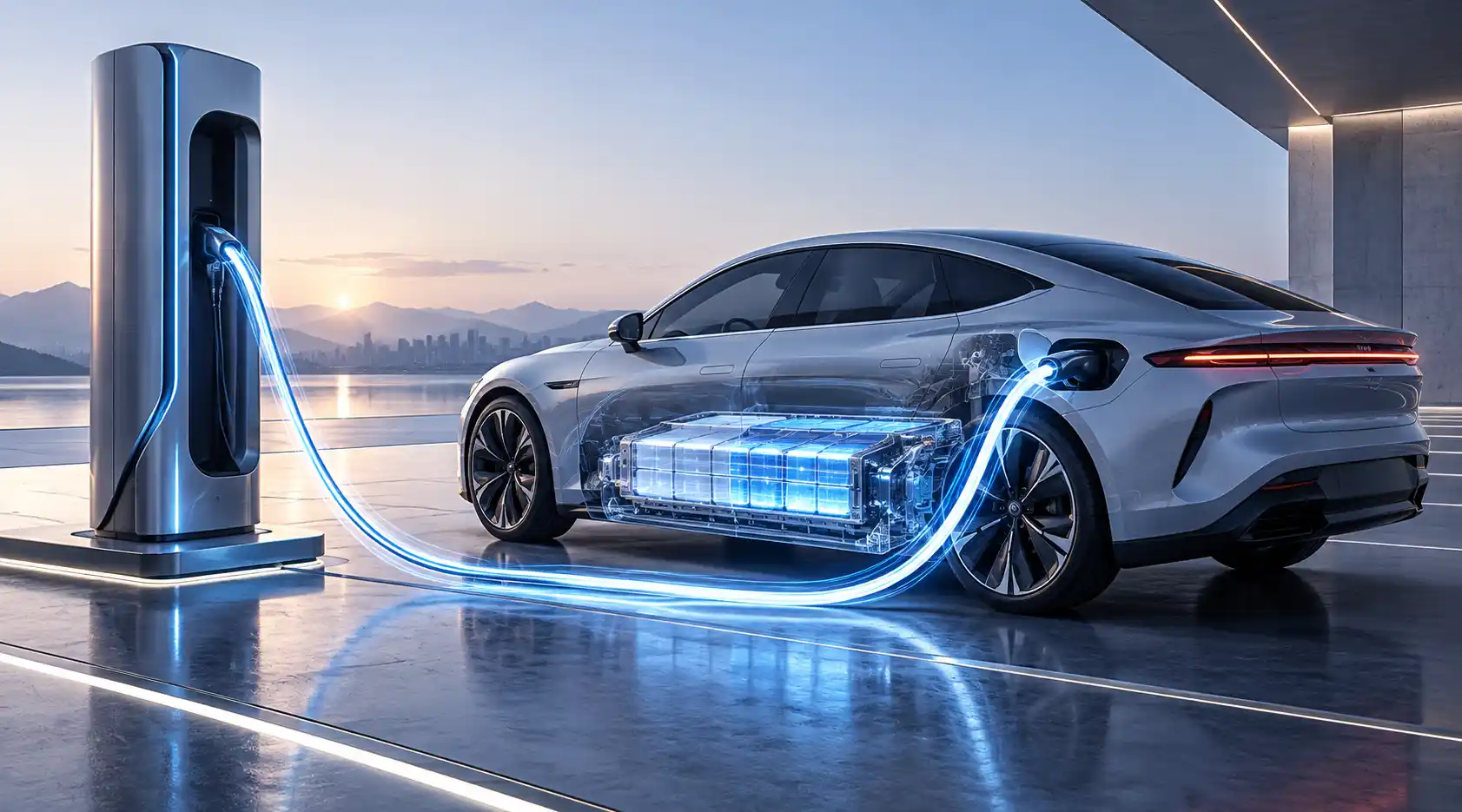

Chinese battery maker Sunwoda Electric Vehicle Battery Co Ltd has unveiled a new fast-charging battery system it says can take an electric vehicle from 10 percent to 97 percent state of charge in about nine minutes. The announcement, made at a battery industry conference held September 16-17 in Zaozhuang, Shandong province, adds Sunwoda to a growing list of Chinese battery and vehicle makers racing to shorten EV charging times toward something closer to a conventional fuel stop.
Sunwoda says the battery can charge from 10 percent to 97 percent in about nine minutes under specified conditions, at room temperature. The company also said the battery can go from 10 percent to 70 percent in roughly five minutes, with the remaining charge to 97 percent taking about four more minutes. At that rate, Sunwoda said, one minute of charging adds approximately 100 kilometers, or about 62 miles, of driving range. These figures come from Sunwoda's own conference presentation and have not been independently verified through third-party or real-world testing.
What 15C Charging Means
The "15C" designation refers to a charging rate, where C represents a multiple of the battery's total capacity per hour. A 15C rate implies a battery could theoretically be fully charged in about four minutes if that rate were sustained throughout. In practice, charging rates taper as the battery fills, so 15C describes Sunwoda's peak charging rate rather than a constant rate applied across the entire session. Independent analysis by the trade publication electrive.com noted that Sunwoda's own figures, an SOC increase from roughly 5 to 95 percent in nine minutes, cited for an earlier version of the technology, correspond to an average C-rate of around 6.7, a useful reminder that headline "C" figures describe peak, not average, performance.
Chemistry, Capacity and Power
Sunwoda's fast-charging battery uses lithium iron phosphate (LFP) chemistry. Technical details disclosed at an earlier Sunwoda technology event in Beijing in April 2026, for what the company called its Xingchi Supercharge Battery 2.0, a pack built on the same 15C platform, included a 264-cell prismatic pack with capacity exceeding 98.8 kWh, an operating voltage of 844.8 volts, and a maximum charging current of 1,800 amperes. Those figures imply a theoretical peak charging power just above 1.5 megawatts. Sunwoda also disclosed a cycle life beyond 1,500 cycles for that pack. It is not fully clear from public disclosures whether the September figures announced in Zaozhuang describe an identical pack or a refined iteration of the same underlying platform, and Sunwoda has not published a complete technical datasheet for the version shown most recently.
Reaching and sustaining that kind of power draw is only possible with megawatt-class charging hardware, since standard high-power DC fast chargers today typically top out in the 150 to 400 kilowatt range. For commercial vehicles, Sunwoda separately demonstrated a dual-gun charging system with peak power of 1.44 megawatts. Delivering that much power into a battery pack in minutes generates substantial heat, and Sunwoda said advanced thermal management is central to the system, since controlling battery temperature is what allows the charging rate to be sustained without triggering the throttling that typically slows fast charging as a battery heats up.
Cold-Weather Performance
Sunwoda also disclosed cold-weather figures. At minus 20 degrees Celsius, the company said the battery can still charge from 10 percent to 97 percent, though the process takes about 15 minutes rather than nine. Battery chemistry generally becomes less efficient at low temperatures, so a claimed 15-minute charge in freezing conditions, if confirmed independently, would represent a meaningfully smaller cold-weather penalty than many current EV batteries exhibit.
Infrastructure Plans and Durability Claims
Sunwoda said it is also building out the charging infrastructure needed to support these speeds, targeting 10,000 megawatt-class charging stations by the end of 2027. The company described an integrated system combining solar power generation, battery energy storage and ultra-fast charging, positioning itself as an energy infrastructure provider rather than only a battery supplier. This is a stated target rather than a completed build-out, and no information on current station counts or a phased rollout schedule was disclosed.
On durability, Sunwoda said the battery meets warranty terms of 10 years or 300,000 kilometers and that there is no separate limit on the number of ultra-fast charging sessions for non-commercial vehicles, addressing a common concern that repeated high-speed charging accelerates battery degradation. As with the charging-speed figures, these are company claims rather than results from independent long-term testing.
How It Compares
Sunwoda's announcement follows a string of similar claims from Chinese competitors in 2026. BYD introduced a second-generation Blade Battery and new flash chargers in March. CATL's Shenxing Ultra-Fast Charging Battery, in its second generation, is rated for 12C charging and has been said to add up to 520 kilometers, or about 323 miles, of range in five minutes using 1.3 megawatt charging. Automaker Hongqi has demonstrated a 10 to 70 percent charge in 3 minutes 41 seconds, and Dongfeng has unveiled a 1,500-kilowatt ultrafast charger. Xpeng has also announced related battery and charging advances. As with Sunwoda's figures, these competing claims come from manufacturer presentations and have not been independently benchmarked against one another under identical conditions.
Sunwoda, which traces its battery business back to consumer electronics before expanding into EV cells, already supplies batteries to Chinese automakers including Geely, Dongfeng and GAC, though it has not been confirmed which, if any, vehicle programs will use the new 15C battery specifically. Separately, Sunwoda said its fast-charging development has progressed from 4C-capable packs in 2022 to 6C in 2024 and now to 15C for LFP chemistry and 8C for ternary lithium packs.
Closer to a Petrol Stop, With Caveats
A nine-minute charge to near-full capacity would narrow, though not close, the gap with a typical gasoline refueling stop, which usually takes around five minutes. If Sunwoda's figures hold up under independent and real-world testing, they would represent a significant reduction from the 20 minutes or more that many current fast-charging EVs require to require to reach a high state of charge. That comparison, however, depends entirely on whether the claimed performance can be replicated outside a controlled demonstration.
Key Limitations
Several factors limit how much can be concluded from this announcement. The figures presented in Zaozhuang are Sunwoda's own, drawn from a company event rather than from independent laboratory or on-road testing, and no third-party organization has yet verified them. Achieving the claimed charging speeds also depends on megawatt-class charging infrastructure that remains limited even in China and is largely unavailable elsewhere, meaning the 10,000-station target for 2027 is a plan rather than a present reality. No production timeline, vehicle model, pricing or specific model-year launch has been confirmed for a production vehicle equipped with this exact battery. Long-term degradation and safety performance under repeated ultra-fast charging in everyday use, as opposed to a conference demonstration, also remain unverified.
Further reading and useful links
Reader questions
Frequently asked questions
Is the Sunwoda 15C battery guaranteed to fully charge an EV in nine minutes?
No. Sunwoda says the battery can go from 10 percent to 97 percent, not zero to 100 percent, in about nine minutes, and only under the specified room-temperature test conditions it presented. This has not been independently verified.
What does "15C" mean for an EV battery?
C-rate describes charging speed relative to battery capacity. A 15C rate is Sunwoda's stated peak rate; the average rate across a full charging session is lower, since charging speed typically tapers as the battery fills.
Can the battery charge quickly in cold weather?
Sunwoda says the battery can still charge from 10 percent to 97 percent at minus 20 degrees Celsius, though this takes about 15 minutes rather than nine, according to the company's own figures.
When will vehicles with this battery be available to buy?
Sunwoda has not confirmed a production timeline, specific vehicle model, or price for a production EV using this exact battery. The company's disclosed 2027 target relates to charging infrastructure, not vehicle availability.
Nexuswild welcomes factual corrections. Email [email protected] with evidence and the article URL.