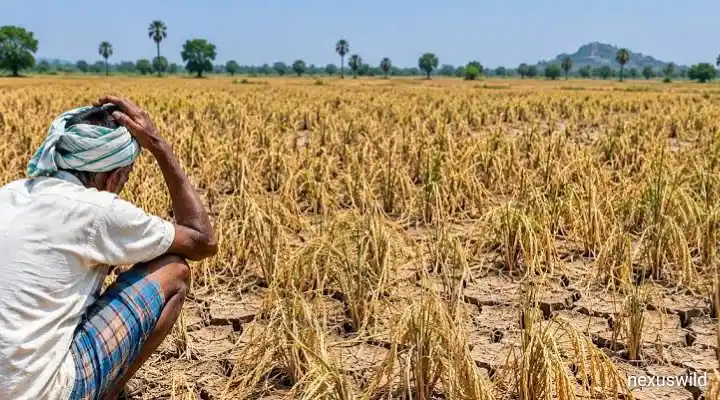

Telangana has declared 365 of its 621 mandals drought-affected for the 2026 kharif season, with 111 classed as severe and 254 as moderate, according to a government order reported on October 27. Two weeks later, the state used a special meeting of bankers to press for loan relief for farmers.
The state received 615.5 mm of rain between June 1 and September 30, against a normal of 740.6 mm, a deficit of 17%. Eighteen of 33 districts were in deficit, and the area sown to kharif crops fell from 139.28 lakh acres to 126.06 lakh acres, a drop of about 9.5% by this article's calculation. The order blamed an El Niño-affected southwest monsoon.
The ask to banks
At a State Level Bankers' Committee (SLBC) meeting on November 10, Deputy Chief Minister Mallu Bhatti Vikramarka urged banks to restructure or reschedule crop loans for eligible farmers under RBI guidelines and to provide fresh rabi loans on time. The rabi crop loan target is ₹38,268 crore.
He raised concern about lending so far. IANS reported that only 53% of a ₹96,943 crore disbursement target for the period ending September 2026 had been achieved, and that loans for the monsoon season had reached only 17% of target. Another report, summarized by Indian Opinion, cited a 74% achievement for the kharif target. The two figures are not reconciled in the sources reviewed.
Agriculture Minister Tummala Nageswara Rao said 10 to 15 lakh borewells had dried up. He asked banks to take services to farmers so they need not visit branches repeatedly, and to give timely loans to farmer producer organizations and women's self-help groups.
Officials from the RBI's Hyderabad office, NABARD, the Department of Financial Services and the State Bank of India attended, according to Telangana Today.
What the RBI rules allow
The state's drought order directs district collectors to take up with the SLBC the restructuring of agricultural credit and a halt to coercive recovery, "as permissible" under RBI guidelines. Those guidelines set conditions.
Under the RBI's Master Direction on relief measures in areas hit by natural calamities, relief applies where assessed crop loss is 33% or more. Short-term crop loans that were not already overdue are eligible. The principal and interest due in that year can be converted into a term loan.
If the crop loss is between 33% and 50%, repayment can run up to two years including a one-year moratorium. If loss is 50% or more, it can run up to five years. Once the SLBC or district-level committee decides on rescheduling, banks are to grant fresh crop loans to affected farmers. The government has also provided a 2% interest subvention to banks on restructured crop loans in the first year, according to a 2019 PIB release.
Where the gaps are
The following points are this article's analysis, based on the sources reviewed.
Crop-loss assessment. Telangana's drought declaration used rainfall, sown area, soil moisture and groundwater indicators under the National Manual for Drought Management, 2016. The RBI's relief is tied to an assessed crop loss of 33% or more, and the SLBC and district committees must satisfy themselves of that before acting. The sources reviewed do not say whether those loss assessments are complete.
Bank discretion. The SLBC is a coordination forum. The state can urge, but the sources do not show that banks have committed to restructure specific loans or by when.
Repayment capacity. Dry borewells can affect the rabi crop as well as kharif. A farmer whose loan is restructured but who cannot irrigate rabi may still struggle to repay.
Lending already lagging. If disbursement is behind target, farmers may be relying on informal credit during the drought. The sources reviewed do not measure that.
Politics and the Centre
Telangana's Legislative Assembly unanimously adopted a resolution on September 18 seeking additional assistance from the Union government. The outcome is not known from the sources reviewed.
The opposition Bharat Rashtra Samithi called the government order an "irresponsible eyewash," according to South First. The Cabinet Sub-Committee reviewed the situation on October 23 before the declaration, ETV Bharat reported. The order also cited reservoir storage of 179.63 TMC out of 585 TMC, according to South First.
What is known and what is not
What is known: the drought declaration, the rainfall and sowing figures, the state's request to banks, and the rules that govern restructuring. What is not known is how many farmers have applied for relief, how many loans banks will restructure, what share of the 365 mandals meets the 33% crop-loss test, and what additional central assistance, if any, will follow.
Nexuswild welcomes factual corrections. Email contact@nexuswild.com with evidence and the article URL.