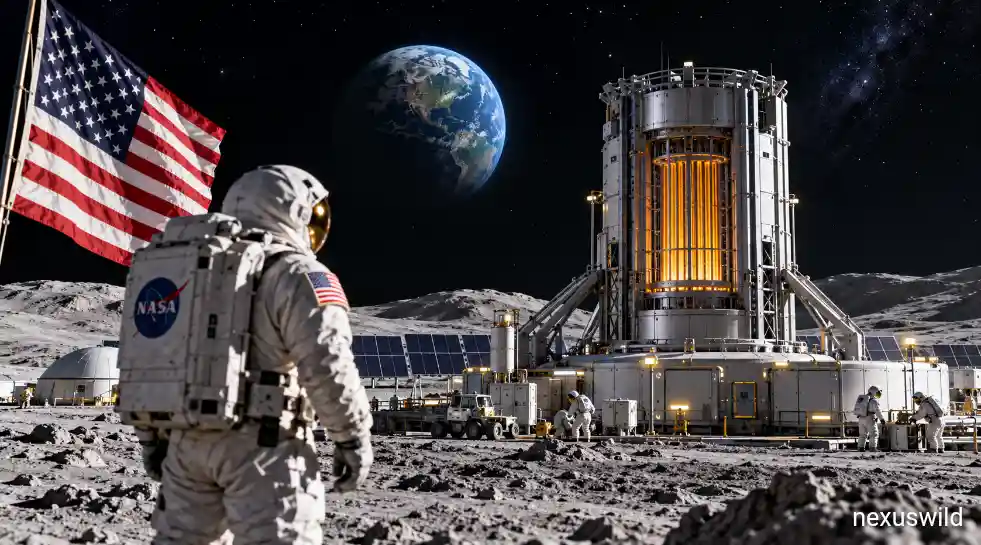

The United States is pushing to place a nuclear fission power system on the Moon by 2030, as major space powers increasingly view reliable electricity as essential infrastructure for long-term lunar exploration.
NASA and the US Department of Energy renewed their partnership in January 2026 with an agreement aimed at developing, fueling and preparing a lunar surface reactor for launch. The agencies said the effort includes the development of a reactor for use on the Moon by 2030.
The program is part of a broader move beyond short lunar visits toward operations that could include habitats, scientific equipment, communications systems and eventually more permanent facilities.
The United States is not alone. China and Russia have also outlined plans that include nuclear power for their proposed International Lunar Research Station, creating a developing competition over how future Moon bases will be powered.
Why NASA Wants Nuclear Power on the Moon
Solar panels are already widely used in space, but the Moon presents a difficult energy problem.
A lunar night lasts roughly two Earth weeks in many locations, meaning solar-powered equipment can face long periods without direct sunlight. Permanently shadowed regions near the lunar poles create an even greater challenge.
Fission reactors can operate independently of sunlight and are designed to provide continuous electricity for years.
NASA says lunar fission power could support habitats, rovers, scientific instruments and other equipment while helping establish technologies that could later be used on Mars.
The agency has described nuclear power as a key part of sustained lunar operations rather than simply a scientific experiment.
NASA Has Raised the Power Target
The lunar reactor program has evolved significantly over the past several years.
In 2022, NASA and the Department of Energy selected three industry teams to develop concepts for a roughly 40-kilowatt-class fission power system capable of operating for at least 10 years. Each initial design contract was valued at about $5 million.
By August 2025, NASA had moved toward a more ambitious system.
The agency said it intended to pursue a reactor capable of generating at least 100 kilowatts of electrical power, with the goal of placing a system on the Moon by fiscal year 2030.
NASA has also been seeking industry participation in designing and developing the system.
That means the 2030 target is not simply a continuation of the earlier 40-kilowatt demonstration concept. The current effort represents a larger power requirement and a stronger focus on supporting future lunar infrastructure.
A New NASA-DOE Agreement Strengthens the 2030 Goal
In January 2026, NASA and the Department of Energy signed a new memorandum of understanding to deepen cooperation on space nuclear power.
The agencies said they would work together on development, fuel, authorization and launch preparation for a lunar reactor.
NASA Administrator Jared Isaacman said nuclear energy would be important to supporting a long-term US presence on the Moon and future missions to Mars.
The Department of Energy brings expertise in reactor technology, nuclear fuel and national laboratories, while NASA is responsible for mission requirements and integrating the system into its wider lunar exploration architecture.
NASA now describes its planned first lunar fission installation as Lunar Reactor-1, with a target landing in 2030.
China and Russia Are Also Planning Lunar Nuclear Power
The US effort is developing alongside a separate China-Russia lunar program.
China and Russia are planning the International Lunar Research Station, or ILRS, with a basic version expected to take shape around the Moon's south polar region during the 2030s.
A presentation by a senior Chinese space official in 2025 showed nuclear power as part of the proposed energy infrastructure for the station. Russia's space agency had previously said it planned to work with China on a lunar nuclear reactor by around 2035.
China is also planning large solar arrays, cables and other infrastructure for the proposed base.
The difference in timelines is notable: NASA is currently targeting 2030 for its reactor, while the China-Russia nuclear power concept has generally been associated with a 2035 timeframe.
Those schedules remain ambitious and could change as engineering and launch programs develop.
Why Lunar Power Has Become Strategically Important
Electricity could become one of the most important resources in any permanent lunar settlement.
Future bases may need power for life-support equipment, communications, scientific laboratories, heating, resource processing and vehicles.
Reliable energy is particularly important near the lunar south pole, where space agencies are interested in exploring permanently shadowed regions that may contain water ice.
Power infrastructure could therefore influence where future bases are located and how much work they can perform.
NASA has also framed its fission program partly in terms of strengthening US leadership in space, while China and Russia view their own lunar station as a long-term international research project.
The result is not a conventional nuclear race involving weapons. These planned reactors are intended to generate electricity.
But the programs do show how lunar exploration is increasingly shifting from individual missions toward infrastructure, logistics and long-term presence.
Major Engineering Challenges Remain
Putting a nuclear reactor on the Moon is far more difficult than operating one on Earth.
The system must survive launch vibration, extreme temperatures, radiation and the vacuum of space. It must also operate with very limited opportunities for repair.
The reactor will need shielding and heat-rejection systems while remaining light enough to launch and land on the lunar surface.
Safety is another major consideration.
NASA and the Department of Energy will need to address nuclear fuel handling, launch authorization and potential accident scenarios before a reactor can leave Earth.
A 2030 deployment therefore remains a target, not a guarantee.
NASA's earlier fission program had aimed for the early 2030s before the agency accelerated its stated schedule.
The Technology Builds on Decades of Research
Space nuclear power is not entirely new.
The United States has used radioisotope power systems on deep-space missions for decades, while NASA and the Department of Energy have previously tested compact fission concepts.
NASA's Kilopower program culminated in the 2018 KRUSTY ground experiment, which demonstrated a small uranium-fueled fission system under test conditions.
The new lunar reactor would be considerably more ambitious because it is intended to provide sustained electrical power for infrastructure on another world.
Conclusion
The United States has set an ambitious goal of developing and deploying a nuclear fission power system on the Moon by 2030, with NASA and the Department of Energy now working together under a renewed agreement.
The project is moving toward a system capable of producing at least 100 kilowatts of electricity, enough to support substantially more than a short scientific demonstration.
China and Russia are pursuing their own plans for nuclear power as part of a future lunar research station, generally targeting the middle of the 2030s.
That makes lunar energy infrastructure an increasingly important part of the next phase of space exploration.
Whether the United States actually places a reactor on the Moon by 2030 will depend on engineering, testing, funding and launch readiness. But the direction is becoming clear: future competition on the Moon will not be only about who lands there, but also about who can build the systems needed to stay.
Nexuswild welcomes factual corrections. Email contact@nexuswild.com with evidence and the article URL.