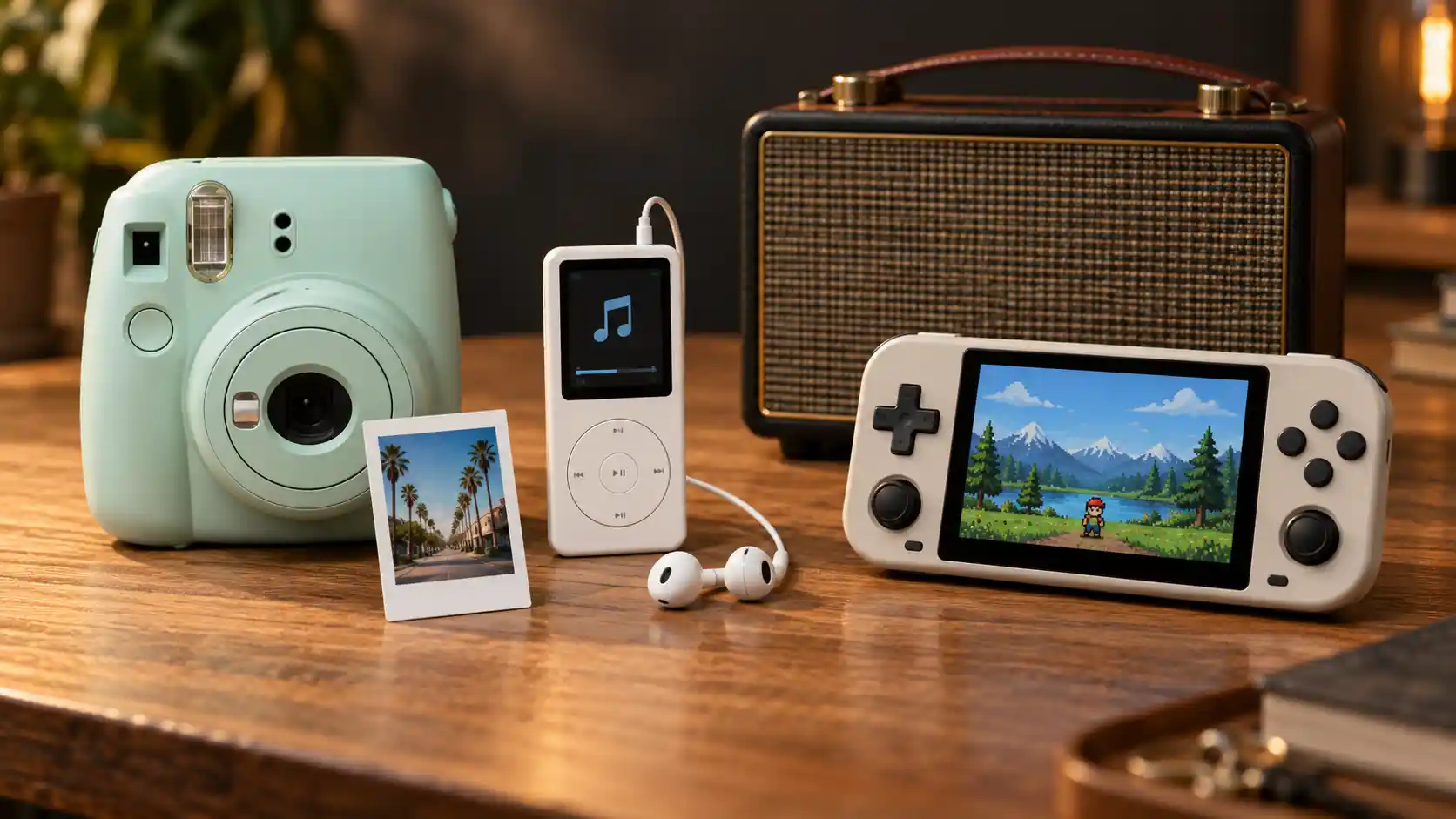

As smartphones, wearables, and smart-home products absorb more artificial intelligence features, a countertrend has become visible in specific pockets of the consumer electronics market: renewed demand for gadgets built around fewer functions rather than more. Sales data from camera and phone manufacturers, along with survey research on digital wellbeing, point to a real, if niche, shift in some consumer preferences, running alongside, not replacing, the broader move toward increasingly intelligent devices. The pattern spans several product categories with otherwise little in common, from decades-old feature phone brands to newly launched premium minimalist devices to a resurgence in dedicated cameras, suggesting the underlying drivers are not confined to any single product type.
This article examines the verified evidence behind this shift, the reasons consumers and industry figures give for it, and what the available data suggests about its size and durability, while distinguishing confirmed sales and survey figures from opinion and commentary.
The Rise of Simpler Gadgets
The clearest documented evidence of renewed interest in simpler devices comes from two categories: minimalist phones and compact cameras.
The Light Phone, a Brooklyn-based device deliberately designed around calling, texting, and a handful of other functions, without social media, browsers, or app stores, has shipped more than 100,000 units across its first two generations, according to TechCrunch, with the Light Phone II accounting for roughly two-thirds of that total. Its third generation, released with an upgraded OLED display, NFC chip, and camera, has been reviewed by outlets including The Verge, Wired, and Business Insider as a premium alternative to conventional smartphones, priced above many flagship Android devices. In July 2026, the company's co-founder Kaiwei Tang told TechCrunch that Light was launching a flip-phone model, the Light Flip, after fielding repeated requests from younger customers. Tang, who previously worked on the Motorola Razr, said the company had spent years "interviewing young people that use flip phones," and found that while these users often complained about the build quality of cheap flip phones, they stuck with the format regardless.
Feature phones, the more basic, non-touchscreen devices still sold widely under brands including Nokia, have also remained commercially significant rather than disappearing. According to IDC data cited by the technology publication Gizmochina, HMD Global, the Finnish company that produces Nokia-branded feature phones, held a 22.4 percent volume share and roughly 30.7 percent value share of India's feature phone market as of 2025, with India serving as both HMD's largest market and an export hub for the devices. Notably, when HMD discontinued new Nokia-branded smartphones in 2025 as its original licensing arrangement with Nokia Corporation neared expiration, the two companies separately extended their agreement specifically to continue Nokia-branded feature phone production beyond 2026, according to Gizmochina's reporting, indicating that this simpler product category was judged commercially viable enough to warrant a dedicated, extended agreement even as the branded smartphone line ended.
In photography, compact, built-in-lens cameras have posted two consecutive years of shipment growth, according to data from the Camera and Imaging Products Association (CIPA), the Japan-based industry body that tracks global camera shipments from major manufacturers. CIPA figures reported by outlets including PetaPixel and Digital Camera World show global compact camera shipments reached approximately 2.4 million units in 2025, up around 29.6 to 30 percent from 2024 and the highest total since 2021, while total digital camera shipments across all categories reached roughly 9.4 million units, up 11.2 percent year-over-year and the first back-to-back annual increase in nearly two decades. Camera shipment data through the first third of 2026 showed built-in-lens cameras continuing to outpace the prior year's monthly figures, according to PetaPixel's analysis of CIPA data. These figures remain a small fraction of the compact camera category's historical peak: more than 108.5 million compact cameras were shipped worldwide in 2010, meaning 2025's 2.4 million units represent roughly 2 percent of that peak year, according to Digital Camera World's analysis of CIPA figures.
In wearables, the pattern is less quantified but still visible in product design and retail coverage. Reviewers at the wearable technology publication Wareable, evaluating the fitness tracker market in 2026, noted that even as smartwatches have added increasingly sophisticated sensors covering recovery, stress, and training load, a market for simple, screenless activity bands, priced around $50, has persisted alongside these more complex devices, giving buyers who want basic step and sleep tracking a lower-cost, lower-complexity alternative to full-featured smartwatches. Unlike the phone and camera data above, this description reflects product-category commentary from a specialist outlet rather than independently verified unit-sales figures, and should be read as a qualitative observation rather than a quantified market trend.
Why Consumers Want Less Complexity
Industry figures involved in designing simpler devices describe a deliberate response to what they characterize as smartphone feature creep. Light Phone co-founder Joe Hollier has said the company's approach involves forgoing revenue streams common elsewhere in the industry, telling Prospect Magazine, "there is no hidden, backstream revenue from selling data or ads," a design choice he and co-founder Kaiwei Tang have framed as central to the product's appeal, since it removes the commercial incentive to maximize user engagement that shapes many mainstream apps and devices.
On the camera side, industry commentary has linked renewed compact camera interest partly to consumers wanting a dedicated device for photography rather than relying solely on smartphones, alongside viral attention on social media platforms and a broader resurgence of interest in retro consumer technology. At the CP+ trade show in 2025, Canon executive Go Tokura acknowledged, according to reporting from Fstoppers, that the compact camera category had fallen to roughly one-fortieth of its historical peak before showing early signs of renewed interest, a trajectory Canon and other manufacturers have since responded to with continued investment in compact models. Coverage of the trend from outlets including Nikkei has also pointed to social media habits among younger users in Asian markets as a specific driver, with camera makers reportedly adjusting feature sets on compact models to appeal to that demographic, according to industry analysis reviewed for this article, distinct from the digital-wellbeing motivations more commonly cited around minimalist phones.
Privacy, Digital Distraction and Device Fatigue
Survey research provides some support for the idea that concerns about phone-related digital distraction are widespread, particularly among younger users, though this research generally documents attitudes and behaviors around existing smartphones rather than directly measuring intent to switch to simpler devices. A Pew Research Center survey, conducted from September 26 to October 23, 2023, among 1,453 U.S. teen-parent pairs, with a margin of error of plus or minus 3.2 percentage points, and reported by the Associated Press, found that nearly three-quarters of U.S. teens said they feel happy or peaceful when they do not have their phones with them. The same survey found that despite this, most teens had not actually limited their phone or social media use, and that 95 percent of U.S. teens had access to a smartphone. Notably, the same respondents also reported clear benefits from smartphone ownership: majorities said the devices made it easier to pursue hobbies and be creative, and 45 percent said smartphones helped them do well in school, illustrating that survey respondents generally described a mixed rather than uniformly negative relationship with their devices.
Separately, the Organisation for Economic Co-operation and Development (OECD), in a 2025 policy brief conducted in collaboration with Cisco, examined the relationship between screen time and subjective wellbeing across several countries, part of a broader body of academic and policy research treating digital engagement's effects on wellbeing as an active, ongoing area of study rather than a fully settled question. Reflecting this general area of concern, both Apple and Google have expanded built-in screen-time and digital-wellbeing features in recent operating system updates, an industry response that itself signals mainstream, if not universal, consumer interest in moderating device use, even among owners who continue using full-featured smartphones rather than switching to simpler alternatives.
Institutional responses to concerns about phone-related distraction extend well beyond individual consumer choices. According to UNESCO's Global Education Monitoring Report, 114 national education systems, representing 58 percent of countries worldwide, had a national ban on mobile phones in schools as of its March 2026 analysis, up sharply from 40 percent in early 2025 and just 24 percent when the report first tracked the measure in June 2023. In the United States specifically, U.S. News reported in August 2026 that 39 states and Washington, D.C., along with 106 countries globally, now prohibit or restrict phone use in classrooms, with New York's statewide bell-to-bell ban, in effect since fall 2025, affecting nearly 2.5 million students in kindergarten through twelfth grade. UNESCO's Global Education Monitoring Report team has cautioned, however, that while restricting in-class phone use may reduce classroom distraction, evidence on broader student wellbeing benefits remains mixed, and the policy does not remove the separate need for students to develop digital literacy skills. While these bans target classroom phone use specifically rather than reflecting a documented shift toward simpler personal devices, their rapid global spread illustrates that concern about smartphone-related distraction has moved from informal commentary into formal policy across a majority of the world's education systems.
Price, Battery Life and Practicality
Beyond digital wellbeing concerns, practical factors including price and battery life feature prominently in coverage of simpler devices. Feature phones marketed by HMD under the Nokia brand are generally positioned at price points well below flagship smartphones and are commonly promoted for long battery life measured in days rather than hours, characteristics that HMD's own product marketing emphasizes as core selling points for its feature phone line. The Light Phone III, by contrast, illustrates that simplicity does not always correspond to a lower price: reviewers including Business Insider have noted the device costs more than some full-featured iPhone models, positioning it as a premium, deliberately restrained product rather than a budget option.
Reliability and repairability have also featured in coverage of the simpler device trend, particularly for feature phones, which generally have fewer components and simpler software than smartphones, potentially reducing points of failure, though the sources reviewed for this article did not include controlled comparative data on repair or failure rates between feature phones and smartphones specifically. Broader industry commentary on the technology sector's repairability practices, including "right to repair" advocacy, has separately gained regulatory attention in multiple markets in recent years, forming part of the wider context in which simpler, ostensibly more durable devices are marketed.
Subscription-based pricing, increasingly common across smartphone software, cloud storage, and AI-powered features, represents a further practical consideration distinct from the upfront device price. Devices such as feature phones and the Light Phone, which do not rely on app-store ecosystems or ongoing subscription services for their core functions, are generally positioned by their manufacturers as carrying no recurring software costs beyond a standard mobile service plan, a contrast some coverage of the category has drawn with the growing number of subscription add-ons, from cloud photo storage to AI assistant tiers, now offered alongside mainstream smartphones.
How the AI Era Is Changing Consumer Preferences
The renewed interest in simpler devices has coincided with a period of rapid change in mainstream consumer technology, as smartphone makers, wearable manufacturers, and smart-home companies have incorporated artificial intelligence features including generative AI assistants, computational photography, health-monitoring algorithms, and predictive recommendations into flagship products. In photography specifically, CIPA-linked industry commentary reported by Capture magazine described 2025 as a year in which computational photography, including AI-driven subject-movement prediction and in-camera noise reduction, moved from smartphones into professional and consumer camera bodies in a more substantial way than in prior years, indicating that AI integration itself has become a differentiator across both ends of the camera market, not only in smartphones.
This expansion of AI-driven features appears to be widening, rather than narrowing, the range of choices available to consumers: at one end, increasingly capable, AI-integrated flagship smartphones, smartwatches, and mirrorless cameras continue to add functionality, while at the other end, manufacturers of feature phones, minimalist phones, and compact cameras have continued to invest in products that deliberately limit functionality. Reviewers, including Wired's assessment of the Minimal Phone, have generally described simpler devices as involving genuine trade-offs rather than a free upgrade in wellbeing, noting that limiting a phone's capabilities can create practical compromises, such as reduced access to navigation, payment, or messaging features that many users rely on daily.
A related, though less quantitatively documented, pattern has emerged in the smart-home category. As voice assistants, connected appliances, and AI-driven home devices have added cloud connectivity and subscription-based features, technology publications have increasingly covered concerns about the ongoing costs, data collection, and reliability implications of connected home products, including cases where cloud-dependent smart devices become partially or fully non-functional if a manufacturer discontinues server support. These concerns echo the same underlying themes documented above in phones and cameras, namely privacy, recurring cost, and dependence on services outside a user's direct control, though the sources reviewed for this article did not include comparable sales or shipment data specifically quantifying consumer movement toward offline or non-connected smart-home alternatives, and this pattern should therefore be read as a related concern rather than a separately verified sales trend.
Industry and Expert Views
Perspectives from designers and executives directly involved in producing simpler devices consistently frame their products as a deliberate alternative rather than a rejection of technology generally. Light Phone's founders have described their approach as offering consumers a choice rather than a mandate, with Kaiwei Tang telling the interview publication Frugalmatic that the company's philosophy involves letting users decide which functions they actually want, rather than defaulting to the full feature set of a conventional smartphone. Tang has separately noted, in comments to Frugalmatic, that this approach draws on his own earlier career designing mainstream smartphone hardware, giving the company's design decisions a perspective informed by, rather than opposed to, conventional smartphone engineering.
On the camera side, CIPA's own market projections, presented at the CP+ trade show and reported by Yahoo Finance, anticipate continued, though more modest, growth in compact camera shipments through 2026, alongside a slight projected decline in mirrorless camera shipments, suggesting the association itself views the compact camera segment's recent growth as an established, if still small-scale, trend rather than a one-year anomaly. CIPA forecast overall camera shipments of approximately 9.59 million units in 2026, representing modest year-over-year growth of about 1.6 percent, following 2025's stronger 11.2 percent increase.
What the Trend Means for the Gadget Market
The available data supports describing renewed interest in simpler gadgets as a real, measurable trend within specific product categories, rather than a broad-based consumer rejection of smart technology. In each category examined, including minimalist phones, feature phones, and compact cameras, growth or sustained demand is documented against a backdrop of a vastly larger market for full-featured smartphones and increasingly AI-integrated devices; compact camera shipments, for instance, remain a small fraction of smartphone camera usage worldwide, and Light Phone's cumulative shipments over roughly a decade represent a tiny fraction of annual global smartphone sales, which run into the hundreds of millions of units. Feature phones retain meaningful commercial significance in specific markets, particularly India, according to the IDC data cited above, but represent a shrinking overall category globally as smartphone adoption continues to expand in developing markets. The school phone-ban data reviewed above adds a further, related dimension: while distinct from consumer purchasing decisions, the rapid, worldwide adoption of formal restrictions on phone use in educational settings indicates that institutional concern about smartphone-related distraction is not confined to the relatively small population of consumers actively purchasing simpler devices, but extends to policymakers and education systems representing a majority of countries globally.
Whether this pattern represents a temporary cultural moment, a stable niche market, or the early stage of a broader shift in consumer behavior is not something the sales and survey data reviewed for this article can conclusively determine. The consistency of year-over-year growth in compact cameras across 2024 and 2025, and sustained, continued investment by companies including HMD and Light in their respective simpler-device product lines, suggest more than a single-year fad within these specific categories. At the same time, the relatively small absolute size of these markets compared with mainstream smartphone and wearable sales indicates that, based on currently available data, simpler gadgets represent a defined niche within consumer electronics rather than a mainstream alternative to smart technology.
For established manufacturers, the trend carries a specific practical implication: several of the companies documented in this article, including HMD Global and Canon, are not niche startups but established players who have chosen to maintain or expand investment in simpler product lines alongside their primary, more feature-rich offerings, rather than treating the simpler category as a legacy business to be phased out. HMD's decision to extend its feature-phone licensing arrangement with Nokia specifically, even as it wound down Nokia-branded smartphones, and Canon's acknowledgment of renewed compact camera interest following a steep historical decline, both suggest that at least some manufacturers view sustained, if modest, demand for simpler devices as commercially worth serving on an ongoing basis, rather than as a one-time nostalgia purchase. For consumers, the continued coexistence of both product categories means the choice between simpler and more feature-rich devices is likely to remain available, rather than one category displacing the other in the near term based on currently observable market trends.
Verified sales and shipment data from camera manufacturers, feature phone producers, and minimalist phone makers confirm that demand for simpler consumer electronics has grown in specific, measurable ways over the past two to three years, coinciding with a period of rapid AI-driven advancement in mainstream smartphones, wearables, and cameras. Survey research on digital wellbeing and screen time provides context for why some consumers describe an interest in reduced complexity, even as the same research shows most people continue using full-featured smartphones and reporting genuine benefits from them. Taken together, the evidence points to a real but bounded trend: a growing, well-documented niche market for simpler gadgets operating alongside, rather than displacing, the broader trajectory toward smarter, more AI-integrated consumer technology.
Further reading and useful links
Reader questions
Frequently asked questions
What is the Light Phone?
The Light Phone is a premium minimalist device designed primarily for calling and texting, intentionally excluding social media, browsers, and app stores to reduce digital distraction.
Are compact digital cameras becoming popular again?
Yes, global shipments of compact, built-in-lens cameras grew by roughly 30 percent in 2025 to 2.4 million units, marking the highest total since 2021.
Why are some consumers switching back to simpler devices?
Consumers are increasingly seeking to reduce screen time and digital distraction, avoid subscription-based software costs, and find dedicated tools (like a standalone camera) rather than relying exclusively on multipurpose smartphones.
Nexuswild welcomes factual corrections. Email [email protected] with evidence and the article URL.