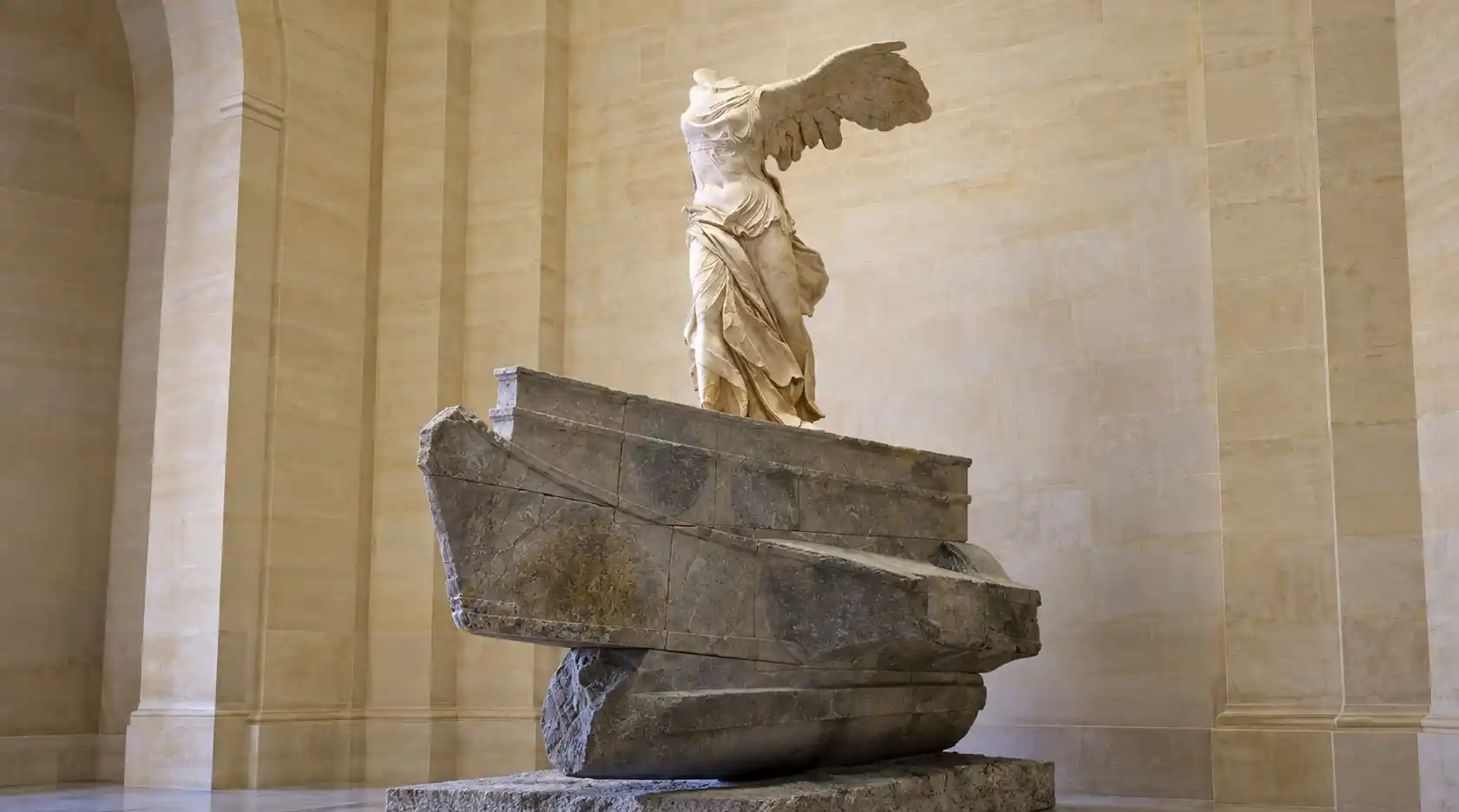

Visitors ascending the Daru staircase at the Musée du Louvre are met with one of the most arresting sights in Western art. Positioned at the summit, the Winged Victory of Samothrace commands the space not through static perfection, but through an overwhelming sense of kinetic energy. Thrusting forward against an invisible gale, the headless, armless marble goddess appears caught in the exact fraction of a second before her feet settle onto the prow of a warship. Created in the early second century BC, this monument to triumph remains the defining masterpiece of Hellenistic sculpture, achieving a fusion of heavy stone and weightless motion that has rarely been equaled.
The figure represents Nike, the Greek personification of victory, a deity traditionally depicted descending from the heavens to bestow favor upon the winners of naval battles or athletic contests. Carved during the Hellenistic period - broadly spanning the death of Alexander the Great in 323 BC to the emergence of the Roman Empire in 31 BC - the statue exemplifies a radical shift in Greek art. While the preceding Classical era prioritized serene restraint, idealized proportions, and emotional detachment, Hellenistic sculptors embraced theatricality, dramatic tension, and raw dynamism. The Winged Victory is the apotheosis of this movement, prioritizing the physical and emotional resonance of a specific, fleeting moment over timeless tranquility.
The sculptor’s ability to render the illusion of wind and water in solid stone is the statue’s greatest technical triumph. Nike is draped in a *chiton*, a finely gathered tunic of light linen, over which a heavier *himation*, or mantle, is wrapped around her hips and legs. The unknown artist utilized the "wet drapery" technique, where the fabric clings tightly to the goddess’s torso and thighs as if plastered there by sea spray and a powerful headwind. Deep, deeply undercut folds billow out behind her, creating harsh shadows that heighten the sense of forward momentum. A strong diagonal axis runs from her leading right leg up through her torso and out toward the magnificent, feathered wings. This twisting posture, known as extreme contrapposto, forces the viewer's eye to move continuously around the form. The wings themselves were a marvel of ancient engineering, cantilevered outward and secured with hidden metal dowels to support the massive weight of the overhanging marble.
The statue’s current state of ruin - missing its head and arms - has paradoxically heightened its modern appeal. The absence of a face allows the figure to transcend specific human identity, becoming a pure, romantic abstraction of victory and movement. For decades, antiquarians debated what the goddess might have held in her lost hands. Early 19th-century reconstructions hypothesized she was blowing a trumpet to announce a victor, or holding a laurel wreath. This debate was largely settled in 1950 when the American archaeologist Karl Lehmann and his wife, Phyllis Williams Lehmann, discovered the statue’s missing right hand on the island of Samothrace. The hand, now displayed in a vitrine near the statue at the Louvre, features outstretched, open fingers, proving she was not gripping any object but was rather raising her hand in a simple, open gesture of greeting or triumph.
To understand the sculpture’s original power, it must be imagined in its ancient context. It was not designed for a sterile museum hall, but for the Sanctuary of the Great Gods on the northern Aegean island of Samothrace. This secretive, mystery-cult sanctuary was a major religious and political center in the ancient world. The monument was placed high on a terraced hill overlooking the sanctuary, housed within a small, rock-cut niche that likely featured a reflective pool of water at its base. The setting heavily dictated the carving. The sculptor intentionally left the right side of the figure less finished than the left, knowing the statue was designed to be viewed from an oblique, front-left angle from the sanctuary pathways below.
The monument was not carved from a single piece of stone, nor is it all of the same material. While the goddess herself is shaped from luminous white Parian marble - highly prized for its ability to absorb light and mimic the translucence of human skin - the massive ship’s prow she stands on is carved from gray Lartian marble, quarried exclusively on the island of Rhodes. This material distinction has led most scholars to conclude that the monument was a dedication by the Rhodian state to commemorate a significant naval victory. While the exact battle remains contested by historians, many point to the naval conflicts around 190 BC, such as the battles of Side or Myonessos, when the formidable Rhodian fleet, allied with Pergamon and Rome, defeated the naval forces of the Seleucid king Antiochus III.
The monument’s journey to Paris began in April 1863, when Charles Champoiseau, a French vice-consul stationed in Adrianople with a passion for antiquities, launched an excavation on Samothrace. He unearthed a fragmented torso and several pieces of heavily folded drapery in a ruined heap, quickly recognizing the exceptional quality of the carving. While he initially left behind the heavy, gray marble blocks of the ship's prow - unaware they were part of the same monument - he shipped the figure’s fragments back to France. It took years of painstaking puzzle-work by Louvre conservators to reassemble the goddess. In 1879, Champoiseau realized his mistake regarding the prow, and the gray blocks were subsequently retrieved and shipped to Paris, allowing the full monument to be assembled and given its commanding position on the Daru staircase in 1883.
Over the subsequent century, the Louvre periodically stabilized the sculpture, but it wasn't until a monumental restoration project in 2013 and 2014 that the true brilliance of the marble was revived. Conservators carefully removed decades of accumulated dust and yellowed coatings, restoring the stark visual contrast between the bright white Parian marble of the figure and the dark gray Rhodian marble of the prow. Crucially, the conservation team also discovered microscopic traces of Egyptian blue pigment on the wings and the hem of her garment. This confirmed that, like most ancient Greek statuary, the Winged Victory was originally painted in vibrant colors, a stark departure from the pristine, monochromatic white aesthetic later idealized by Renaissance and Neoclassical artists.
Today, the Winged Victory of Samothrace stands as one of the ultimate achievements of human craftsmanship, an anchor of Western art history that has profoundly influenced subsequent generations of creators. Its pure expression of speed and power captivated the early 20th-century avant-garde. The Italian poet Filippo Tommaso Marinetti famously weaponized the statue in his 1909 *Futurist Manifesto*, declaring controversially that "a roaring motor car... is more beautiful than the Victory of Samothrace." Yet, rather than diminishing the statue, Marinetti's comparison cemented it as the ultimate historical benchmark for kinetic energy. The sculpture’s silhouette later inspired Charles Sykes when he designed the "Spirit of Ecstasy" hood ornament for Rolls-Royce, and its form continues to echo through contemporary design, fashion, and pop culture.
Stripped of her architectural context, her ancient colors, and even her identity-defining facial features, Nike remains undefeated by time. The Winged Victory of Samothrace endures because it perfectly captures a contradiction: the heavy permanence of stone and the fleeting, weightless instant of a landing. It is a monument that no longer just celebrates an ancient, forgotten naval battle, but stands as an enduring testament to the limitless ambition of human artistry.
Further reading and useful links
Reader questions
Frequently asked questions
When was the Winged Victory of Samothrace created?
The sculpture was created during the Hellenistic period, dating to the early 2nd century BC, likely around 190 BC.
What is the Winged Victory of Samothrace missing?
The statue is famously missing its head and both arms. A fragment of the right hand was discovered in 1950, revealing her fingers were open rather than holding an object.
What event did the sculpture commemorate?
Due to the naval theme and the use of gray Lartian marble from Rhodes for the ship's prow, scholars believe it was dedicated by the Rhodians to commemorate a major naval victory, likely the Battle of Side or Myonessos against Antiochus III.
Nexuswild welcomes factual corrections. Email [email protected] with evidence and the article URL.