
Xiaomi brought its UltraThin Magnetic Power Bank lineup to India on September 8, 2026, introducing two models, the UltraThin 5000 15W and the Magnetic 10000 45W, to a market where the company has not previously disclosed local pricing for either device. The launch extends a product line Xiaomi first introduced in Japan in January 2026 before giving it a formal global unveiling at MWC Barcelona on February 28, 2026.
Xiaomi's New Ultra-Thin Power Bank
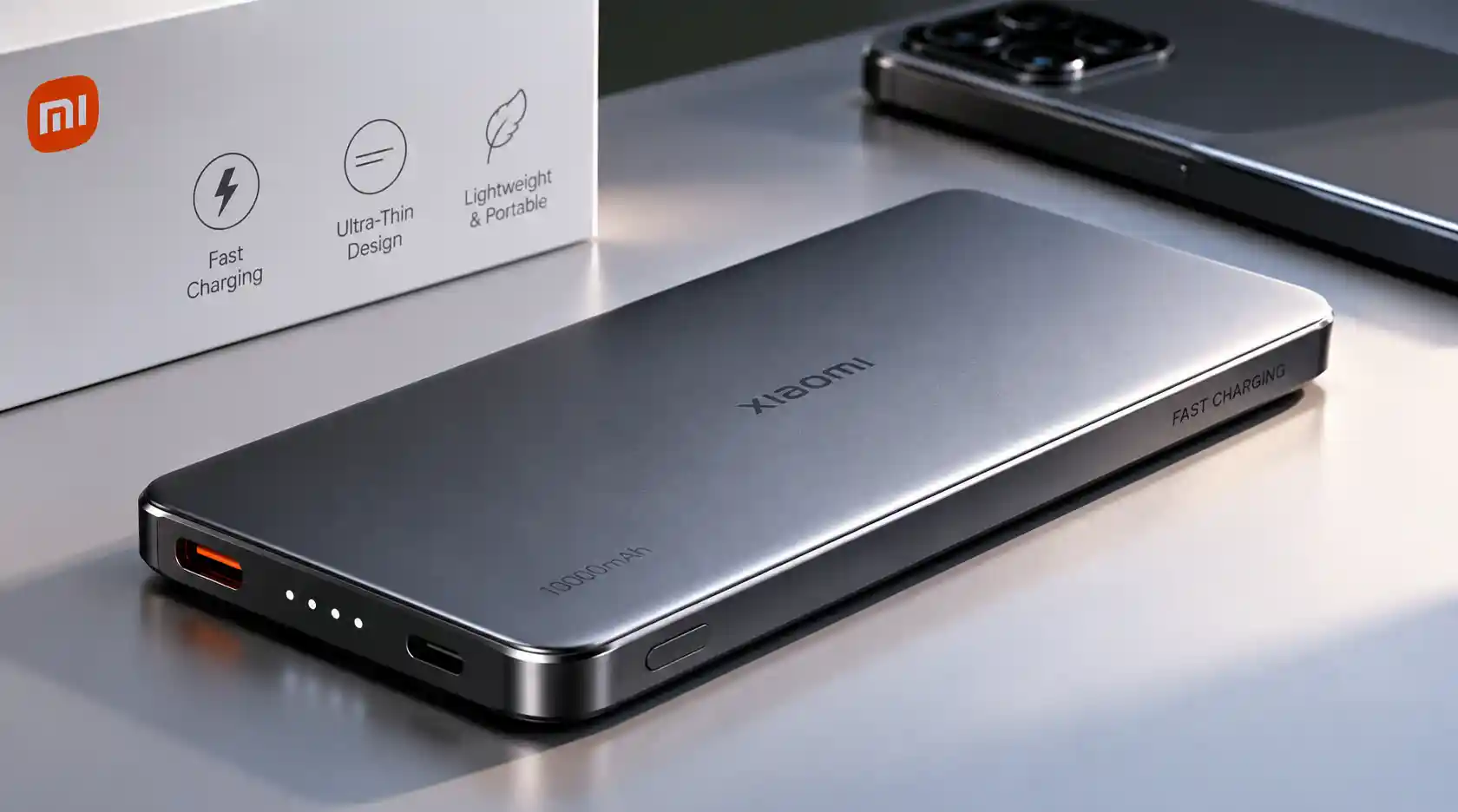
The India launch centers on two distinct models rather than a single product. The UltraThin 5000 15W is the slimmer, lighter of the pair, built around a 5,000mAh silicon-carbon battery cell. The Magnetic 10000 45W is a higher-capacity variant with two 5,000mAh cells and a built-in lanyard cable, previously sold in China under the name Jinshajiang Ultra-Thin Magnetic Power Bank 10000 45W. Both models carry Qi2 wireless charging certification and Xiaomi has marketed them with flight-safe aviation transport certification, according to reporting on the India launch. As of this report, Xiaomi had not disclosed Indian pricing or a specific retail sale date for either model.
Design and Portability
The UltraThin 5000 15W measures 6mm thick and weighs 98 grams, dimensions Xiaomi has marketed as making it the thinnest power bank in the portable charger category, thinner than many current smartphones. The Magnetic 10000 45W is larger, at 13.2mm thick and 195 grams, with a compact footprint of 102 by 70.5 by 13.2mm. Both models achieve their slim profiles through what Xiaomi calls a silicon-carbon anode battery, a chemistry the company says allows higher energy density than conventional lithium-polymer cells used in similarly sized portable chargers, letting more battery capacity fit into a thinner body. For the 10000mAh model specifically, Xiaomi has cited an energy density of up to 840 watt-hours per litre and a silicon content of 16 percent in the battery's anode material.
Battery Capacity and Charging Speed
The UltraThin 5000 15W carries a 5,000mAh rated capacity and supports up to 15W magnetic wireless charging alongside 22.5W wired charging through its USB-C port. Independent reviewers have noted that, as with any power bank, the usable output after voltage conversion losses is lower than the rated cell capacity, with one review estimating roughly 3,000mAh of usable output for this model; this figure comes from independent testing rather than an official Xiaomi specification.
The Magnetic 10000 45W offers a larger 10,000mAh rated capacity, split across two 5,000mAh cells, with wired charging up to 45W and support for additional speed tiers at 40W, 30W and 27W depending on the connected device. Its magnetic wireless charging tops out at 20W. The device supports Qualcomm Quick Charge and USB Power Delivery protocols, and it can itself be recharged at up to 30W.
Ports, Compatibility and Safety Features
Both models rely on a single USB-C port for wired connections, and Xiaomi has confirmed both can be used with select devices across multiple phone ecosystems, including Xiaomi's own phones, Apple iPhones, Samsung devices and Google Pixel phones, according to the India launch reporting. Xiaomi has cautioned that maximum charging speed varies by connected device, meaning not every compatible phone will draw the full rated wattage.
The Magnetic 10000 45W can charge a device over wired and wireless connections at the same time, and both models support pass-through charging, allowing a connected device to keep charging while the power bank itself is being recharged. On safety, Xiaomi has said its broader 2026 power bank lineup, including models built to comply with China's GB47372-2026 safety standard, which took effect April 3, 2026, includes protections such as dual NTC temperature sensors for thermal monitoring and resistance testing against needle puncture and crushing, alongside multiple internal protection layers against overcharging. Xiaomi has not specifically confirmed which of these standardized protections apply to the India-market UltraThin and Magnetic models beyond the general safety features described for its silicon-carbon power bank range.
Price and Availability
Outside India, Xiaomi has disclosed regional pricing for these devices. The UltraThin 5000 15W launched in Europe at €59.99 for its Glacier Silver and Graphite Black colour options and €64.99 for Radiant Orange, following earlier availability in Japan, Australia and the UK, where it was priced at £49.99. In China, the Magnetic 10000 45W was made available for pre-order at 369 yuan, approximately 54 US dollars. For India specifically, Xiaomi confirmed the September 8, 2026 launch date for both models but had not released local pricing or a fixed retail availability date as of the most recent reporting reviewed for this article. Reporting on the India launch also referenced local production in connection with the devices, though further manufacturing details were not specified.
Comparison With Earlier Xiaomi Power Banks
Compared with Xiaomi's earlier portable charger designs, the UltraThin and Magnetic lines represent a shift toward silicon-carbon battery chemistry specifically to reduce thickness and weight without sacrificing rated capacity, a technical approach the company has said mirrors how smartphone makers have used similar battery chemistry to fit larger batteries into slimmer phone bodies. This differs from Xiaomi's older magnetic power banks, which the company has not detailed in the sources reviewed for this article, making a precise specification-by-specification comparison with prior generations unavailable at this time.
Who Is the Power Bank Designed For?
Based on their confirmed specifications, these two models appear oriented toward different use cases within Xiaomi's lineup. The UltraThin 5000 15W's minimal thickness and weight suit users who want a magnetic charger they can keep attached to a phone throughout the day without added bulk, such as commuters or students needing a modest top-up rather than a full recharge. The Magnetic 10000 45W's higher capacity and faster wired charging speed make it better suited to travellers or professionals who need to fully recharge a phone, or top up multiple devices, away from a wall outlet. This article does not make claims about which specific use case Xiaomi intends as primary, since the company's own marketing for the India launch presented both models together without differentiating target users.
Expert and Company Views
Xiaomi's own marketing material for the UltraThin 5000 15W has emphasized its thinness directly, describing the device at its Barcelona reveal as "the thinnest power bank in the industry" at "6mm thin, 98g light." Independent reviewers covering the device have generally confirmed its physical dimensions match Xiaomi's stated figures, with one review describing the design as thin enough that it "feels like part of the phone rather than an add-on" when attached magnetically, though this characterization reflects a reviewer's subjective impression rather than an official specification.
Conclusion
Xiaomi's September 8, 2026 India launch brings its UltraThin 5000 15W and Magnetic 10000 45W power banks to a new market, building on confirmed specifications already established through earlier launches in Japan, Europe, the UK, Australia and China. Both devices rely on silicon-carbon battery technology to combine slim, lightweight designs with meaningful charging capacity and speed, though Indian pricing and a fixed retail availability date remain undisclosed as of this report. Prospective buyers in India will need to wait for Xiaomi's official pricing announcement before comparing the devices against the regional pricing already confirmed elsewhere.
Further reading and useful links
Reader questions
Frequently asked questions
What models were launched in Xiaomi's UltraThin power bank lineup for India?
Xiaomi launched two models: the UltraThin 5000 15W (6mm thick, 98g) and the Magnetic 10000 45W.
What is the price of Xiaomi's UltraThin power banks in India?
As of the initial launch announcement on September 8, 2026, Xiaomi had not disclosed local Indian pricing or a fixed retail sale date for either model.
What battery technology do these power banks use?
Both models use silicon-carbon anode battery technology, allowing for higher energy density and a significantly slimmer body compared to conventional lithium-polymer cells.
Do these power banks support wireless charging?
Yes, both models carry Qi2 wireless charging certification, supporting up to 15W magnetic wireless charging on the 5000 model and up to 20W on the 10000 model.
Nexuswild welcomes factual corrections. Email [email protected] with evidence and the article URL.