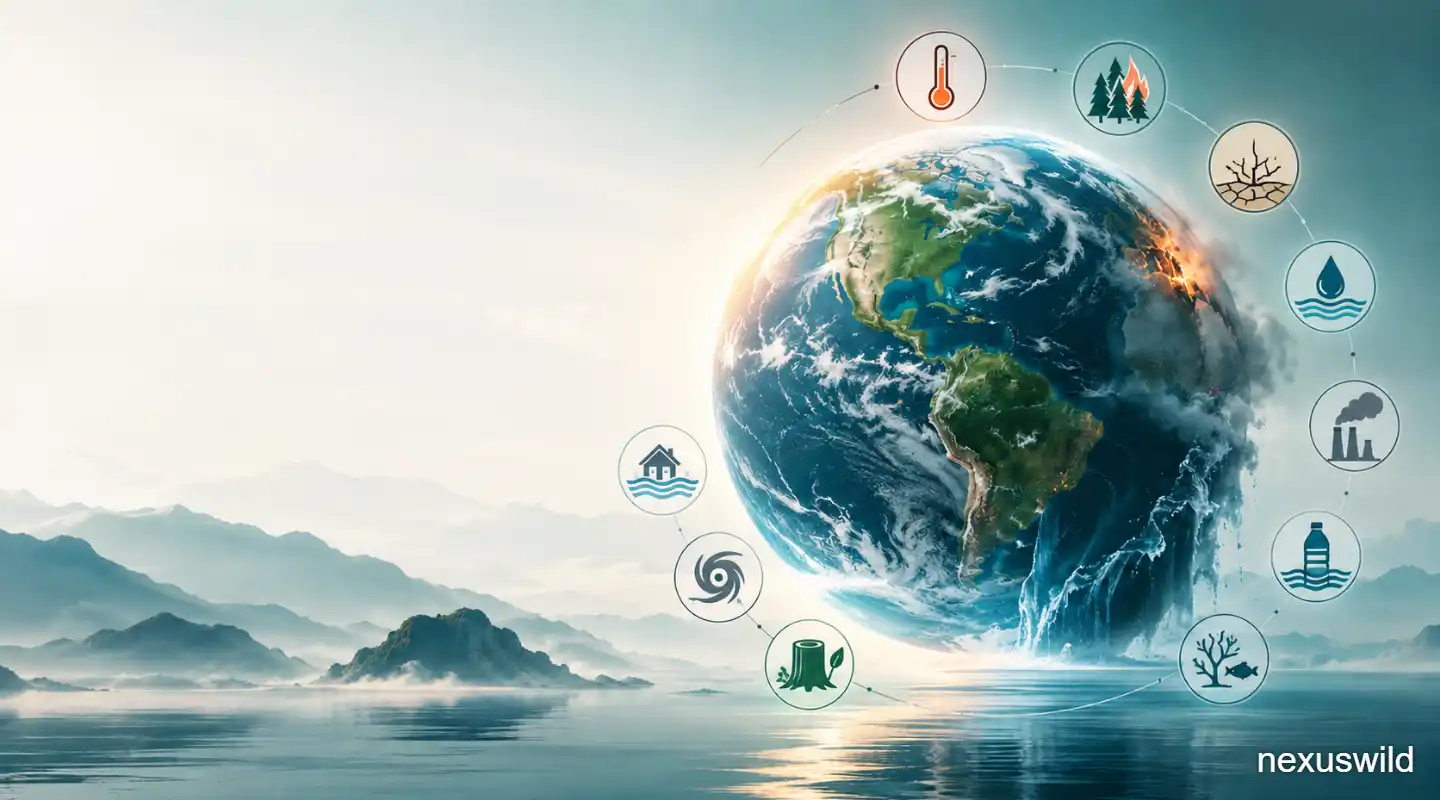

In 2026, the global environmental narrative has shifted from isolated warnings to a complex, lived reality. We are no longer dealing with a single ecological threat; we are managing overlapping, systemic pressures. According to the United Nations Environment Programme’s (UNEP) latest Global Environment Outlook 7 (GEO-7), the planet has entered uncharted territory driven by interconnected crises: climate change, biodiversity and nature loss, land degradation, and pollution and waste.
These challenges are not occurring in a vacuum. Deforestation accelerates climate change, which worsens water scarcity, which in turn threatens global food systems. Understanding these global environmental problems requires looking at the big picture. Here are the 10 critical environmental challenges shaping our world in 2026, the human consequences they carry, and how global communities are attempting to adapt.
1. Climate Change and Extreme Heat
The defining hallmark of climate change 2026 is relentless, record-breaking heat. Following a trajectory where 2024 and 2025 successively shattered global temperature records, the World Meteorological Organization (WMO) confirmed that July and August 2026 continued this historic warming streak. High-pressure systems simultaneously scorched North America, Western Europe, and East Asia, exposing billions of people to hazardous temperatures.
Extreme heat is no longer just a meteorological anomaly; it is a profound threat to human health, labour productivity, and urban infrastructure. While the transition toward renewable energy is accelerating, atmospheric greenhouse gases like carbon dioxide and methane remain at levels unprecedented in human history.
2. Biodiversity Loss and Ecosystem Decline
The natural world is eroding at a speed that alarms conservationists. Biodiversity loss is largely driven by unsustainable land-use changes, resource exploitation, and invasive species. UNEP assessments warn that without intervention, up to 1 million square kilometres of natural spaces could be severely degraded.
The decline of species is not merely an aesthetic loss; it undermines the ecosystems that filter our water, pollinate our crops, and sequester carbon. From the Amazon rainforest to the savannas of East Africa, the collapse of complex biological networks threatens indigenous livelihoods and global economic stability alike.
3. Deforestation and Land Degradation
Forests act as the planet’s lungs, yet they face continuous pressure from logging, mining, and agricultural expansion. Land degradation and desertification are stripping topsoil of its nutrients, turning once-fertile regions into barren landscapes.
Scientists are closely monitoring several environmental tipping points, including the potential die-back of the Amazon rainforest and widespread permafrost thaw. When these systems degrade, they transition from absorbing carbon to releasing it, creating a dangerous feedback loop that accelerates global warming.
4. Water Scarcity and Drought
Freshwater is becoming an increasingly contested resource. Changing precipitation patterns have triggered severe flash floods in regions like Central Asia and East Asia, while simultaneously causing prolonged droughts elsewhere.
Water scarcity directly impacts human survival and economic output. Depleted aquifers and shrinking reservoirs strain urban water grids and slash agricultural yields. The GEO-7 report highlights that transforming our environmental management by 2050 could secure safe drinking water for 300 million people and sanitation for 1 billion, proving that the water crisis is deeply tied to broader environmental policy.
5. Air Pollution
Often referred to as the "invisible killer," air pollution remains one of the most lethal global environmental issues. The combustion of fossil fuels, industrial emissions, and frequent wildfires—such as those seen raging across western North America and Europe in 2026—pump particulate matter into the atmosphere.
The human toll is staggering. Billions of people, particularly in the developing world, are exposed to hazardous air quality, which drives a wave of respiratory and cardiovascular illnesses. UNEP projects that transitioning to a greener economic model could prevent more than 9 million premature deaths annually, largely by cleaning up the air we breathe.
6. Plastic Pollution and Waste
The modern economy’s reliance on disposable materials has created a waste crisis. Currently, global annual solid waste exceeds 2 billion tonnes. Given current consumption trends, UNEP projects this figure will skyrocket to 3.8 billion tonnes by 2050.
Plastic pollution is particularly insidious, breaking down into microplastics that infiltrate water systems, soil, and the human food chain. While international treaties aimed at capping plastic production are gaining traction, the sheer volume of legacy waste requires a massive shift toward circular economic models—keeping materials in use through redesign, reuse, and recycling rather than discarding them.
7. Ocean Degradation and Marine Pollution
The oceans absorb roughly 29% of human-made carbon dioxide emissions and over 90% of the excess heat trapped by greenhouse gases. This heavy lifting comes at a catastrophic cost. In 2025, global ocean heat content hit the highest level in the 66-year observational record, jumping significantly above the records set in 2024.
This extreme warming, combined with ocean acidification (dropping pH levels), has pushed coral reef ecosystems to the brink of collapse. Furthermore, marine pollution from agricultural runoff and plastic waste continues to create oceanic "dead zones" where marine life cannot survive, threatening the primary protein source for billions of coastal residents.
8. Chemical and Industrial Pollution
Beyond plastics and carbon, the environment is saturated with industrial pollutants, heavy metals, and "forever chemicals" (PFAS). These synthetic compounds do not break down naturally and accumulate in the environment over time.
Additionally, the rapid turnover of modern technology has caused a surge in electronic waste (e-waste). While some countries are beginning to capitalize on e-waste through advanced recycling, improper disposal in many regions leads to toxic chemicals leaching into the soil and groundwater, posing severe long-term health risks to local communities.
9. Food-System and Agricultural Pressures
Feeding a population of over 8 billion people requires immense resources, making the global food system a primary driver of environmental degradation. Industrial agriculture is resource-intensive, relying heavily on synthetic fertilizers, mass irrigation, and land clearing.
According to environmental experts, the food system must undergo a radical transformation. This includes adopting sustainable farming practices, reducing the staggering amount of food lost or wasted globally, and shifting diets in high-income nations toward plant-based or alternative proteins to reduce the massive land and emission footprint of livestock farming.
10. Natural Resources and Environmental Finance
Addressing the environmental crisis is fundamentally an economic challenge. The current global financial architecture often subsidizes environmentally destructive practices, such as unabated fossil fuel extraction.
However, the economics of action are clear. UNEP’s GEO-7 assessment indicates that the macroeconomic benefits of transforming our systems will begin to materialize around 2050; by 2070, these benefits could reach $20 trillion a year, and potentially $100 trillion annually by 2100. Financing this transition—particularly the mining of critical minerals required for renewable energy—must be managed carefully to ensure it does not spark new ecological damages.
2026 Environmental Challenges at a Glance
| Challenge | What Is Happening | Main Impact | Key Response |
|---|---|---|---|
| Extreme Heat | 2024–2026 recorded historically high global temperatures. | Severe health risks, infrastructure stress, and agricultural losses. | Accelerating the phase-out of unabated fossil fuels. |
| Ocean Degradation | Ocean heat hit a 66-year record high in 2025; pH levels are falling. | Collapse of coral reefs and disruption of marine food webs. | Expanding marine protected areas and reducing carbon emissions. |
| Plastic Waste | Global solid waste is projected to hit 3.8 billion tonnes by 2050. | Microplastic contamination in soil, water, and human food chains. | Transitioning to circular economic models (reuse and recycling). |
| Air Pollution | Hazardous air quality persists globally due to emissions and wildfires. | Up to 9 million preventable premature deaths annually. | Electrifying transport and tightening industrial emission standards. |
| Biodiversity Loss | Natural spaces are eroding due to land-use changes and invasive species. | Threatens food security, pollination, and natural climate regulation. | Implementing conservation strategies and sustainable farming models. |
How Governments, Businesses and Communities Are Responding
The response to these sustainability challenges requires a whole-of-society approach. Governments and industries are increasingly focusing on:
- The Energy Transition: Accelerating the rollout of solar and wind technologies while pushing to phase out unabated fossil fuels.
- Circular Economies: Redesigning supply chains to minimize raw material extraction and eliminate waste.
- Nature-Based Solutions: Protecting wetlands and forests to act as natural carbon sinks and flood barriers.
However, these solutions have limits. Transitioning to renewable energy requires mining lithium, cobalt, and copper, which carry their own environmental footprints. Similarly, planting trees cannot substitute for actual emissions reductions at the industrial source. True resilience requires structural economic changes rather than just technological fixes.
Conclusion
The 10 environmental challenges 2026 presents are formidable, but they are not insurmountable. The scientific consensus is clear: the crises of climate change, biodiversity loss, land degradation, and pollution are deeply intertwined. By aligning global financial systems, reimagining how we produce food and energy, and treating nature as an invaluable asset rather than an infinite resource, society still has the power to choose a future that balances human progress with planetary health.
Nexuswild welcomes factual corrections. Email contact@nexuswild.com with evidence and the article URL.