
Artificial intelligence has become a physical infrastructure problem
Artificial intelligence may appear to exist inside software.
A user writes a prompt.
A model produces an answer.
A coding agent creates software.
A search engine summarizes the web.
But every one of those actions ultimately runs through physical infrastructure.
Processors consume electricity.
Electricity becomes heat.
Heat has to be removed.
Power has to reach the building through substations, transformers and transmission lines.
Cooling systems need electricity and, in many designs, water.
Backup power has to be available when the grid fails.
And the chips themselves require enormous industrial supply chains before they ever reach a server rack.
As artificial intelligence becomes one of the fastest-growing categories of computing, the technology industry is discovering that its biggest constraints increasingly exist outside software.
The global AI race is becoming a race for electricity, cooling, water and grid capacity.
Data-center electricity demand jumped 17% in one year
The International Energy Agency says global data-center electricity demand increased approximately 17% during 2025.
That compares with roughly 3% growth in global electricity demand overall.
AI-focused facilities grew even faster.
The scale of the divergence matters because the technology industry is expanding computing consumption at a pace that traditional electricity planning was not designed to absorb.
The IEA estimates that data centers consumed around 485 terawatt-hours of electricity globally in 2025.
By 2030, its central projection rises to approximately 950 TWh.
That is roughly double within five years.
By the end of the decade, data centers could represent around 3% of worldwide electricity demand.
The percentage may sound modest globally.
The local impact can be much larger.
Data centers tend to cluster in particular cities and power markets rather than distributing their demand evenly across the world.
AI-focused data-center electricity use could triple by 2030
The most important driver of the growth is not ordinary web hosting.
It is accelerated computing.
AI training and inference increasingly depend on high-performance GPUs and other specialized processors that consume far more electricity per rack than traditional enterprise servers.
The IEA's updated 2026 outlook projects electricity consumption from AI-focused data centers to roughly triple between 2025 and 2030.
Even though the energy required for an individual AI task is falling rapidly as chips, models and software become more efficient, total electricity demand continues rising because AI usage is expanding even faster.
More people use AI.
Models are integrated into more applications.
AI agents carry out longer sequences of work.
Companies run more inference.
Larger clusters are built to train increasingly capable systems.
Efficiency reduces the cost per unit of intelligence.
Lower cost can then increase the number of units consumed.
AI server racks are becoming miniature industrial loads
The change can be seen inside a single rack.
Traditional data-center racks often operated at relatively modest power densities.
Modern AI racks can require tens or even more than 100 kilowatts, depending on the architecture.
The IEA says power density in AI servers increased around elevenfold between 2020 and 2025 and could increase another fourfold by 2027.
An individual advanced server rack could then have peak power demand equivalent to approximately 65 households.
That is an extraordinary concentration of energy into an enclosure roughly the size of a large refrigerator.
When thousands of these racks are installed together, the data center begins to resemble a major industrial facility rather than an office building filled with computers.
The grid is becoming the bottleneck
Technology companies can build software quickly.
They can order new generations of chips on an 18-month product cycle.
Electricity infrastructure moves much more slowly.
The IEA says constructing major new transmission lines in advanced economies can take roughly four to eight years.
Wait times for critical grid components such as transformers and cables have approximately doubled over the past three years.
New gas-turbine deliveries can involve lead times extending several years.
That creates a basic timing mismatch.
An AI company may decide today that it needs another gigawatt of compute capacity.
The grid serving that capacity may not be ready for years.
This is why data-center operators increasingly describe access to energized capacity as more important than access to land.
Data centers are competing with other forms of electrification
AI is not the only industry asking the grid for more electricity.
Electric vehicles are expanding.
Manufacturing is electrifying.
Heat pumps are replacing fossil-fuel heating.
Air-conditioning demand is rising.
Battery factories, semiconductor plants and green-hydrogen projects can also require large new loads.
If data centers absorb grid capacity faster than utilities can add generation and transmission, trade-offs can emerge.
The IEA warns that insufficient electricity-system investment could create tension between data-center growth and other economic objectives including manufacturing expansion, electrification and affordable power.
The challenge is therefore not merely producing enough electricity nationally.
It is producing enough electricity in the correct locations and delivering it through grids capable of handling the load.
The United States shows how concentrated the challenge can become
The U.S. is one of the world's largest data-center markets and provides a useful illustration of how quickly the power system can change.
Lawrence Berkeley National Laboratory's 2026 update estimates that data centers could account for approximately 11.8% of total U.S. electricity use in 2030 under its central estimate.
Its scenario range stretches from roughly 9.5% to 15.3%.
That would represent a remarkable shift for an industry that historically accounted for a much smaller share of national electricity demand.
The IEA separately estimates that data centers could account for almost half of the growth in U.S. electricity demand through 2030.
The issue becomes even more intense in individual data-center hubs.
Northern Virginia, Texas, Arizona and other major markets can experience infrastructure pressure long before national electricity statistics appear alarming.
Developers are trying to move electricity behind the meter
When grid connections take too long, data-center developers look for alternatives.
One increasingly discussed option is onsite power generation.
The IEA estimates that around 15 GW to 27 GW of onsite natural-gas generation could potentially serve data centers globally by 2030, mostly in the United States.
The attraction is obvious.
A developer that can build its own generation may not have to wait as long for utility capacity.
But onsite generation creates new problems.
Large AI clusters can create rapid changes in electrical load.
Gas plants need to respond reliably to those swings.
Fuel infrastructure must be available.
Emissions rise if natural gas displaces lower-carbon electricity.
And onsite generation does not eliminate the need for broader grid modernization.
AI is giving natural gas another source of demand
This is one of the more uncomfortable consequences of the AI infrastructure boom.
Technology companies often have aggressive climate goals.
But the speed of AI deployment can exceed the speed at which clean electricity becomes available in particular regions.
The IEA expects renewables to provide a large part of the incremental electricity needed by data centers.
Natural gas is also expected to play an important role because it can provide dispatchable power around the clock.
The 2025 IEA Energy and AI analysis projected approximately 175 TWh of additional natural-gas generation for data centers through 2035 in its base case.
AI growth can therefore simultaneously accelerate renewable investment and prolong demand for fossil generation in constrained markets.
The technology industry is becoming one of the biggest buyers of renewable electricity
Big Tech is responding aggressively through power-purchase agreements.
The IEA says the technology sector accounted for approximately 40% of all corporate renewable power-purchase agreements signed during 2025.
Google alone says it contracted more than 12 GW of new clean energy during 2025.
These agreements can accelerate solar, wind and storage projects by giving developers long-term revenue certainty.
But renewable generation does not solve every data-center energy problem automatically.
AI servers operate continuously.
Solar power disappears at night.
Wind output fluctuates.
Grid congestion can prevent electricity from reaching a facility even when renewable projects exist elsewhere.
Storage, transmission and dispatchable power remain essential.
Nuclear power is being pulled into the AI race
The extraordinary energy requirements of AI have also revived interest in nuclear power.
Technology companies want large quantities of firm, carbon-free electricity that can run around the clock.
The IEA says the pipeline of conditional offtake agreements between data-center operators and small modular reactor projects increased from approximately 25 GW at the end of 2024 to around 45 GW by 2026.
Traditional nuclear projects have long construction periods and high capital costs.
Small modular reactors remain commercially immature in many markets.
But AI gives developers something the nuclear industry has historically struggled to secure: large corporate customers willing to sign long-term electricity commitments.
Whether the technology can be deployed quickly enough to influence this decade's data-center expansion remains uncertain.
Geothermal energy is receiving the same attention
Advanced geothermal systems are another potential source of around-the-clock clean electricity.
Unlike wind and solar, geothermal output can be available continuously where geology and drilling technology allow it.
Technology companies have begun supporting next-generation geothermal projects because AI infrastructure creates demand for clean firm power.
The significance extends beyond individual data centers.
AI may accelerate commercialization of energy technologies that previously lacked customers willing to pay a premium for reliability and low carbon intensity.
The relationship between technology and energy is therefore becoming two-directional.
AI creates stress for electricity systems.
The resulting demand can also finance energy innovation.
Electricity eventually becomes heat
Every watt consumed by computing hardware has to go somewhere.
Inside a data center, nearly all of it ultimately becomes heat.
A GPU drawing one kilowatt of electricity eventually produces approximately one kilowatt of heat that must be removed from the server environment.
As rack density rises, cooling becomes harder.
Traditional air cooling works well at moderate densities.
High-density AI hardware pushes facilities toward direct-to-chip liquid cooling, cold plates, coolant distribution units and other more sophisticated thermal systems.
The cooling architecture is therefore becoming part of computer architecture itself.
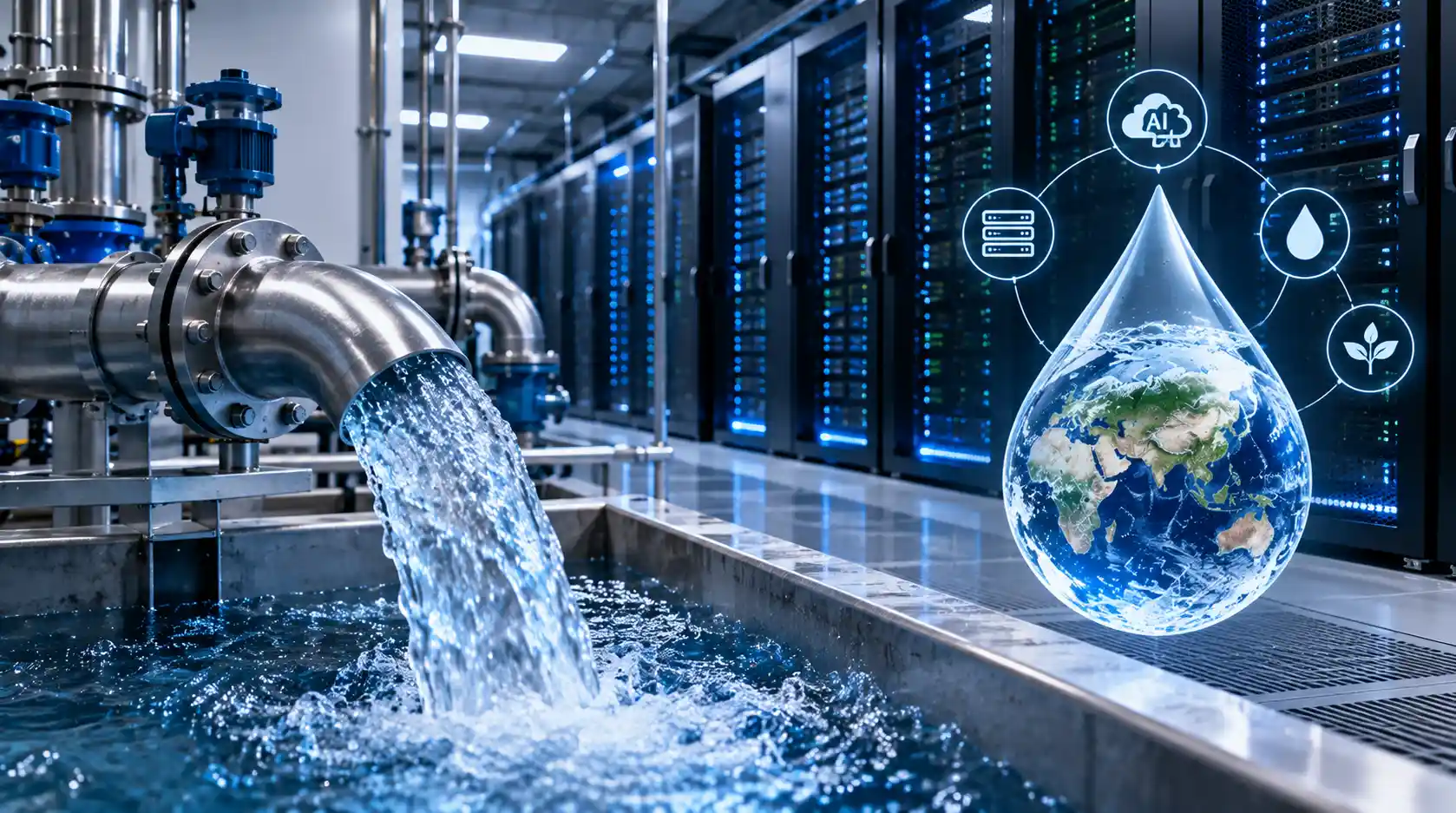
Cooling can consume enormous amounts of water
Water has historically been attractive for cooling because evaporation removes heat efficiently.
Cooling towers can therefore reduce the electricity required for mechanical refrigeration.
But evaporated water has to be continuously replaced.
A UK government analysis using IEA estimates places current global data-center water consumption above 560 billion litres annually.
That equals more than 1.5 billion litres per day on average.
The same analysis says annual global data-center water consumption could approach 1.2 trillion litres by 2030.
That would equal roughly 3.3 billion litres every day.
These numbers describe a broad data-center water footprint rather than water poured directly onto processors.
The distinction matters.
Most of the water footprint may sit outside the data center
A 2026 systematic review breaks an estimated 560-billion-litre annual data-center water footprint into three broad categories.
Approximately 140 billion litres represent direct consumption at data centers.
Around 373 billion litres are associated indirectly with energy production.
A further roughly 47 billion litres are attributed to manufacturing servers and related hardware.
On a daily basis, those figures are approximately 384 million litres directly at facilities, just over 1 billion litres associated with energy, and roughly 129 million litres connected with manufacturing.
The numbers are estimates and boundaries vary between studies.
But the breakdown demonstrates why focusing only on cooling towers can seriously understate the water footprint of digital infrastructure.
Electricity has a water footprint too
Many conventional power plants use water for cooling.
Coal, gas and nuclear plants can withdraw or consume significant amounts depending on their design.
This means an AI data center can have low direct water consumption while still indirectly driving water use through its electricity supply.
The opposite is also possible.
A facility using highly water-efficient renewable electricity could reduce its indirect footprint even if its own cooling system uses some water.
There is therefore no universal amount of water consumed by a kilowatt-hour of AI computing.
Location and generation mix matter enormously.
Withdrawal and consumption are different metrics
Water statistics can appear contradictory because studies frequently measure different things.
Water withdrawal is the total volume taken from a river, aquifer, reservoir or utility.
Water consumption is the portion that is not immediately returned to the original source, often because it evaporates.
A power plant may withdraw a huge volume of cooling water while returning most of it.
Its withdrawal can therefore be much larger than its consumption.
The same distinction applies to data centers.
Companies also report water in different ways, making simple comparisons difficult.
A facility's WUE figure may represent withdrawal while another company's sustainability report discusses consumption.
These should not be treated as interchangeable.
Water availability can determine whether a project is socially acceptable
The global water total is less important than where the consumption occurs.
A million litres used in a water-abundant basin has a different impact from a million litres consumed during drought in a highly stressed region.
Data centers increasingly operate in places where residents, agriculture and industry already compete for limited water supplies.
That creates social and political risk.
Communities may support technology investment and jobs while opposing projects they believe could raise electricity prices or place pressure on local water resources.
The IEA's 2026 energy analysis specifically identifies social acceptability as an emerging constraint on data-center development.
Infrastructure expansion is no longer only a negotiation between developers and utilities.
Local communities are becoming part of the equation.
Microsoft is trying to eliminate cooling-water evaporation
One technological response is to remove water consumption from the cooling process itself.
Microsoft introduced a new data-center design optimized for AI workloads that uses closed-loop direct-to-chip cooling and consumes effectively zero water for cooling during operations.
Water is initially placed inside the cooling loop and continuously recirculated rather than being evaporated through cooling towers.
Microsoft says the design can avoid more than 125 million litres of water annually per data center compared with previous water-consuming cooling designs.
The company still uses small amounts of water for ordinary building purposes such as kitchens and restrooms.
But the large evaporative cooling load can be eliminated.
Ninety percent of Microsoft's owned fleet now uses low- or zero-water cooling
Microsoft said in June 2026 that approximately 90% of its owned data-center fleet operated using highly efficient low- to zero-water cooling systems during 2025.
That includes several different approaches.
Direct outside air can cool facilities with little or no water under favorable weather conditions.
Air-cooled chillers reject heat through the atmosphere without evaporating cooling water.
Hybrid systems use water only during the hottest conditions.
Direct-to-chip systems move liquid directly to high-power processors and can operate in closed loops.
The ideal design depends heavily on climate and hardware density.
There is no single cooling system appropriate for every location.
India's newest Microsoft region shows where design is heading
The water issue is particularly relevant in fast-growing markets such as India.
Microsoft's new India South Central data-center region in Hyderabad became operational in September 2026 as an AI-ready hub for India, Asia and the Global South.
Microsoft says the facility uses high-efficiency mechanical cooling with effectively zero water consumption for cooling.
The company is also investing in nearby groundwater-recharge and watershed projects.
The Hyderabad example is important because the city is simultaneously becoming a major AI and cloud infrastructure hub and operates in a region where water resilience matters.
Future data centers in water-stressed areas may increasingly be judged not only by their electricity efficiency but by whether routine cooling can operate without freshwater evaporation.
AWS has pushed water usage per unit of computing lower
Amazon Web Services reports a global data-center Water Usage Effectiveness of 0.12 litres of water withdrawn per kilowatt-hour of IT load for 2025.
AWS says that represents a 20% improvement from 2024 and a 52% improvement since 2021.
The company uses sensors, leak detection, water treatment and cooling optimization to reduce withdrawals.
Its global average Power Usage Effectiveness was 1.14 in 2025.
These efficiency metrics matter because reducing water or electricity per unit of computing can partially offset the extraordinary growth in total demand.
The difficult question is whether efficiency can improve faster than computing usage grows.
So far, total industry energy demand suggests usage is winning that race.
Google is spending heavily on water replenishment
Google uses another strategy alongside efficiency improvements: replenish water in the watersheds where the company operates.
In 2025, Google says its water-stewardship projects replenished approximately 7.7 billion gallons of water.
That was equivalent to roughly 78% of Google's total freshwater consumption during the year.
The company operated 165 water projects across 97 watersheds.
Replenishment can include groundwater recharge, wetland restoration, irrigation efficiency and other projects designed to return water benefits to local ecosystems or communities.
It does not erase the physical water consumed by a specific data center at the moment that consumption occurs.
But it attempts to address watershed impact over a broader geographic and temporal scale.
Google is also buying clean electricity at unprecedented scale
During 2025, Google says it signed agreements covering more than 12 GW of net-new clean-energy capacity.
That total exceeded its procurement across the previous two years combined.
This illustrates the scale of infrastructure required when a technology company expands both conventional cloud computing and advanced AI.
The company is no longer merely buying electricity from whatever generation already exists.
Large hyperscalers increasingly influence which power plants get built.
They can become anchor customers for renewable, geothermal, nuclear and storage projects.
The technology industry's electricity purchasing strategy is therefore beginning to reshape the energy market itself.
AI creates a power-quality challenge, not just an energy-volume challenge
Traditional electricity planning often focuses on how many megawatt-hours a customer consumes over time.
AI facilities introduce another problem.
AI training and inference workloads can create rapid changes in power draw.
Clusters may move quickly between different computational states.
That can create sharper power swings than many conventional industrial loads.
The IEA argues that energy storage will become increasingly important for maintaining reliable power around AI data centers.
It estimates that approximately 20 GW to 25 GW of battery storage could be installed in data centers globally by 2030.
Those batteries could do more than protect servers.
If markets and regulations allow it, data-center storage could potentially support the surrounding grid during periods of stress.
Backup power could also become a grid resource
Most large data centers already contain significant backup capacity because computing services cannot simply stop whenever the power grid fails.
Historically that backup has often taken the form of diesel generators and UPS systems.
New campuses increasingly incorporate batteries and alternative fuels.
If operators allow utilities to coordinate some of these assets, idle backup systems could potentially provide demand response or grid support.
The concept is technically attractive.
The commercial challenge is that data centers are extraordinarily expensive infrastructure.
Operators may be reluctant to let grid requirements interfere with computing workloads for which customers are paying substantial premiums.
Efficiency gains are enormous, but rebound effects are larger
AI chips are becoming much more energy efficient.
Google says the energy required for its median Gemini text prompt fell by a factor of 33 over a twelve-month period, while its carbon footprint fell by a factor of 44.
This demonstrates how quickly per-task efficiency can improve.
But the broader industry still consumed more electricity.
This is an example of the rebound effect.
When computing becomes cheaper and more efficient, new applications become economical.
People use AI more often.
Developers build agentic systems that perform dozens or hundreds of model calls rather than one.
Companies deploy AI into workflows that previously did not use large-scale computation.
Per-query efficiency can therefore improve dramatically while total electricity demand continues rising.
Agentic AI may be especially energy intensive
A basic chatbot interaction may involve a single exchange.
An autonomous agent can operate very differently.
It may search the web, inspect documents, call multiple models, execute code, verify results, retry failed steps and continue working for hours.
The IEA specifically identifies rising use of energy-intensive applications such as AI agents as one reason total data-center power demand is still expected to grow rapidly despite efficiency gains.
This means the future energy intensity of AI depends not only on model architecture.
It depends on how humans choose to use the models.
A highly efficient model used millions of times by autonomous systems can consume more total electricity than a less efficient model used occasionally.
AI chips also carry an embodied water and energy footprint
The environmental impact begins before a data center is switched on.
Advanced semiconductors require extremely sophisticated manufacturing.
Chip fabrication uses electricity, ultrapure water, chemicals and highly specialized equipment.
Servers require metals, printed circuit boards, memory, networking equipment and cooling hardware.
A 2026 resource-management review attributes an estimated 47 billion litres of the broader current data-center water footprint to server manufacturing.
Embodied emissions and resource demand are therefore becoming more relevant as AI companies replace hardware at increasingly rapid intervals.
The physical building may remain useful for decades.
The processors inside it can become technologically outdated within only a few years.
The energy challenge creates a supply-chain challenge
Electricity is not generated and delivered by software.
Data-center expansion depends on transformers, switchgear, high-voltage cables, generators, cooling equipment and power electronics.
Many of these industries were designed around slower utility construction cycles.
AI companies are suddenly asking them to expand at technology-industry speed.
The IEA says transformer and gas-turbine supply chains have tightened significantly.
High-bandwidth memory used in AI accelerators has also emerged as a bottleneck.
This creates a situation where an AI project can have financing, land and customer demand while still waiting for electrical equipment or chips.
The physical supply chain becomes the rate limiter for digital growth.
The challenge becomes harder at gigawatt scale
Data centers were historically discussed in megawatts.
AI campuses are increasingly discussed in hundreds of megawatts and gigawatts.
One gigawatt represents a continuous power draw comparable to a large power station.
A multi-gigawatt AI campus effectively requires the technology company to think like an industrial utility customer.
Power generation may need to be planned alongside the server campus.
Transmission may need to be upgraded.
Cooling infrastructure has to handle enormous heat loads.
Water availability has to be assessed over decades.
Emergency systems have to operate at unprecedented scale.
The economic risk of choosing the wrong location becomes much larger.
The location of AI infrastructure will increasingly follow energy
Early internet infrastructure followed population centers and fiber routes.
Those remain important.
But power availability is becoming a dominant site-selection factor.
Regions with abundant renewable electricity, available transmission, cool climates and reliable water resources can become attractive even if they are farther from traditional technology hubs.
Some AI training workloads are less sensitive to latency than consumer services.
That creates opportunities to place them where energy is abundant and then move model outputs across networks.
Inference serving real-time applications may still need to remain closer to users.
The result could be a more geographically specialized data-center system.
Water-aware computing could become a real scheduling strategy
Computing workloads do not always have to run in one location at one particular time.
Some AI training, batch inference and data processing can be delayed or moved between cloud regions.
That creates the possibility of water-aware computing.
A workload could be routed to a location where temperatures are lower, water stress is lower or the electricity mix has a smaller water footprint.
A cloud provider could also time flexible workloads to periods when renewable electricity is abundant.
This type of scheduling is still developing.
But increasingly detailed environmental telemetry could turn location and timing into another dimension of computing efficiency.
Heat itself could become a resource
Nearly all electricity consumed by servers ultimately appears as heat.
Lawrence Berkeley researchers estimate that approximately 70% to 80% of data-center waste heat could theoretically be recoverable under suitable conditions.
Some European data centers already supply heat to district-heating networks.
Waste heat can also potentially support greenhouses, industrial processes or nearby buildings.
The economics depend strongly on distance and temperature.
Heat is difficult to transport efficiently over long distances.
But as data centers grow into gigawatt-scale facilities, throwing away all of that thermal energy becomes increasingly difficult to justify.
Water-free cooling can create an electricity trade-off
There is no perfect cooling technology.
Evaporative cooling is popular partly because it can remove heat with relatively little electricity.
Replacing evaporation with dry mechanical cooling can reduce water use while increasing electrical demand, particularly during hot weather.
A facility therefore has to optimize energy and water together.
Saving water by consuming much more electricity may simply shift environmental impact elsewhere if the extra electricity is produced from water-intensive or carbon-intensive generation.
Microsoft's direct-to-chip architecture is designed partly to reduce that trade-off by removing heat efficiently at the processor while operating a closed water loop.
Future cooling systems will increasingly be evaluated across several metrics simultaneously rather than only energy efficiency.
The old PUE metric is no longer enough
Data centers have traditionally been evaluated using Power Usage Effectiveness.
PUE compares total facility electricity use with the electricity consumed by IT equipment.
A lower number means less power is being spent on cooling and other overhead.
AI infrastructure requires a broader set of metrics.
Water Usage Effectiveness tracks water used or withdrawn relative to computing energy.
Carbon intensity tracks emissions associated with electricity.
Operators increasingly monitor utilization, heat-recovery potential and embodied carbon as well.
A facility can have an excellent PUE while consuming large amounts of water.
Another can have low water use while consuming more electricity.
Sustainability therefore cannot be represented by one number.
The cloud is becoming one of the world's most physical industries
For years, technology marketing encouraged the idea that digital services were almost immaterial.
Files moved to the cloud.
Software became virtual.
Applications could scale without consumers seeing any physical infrastructure.
AI is revealing how incomplete that picture was.
The cloud requires power stations.
It requires substations.
It requires transmission.
It requires cooling.
It can require water.
It requires millions of advanced chips.
It requires enormous construction projects.
And increasingly, it requires negotiations with utilities, communities and governments over resources.
The technology industry's next competitive advantage may be energy access
Frontier AI companies compete on models.
Chip companies compete on performance.
Cloud providers compete on price and developer tools.
But all of those advantages become irrelevant if the infrastructure cannot be energized.
This is why power procurement, data-center design and cooling expertise are becoming strategic capabilities rather than back-office operational functions.
A company that secures clean electricity and grid connections several years ahead of competitors can potentially deploy AI capacity faster.
A company that reduces cooling-water requirements can build in regions that would otherwise reject large data centers.
Infrastructure efficiency becomes a business advantage.
The next AI breakthrough may come from outside AI research
The industry's computing trajectory depends partly on better models and chips.
But many of the technologies that unlock the next generation of AI capacity may come from completely different industries.
Higher-efficiency transformers.
Advanced geothermal drilling.
Small modular reactors.
Better grid software.
Direct-to-chip cooling.
Higher-temperature server operation.
Water recycling.
Grid-scale batteries.
Improved power electronics.
The AI revolution is increasingly dependent on innovation in energy and industrial engineering.
India faces the same challenge at a much earlier stage of expansion
India's data-center market is growing rapidly as cloud adoption, digital services, AI, banking and data-residency requirements increase demand for domestic computing infrastructure.
The country's opportunity is large because it can build some of its future AI infrastructure using modern cooling and energy systems from the beginning rather than retrofitting decades of older facilities.
Microsoft's new Hyderabad region demonstrates one possible approach with effectively zero water use for cooling.
But India's broader data-center expansion will still require large amounts of electricity, transmission capacity, renewable generation, land and skilled engineering.
Several major Indian technology hubs also operate in regions where water stress is a recurring concern.
Infrastructure decisions made now could therefore shape the resource intensity of India's AI economy for decades.
The answer is not to stop building data centers
AI and cloud computing provide substantial economic and scientific value.
The infrastructure can support research, business productivity, healthcare, education, government services and new industries.
The energy and water challenge does not automatically mean the expansion should stop.
It means the physical costs have to be included in the engineering and economic model.
A sustainable AI strategy requires faster electricity-grid investment.
It requires more low-carbon power.
It requires smarter placement of data centers.
It requires cooling systems appropriate to local water conditions.
It requires greater transparency around water withdrawal and consumption.
And it requires using computing resources efficiently rather than assuming electricity, water and grid capacity are unlimited.
AI is forcing the technology industry to think like an industrial sector
The first era of software was capital light.
A small team could write code and distribute it globally.
The AI era is different.
Frontier models depend on infrastructure costing billions of dollars.
The chips need power.
The power needs grids.
The grids need equipment.
The chips need cooling.
Cooling can require water.
Every additional layer moves technology deeper into the physical economy.
That transition creates enormous business opportunities.
It also creates responsibilities the software industry historically did not have to confront at this scale.
The AI race may ultimately be constrained by physics
The industry has spent years discussing model parameters, training data and algorithmic breakthroughs.
The next phase may increasingly be determined by megawatts, litres, transformers and cooling capacity.
Global data-center electricity use is projected to rise from about 485 TWh in 2025 to around 950 TWh in 2030.
AI-focused facilities are expected to grow even faster.
The broader data-center water footprint is estimated above 560 billion litres per year and could approach 1.2 trillion litres by the end of the decade.
Those numbers do not imply that AI growth is environmentally impossible.
They show what must change if the growth is to continue responsibly.
Closed-loop cooling can reduce direct water consumption.
Renewables, nuclear and geothermal can expand clean power supply.
Batteries can reduce grid stress.
Smarter location choices can avoid the most constrained regions.
More efficient chips and models can reduce resource demand per task.
But none of those solutions changes the central fact.
Artificial intelligence is not weightless.
Its future will be built from electricity, silicon, cooling systems, transmission networks and water.
The technology industry has entered an era in which scaling intelligence increasingly means scaling physical infrastructure as well.
Reader questions
Frequently asked questions
How much electricity do data centers use globally?
The International Energy Agency estimates that global data centers consumed approximately 485 TWh of electricity in 2025.
How much electricity will data centers use by 2030?
The IEA's 2026 central projection places global data-center electricity consumption at approximately 950 TWh in 2030, roughly double the 2025 level.
Is AI responsible for the growth in data-center electricity use?
AI is the largest driver of the increase. The IEA expects electricity consumption from AI-focused data centers to roughly triple between 2025 and 2030.
How much did data-center power demand grow in 2025?
The IEA says global data-center electricity demand increased approximately 17% during 2025, compared with roughly 3% growth in global electricity demand overall.
Why do AI data centers consume so much electricity?
AI workloads rely heavily on high-performance accelerators operating in large clusters. Training and inference can run thousands of processors simultaneously, creating extremely high electricity and cooling demand.
Why are power grids struggling with AI data centers?
Data-center projects can be planned faster than transmission, substations and generation can be built. The IEA says major new transmission projects can require four to eight years and lead times for transformers and cables have increased substantially.
How much water do data centers use globally?
A government analysis drawing on IEA estimates places the broader global data-center water footprint above 560 billion litres annually.
How much water could data centers use by 2030?
Current projections cited in the UK government's AI and data-center water analysis suggest annual global consumption could approach 1.2 trillion litres by 2030.
Do servers directly consume water?
No. Water is primarily used by cooling systems, electricity generation and semiconductor and server manufacturing rather than by the processors themselves.
How much of data-center water use is direct cooling?
One 2026 review estimates approximately 140 billion litres of an annual 560-billion-litre footprint is direct consumption at data-center facilities, while a larger share is associated with energy production.
What is the difference between water withdrawal and consumption?
Withdrawal measures all water taken from a source. Consumption measures the portion not returned to the original source, often because it evaporates.
Can a data center operate without using water for cooling?
Yes. Closed-loop direct-to-chip systems and dry mechanical cooling can eliminate routine evaporative cooling-water consumption, although small amounts of water may still be used elsewhere in the facility.
How much water can Microsoft's zero-water cooling design save?
Microsoft says its next-generation closed-loop cooling design can avoid more than 125 million litres of water per data center per year compared with older evaporative cooling approaches.
What is AWS Water Usage Effectiveness?
AWS reported a global WUE of 0.12 litres of water withdrawn per kilowatt-hour of IT load in 2025, a 52% improvement from 2021.
How much water did Google replenish in 2025?
Google says its water projects replenished approximately 7.7 billion gallons during 2025, equivalent to roughly 78% of its total freshwater consumption.
Are AI data centers increasing natural-gas demand?
In some markets, yes. Developers are considering natural-gas generation where grid connections cannot arrive fast enough, while the IEA also expects gas to contribute to meeting rising global data-center electricity demand.
Why are technology companies interested in nuclear power?
AI data centers need large amounts of reliable electricity around the clock. Nuclear can provide firm low-carbon power, making it attractive to hyperscalers seeking alternatives to fossil generation.
Will renewable energy be enough to power AI?
Renewables are expected to provide a major share of new electricity, but grids, storage and dispatchable generation are also required because data centers operate continuously and renewable generation varies with weather.
Why are batteries useful for AI data centers?
AI workloads can create rapid changes in power demand. Batteries can smooth those fluctuations, provide backup power and potentially support the local electricity grid.
Are AI models becoming more energy efficient?
Yes. Energy required per task is falling rapidly, but overall electricity demand is still rising because AI use, model deployment and agentic workloads are expanding even faster.
Why does location matter for AI data centers?
The environmental and economic impact depends heavily on grid capacity, electricity generation mix, climate, water availability, fiber connectivity and local regulation. The same data center can have very different energy and water impacts in different regions.
Nexuswild welcomes factual corrections. Email [email protected] with evidence and the article URL.