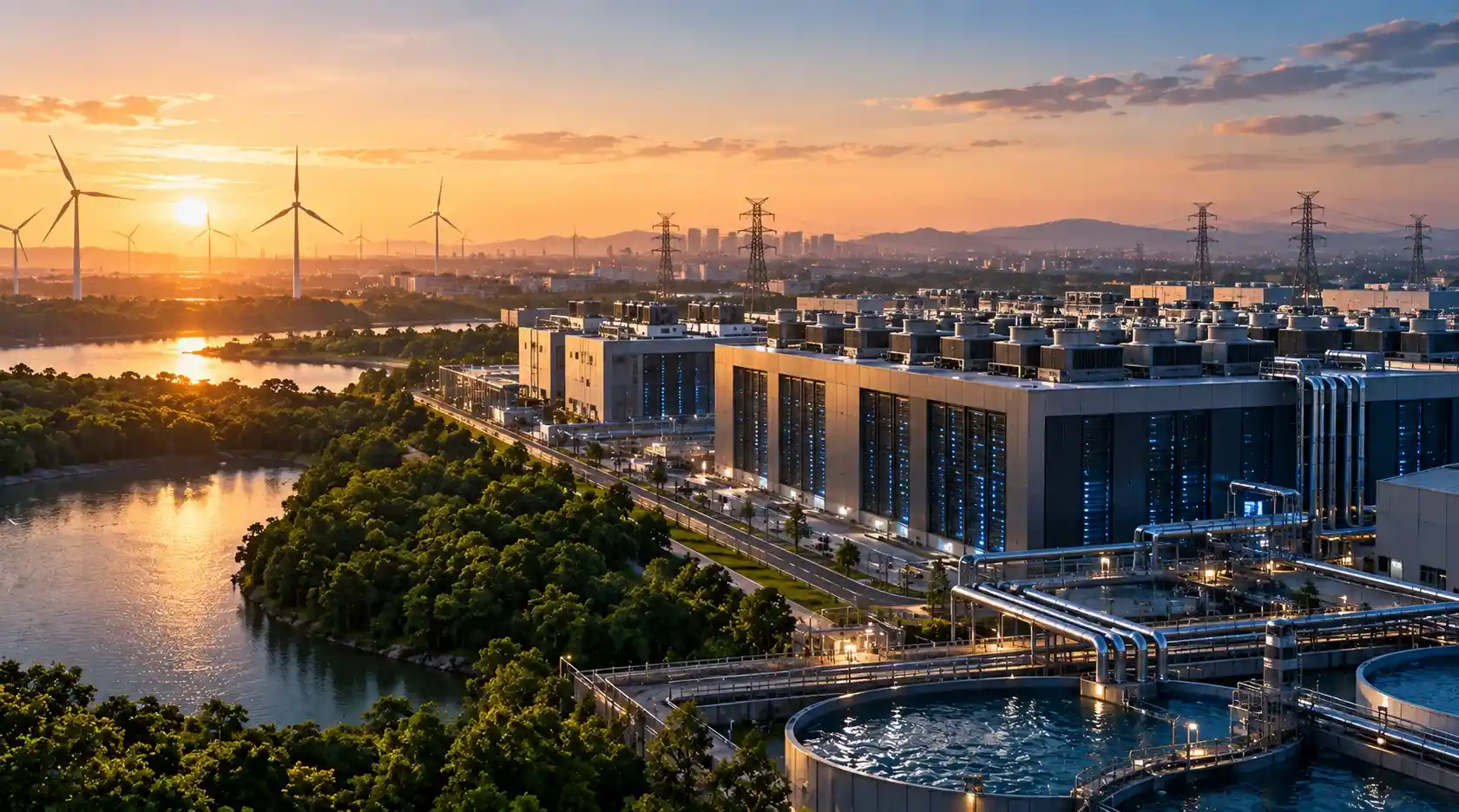

The next great infrastructure business is already being built
For most of the internet era, data centers were largely invisible.
Consumers saw websites, apps, search engines, streaming services and cloud software.
Behind them sat anonymous buildings filled with servers.
Artificial intelligence has changed that relationship.
Data centers are becoming one of the most capital-intensive and strategically important infrastructure industries in the world.
McKinsey estimates that approximately $6.7 trillion of global capital investment may be required for data centers through 2030 to keep pace with demand for computing power.
About $5.2 trillion of that requirement is associated with infrastructure serving AI workloads, while approximately $1.5 trillion is linked to conventional computing.
This is no longer merely a billion-dollar opportunity.
It is a multi-trillion-dollar infrastructure transformation.
And the opportunity extends far beyond companies that own server buildings.
The economic stack includes semiconductors, GPUs, memory, power generation, transformers, transmission lines, fiber, cooling systems, real estate, construction, utilities, cloud platforms, networking, batteries, gas turbines, nuclear power, renewable energy and financing.
AI may be the software story everyone sees.
Data centers are the physical economy underneath it.
Why data centers suddenly matter so much
Traditional cloud computing already required enormous infrastructure.
Companies moved email, databases, enterprise software, websites, video and storage from private server rooms into hyperscale cloud platforms operated by companies such as Amazon, Microsoft and Google.
AI adds a different level of computing intensity.
Training frontier models can involve enormous clusters of accelerators working continuously for weeks or months.
Inference, the process of running trained AI models when users or software request an answer, also consumes substantial computing resources.
As AI becomes embedded into search engines, coding tools, enterprise software, advertising, healthcare, robotics, autonomous systems and consumer applications, inference could ultimately become an even larger source of infrastructure demand than model training.
The result is a simple economic equation.
More AI usage means more compute.
More compute means more chips.
More chips mean more electricity.
More electricity means larger data centers, more cooling and more grid infrastructure.
That chain is creating one of the largest industrial investment cycles of the decade.
Global capacity could almost triple by 2030
McKinsey's continued-momentum scenario estimates global data-center capacity demand at approximately 82 GW in 2025.
By 2030, it could reach roughly 219 GW.
AI workloads could account for approximately 156 GW of that total, compared with around 64 GW for traditional non-AI workloads.
That means AI could represent roughly 70% of global data-center capacity demand by the end of the decade under the model.
The physical scale is changing too.
Older data-center campuses were often measured in tens of megawatts.
The industry is increasingly discussing campuses measured in hundreds of megawatts and even gigawatts.
A one-gigawatt campus is not simply a larger server building.
It is closer to an industrial complex with its own power strategy, substations, cooling systems, fiber routes and long-term energy contracts.
Compute is becoming infrastructure like electricity
The most important change may be conceptual.
Computing capacity used to be treated mainly as an IT expense.
AI is turning compute into strategic infrastructure.
Governments increasingly think about domestic computing capacity in the same way they think about energy, telecommunications or semiconductor manufacturing.
Companies worry about whether enough GPU capacity will be available when they need it.
AI developers sign multi-year infrastructure agreements.
Hyperscalers reserve equipment years in advance.
Utilities are redesigning generation plans around data-center demand.
Private-equity funds and pension investors are moving capital into digital infrastructure.
Compute is starting to behave like a scarce industrial commodity.
The $7 trillion opportunity is much bigger than buildings
The popular image of a data-center investment is a warehouse full of server racks.
That represents only one part of the economics.
McKinsey's AI-related $5.2 trillion base-case estimate divides investment into three major physical categories.
Approximately $800 billion, or around 15%, could go toward builders responsible for land, materials, construction and site development.
Roughly $1.3 trillion, about 25%, could flow toward what McKinsey calls energizers, including power generation, transmission, electrical equipment, cooling and connectivity.
The largest share, approximately $3.1 trillion or 60%, could go toward technology developers and hardware suppliers producing GPUs, CPUs, memory, networking equipment, storage and servers.
This explains why the data-center boom is affecting industries that once appeared far removed from software.
Transformer manufacturers matter.
Cooling-equipment suppliers matter.
Copper matters.
Fiber matters.
Electric utilities matter.
Engineering firms matter.
Gas turbines matter.
Nuclear developers may increasingly matter.
The AI economy is becoming an industrial economy.
Chips are likely to capture the largest pool of capital
The largest individual opportunity sits inside computing hardware.
AI accelerators are expensive and are replaced far more frequently than the buildings around them.
A data-center shell may operate for decades.
A generation of AI servers can become economically outdated within a handful of years.
That creates a recurring capital cycle.
The building remains.
The transformers remain.
The fiber remains.
But the GPUs, memory, networking and server platforms continue changing.
This is one reason semiconductor companies have captured so much of the economic value created by the AI boom.
The most valuable square metre inside an AI data center is not the floor itself.
It is the computing equipment that can be powered and cooled on that floor.
Power may become more valuable than land
Traditional real estate begins with location.
Data-center real estate increasingly begins with electricity.
CBRE says power availability and the speed at which it can be delivered are becoming more important than connectivity in major development decisions.
In several markets, the ability to secure hundreds of megawatts within an acceptable time frame can determine whether a project is viable.
A cheap piece of land without available power may have little value to a hyperscaler.
Land beside a transmission corridor, generation asset and multiple fiber routes can become strategically valuable even when it is far from a traditional technology hub.
This is shifting data-center development into new geographies.
There is already a shortage of available capacity
The investment boom has not yet created an obvious oversupply in the largest markets.
CBRE reported that data-center supply across 16 major global markets reached approximately 16 GW in the first quarter of 2026, an increase of around 25% year over year.
Yet average vacancy still fell to 6.7%, from 8.3% a year earlier.
In several North American hubs, available capacity is effectively disappearing before facilities are finished.
Northern Virginia recorded vacancy around 0.3% in CBRE's global 2026 study.
North America's major markets subsequently reached a record-low 1.4% vacancy rate in the first half of 2026 even as supply expanded substantially.
Demand is absorbing capacity almost as quickly as developers can build it.
New data centers are being leased before they exist
The strongest sign of demand is pre-leasing.
Companies increasingly commit to capacity before construction is complete.
Colliers reported that more than 90% of new capacity in its 2026 marketplace analysis was being pre-leased before delivery.
CBRE raised its 2026 outlook for pre-leasing on projects under construction as demand continued to exceed available supply.
That changes the economics for developers.
A project with a long-term hyperscaler or AI customer attached can be financed more like contracted infrastructure than speculative property.
The building becomes less like an office development and more like an energy-intensive utility asset.
Data centers are becoming energy businesses
Power can now represent 40% to 50% of total project costs in some large developments, according to Colliers' 2026 marketplace assessment.
That changes who can compete.
Developers increasingly need expertise in power markets, grid interconnection, transmission, renewable generation, backup systems and long-term power contracts.
Some projects are exploring behind-the-meter generation because utilities cannot deliver power quickly enough.
Natural gas is being considered as a bridge in some markets.
Nuclear and small modular reactors are attracting attention for long-term baseload supply.
Geothermal is being evaluated where geography allows it.
Renewables and batteries will remain important, particularly for companies with emissions commitments.
The defining question for a future AI campus may not be 'How much land can we buy?'
It may be 'How many megawatts can we reliably energize?'
Electricity demand could roughly double by 2030
The International Energy Agency estimates that global data centers consumed approximately 485 TWh of electricity in 2025.
Its updated central projection places consumption at around 950 TWh in 2030.
That would represent approximately 3% of global electricity demand.
AI-focused data-center electricity consumption is projected to grow substantially faster than the overall sector, roughly tripling over the period in the IEA's updated outlook.
The power industry therefore becomes one of AI's biggest secondary beneficiaries and one of its biggest constraints.
AI developers can order more GPUs faster than a utility can build a transmission network.
That difference in construction timelines may define how quickly the next generation of data centers can expand.
The grid is becoming the bottleneck
A modern AI data center can sometimes be designed and constructed faster than the generation and transmission systems required to power it.
New transmission lines may need permits, rights-of-way, substations and years of regulatory work.
Transformers and high-voltage equipment have their own manufacturing lead times.
A proposed project may therefore have financing, land and customers while still waiting for electricity.
This creates an unusual situation.
Technology is moving on an 18-month innovation cycle.
Electricity infrastructure can move on a five-to-ten-year planning cycle.
Those timelines are colliding.
The winners in the next phase of the data-center market may be companies that can shorten the gap.
Cooling is becoming a billion-dollar industry inside a trillion-dollar industry
AI servers are denser than traditional CPU infrastructure.
CBRE notes that traditional CPU racks historically operated around 3 to 10 kW in many environments, while modern GPU racks can reach around 100 kW and require closed-loop liquid cooling.
Future architectures are pushing density still higher.
Air cooling that worked for conventional enterprise servers becomes increasingly difficult at those heat loads.
That creates demand for direct-to-chip liquid cooling, coolant distribution units, heat exchangers, pumps, cooling towers, dry coolers and potentially immersion systems.
The cooling system is no longer a secondary facility component.
It is becoming part of the computing architecture itself.
AI data centers are more expensive to build
Turner & Townsend's construction-cost research found a measurable premium for AI-ready facilities.
Its 2025-2026 analysis identified approximately a 7% to 10% construction-cost premium for comparable AI data centers in the United States relative to traditional facilities.
That premium comes from greater electrical density, liquid cooling, additional mechanical infrastructure and more demanding power systems.
Traditional data-center construction costs were already increasing.
Turner & Townsend reported average global cost-per-watt inflation of around 5.5% for conventional data centers in its 2025 analysis.
The AI transition therefore creates more demand while simultaneously making the asset more complicated to construct.
Hyperscalers are spending hundreds of billions every year
The clearest evidence of the boom sits inside Big Tech capital budgets.
Amazon raised its 2026 capital-spending forecast to approximately $220 billion as AWS demand accelerated.
The company said that even at that level it expected insufficient capacity to satisfy all computing demand during 2026 and indicated the constraint could continue into 2027.
Alphabet's AI-related investment climbed above $200 billion in 2026 according to Reuters reporting following its July results.
Microsoft had earlier indicated spending around $190 billion for 2026.
Meta expected to spend as much as approximately $145 billion on AI infrastructure in 2026 and was working toward dramatically larger computing capacity.
Across the largest U.S. technology companies, AI-related investment is expected to exceed $700 billion during 2026.
Few industries in history have experienced this level of capital expenditure concentrated into such a short period.
Amazon's numbers show why companies continue spending
The counterargument to the AI infrastructure boom is straightforward.
What if companies build too much?
Amazon's latest results provide one explanation for why hyperscalers continue taking that risk.
AWS revenue grew 37% year over year to approximately $42.2 billion in the second quarter of 2026.
Its contracted backlog reached approximately $496 billion.
Amazon CEO Andy Jassy said the company still could not provide enough computing capacity to satisfy demand.
He also explained an important feature of the economics.
Data centers require spending years before they begin generating revenue.
Once operating, however, the physical facility can remain economically useful for decades while successive generations of servers are installed inside it.
The infrastructure is long-lived even when the computers are not.
The financing industry is being transformed too
Building trillion-dollar infrastructure requires more than Big Tech balance sheets.
Data centers are increasingly being financed through private equity, infrastructure funds, sovereign wealth, real-estate capital, bank debt and corporate bonds.
This has created a new asset class at the intersection of technology, utilities and real estate.
But the capital intensity is becoming large enough to create financial-system questions.
Reuters reported in September 2026 that hyperscaler debt issuance could accelerate sharply as companies finance increasingly expensive AI infrastructure programs.
Investors are beginning to ask whether returns from AI will grow quickly enough to justify the enormous capital being deployed.
That question is important.
A data-center boom can be structurally real and still produce bad individual investments.
The business is attractive because capacity can produce recurring revenue
Unlike selling a one-time construction project, operating data centers can generate long-duration revenue.
Customers lease electrical capacity, racks, halls or entire buildings.
Hyperscalers can sign multi-year commitments.
Cloud providers monetize installed computing capacity continuously.
GPU cloud companies sell access by the hour or through longer commitments.
Interconnection services produce additional recurring revenue.
Managed infrastructure, networking and security add more layers.
For investors, the combination of contracted demand and scarce power can make high-quality facilities resemble infrastructure assets with technology-driven growth.
But this is not easy real estate
The phrase 'data-center real estate' can be misleading.
Owning land is the easiest part.
A competitive facility needs reliable power, redundant electrical systems, high-capacity fiber, cooling, physical security, generators or alternative backup, fire suppression, specialized operations teams and regulatory approvals.
Downtime can cost customers enormous amounts of money.
Redundancy has to be engineered into nearly every critical system.
The business therefore sits somewhere between a power plant, telecommunications network, industrial facility and cloud-computing platform.
That complexity creates barriers to entry.
India is entering the race at exactly the right moment
India has several ingredients that make the data-center opportunity particularly significant.
It has more than a billion internet users.
Its digital economy is expanding.
Cloud adoption continues growing.
AI usage is rising rapidly.
Banks, governments and regulated industries increasingly care about local data residency.
The country also possesses large technology-services companies, engineering talent and expanding renewable-energy capacity.
India's operational data-center capacity crossed roughly 1.5 GW during 2025 according to CBRE.
CBRE recorded approximately 23 million square feet of operational stock by the first nine months of that year.
That is meaningful, but still small relative to what several investors are now proposing.
India could become a multi-gigawatt market
Forecasts vary because project pipelines change quickly.
Colliers estimated that India's major-city data-center capacity could exceed 4.5 GW by 2030, compared with approximately 1.26 GW in April 2025.
Other industry projections are significantly higher when announced hyperscale and AI campuses are included.
Grant Thornton Bharat has cited a possible path toward approximately 6.5 GW by 2030.
TCS, discussing its HyperVault investment, has referenced industry estimates suggesting national capacity could eventually exceed 10 GW by 2030.
These numbers should not be treated as identical forecasts because they use different market definitions and project assumptions.
What they agree on is direction.
India's data-center footprint is expected to expand by several multiples.
India already attracted tens of billions in commitments
CBRE estimated that India secured nearly $94 billion of data-center investment commitments between 2019 and the first nine months of 2025.
Colliers separately estimated that $20 billion to $25 billion of additional data-center investment could materialize during the following five to six years across its tracked market.
Those estimates predate several enormous AI-infrastructure announcements made during 2026.
Investment intentions have accelerated further.
Reliance and Adani are treating AI infrastructure as strategic industry
At the India AI Impact Summit in February 2026, Reliance Industries and Adani Group announced plans that together represented approximately $210 billion of investment ambitions tied to AI and data infrastructure over extended periods.
Reliance outlined approximately $110 billion of investment, while Adani announced around $100 billion through 2035.
These commitments are broader than data-center construction alone, so they should not be counted directly as pure data-center market size.
But they demonstrate how India's largest industrial conglomerates view AI infrastructure.
They are approaching compute in much the same way earlier generations approached telecom, ports, energy and petrochemicals.
It is becoming strategic industrial infrastructure.
Reliance is already attracting global AI customers
In June 2026, Meta entered a partnership involving an AI-ready data center being developed by Reliance in Jamnagar.
Reuters reported that the facility is planned at approximately 168 MW and will draw on Reliance's renewable-energy infrastructure.
That matters because it demonstrates how India's advantage may evolve.
The country does not need only domestic customers.
It can potentially sell computing infrastructure to global AI companies seeking power, geographic diversification, data residency and lower-cost capacity.
TCS is turning from software services into physical infrastructure
One of the most significant changes in Indian technology is happening inside Tata Consultancy Services.
TCS historically built its global business around software services, consulting and outsourcing.
Its HyperVault strategy pushes it directly into AI infrastructure.
OpenAI agreed to become the first customer of the HyperVault data-center business, beginning with 100 MW of capacity and with an option to scale toward 1 GW.
TCS has said HyperVault plans more than 1 GW of new capacity across India.
In September 2026, the company secured 264 acres in Hyderabad for an AI data-center campus capable of reaching up to 1 GW.
The campus is being designed around high-density GPU systems, direct-to-chip liquid cooling and large-scale AI training and inference.
This is a remarkable strategic transition.
One of India's largest IT-services companies is moving from managing software to owning part of the physical compute layer beneath the software.
TPG is putting real capital behind HyperVault
The project is not only an internal TCS experiment.
TCS secured a strategic investment arrangement with TPG for HyperVault.
The partners committed up to ₹18,000 crore, with TPG planning investment of up to ₹8,820 crore and potentially holding a substantial minority stake.
The financing combines equity and debt.
That structure shows how global private capital is beginning to treat Indian AI infrastructure as a dedicated investable platform.
Microsoft is also building at unprecedented scale in India
Microsoft has committed heavily to India's cloud and AI infrastructure.
Its largest Indian data center was scheduled to begin operations in Hyderabad during 2026 as part of a broader $17.5 billion investment program.
The expansion reflects accelerating demand for Azure and AI workloads in India.
Cloud competition increasingly depends on physical availability.
A software customer cannot buy computing capacity that has not been built.
That makes every new cloud region and data-center campus a competitive asset.
NTT is expanding too
NTT Data said in February 2026 that it planned approximately $1.5 billion of investment to build four additional data centers in India.
The company highlighted an important imbalance: India generates a very large share of the world's digital data while holding a much smaller share of global data-center capacity.
That mismatch is one reason investors believe the country has substantial room for expansion.
Yotta shows the emergence of a domestic GPU-cloud business
Yotta Data Services is another example of the market changing from simple colocation toward AI compute.
The company is building NVIDIA-powered AI infrastructure and sovereign-cloud capacity in India.
In September 2026, Reuters reported that Yotta was preparing for a potential 2027 IPO seeking to raise as much as $1.5 billion.
The proceeds would support GPU purchases, debt reduction and sovereign cloud expansion.
Yotta had recently raised capital at a reported valuation of approximately $3.9 billion.
That shows the investment market is beginning to value AI compute platforms separately from traditional server-hosting businesses.
India's opportunity extends beyond Mumbai
Mumbai remains the country's largest data-center hub because of submarine cable connectivity, financial-sector demand, internet exchanges and established infrastructure.
Chennai benefits from cable connectivity and a large technology ecosystem.
Delhi NCR serves one of India's largest economic and government regions.
Bengaluru provides deep technology demand.
Hyderabad is becoming increasingly important for hyperscale and AI infrastructure.
Pune, Kolkata and Tier II cities are also receiving interest.
As power availability becomes more important than proximity to traditional business districts, the map can expand further.
The next fortunes may be made in boring equipment
AI discussions focus on glamorous companies and powerful models.
Some of the most durable business opportunities may exist in products few consumers ever see.
Transformers.
Switchgear.
Busways.
Backup generators.
Cooling distribution units.
Heat exchangers.
Pumps.
Fiber-optic systems.
Power-management software.
UPS systems.
Electrical engineering.
Construction modules.
Water-treatment systems.
These products become increasingly valuable when every hyperscaler is trying to build at the same time.
A shortage of one relatively mundane component can delay billions of dollars of computing equipment.
Transformer lead times can matter more than GPU delivery
A company can purchase thousands of accelerators and still be unable to operate them without electrical infrastructure.
High-voltage transformers, substations, switchgear and transmission equipment have become strategic supply-chain items.
Manufacturers that historically served slow-moving utilities are being asked to support technology companies operating at a radically faster pace.
McKinsey argues that this mismatch between traditional industrial supply chains and hyperscaler timelines creates space for new suppliers and new manufacturing capacity.
The AI boom therefore creates opportunity far beyond Silicon Valley.
Fiber becomes the nervous system
Compute without connectivity has limited value.
Large AI clusters require high-speed networking internally, while data centers also need redundant external fiber routes connecting cloud regions, internet exchanges, businesses and consumers.
McKinsey estimates that approximately $150 billion of fiber-related investment could be associated with the broader AI infrastructure requirement in its illustrative scale analysis.
AI also increases east-west data movement inside facilities as accelerators exchange enormous quantities of information.
Networking silicon, optical equipment and fiber systems therefore become another critical layer of the opportunity.
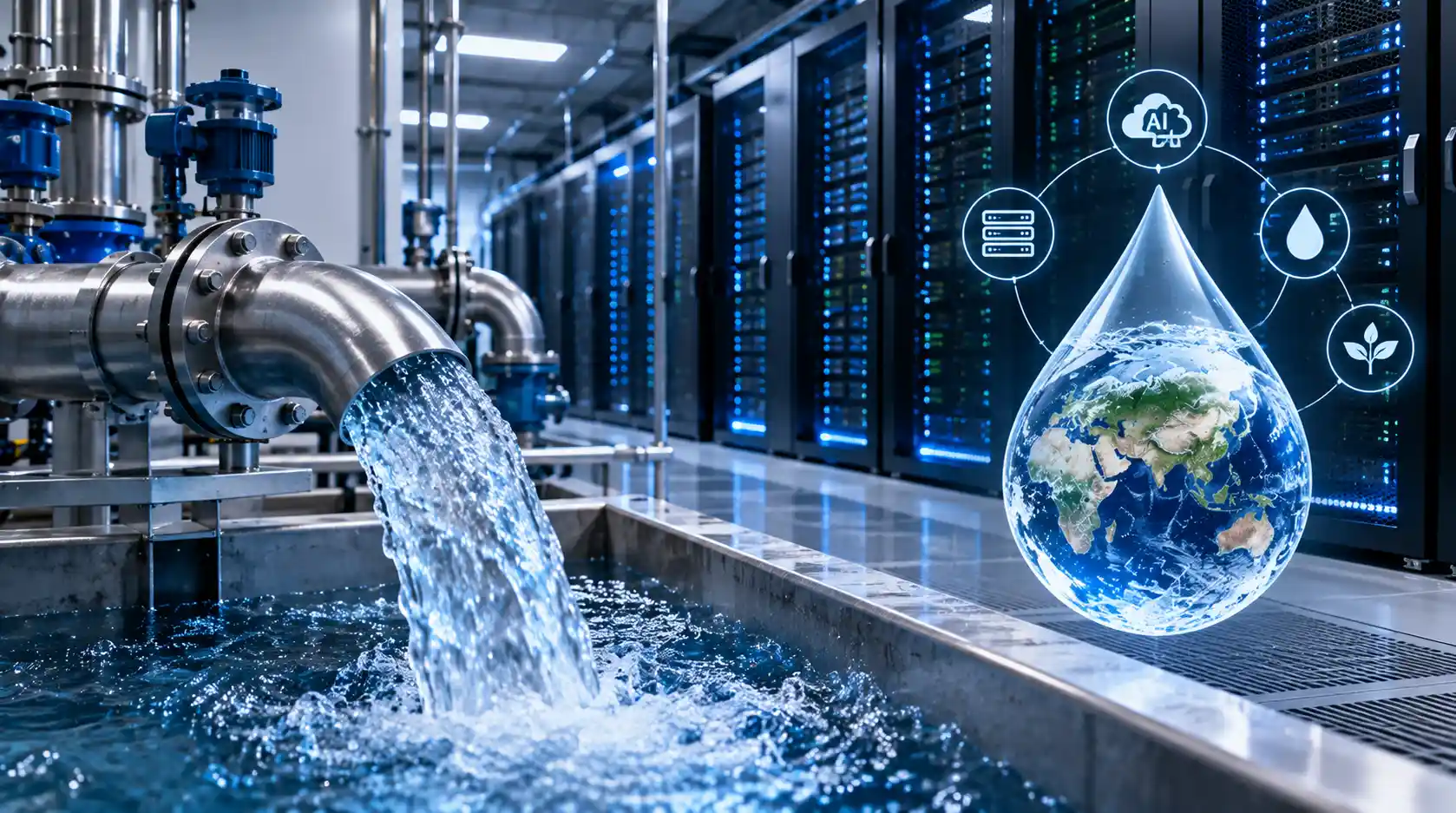
Water is becoming part of investment due diligence
Power is not the only resource constraint.
Cooling can consume substantial water depending on facility design and local climate.
Data-center projects are increasingly being evaluated against regional water availability and community impact.
That matters in India, where several major planned data-center regions already experience water stress.
Future facilities will increasingly need reclaimed water, closed-loop liquid cooling, dry cooling and better heat-management technology.
A location with cheap electricity but severe water constraints may not be as attractive as it first appears.
Sovereign AI creates another demand layer
Cloud computing was historically dominated by a handful of global providers.
AI is adding national-security considerations.
Governments increasingly want sensitive models and data to run within domestic infrastructure.
Financial institutions face residency rules.
Public-sector workloads may need local control.
Companies may want private inference environments for intellectual property.
These requirements create demand for sovereign AI infrastructure.
India's OpenAI-Tata partnership explicitly emphasizes local infrastructure for data residency, security and compliance.
Sovereign compute can therefore create demand even when global cloud capacity exists elsewhere.
Edge data centers could create the next layer
Training giant models tends to favor enormous centralized campuses.
Inference can be different.
Applications such as industrial AI, telecom systems, autonomous machines, augmented reality and real-time consumer services may require lower latency.
That creates a potential role for smaller regional and edge facilities closer to users.
The future data-center market may therefore split into several architectures.
Gigawatt-scale AI factories train and serve enormous models.
Large regional cloud campuses host enterprise workloads.
Smaller edge facilities handle latency-sensitive inference.
Each architecture produces different investment opportunities.
There is a real danger of overbuilding
No serious investment analysis should assume every announced data center will produce attractive returns.
AI demand remains difficult to forecast.
Models are becoming more efficient.
Inference costs continue falling.
Custom chips may reduce the amount of hardware required for some workloads.
Enterprises may discover that certain AI applications do not generate enough economic value to justify their computing cost.
Some planned campuses may never be built.
Others may be delayed by power constraints.
A project developed without a strong customer or energy advantage can become a stranded asset.
McKinsey's AI infrastructure scenarios range widely, from approximately $3.7 trillion of required investment in a constrained-demand case to about $7.9 trillion under accelerated demand.
That range alone shows how much uncertainty remains.
Efficiency does not necessarily kill demand
The strongest argument against massive infrastructure growth is that AI is becoming more efficient.
A future model may achieve today's performance using a fraction of the compute.
But computing has historically demonstrated a rebound effect.
When the cost of a capability falls, usage often expands.
More efficient AI can make millions of new use cases economically viable.
A model that becomes ten times cheaper may be used one hundred times more often.
McKinsey specifically notes this Jevons-paradox dynamic in its infrastructure modeling.
Efficiency may reduce the computing requirement per task while increasing total demand for tasks.
The real asset is not the building, it is energized capacity
This distinction may become one of the most important investment concepts of the AI era.
A finished warehouse is not necessarily valuable compute infrastructure.
A data center becomes strategically valuable when it has several things simultaneously:
Reliable megawatts.
Cooling capable of supporting high-density hardware.
Fiber connectivity.
Permits.
A strong customer pipeline.
A resilient energy strategy.
And the ability to deploy new computing hardware quickly.
The scarce commodity is increasingly not square footage.
It is usable, connected, cooled and energized compute capacity.
This creates five different billion-dollar businesses
The data-center boom can be understood as five overlapping businesses.
First are builders, including real-estate developers, engineering companies and construction contractors.
Second are energizers, including utilities, renewable developers, nuclear companies, transformer manufacturers, cooling providers and grid equipment companies.
Third are hardware companies producing GPUs, CPUs, memory, servers, optical networking and storage.
Fourth are operators, including hyperscalers, colocation providers and GPU-cloud companies.
Fifth are AI companies that convert infrastructure into models and software products.
Different parts of the stack have different margins and risks.
But nearly all benefit when global compute consumption rises.
The biggest mistake would be thinking this is only a technology story
The data-center boom affects technology, but its constraints come from the physical world.
Land.
Power.
Water.
Copper.
Transformers.
Cooling.
Construction workers.
Fiber.
Permits.
Capital.
This is why traditional industrial companies are suddenly becoming strategically connected to the AI revolution.
A world-class model cannot run without physical infrastructure.
Data centers could become the railroads of the AI economy
Every major economic transformation creates foundational infrastructure.
Industrialization required ports, factories and railroads.
Electrification required generation and grids.
The internet required fiber and telecom networks.
Cloud computing required hyperscale data centers.
Artificial intelligence is now demanding another expansion of physical compute infrastructure at a scale that may exceed previous digital build-outs.
The analogy is not perfect.
But the economic role is similar.
Data centers are becoming the places where a new general-purpose technology is physically produced and delivered.
Instead of transporting people or electricity, they manufacture computing power.
The next trillion-dollar opportunity may be selling the picks and shovels
During a gold rush, owning the mine is not the only way to make money.
Infrastructure providers can capture enormous value by supplying everyone competing for the resource.
The AI equivalent includes chips, power systems, cooling, fiber, construction and data-center capacity.
Individual AI applications may rise and fall.
Individual model companies may lose leadership.
But almost every serious competitor requires computing infrastructure.
That makes the physical compute layer unusually broad exposure to the AI economy.
India has a rare opportunity to move up the technology stack
For decades, India's technology story was dominated by software services and IT outsourcing.
Data centers create an opportunity to add physical digital infrastructure to that strength.
The country can provide software engineering, cloud services, AI integration, sovereign compute and potentially large-scale AI infrastructure from the same ecosystem.
TCS HyperVault demonstrates the strategic shift.
Reliance and Adani are bringing industrial-scale capital and energy capabilities.
Yotta is building GPU infrastructure.
Microsoft, Amazon, Google and NTT are expanding locally.
Power companies, construction groups and equipment manufacturers can participate as well.
The economic opportunity spreads far beyond the companies whose names appear on the server racks.
But India will need more than capital
Large announcements do not automatically create operating data centers.
India will need dependable electricity.
Transmission infrastructure.
Renewable capacity.
Water-efficient cooling.
Fast approvals.
Skilled electrical and mechanical engineers.
Domestic equipment supply chains.
Fiber connectivity.
Land with the right infrastructure.
And financing structures capable of supporting projects that cost billions before producing revenue.
Execution will determine whether announced gigawatts become operational gigawatts.
The data-center boom is moving from megawatts to gigawatts
That may be the simplest way to understand what is changing.
The cloud era built data centers in megawatts.
The AI era is beginning to discuss infrastructure in gigawatts.
TCS is planning beyond 1 GW.
Meta is working toward multi-gigawatt computing capacity.
Reliance and Adani are planning industrial-scale AI infrastructure.
North American developers are searching for sites capable of receiving hundreds of megawatts at a time.
When an industry moves from MW to GW, almost everything around it changes.
Financing changes.
Grid planning changes.
Cooling changes.
Site selection changes.
Supply chains change.
The industry becomes infrastructure.
Is the data-center industry the next trillion-dollar business?
The answer is increasingly yes, with an important qualification.
The opportunity is not a single $7 trillion market belonging to data-center landlords.
It is approximately $7 trillion of projected cumulative investment distributed across an entire compute infrastructure value chain.
Hardware is likely to capture the largest portion.
Power and cooling represent another enormous pool.
Construction and real estate represent hundreds of billions more.
Operators can build recurring infrastructure revenue.
Cloud providers monetize the computing layer.
AI companies monetize the intelligence running above it.
The opportunity is therefore larger and more complicated than simply owning server buildings.
The world is building factories for intelligence
For more than a century, factories transformed raw materials into physical products.
The new AI data center transforms electricity, silicon and information into computation.
That computation becomes software, language, images, scientific analysis, automation and increasingly autonomous decisions.
The infrastructure required to produce it is becoming one of the world's most expensive industrial systems.
McKinsey's projection of almost $7 trillion through 2030 captures the scale of what is beginning.
The IEA's forecast of roughly 950 TWh of annual data-center electricity demand by the end of the decade captures the energy behind it.
Record-low vacancy rates capture the current shortage.
Hundreds of billions in hyperscaler spending capture the urgency.
And India's rapidly expanding pipeline shows that the build-out will not be limited to the United States.
The AI revolution may be experienced through software.
But one of its biggest businesses will be built from concrete, copper, silicon, fiber, electricity and water.
The cloud is becoming one of the most physical industries on Earth.
Reader questions
Frequently asked questions
Are data centers the next trillion-dollar business?
The broader data-center infrastructure ecosystem is already becoming a multi-trillion-dollar investment market. McKinsey estimates approximately $6.7 trillion of cumulative global capital spending could be required through 2030.
How much investment will AI data centers require?
McKinsey's base-case estimate places cumulative AI-related data-center infrastructure investment at approximately $5.2 trillion through 2030.
Where will the $5.2 trillion in AI data-center investment go?
McKinsey estimates approximately $3.1 trillion could go to computing hardware, $1.3 trillion to power, cooling and connectivity infrastructure, and roughly $800 billion to land, materials and construction.
How large will global data-center capacity be by 2030?
McKinsey's continued-momentum scenario estimates global demand at roughly 219 GW by 2030, including approximately 156 GW associated with AI workloads.
How much electricity will data centers use by 2030?
The International Energy Agency's updated central projection puts global data-center electricity consumption at approximately 950 TWh in 2030, compared with about 485 TWh in 2025.
Why are data centers becoming so valuable?
AI and cloud workloads require enormous amounts of computing capacity. Facilities with secured electricity, high-density cooling, fiber connectivity and long-term customers are becoming scarce infrastructure assets.
What is the biggest constraint on new data centers?
Power availability is increasingly the biggest constraint. Developers may secure land and financing years before utilities can provide the hundreds of megawatts required by large AI campuses.
Why do AI data centers need liquid cooling?
Modern GPU racks can produce far more heat than traditional CPU racks. Direct-to-chip liquid cooling moves heat away from high-power processors more efficiently than conventional air cooling at very high rack densities.
Are AI data centers more expensive than traditional data centers?
Yes. Turner & Townsend identified roughly a 7% to 10% construction-cost premium for comparable AI-ready data centers in the United States because of denser electrical systems, liquid cooling and additional infrastructure.
How big is India's data-center business?
India crossed roughly 1.5 GW of operational capacity in 2025. Forecasts vary, but major industry studies expect several gigawatts of capacity by 2030 as AI, cloud and data-residency demand expand.
How much data-center investment could India attract?
Colliers estimated $20 billion to $25 billion of additional investment could materialize across the Indian data-center market over five to six years, while CBRE previously tracked nearly $94 billion of broader investment commitments between 2019 and September 2025.
What is TCS HyperVault?
HyperVault is TCS's AI-ready data-center business. It plans more than 1 GW of new capacity in India, with OpenAI as its first announced customer starting at 100 MW and an option to scale toward 1 GW.
Where is TCS building its large AI data center?
TCS announced in September 2026 that HyperVault secured 264 acres in Hyderabad for a purpose-built AI data-center campus capable of reaching up to 1 GW.
Is Reliance building AI data centers?
Yes. Reliance is developing large AI-ready infrastructure in India. Meta announced a partnership in 2026 involving a planned 168 MW Reliance AI data center in Jamnagar.
What companies benefit from the data-center boom?
Potential beneficiaries span semiconductor firms, server makers, memory suppliers, utilities, renewable-energy companies, transformer manufacturers, cooling providers, fiber companies, engineering firms, real-estate developers, data-center operators and cloud providers.
Is owning land enough to enter the data-center business?
No. Data-center value depends heavily on secured electricity, grid connections, cooling, redundant fiber, permits, reliability and customer demand. Energized capacity is generally much more valuable than land alone.
Could the AI data-center boom become a bubble?
There is overinvestment risk. AI demand, model efficiency and future returns remain uncertain. McKinsey's scenarios for AI-related infrastructure range from approximately $3.7 trillion under constrained demand to around $7.9 trillion under accelerated demand.
What is sovereign AI infrastructure?
Sovereign AI infrastructure refers to computing systems operated within a country's regulatory and physical environment so governments and enterprises can meet requirements around data residency, security and strategic control.
Why are data centers compared with railroads or utilities?
Like railways, power grids and telecom networks, data centers provide foundational capacity used by many industries. AI is turning computing power into an infrastructure input rather than merely an internal IT resource.
What is the biggest opportunity inside the data-center industry?
Computing hardware represents the largest projected capital pool, but power infrastructure, cooling, electrical equipment and construction also represent very large opportunities because each new gigawatt requires an entire supporting industrial ecosystem.
Nexuswild welcomes factual corrections. Email [email protected] with evidence and the article URL.