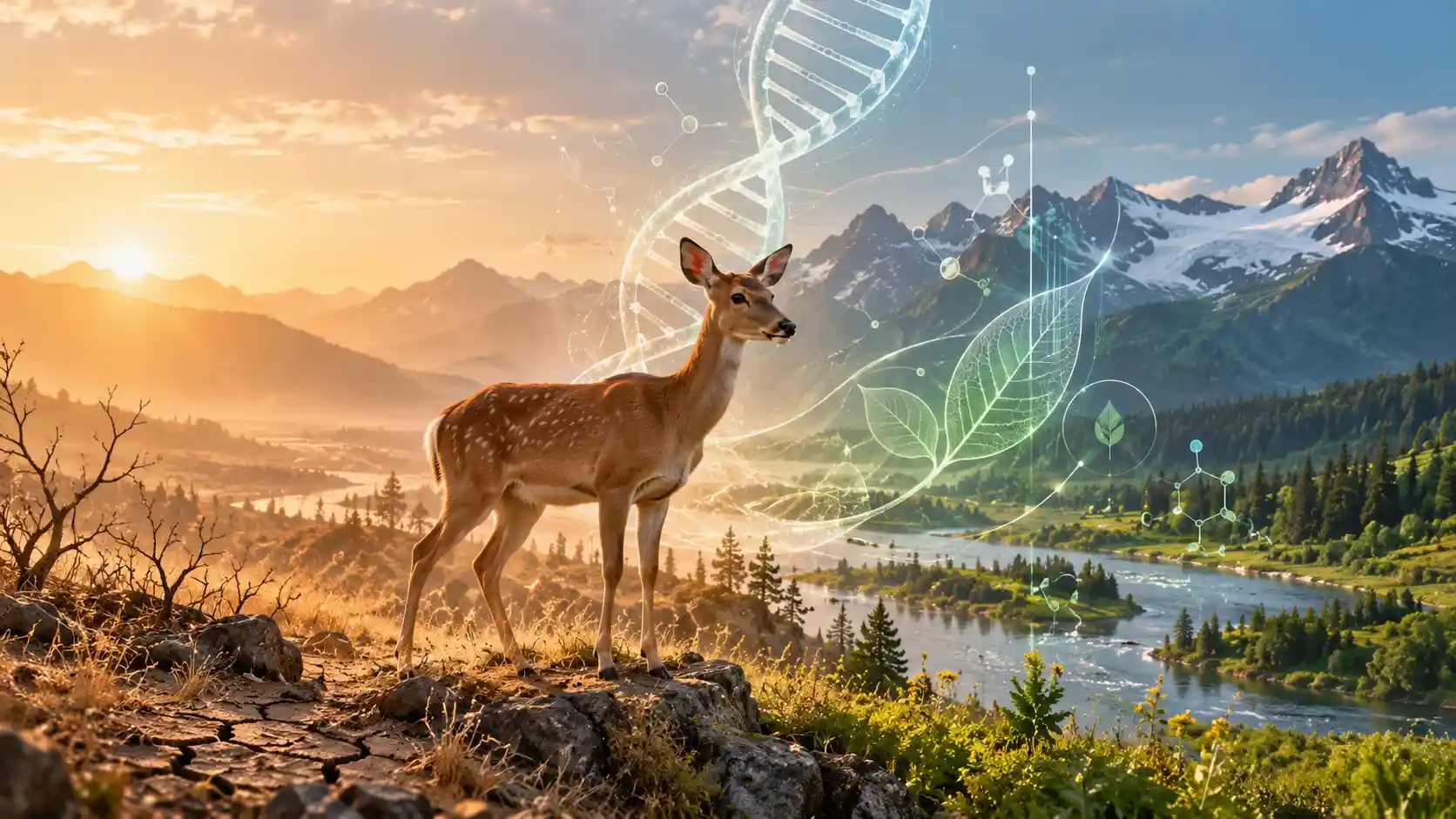

Conservation biology is beginning to borrow tools from biotechnology
For most of modern conservation history, the basic strategy for protecting wildlife has been straightforward.
Protect habitat.
Reduce hunting and pollution.
Control invasive species.
Restore damaged ecosystems.
Create protected areas.
Breed endangered species when populations become dangerously small.
Those approaches remain fundamental.
But climate change is creating a new problem.
In some ecosystems, environmental conditions are changing faster than vulnerable populations can migrate, reproduce or evolve.
Marine heatwaves can transform reefs within a single season. New diseases can move into wildlife populations with little existing resistance. Drought can alter forests faster than long-lived trees can reproduce. Fragmented populations may contain too little genetic diversity to adapt efficiently at all.
That is pushing conservation scientists toward a controversial new question.
If evolution cannot move fast enough, should humans help it?
The answer emerging from laboratories, wildlife agencies and conservation programs is increasingly cautious but significant: sometimes biotechnology may provide another tool.
Not a replacement for habitat protection.
Not a substitute for reducing greenhouse-gas emissions.
And not permission to engineer ecosystems casually.
Instead, researchers are testing whether genomics, assisted breeding, cloning, cryopreservation, engineered microorganisms and eventually targeted genome editing can preserve or restore adaptive capacity that threatened species are rapidly losing.
The UK is putting £54 million behind accelerated adaptation
One of the clearest signs that the field is moving from theory toward organized research came from the UK's Advanced Research and Invention Agency, known as ARIA.
ARIA's Accelerated Adaptation programme is backed by £54 million and is designed to investigate whether the adaptation of wild species can be measurably and responsibly accelerated.
The programme combines genomics, molecular biology, ecological modelling, artificial intelligence and other technologies.
Its funded research spans trees, forests, amphibians, pollinating insects, peat-forming mosses and dune-building grasses.
The objective is unusual for conservation science.
Instead of only measuring how nature responds to environmental stress, researchers are asking whether some of those responses can be deliberately strengthened before populations collapse.
ARIA describes the programme as an attempt to expand the conservation toolkit, not replace conventional environmental protection.
That distinction is central to the emerging field.
Scientists are trying to help evolution keep pace
Evolution already helps wildlife adapt to changing environments.
Individuals differ genetically.
Some survive heat, drought, disease or other stresses better than others.
Those individuals reproduce and pass useful traits into future generations.
Over time, the population changes.
The problem is speed.
Natural selection needs genetic variation, enough surviving individuals and enough generations for useful variants to spread.
Many threatened species have exactly the opposite conditions.
Their populations are small.
Their habitats are fragmented.
Their genetic diversity has declined.
Their generation times may be long.
And climate conditions can shift dramatically within decades.
Conservation biotechnology tries to increase the options available to those populations.
Genetic diversity is biological insurance
Genetic diversity is one of the most important concepts behind the new conservation biotechnology movement.
A large, genetically diverse population contains many different versions of genes.
Most differences may have little importance under normal conditions.
But when the environment changes, some variants can become extremely valuable.
One animal may tolerate heat better.
Another may possess stronger resistance to a pathogen.
One plant may survive severe drought.
Another may reproduce successfully under altered seasonal conditions.
Diversity provides evolution with material to work with.
When populations become extremely small, that biological insurance policy shrinks.
Inbreeding can increase harmful genetic variants, while useful adaptations that existed historically may disappear entirely from the surviving population.
Modern genomics allows conservationists to measure this loss much more precisely than previous generations could.
And biotechnology increasingly provides ways to act on that information.
Genetic rescue is one of the least futuristic approaches
Genetic rescue does not necessarily involve editing DNA.
The traditional form can be surprisingly simple.
Conservationists move individuals, or their reproductive material, from one population into another genetically depleted population.
The incoming genes can reduce inbreeding and increase adaptive potential.
A 2026 special issue of Evolutionary Applications reviewed a growing body of work around genetic rescue and concluded that integrating population genomics and evolutionary biology can improve resilience and long-term persistence in threatened populations.
The fundamental concept is straightforward.
If isolation has left a population genetically vulnerable, carefully introducing additional variation may improve its ability to survive future environmental change.
But genomics is making those decisions increasingly precise.
Instead of moving animals based only on geography, scientists can compare genomes and identify which populations carry diversity or potentially useful adaptations.
Assisted gene flow could move climate resilience between populations
Assisted gene flow takes the idea further.
Scientists deliberately move individuals or genetic material between populations to increase the frequency of traits that may be useful under future conditions.
Climate change is making this particularly relevant.
Imagine two populations of the same species.
One lives in a relatively cool region.
Another has survived for generations in much hotter conditions.
The warmer population may carry genetic variants associated with greater heat tolerance.
Moving some of that diversity into the cooler population could theoretically give the second group a larger evolutionary head start as temperatures rise.
The approach is already being studied in coral reefs and threatened terrestrial species.
Corals are becoming the laboratory for assisted evolution
Few ecosystems illustrate the urgency better than coral reefs.
Marine heatwaves can cause corals to expel the symbiotic algae that provide much of their energy.
The resulting bleaching can lead to widespread mortality.
As ocean temperatures rise, severe bleaching events can occur too frequently for damaged reefs to recover fully.
Scientists are therefore investigating assisted evolution.
The term covers several interventions intended to accelerate processes that could also occur naturally.
Researchers can selectively breed heat-tolerant corals.
They can move genes between naturally separated populations through assisted gene flow.
They can study or manipulate the symbiotic microorganisms associated with corals.
And genomic tools can identify which individuals carry traits associated with survival under heat stress.
Heat tolerance can be inherited
Research published in Nature Climate Change in 2025 found widespread heritable genetic variation in heat tolerance among reef-building coral populations across the Indo-Pacific.
Populations exposed to stronger marine heatwave pressure showed greater heat tolerance.
That matters because assisted evolution depends on traits being at least partly heritable.
If heat tolerance can pass from parents to offspring, selective breeding and assisted gene flow may be able to increase the trait within vulnerable populations.
But the science is not as simple as choosing the hottest surviving coral and breeding it repeatedly.
Different types of thermal stress can involve different genetic mechanisms.
A coral that survives one kind of heat event may not necessarily be equally resilient to another.
A 2026 coral study showed both promise and complexity
Research published in Science Advances in July 2026 tested selective breeding and experimentally evolved symbiotic algae.
Breeding from corals selected for heat tolerance improved survival and growth under elevated temperature in some experimental populations, but the benefit did not appear consistently across every reef population tested.
Heat-evolved symbionts also improved survival and bleaching resistance under high temperatures, but came with reduced growth under normal conditions in the experiment.
When researchers combined interventions, the effects could be additive, neutral or sometimes interfere with each other.
That finding captures one of the defining challenges of conservation biotechnology.
Biological traits rarely operate independently.
Changing one part of an organism or ecological relationship can create trade-offs somewhere else.
Scientists warn that coral biotechnology is still racing against climate change
A major 2026 Nature Reviews Biodiversity analysis concluded that assisted evolution has genuine potential to increase coral thermal tolerance.
But the authors also found that the gains currently demonstrated experimentally are unlikely, at present, to keep pace with projected increases in marine heat stress.
Their proposed solution was not abandonment of the idea.
It was faster and larger research.
The researchers called for multi-institutional field hubs, longer experiments spanning coral generations, improved genetic prediction and methods capable of scaling successful interventions.
The race is therefore not simply between coral and temperature.
It is also between the speed of scientific development and the speed of climate change.
Black-footed ferrets show what biotechnology can already do
One of the strongest real-world demonstrations of conservation biotechnology comes from an animal that nearly disappeared entirely.
The black-footed ferret once ranged across the North American Great Plains.
Habitat loss, declining prairie-dog populations and disease devastated the species.
After it was rediscovered in Wyoming in 1981, conservationists established a captive breeding program.
But the surviving population created a genetic problem.
Virtually the entire modern recovery population descended from only seven genetic founders.
That severely restricted the amount of genetic diversity available for future adaptation.
Then scientists turned to cells frozen decades earlier.
DNA from 1988 returned to the population
A female black-footed ferret named Willa died in 1988 without leaving descendants in the recovery population.
Her tissue had been cryopreserved by what became the San Diego Zoo Wildlife Alliance's Frozen Zoo.
More than three decades later, researchers used those preserved cells to clone black-footed ferrets.
Elizabeth Ann, born in 2020, became the first successfully cloned endangered species native to the United States.
Two additional clones, Antonia and Noreen, were born in 2023.
The importance was not simply cloning an animal.
It was recovering genetic variation that had effectively disappeared from the living breeding population.
The cloned genetics are now reproducing naturally
The experiment moved into an entirely new stage when Antonia produced offspring in 2024.
The U.S. Fish and Wildlife Service described the births as the first offspring produced by a cloned U.S. endangered animal.
The program advanced again in 2025 with four additional litters involving descendants of the cloned lineage.
Six female and six male kits were born during that season.
The result means preserved DNA from an animal that died in the 1980s is no longer simply sitting in a freezer or existing in clones.
It is entering a living, reproducing conservation population.
That is genetic rescue in a very literal sense.
Cloning does not create a new adaptation by itself
The black-footed ferret project also illustrates an important distinction.
Cloning is not automatically genetic engineering.
Researchers did not design Willa's DNA to create a new trait.
They recovered genetic variation that already existed historically in the species but had been lost from the surviving breeding population.
The hope is that greater diversity improves the population's ability to remain healthy and adaptable over the long term.
That makes cloning potentially useful for species that have experienced extreme genetic bottlenecks.
Cryobanks can preserve versions of a species' genome that might otherwise disappear forever.
Frozen zoos could become genetic libraries for conservation
Wildlife biobanks traditionally looked like archives.
Tissue, cells, sperm, eggs and other biological material were preserved in ultra-cold storage because scientists believed future technology might find a use for them.
That future is beginning to arrive.
Cryopreserved cells can support cloning.
Frozen reproductive material can be used in assisted breeding.
Genomes from historical specimens can show conservationists which genetic variants have disappeared.
Stem-cell technology could eventually create new reproductive options for endangered animals.
Biobanking therefore changes the time horizon of conservation.
A species can lose an individual today while retaining some of that individual's genetic potential for decades.
Genome editing moves into more controversial territory
Cloning lost genetic variation is one thing.
Editing wildlife genomes is another.
CRISPR and other genome-engineering technologies make it increasingly possible to modify DNA directly.
In principle, conservationists could restore beneficial variants that disappeared from a population, remove damaging mutations, increase resistance to disease or potentially introduce adaptations observed in related populations.
A 2025 Nature Reviews Biodiversity perspective argued that genome engineering could eventually restore lost adaptive traits and reduce damaging genetic load in severely depleted populations.
But the authors also emphasized ecological, ethical, social and economic risks.
Editing a laboratory organism is fundamentally different from changing an animal or plant intended to reproduce in an ecosystem.
The genetic change may not remain confined to the original individual.
Britain's new programme is explicitly testing the boundary
ARIA's Accelerated Adaptation programme gives a glimpse of how experimental this field is becoming.
Projects include RNA-interference-based protection against fungal disease in trees.
Another team is investigating whether natural tree immune responses can be strengthened rapidly enough to protect mature trees.
Researchers are working on drought tolerance through seed priming.
Another project is exploring reversible changes to flowering time in trees.
For amphibians, the SHIELD project is investigating whether the skin microbiome can be engineered to increase resistance to chytrid fungus.
Other groups are studying disease resilience in wild pollinators, climate-resilient peat moss and adaptation in marram grass that stabilizes sand dunes.
These projects represent a broader shift from simply documenting ecological decline toward developing intervention technologies.
Engineered microbes could protect animals without editing the animal itself
The microbiome provides one of the more intriguing possibilities.
Animals live in partnership with enormous microbial communities.
Microorganisms on the skin, in the digestive tract and elsewhere can influence health and disease resistance.
That creates a potential conservation strategy that sits between traditional medicine and genetic engineering.
Instead of editing the genome of an endangered amphibian, scientists could potentially modify or select bacteria living on its skin so those microbes provide better protection against disease.
ARIA's SHIELD project is exploring this type of approach against chytrid fungus.
Chytridiomycosis has caused catastrophic declines in amphibian populations around the world.
A durable microbial defense could theoretically protect vulnerable populations without altering every frog's genome directly.
But engineered microorganisms create their own containment and ecosystem questions.
Microbes reproduce.
They move between hosts.
They can exchange genes.
A conservation intervention therefore has to be evaluated at an ecological level, not simply as a treatment for one animal.
Climate change and infectious disease interact
Climate adaptation cannot be reduced to heat tolerance.
Changing temperature and rainfall patterns can alter the range, seasonality and transmission of wildlife diseases.
Animals already weakened by habitat loss or heat stress may become more susceptible to infection.
USGS researchers have argued for disease-smart climate adaptation because wildlife disease management and climate adaptation have historically often been treated separately.
Biotechnology could connect those fields.
Genomics can identify disease-resistance variants.
Vaccines can protect threatened populations.
Engineered microbial communities could potentially strengthen host defenses.
And selective breeding can increase resistance when the trait is heritable.
AI is becoming part of conservation biotechnology too
The biotechnology itself is only part of the challenge.
Scientists first need to determine what should be changed.
A wild population may contain millions of genetic variants.
Only some influence a relevant trait.
Those traits may interact with one another.
An intervention that improves heat tolerance could reduce fertility or growth.
An animal that survives one climate extreme may perform poorly under another.
Artificial intelligence and large-scale statistical modelling can help researchers connect genomic information with environmental data and observed traits.
ARIA's programme explicitly combines genomics with modelling, automation and AI in an attempt to identify useful targets and evaluate risks.
The ultimate goal is precision conservation: intervene only where evidence suggests the benefits justify the risks.
Biotechnology cannot manufacture habitat
This is the most important limitation.
An animal can have excellent genetic diversity and still disappear if its habitat is destroyed.
A heat-tolerant coral cannot build a reef if water quality collapses and marine heatwaves become indefinitely severe.
A disease-resistant amphibian cannot persist if its wetlands disappear.
A genetically resilient pollinator still needs flowers, nesting habitat and landscapes through which populations can move.
The U.S. Fish and Wildlife Service makes this point explicitly in its black-footed ferret work.
Cloning does not reduce the need for habitat conservation, disease management and wild-population recovery.
ARIA makes the same distinction in its programme.
Reducing human pressures on nature remains the first-order response.
Biotechnology may increase resilience.
It cannot make ecological limits disappear.
Faster adaptation could also produce unintended consequences
Evolution is interconnected.
A genetic variant rarely exists in isolation from the rest of an organism.
Selecting aggressively for one trait can change another.
Introducing individuals from a distant population could disrupt local adaptations.
Modified organisms could move outside a target area.
Greater resistance in one species might alter competition with another.
Changing flowering time could affect pollinators.
Changing disease resistance could alter pathogen evolution.
Researchers therefore have to think not just about whether an intervention works, but what happens after it works.
Ecological success can create its own second-order effects.
The most powerful interventions may also be the hardest to reverse
A vaccine can eventually stop being administered.
A translocated animal can sometimes be removed.
A genetic change that spreads through a reproducing wild population may be much harder to reverse.
That creates a basic governance principle.
The more persistent and self-propagating an intervention is, the higher the evidentiary threshold should be before deployment.
ARIA's research framework explicitly requires precaution, long-term risk assessment and consideration of effects extending decades or multiple generations into the future.
No novel interventions from the programme are being released into the wild during its funded research phase.
That containment matters because there is still no broadly established regulatory pathway for many forms of genetically accelerated wildlife adaptation.
Who gets to decide what nature should become?
The challenge is not purely scientific.
Wild species do not belong to laboratories.
Animals migrate across political borders.
Rivers flow between jurisdictions.
Indigenous communities may have relationships with species extending thousands of years.
A modified organism released in one location may eventually move elsewhere.
That means conservation biotechnology raises questions that conventional biotechnology often does not.
Who has authority to approve the intervention?
Who bears the risk if it fails?
Who monitors the population fifty years later?
Can a genetic intervention cross a national boundary without consent?
Should communities be able to reject a modified organism even when scientists believe it reduces extinction risk?
These questions cannot be solved by better CRISPR alone.
Conservation is shifting from preserving genomes to managing adaptive potential
Traditional conservation genetics frequently focused on preventing inbreeding and preserving genetic diversity.
The emerging approach goes further.
Scientists increasingly want to understand which genetic variants actually contribute to survival under future conditions.
That concept is called adaptive potential.
A population with high adaptive potential has a better chance of evolving as its environment changes.
Genomics can reveal whether that potential remains inside a threatened population.
Assisted gene flow can import it from another population.
Cryobanks can recover it from the past.
Selective breeding can amplify it.
Genome engineering may one day recreate it directly.
That progression defines much of modern conservation biotechnology.
The Mitchell's satyr butterfly shows how genomics can guide intervention
The endangered Mitchell's satyr butterfly provides another example of a more measured approach.
A U.S. Geological Survey-supported project is using genomic information to assess inbreeding and adaptive potential across populations.
Researchers plan controlled crosses between populations and tests of offspring thermal tolerance.
The objective is not to edit the butterfly's genome.
It is to identify whether strategically moving natural genetic variation could improve climate resilience without causing unacceptable genetic problems.
This illustrates how biotechnology in conservation often begins with measurement rather than modification.
Knowing when not to intervene may be as important as knowing how.
The black-footed ferret provides a template, but not a universal recipe
The ferret cloning program is compelling because it solves an unusually clear genetic problem.
The modern population descended from very few founders.
A genetically distinct historical animal had preserved cells.
Scientists could restore missing variation without inventing new DNA.
Many species will not present such a clean opportunity.
Their useful genetic variation may already be gone.
Their climate vulnerability may involve dozens or hundreds of interacting traits.
They may live in enormous open populations where controlling gene flow is impossible.
Or the environmental change may simply be too extreme for biological adaptation to compensate.
Biotechnology therefore has to be species-specific.
There is unlikely to be one technology that climate-proofs wildlife generally.
Assisted evolution is not the same as de-extinction
The concepts are sometimes grouped together because they use overlapping technologies.
But their objectives differ.
De-extinction attempts to recreate characteristics of extinct organisms or lineages.
Genetic rescue works with threatened living populations.
Assisted evolution tries to increase the rate at which useful traits spread.
Cloning can be used to recover historical diversity within a living species.
Genome editing could theoretically restore lost variants without trying to reconstruct an extinct animal.
For conservation policy, those distinctions matter.
Saving an existing ecosystem and recreating an extinct organism present very different ecological questions.
Biotechnology could buy species time
Perhaps the most realistic way to understand these technologies is as time-buying tools.
They may not stop climate change.
But they could help some populations survive long enough for habitat restoration, emissions reductions and broader ecosystem recovery to take effect.
A slightly more heat-tolerant coral may survive an additional marine heatwave.
A genetically diverse ferret population may be better equipped to survive future disease or environmental stress.
A fungus-resistant tree may remain part of a forest instead of disappearing before natural resistance evolves.
A protected amphibian population may retain enough individuals to recover later.
In conservation, time can be the difference between a damaged population and extinction.
Biotechnology also changes what extinction means operationally
Historically, once genetic diversity disappeared from the last surviving animals, conservationists had few ways to recover it.
Biobanks are changing that.
A cell frozen forty years earlier can potentially re-enter a breeding population.
Sequenced historical genomes can reveal lost variation.
Future reproductive technologies may make stored biological samples even more useful.
This does not make extinction reversible.
Ecosystems, learned behaviors, ecological relationships and evolutionary histories cannot simply be reconstructed from DNA.
But it does mean conservationists can preserve more biological options than were previously possible.
The next conservation toolkit will probably combine old and new methods
The future of wildlife conservation is unlikely to be purely technological.
It is also unlikely to remain entirely technological-free.
Protected areas will continue to matter.
So will habitat corridors, invasive-species control, emissions reductions, captive breeding, anti-poaching programs and ecosystem restoration.
Alongside them may sit genomic monitoring, cryobanking, assisted gene flow, selective breeding, microbiome engineering, reproductive biotechnology and targeted genome editing.
The powerful shift is not that biotechnology replaces conservation.
It is that conservationists are acquiring additional ways to preserve evolutionary capacity itself.
Climate change is forcing conservation to think about the future genome
Traditional conservation often asks a historical question.
How can this species be preserved as it exists today?
Climate change introduces a harder one.
What traits will this species need to survive the environment that is coming?
That question changes conservation from an effort focused only on preserving present populations into one that also considers their future adaptability.
There is danger in that transition.
Humans have repeatedly underestimated the complexity of ecosystems.
Intervening genetically in wild populations deserves exceptional caution.
But doing nothing is also a decision when extinction risk is increasing.
For some species, the future choice may not be between intervention and an untouched natural ecosystem.
It may be between a carefully managed intervention and the disappearance of the population entirely.
Biotechnology is becoming conservation's newest frontier
The black-footed ferret proves that frozen genetics can be returned to a living breeding population.
Coral research shows that heat tolerance can sometimes be increased through selective breeding, assisted gene flow and manipulation of symbiotic relationships.
Genomic studies are helping identify which populations contain useful adaptive diversity.
ARIA's £54 million programme is now pushing experimental biotechnology into trees, amphibians, pollinators and foundational plant species while building ethics and governance research alongside the science.
None of this establishes that wildlife can simply be engineered around climate change.
The evidence is much more nuanced.
Some interventions work only in particular populations.
Some create biological trade-offs.
Some remain laboratory concepts.
Others may prove impossible to deploy responsibly at scale.
But conservation science is crossing an important threshold.
For most of history, humans could protect wildlife, move wildlife or breed wildlife.
Increasingly, we can also preserve, measure, recover and potentially alter the biological variation that determines how wildlife adapts.
That capability could become one of the most powerful conservation tools of the climate era.
It could also become one of the most consequential.
The challenge will be knowing when to use it.
Reader questions
Frequently asked questions
How can biotechnology help wildlife adapt to climate change?
Biotechnology can help conservationists measure genetic diversity, move useful genetic variation between populations, selectively breed climate-tolerant individuals, preserve reproductive material, restore lost diversity through cloning and potentially use genome engineering or microbiome technologies to increase resilience.
What is genetic rescue?
Genetic rescue is an improvement in population fitness caused by introducing new genetic variation into a small or genetically depleted population. It can reduce inbreeding and increase the population's ability to adapt.
What is assisted gene flow?
Assisted gene flow involves deliberately moving individuals or genetic material between populations to increase genetic diversity or spread naturally occurring traits that may improve adaptation to environmental change.
What is assisted evolution?
Assisted evolution refers to interventions intended to accelerate natural adaptive processes. Examples include selective breeding, assisted gene flow and manipulation of symbiotic organisms to increase climate resilience.
Are scientists genetically modifying wild animals to survive climate change?
Most current conservation biotechnology does not involve releasing gene-edited wildlife. Much of the work focuses on genomics, selective breeding, assisted gene flow, cloning, microbiomes and contained research. Genome editing is being explored but raises greater ecological and governance concerns.
What is ARIA's Accelerated Adaptation programme?
It is a £54 million UK research programme exploring whether genomics, biotechnology, modelling and AI can responsibly accelerate adaptation in wild species threatened by climate change, disease and other environmental pressures.
Will ARIA release genetically modified wildlife into nature?
ARIA states that novel interventions developed during the funded programme will not be released into the wild. Projects are being conducted in contained settings while researchers study technical feasibility, ethics, governance and ecological risk.
Can corals be bred to tolerate hotter oceans?
Research shows that heat tolerance is partly heritable in some coral populations and selective breeding can improve tolerance under certain conditions. However, benefits vary among species and populations, and researchers warn that current progress may not yet be fast enough to match projected ocean warming.
How does assisted evolution help coral reefs?
Researchers can selectively breed heat-tolerant corals, move useful genetic variation between populations and work with heat-tolerant symbiotic algae to increase the probability that coral offspring survive marine heatwaves.
What happened with the cloned black-footed ferrets?
Scientists cloned black-footed ferrets using cells from Willa, an animal that died in 1988 and was not represented in the modern breeding population. A cloned female named Antonia later produced offspring, allowing Willa's previously lost genetic diversity to enter the recovery population.
Why was the black-footed ferret cloned?
Almost the entire recovery population descended from only seven founders, creating extremely low genetic diversity. Cloning Willa allowed conservationists to recover genetic variation that had otherwise disappeared from the living population.
Can cloning help endangered species survive climate change?
Potentially, when historic preserved cells contain genetic variation missing from a depleted population. Cloning itself does not create climate resistance, but greater genetic diversity can increase the evolutionary options available to a species.
What is a frozen zoo?
A frozen zoo is a biobank that preserves cells, tissues and other biological material from wildlife at very low temperatures. Future reproductive and genetic technologies can potentially use those samples in conservation programs.
Can CRISPR save endangered species?
Genome editing may eventually restore lost adaptive traits or disease resistance in some species, but it is not a universal solution. Wild releases raise substantial ecological, ethical and regulatory risks and remain far more controversial than genetic monitoring or conventional genetic rescue.
Can engineered bacteria protect wildlife?
Researchers are investigating whether beneficial microorganisms can be engineered or selected to protect wildlife from disease. ARIA's SHIELD project, for example, is studying skin-associated microorganisms as a possible defense against chytrid fungus in amphibians.
Does biotechnology replace habitat conservation?
No. Wildlife agencies and research programs consistently describe biotechnology as an additional tool. Species still require suitable habitat, healthy ecosystems, disease control and reductions in the environmental pressures driving their decline.
What are the risks of genetically helping wildlife adapt?
Potential risks include loss of local adaptation, unintended genetic trade-offs, effects on non-target species, spread beyond intended populations, altered ecological relationships and changes that may be difficult or impossible to reverse.
Why can't wildlife simply adapt naturally to climate change?
Some species can adapt naturally, but rapid warming, small populations, habitat fragmentation, low genetic diversity and long generation times can cause environmental conditions to change faster than natural adaptation can occur.
How is AI being used in conservation genetics?
AI and computational modelling can help analyze genomic and ecological datasets, identify traits associated with survival, predict which populations may benefit from intervention and model ecological risks before any field deployment.
Is conservation biotechnology already being used in the real world?
Yes in limited forms. Genetic rescue, assisted reproduction, cryobanking and cloning are already used in conservation programs. More radical approaches such as engineered microbiomes and targeted genome editing largely remain experimental or contained.
Nexuswild welcomes factual corrections. Email [email protected] with evidence and the article URL.