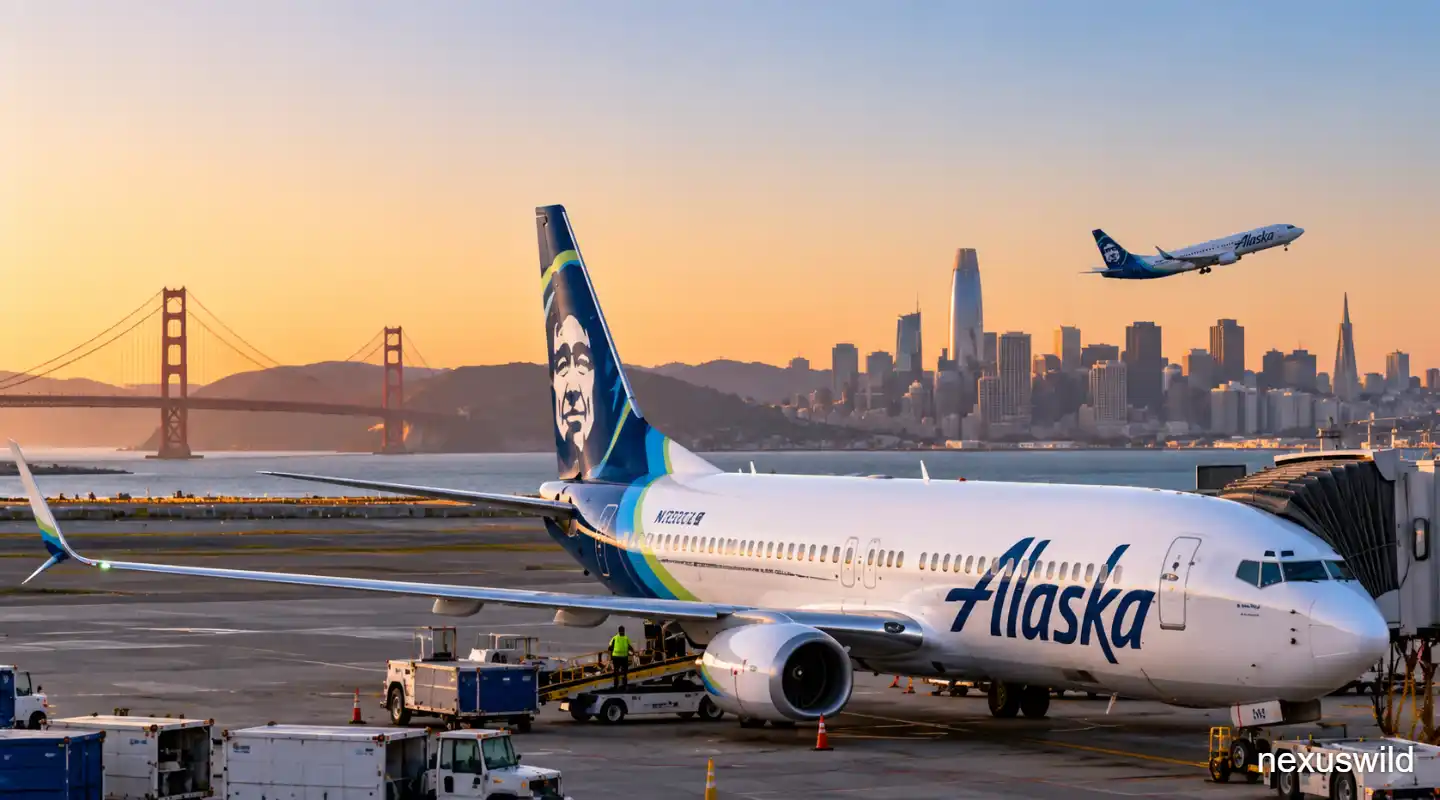

Alaska Airlines is reshaping its business around premium travelers at the same time that its flying from San Francisco International Airport has become smaller than it was a year ago, creating a different mix of choices for passengers at one of the carrier's most important California airports.
The airline remains SFO's second-largest carrier, behind United Airlines. San Francisco International Airport data for fiscal 2025 put United at 48.7% of combined domestic and international seat capacity, compared with 9.5% for Alaska, followed by Delta at 7.6% and American at 6.9%. SFO handled more than 54.1 million arriving and departing passengers during the fiscal year.
Alaska has nevertheless reduced portions of its San Francisco network during 2026 as it reallocates aircraft and concentrates capacity on markets it considers strategically stronger. At the same time, a companywide cabin overhaul is placing greater emphasis on First Class, premium economy and other higher-revenue products.
Those developments mean fewer overall seats in some SFO markets and a larger premium mix across Alaska's fleet. They do not, however, mean that Alaska has stopped selling lower-priced economy tickets from San Francisco.
Alaska Remains SFO's Second-Largest Airline
San Francisco continues to be an important part of Alaska's West Coast network.
The carrier describes SFO as one of its hubs, and its presence was reinforced in 2024 when it moved into a new facility in Harvey Milk Terminal 1. Alaska also operates a lounge there.
Its position is substantial but far smaller than United's dominant SFO operation. The airport's fiscal 2025 figures show Alaska accounting for 9.5% of seats, making it the second-largest carrier by capacity but leaving a wide gap to United's 48.7% share.
Alaska has continued to serve major destinations from San Francisco including Seattle, Los Angeles, San Diego, New York, Hawaii and other West Coast markets.
Its current booking site still advertises Saver fares from SFO, including lower-priced options on routes such as Los Angeles and Seattle, although fares and inventory change by travel date.
SFO Flying Has Been Reduced
Alaska's San Francisco capacity has nevertheless declined as part of a broader network adjustment.
Schedule filings made for 2026 included the removal of several SFO routes. Industry schedule data showed planned discontinuations involving markets including Austin, Boston, Burbank, Newark and Orlando, alongside other adjustments in California.
At the time those changes were filed, Alaska said it needed to be disciplined with its aircraft because fewer new planes were expected to enter the fleet during 2026.
Cirium schedule data cited in aviation reporting indicated that Alaska's planned San Francisco capacity for July 2026 would be nearly 24% lower than a year earlier.
That reduction should be distinguished from Alaska's premium-cabin strategy. The SFO route cuts were linked primarily to fleet availability and network allocation, while the premium push is part of a longer-term companywide plan to generate more revenue from higher-value products.
The airline has not withdrawn from San Francisco. It has retained core routes and added capacity selectively, including increased service from SFO to the Hawaiian islands. Schedule filings showed San Francisco-Lihue and San Francisco-Kona increasing from four weekly flights to daily service during summer 2026.
More Seats Are Being Allocated to Premium Cabins
Alaska has separately been changing the layout of its narrowbody aircraft to provide more First Class and Premium Class seats.
On Boeing 737-800 and 737-8 aircraft, Alaska increased First Class capacity from 12 seats to 16.
On the 737-900ER and 737-9 MAX, Premium Class increased from 24 seats to 30 while the First Class cabin remained at 16 seats.
Those conversions necessarily alter the balance between premium and standard Main Cabin seating within the aircraft because more cabin space is being assigned to higher-tier products.
Alaska told investors in September that its completed 737 premium-seat retrofits were adding approximately 1.3 million premium seats annually across the network.
That is a fleetwide figure, not a count of seats being added specifically at SFO.
Alaska Is Building a Much Larger Premium Business
The seating changes are part of Alaska Air Group's broader Alaska Accelerate strategy following its acquisition of Hawaiian Airlines.
At its September 29 Investor Day, the company said it expects premium products to generate more than 40% of total revenue by 2030, compared with about 35% currently.
Alaska's investor presentation showed premium revenue rising from 29% of total revenue in 2019 to 36% in 2026, with further expansion planned through the end of the decade.
The strategy extends well beyond conventional domestic First Class.
Alaska announced a new Aurora premium product for its Boeing 787 Dreamliners and selected future Boeing 737-10 aircraft. The carrier plans 34 lie-flat Aurora Suites aboard its 787s.
It is also creating Premium Reserve, a dedicated premium-economy cabin that will appear on Boeing 787s, selected 737-10s and Hawaiian Airlines Airbus A330s beginning in 2028.
After modification, Alaska says its 787-9 will have approximately 46% of its seats allocated to premium categories, up from 38% in its current configuration.
Why Alaska Wants More Higher-Value Travelers
The commercial logic is straightforward from Alaska's own investor disclosures.
The airline is trying to increase revenue generated per passenger and make its earnings less dependent on conventional Main Cabin tickets. Its September Investor Day presentation showed the company targeting roughly 60% of revenue from sources other than Main Cabin by 2030, including premium cabins, loyalty and cargo.
Alaska said its strategy is focused particularly on longer flights, where customers place greater value on space, privacy, food, lounges and other premium services. Chief Commercial Officer Andrew Harrison said the new products are intended to help Alaska compete for what the company calls high-value demand in international, Hawaii and premium transcontinental markets.
The emphasis also comes as fuel and other operating expenses pressure airline profitability.
Reuters reported that Alaska expects its premium investments, along with other elements of the Alaska Accelerate program, to contribute to higher margins and earnings as the airline seeks to narrow the revenue gap with larger U.S. network competitors.
Those projections are company targets rather than guaranteed financial outcomes.
Lower-Priced Economy Fares Have Not Disappeared
For passengers, one important distinction is between economy seating capacity and the availability of Alaska's cheapest fare category.
Alaska continues to sell Saver fares, its most restrictive economy product. The airline describes Saver as its lowest-priced fare and says availability can be limited and may not appear on every flight.
Saver customers travel in the Main Cabin rather than in a separate physical basic-economy section.
Under Alaska's current rules, Saver passengers generally cannot select a standard seat in advance, board later than most other customers and face tighter change and cancellation restrictions. For flights booked after June 11 and operated from August 1, 2026, Saver fares also no longer earn Atmos Rewards points, although qualifying lifetime-flight mileage still counts.
Alaska's own booking pages continued to display Saver fares from San Francisco in early October. For example, its SFO-Los Angeles page showed one-way Saver prices from $59 on selected future dates, while fares for near-term departures were considerably higher.
Those advertised fares fluctuate and do not mean the same price will be available on every flight.
It is therefore more accurate to say that the amount of lower-cost capacity is under pressure, rather than that cheap economy tickets are being abolished.
What Changes for SFO Passengers
For travelers using San Francisco, two separate trends are occurring.
First, Alaska is operating a smaller network than it had planned before the 2026 route reductions. Fewer routes and flights mean fewer total Alaska seats available from SFO in some markets.
Second, more space aboard Alaska aircraft is increasingly being allocated to First Class and Premium Class, with additional premium products coming as new aircraft enter service.
That combination can reduce the proportion of inventory available to passengers whose primary consideration is the lowest possible fare, particularly on busy flights.
But the effect will vary significantly by route. Alaska continues to add capacity where it sees demand, including Hawaii and selected Pacific Northwest services, while cutting or withdrawing from less strategically important city pairs.
Premium Class Already Extends Beyond First Class
Not every premium product involves lie-flat seats.
On Alaska's existing narrowbody fleet, Premium Class is an extra-legroom section rather than a separate business-class cabin. The airline advertises four additional inches of legroom compared with standard Main Cabin seating, as well as early boarding and complimentary alcoholic beverages on most flights longer than 350 miles.
Alaska also aligned its cabin terminology with Hawaiian Airlines in 2026, standardizing names including Main Cabin, Main Cabin Preferred and Premium Class across the two brands.
Premium Reserve, beginning in 2028, will sit above that product on longer flights and provide a more distinct premium-economy experience.
Competition at SFO Shapes the Strategy
SFO is an intensely competitive market, particularly because of United Airlines' scale.
United controls nearly half of the airport's total seat capacity, according to SFO's fiscal 2025 statistics. Alaska's 9.5% share makes it a meaningful competitor, but one without comparable network depth at the airport.
That makes competing solely on flight volume difficult.
Alaska's strategy increasingly centers on routes where it has stronger customer loyalty, West Coast relevance or connections to its Seattle, Portland, San Diego and Hawaii networks, while using upgraded cabins and its Atmos Rewards program to pursue passengers willing to pay more.
The company's Investor Day presentation said Alaska Air Group held a 46% share of Northern California-to-Pacific Northwest passenger demand at the end of 2025, based on U.S. Department of Transportation DB1B data cited by the company. It also reported a 51% share between Northern California and Hawaii.
Those figures cover Northern California rather than SFO alone and are company-presented calculations, but they help explain where Alaska sees its strongest regional position.
Premium Expansion Is a Companywide Strategy, Not an SFO-Only Change
Alaska's premium push should not be interpreted as a decision specifically targeted at San Francisco economy passengers.
The company's most extensive investments are tied to its wider transformation following the Hawaiian Airlines acquisition, including international growth from Seattle, new widebody aircraft, lounges, loyalty products and premium cabins.
Alaska plans eventually to operate at least 15 long-haul international destinations by 2030, supported by its Boeing 787 fleet and Hawaiian's existing widebody operation.
SFO fits into that strategy as an important West Coast market, but the cabin changes apply across the network.
The decline in SFO capacity and the rise in premium seating are therefore related commercially, but they are not the same program.
Conclusion
Alaska Airlines remains the second-largest carrier at San Francisco International Airport, holding 9.5% of SFO seat capacity in fiscal 2025, but its San Francisco operation has become smaller after a series of 2026 route and schedule reductions.
At the same time, Alaska Air Group is deliberately increasing the importance of premium travel. Narrowbody retrofits have added First Class and Premium Class seats, and the carrier plans new Aurora lie-flat suites and Premium Reserve cabins as it works toward generating more than 40% of revenue from premium products by 2030.
For SFO passengers, that means a changing mix rather than the disappearance of economy travel. Fewer flights in some markets reduce overall seat availability, while expanded premium cabins allocate a larger portion of aircraft space to higher-priced products.
Alaska's lowest-priced Saver fare remains on sale, including from San Francisco, although the airline explicitly says Saver inventory can be limited and is not offered on every flight.
The confirmed shift is therefore toward a smaller but more premium-oriented revenue mix, not the elimination of budget economy travel from Alaska's SFO operation.
Nexuswild welcomes factual corrections. Email contact@nexuswild.com with evidence and the article URL.