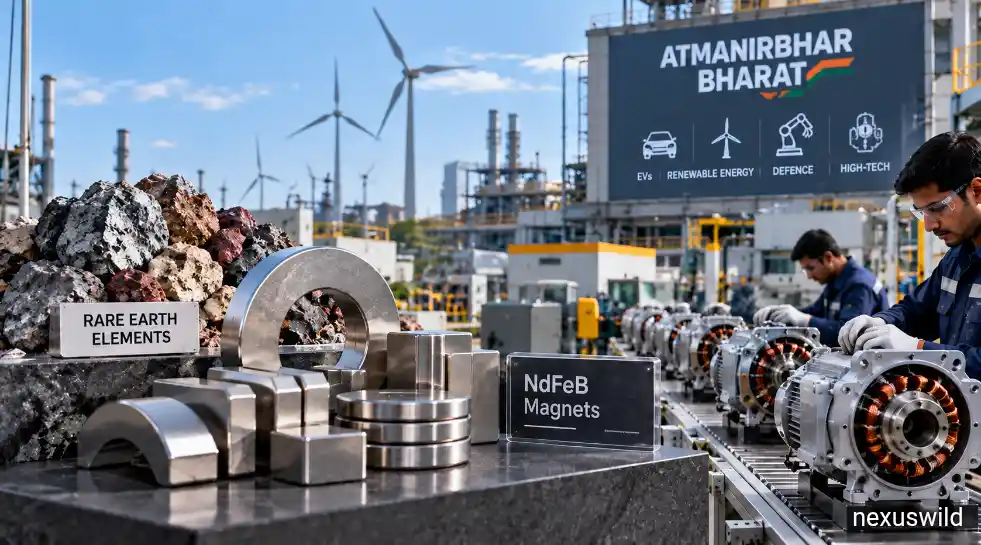

India is accelerating efforts to build a domestic rare-earth permanent magnet industry, targeting a major gap in the supply chain for electric vehicles, wind turbines, electronics, aerospace and defence equipment.
The government’s flagship Rare Earth Permanent Magnet manufacturing scheme aims to create 6,000 metric tonnes a year of integrated sintered magnet capacity in India. The programme carries a financial outlay of ₹7,280 crore and is designed to develop production from rare-earth oxides through metals, alloys and finished magnets.
The push comes at a time when India has domestic rare-earth resources and some upstream processing capability but remains dependent on imports for high-performance sintered neodymium-iron-boron, or NdFeB, magnets used in a wide range of advanced products.
Government data released in July 2026 said India currently imports all of its sintered NdFeB rare-earth permanent magnet requirement for downstream use.
The Missing Link Is Magnet Manufacturing
India’s challenge is not simply a lack of rare-earth minerals.
The government says the country already has capabilities in mining, separation and rare-earth oxide refining. The larger industrial gap lies further downstream, particularly in converting oxides into metals, metals into alloys and alloys into high-performance finished magnets.
That distinction matters because rare-earth magnets are among the most strategically important parts of the clean-energy and advanced-manufacturing supply chain.
Sintered NdFeB magnets are used in traction motors for electric vehicles, wind turbines, industrial motors, electronics and defence systems. Their high magnetic strength allows manufacturers to build smaller and more efficient motors and generators.
India’s policy therefore focuses on creating an integrated value chain rather than merely increasing mineral extraction.
₹7,280 Crore Scheme Targets 6,000 Tonnes of Capacity
The Union Cabinet approved the manufacturing scheme on November 26, 2025, and the Ministry of Heavy Industries formally notified it the following month.
The programme has three major financial components.
It includes ₹6,450 crore in sales-linked incentives, ₹750 crore in capital subsidies, and additional administrative provisions within the total ₹7,280 crore allocation.
The government plans to distribute the 6,000-tonne annual capacity among up to five manufacturers selected through competitive bidding.
Each successful beneficiary can receive an allocation between 600 and 1,200 tonnes per year, according to the tender conditions.
The scheme runs for seven years from the date of award, including a two-year period for setting up facilities followed by five years of production-linked incentive payments.
Twenty Companies Have Entered the Bidding Process
Interest from industry has been significant.
The Ministry of Heavy Industries said in August that it had received 20 bids for the programme after opening the technical bids on August 13, 2026.
The list includes companies from materials, recycling, engineering and manufacturing sectors.
The government has not yet announced final beneficiaries, so it would be premature to describe the planned 6,000 tonnes of capacity as already under construction.
At this stage, the scheme has moved from policy approval into the bidder-selection phase.
Demand Could Exceed Planned Capacity by 2030
India’s own projections suggest domestic demand will continue to rise quickly.
A government assessment by IREL, the Defence Metallurgical Research Laboratory and Bhabha Atomic Research Centre estimates India could require around 8,220 tonnes of rare-earth permanent magnets annually by 2030.
Electric vehicles are expected to be the largest single source of demand at about 3,250 tonnes, followed by wind turbines at 1,800 tonnes.
Other projected uses include:
- BLDC fans: 980 tonnes
- smartphones and computers: 600 tonnes
- industrial motors: 500 tonnes
- solar-powered pumps: 170 tonnes
- elevators and escalators: 100 tonnes
- other consumer and industrial applications: 820 tonnes.
That means the planned 6,000-tonne manufacturing programme would cover a substantial part of expected domestic requirements but would not necessarily eliminate all import dependence if demand develops in line with current projections.
EVs and Wind Power Are Driving the Push
Electric mobility is one of the main reasons rare-earth magnets have become a strategic concern.
Many electric-vehicle traction motors use permanent magnets containing neodymium and praseodymium because they combine high power density with relatively compact size.
Wind turbines also consume large amounts of high-performance magnetic material in some generator designs.
As India expands electric-vehicle manufacturing and renewable-energy capacity, dependence on imported magnets creates a potential vulnerability even if final vehicles and equipment are assembled locally.
Electronics, aerospace and defence add another layer of demand.
That is why the government is treating magnet production as an industrial capability rather than simply a mining issue.
India Has Rare-Earth Resources, but Extraction Is Difficult
India does possess significant rare-earth resources.
A parliamentary response in April said the Atomic Minerals Directorate had identified around 7.23 million tonnes of in-situ total rare-earth oxide equivalent associated with monazite deposits and another 1.29 million tonnes in hard-rock formations.
However, those resources are not automatically easy or cheap to process.
The government said many Indian deposits are relatively low grade and are often associated with radioactive minerals, making extraction and processing more complex.
This is one reason India can possess rare-earth resources while still depending heavily on imported finished magnetic products.
Rare-Earth Corridors Are Planned in Four States
The manufacturing programme is being paired with a wider rare-earth industrial strategy.
The Union Budget for 2026-27 announced dedicated rare-earth corridors in Odisha, Kerala, Andhra Pradesh and Tamil Nadu.
According to the government, these corridors are intended to link mining, processing, research and manufacturing activities rather than treating each part of the supply chain separately.
The aim is to create clusters capable of supporting both raw-material processing and downstream industries.
IREL has also established small-scale facilities for producing rare-earth metals and recycling rare-earth material from end-of-life magnets, according to government information.
These projects are still much smaller than the industrial scale India ultimately wants to reach, but they show that the strategy includes recycling and materials processing as well as new manufacturing.
Import Dependence Will Not Disappear Quickly
The government’s plan is ambitious, but building a competitive rare-earth magnet supply chain is difficult.
Producing sintered magnets requires control over chemistry, alloy making, powder processing, magnetic alignment, sintering, machining and coating. Consistency is especially important when the magnets are used in automotive or aerospace applications.
Manufacturers will also need dependable supplies of suitable rare-earth oxides and the ability to compete on cost and quality with established global suppliers.
The scheme includes limited assured supply of neodymium-praseodymium oxide from state-owned IREL for the three lowest bidders, highlighting the importance of raw-material security alongside factory construction.
Even if the planned capacity is completed on schedule, imports may still be required for specialized grades or to cover demand beyond domestic production.
China Still Dominates the Global Supply Chain
India’s policy also sits within a wider international effort to diversify rare-earth supply chains.
China dominates many stages of global rare-earth processing and magnet manufacturing, making countries that depend heavily on imported magnets vulnerable to export restrictions or supply disruptions.
Recent trade tensions have reinforced those concerns internationally, with rare-earth supply increasingly treated as a strategic industrial issue rather than a purely commercial one.
India’s approach is therefore similar to efforts elsewhere to build more resilient domestic or allied supply chains, although its programme is focused primarily on domestic manufacturing capacity.
What Happens Next
The immediate next step is selection of the companies that will receive capacity allocations under the ₹7,280 crore scheme.
Once beneficiaries are chosen, they will have roughly two years to establish integrated manufacturing facilities before incentive payments begin.
That makes the current phase important but still preliminary.
India has approved the money, defined the capacity target and attracted industry bids. The harder part will be turning those policy commitments into factories capable of producing magnets at automotive and industrial quality on a commercial scale.
Conclusion
India is moving from rare-earth exploration toward one of the more difficult parts of the value chain: manufacturing high-performance permanent magnets.
The government’s current plan targets 6,000 tonnes of annual integrated capacity, backed by ₹7,280 crore in incentives and subsidies, with up to five manufacturers expected to participate.
The reason is straightforward. India expects demand for rare-earth magnets to reach about 8,220 tonnes a year by 2030, led by electric vehicles, wind turbines and other industrial applications, while the country currently imports all of its sintered NdFeB magnet requirement.
That does not mean import dependence will disappear as soon as the new factories are built.
But if the scheme succeeds, India would move from having upstream rare-earth resources without large-scale magnet production toward a more complete domestic supply chain, reducing one of the most important gaps in its electric-mobility and advanced-manufacturing ecosystem.
Nexuswild welcomes factual corrections. Email contact@nexuswild.com with evidence and the article URL.