
Anthropic's Nasdaq debut has created a major test for public-market confidence in frontier artificial intelligence companies. The developer of Claude completed an $81.34 billion initial public offering on November 19, 2026, becoming one of the largest companies ever to enter the public equity markets through a single listing. Its shares began trading under the ticker ANT at $111.50, substantially above the $83 offering price, before retreating and closing at $97.17.
The first session delivered two different messages. Investors who received shares at the IPO price ended the day with a significant gain. However, buyers entering near the opening price experienced a sharp reversal as the stock surrendered much of its initial advance. That divergence has placed Anthropic's valuation, financial disclosures and enormous infrastructure commitments under immediate scrutiny.
The central question is no longer simply whether demand for Claude and other frontier AI products is expanding. Anthropic's prospectus demonstrates that demand has grown rapidly. The more difficult question is whether the company can convert that growth into durable operating profits and cash generation while funding the infrastructure required to develop, train and operate increasingly capable models.
A record-breaking public offering
Anthropic priced its initial public offering at $83 per share. The final prospectus covered 980 million Class A common shares, consisting of 956,351,354 shares sold by the company and 23,648,646 shares sold by existing shareholders.
The aggregate offering value was approximately $81.34 billion before underwriting discounts and expenses. The distinction between gross offering value and money received by the company is important. Anthropic's prospectus showed that the company would receive approximately $78.84 billion before other offering expenses, while selling shareholders would receive approximately $1.95 billion before applicable deductions.
The offering also included an underwriters' option to purchase up to another 147 million shares. Anthropic subsequently announced on November 20 that the underwriters had exercised the option in full. The closing announcement reported an aggregate offering of 1.127 billion shares at $83 each, generating approximately $93.5 billion in gross public-offering proceeds. Anthropic said it received approximately $91.6 billion of that amount, before applicable expenses.
The initial offering was accompanied by a separate $26 billion private placement. Under the arrangement, Advanced Micro Devices, Broadcom, Google, Micron, Microsoft, Nvidia and TSMC Partners agreed to purchase Class N common shares at the same $83 price. These shares are non-voting while held as Class N stock, subject to the conversion provisions described in the prospectus.
The public offering and private placement together represented approximately $119.5 billion in gross transaction value after the underwriters' option was exercised. These are separate financing channels and should not be combined when describing the amount raised specifically through the IPO.
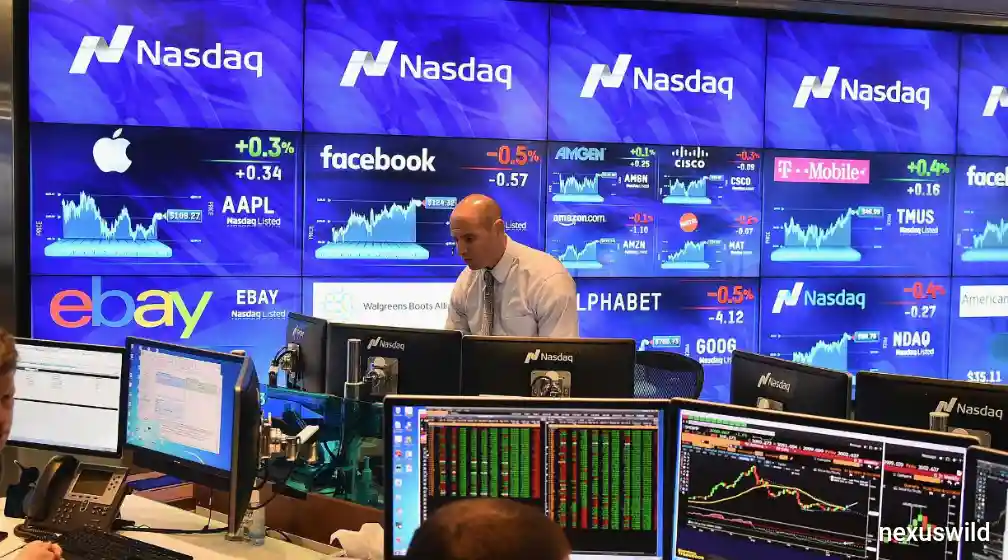
The listing was conducted on the Nasdaq Global Select Market under the symbol ANT. Nasdaq's listing notice and Anthropic's own announcement confirm the November 19 commencement of trading.
A dramatic opening followed by a substantial retreat
The first trading session was unusually volatile. The initial trade was reported at $111.50, approximately 34.3% above the $83 offering price. The stock subsequently reached an intraday high around $115 before reversing direction.
Shares fell to an intraday low of approximately $92.72 and later recovered some ground to finish at $97.17. The closing price represented a gain of approximately 17.1% over the IPO price. At the same time, it was approximately 12.9% below the initial $111.50 trade.
Market reports placed first-day trading volume at roughly 846.7 million shares. That level of activity indicates substantial turnover and intense price discovery during the company's first session as a publicly traded stock.
The distinction between the IPO price, opening trade, intraday high and closing price is essential to understanding the debut.
The $83 offering price was the amount paid by investors allocated shares in the public offering. The $111.50 opening trade represented the price at which the stock first began exchanging on the public market. These prices are not interchangeable: investors who received IPO allocations and investors who purchased shares after trading began entered at materially different prices.
The retreat from the opening level also does not establish that the IPO was unsuccessful. The closing price remained above the offering price, and the company completed its offering and associated private placement. What the session demonstrated was that intense initial demand did not prevent the market from reassessing the price during the same trading day.
The first session therefore offers a more nuanced reading than either a triumphant debut narrative or a collapse narrative. It was a strong offering followed by volatile public-market price discovery.
Why market-capitalisation figures differ
Anthropic's valuation figures require careful treatment because the company has several classes of shares, including economic interests that are not represented by the publicly traded Class A stock alone.
Using the approximately 13.22 billion shares outstanding after the offering and concurrent private placement, the $97.17 closing price implies an equity value of approximately $1.28 trillion. This is a narrower post-transaction share-count calculation.
The fully diluted valuation is higher because it incorporates additional potential shares and equity awards. Market reports put the company's closing fully diluted valuation at approximately $1.76 trillion to $1.77 trillion. At the $83 IPO price, the fully diluted valuation was approximately $1.5 trillion.
The opening price also generated estimates approaching $2 trillion on a fully diluted basis. That figure should not be compared directly with the approximately $1.28 trillion closing calculation because the latter uses a narrower share-count basis.
There is no contradiction in the existence of different valuation estimates when they use different share-count definitions. The editorial problem arises when the basis is not disclosed.
For this reason, any publication discussing Anthropic's market capitalisation should identify whether it is using basic shares outstanding, post-offering shares across relevant classes, or a fully diluted share count. A single market-cap figure without that explanation can mislead readers about the economic value being assigned to the company.
Revenue growth is extraordinary, but profitability remains a central question
Anthropic's prospectus reported revenue of approximately $33.24 billion for the nine months ended September 30, 2026. That compared with approximately $2.55 billion during the corresponding period in 2025, representing growth of roughly 1,206%.
The third quarter alone generated approximately $16.96 billion in revenue. This performance reflects increasing demand for Claude across subscription products, consumption-based services and business customers.
The company's customer disclosures also point to expanding organisational adoption. Anthropic reported more than 11,900 customers generating at least $100,000 in trailing twelve-month revenue as of September 30, 2026. Revenue from customers at that level represented approximately 74% of nine-month revenue.
These figures provide evidence that Anthropic has moved beyond a business dependent exclusively on individual chatbot subscriptions. Its products are being used by organisations that purchase model access, integrate AI into software and deploy AI-powered workflows.
However, rapid revenue growth does not automatically translate into high profitability. The company disclosed a third-quarter operating loss of approximately $567 million, compared with operating income of approximately $974 million in the second quarter.
Anthropic attributed the change primarily to $5 billion in compute procured under short-term commitments, which it said was significantly more expensive than comparable compute under multi-year arrangements, alongside approximately $2 billion in non-cash charges related to its donation-matching programme.
The company also reported that compute and infrastructure expenses reached approximately $9.9 billion in the third quarter, equivalent to 58% of revenue. This illustrates how the cost of supplying AI services can rise sharply as additional computing capacity becomes available and is consumed.
The relationship between revenue and infrastructure spending is particularly important. Anthropic's business depends on expensive accelerators, data centres, electricity, networking and cloud capacity. Even when demand grows quickly, the company must ensure that the revenue generated from each additional workload is sufficient to cover the associated infrastructure and operating costs.
The prospectus also reported a net loss of approximately $104.04 billion for the first nine months of 2026. That figure should not be interpreted as equivalent to the company's operating cash burn. The accounting result includes substantial non-cash and fair-value-related items, including changes in the valuation of financial instruments. Operating performance, adjusted operating measures, cash flow and accounting net income are different financial indicators and should be examined separately.
The key investment issue is therefore not simply whether Anthropic is growing. It is whether its growth can eventually produce sustainable operating margins and cash flows after the cost of compute, research, sales, partnerships, personnel and other expenses is accounted for.
The $900.9 billion infrastructure commitment
The most consequential disclosure in the prospectus may be Anthropic's aggregate committed spending.
The company reported approximately $900.9 billion in purchase commitments and lease agreements, including short-term commitments and leases that had not yet commenced. Substantially all of this amount related to compute and infrastructure.
Anthropic indicated that approximately $451.6 billion was expected to be incurred before December 31, 2030. Substantially all of the remainder was expected to be incurred between 2031 and 2045. Approximately $70.7 billion was due in the 12 months following September 30, 2026.
These figures are not equivalent to a single immediate cash payment. They represent contractual commitments and leases with different schedules, conditions and delivery periods. Some arrangements involve capacity that will become available over time. Others relate to infrastructure that has not yet commenced.
Nevertheless, the scale of the disclosed obligations is significant. It demonstrates that Anthropic's strategy requires substantial long-term access to computing resources and infrastructure.
The company has also described a shift towards a hybrid compute model. In addition to relying on cloud service providers, Anthropic is increasingly leasing chips directly and arranging for them to be hosted in dedicated facilities operated on its behalf. The company refers to this approach as Anthropic Direct.
Management's stated rationale is flexibility. By separating data-centre capacity arrangements from accelerator procurement, the company believes it can secure long-lead-time infrastructure while deferring some larger accelerator investments until compute needs become clearer.
This model may provide greater control over capacity and procurement. However, it also introduces execution requirements. Anthropic must coordinate hardware supply, facility construction, power availability, networking, deployment schedules and operational utilisation.
A data centre that is delayed, underutilised or more expensive than expected can weaken the economics of the associated commitment. The same applies if model demand grows more slowly than anticipated or if new hardware generations make existing infrastructure less economically attractive.
The scale of the commitments therefore creates both an opportunity and a risk. If demand continues expanding and Anthropic deploys capacity efficiently, long-term infrastructure access could support growth and improve service availability. If utilisation, pricing or customer demand disappoints, the company could face pressure from a substantial fixed or contractually committed cost base.
Why compute economics matter to the wider AI industry
Anthropic's listing is significant beyond the company's own shareholders. It offers public-market investors a more direct way to assess the economics of a frontier AI developer.
For much of the recent AI investment cycle, private valuations were influenced by expectations about future model capabilities, strategic partnerships and anticipated enterprise adoption. Public markets introduce a different level of scrutiny because listed companies must regularly disclose financial performance and respond to a broader investor base.
The economics of AI infrastructure are particularly complicated.
Training frontier models requires large clusters of specialised accelerators and supporting systems. Inference—the process of generating outputs for users and applications—creates a recurring demand for compute whenever customers interact with those models.
A successful AI platform must therefore balance two distinct requirements. It needs enough capacity to train and improve models, while also operating inference services at a cost that supports attractive margins.
The economics can change as model capabilities improve, workloads become more complex and customers adopt agents that perform longer sequences of tasks. A simple chatbot interaction and an autonomous software workflow can require very different quantities of computing resources.
This creates uncertainty around long-term cost forecasting. Greater efficiency in model architecture, hardware utilisation and inference optimisation may reduce the cost of delivering a given level of capability. At the same time, stronger demand and more intensive workloads may absorb those efficiency gains by increasing total usage.
Anthropic's disclosures make this tension visible. Its revenue growth is substantial, but its infrastructure spending and commitments are also unusually large.
The company's public-market performance will consequently be watched by other AI developers, infrastructure suppliers, cloud providers and investors considering future technology listings. Its financial results may help establish how investors value companies whose growth depends on very large, continuing investments in computing capacity.
However, Anthropic should not automatically be treated as a universal valuation benchmark for every AI company. Business models differ. Some companies develop foundation models, some sell cloud infrastructure, some build application software and others provide specialised tools. Their capital requirements, revenue quality and margin structures are not directly comparable.
Strategic investors and the structure of the offering
The $26 billion private placement adds another dimension to the listing.
The seven participating strategic investors include major technology and semiconductor companies: AMD, Broadcom, Google, Micron, Microsoft, Nvidia and TSMC Partners.
Their participation reflects the importance of compute supply chains to Anthropic's operations. Access to accelerators, memory, networking, cloud infrastructure and manufacturing capacity is essential for a company operating at the frontier of AI development.
The private placement should not, however, be presented as a guarantee of future chip supply, favourable pricing or commercial success. The investment arrangements and the companies' broader commercial relationships are separate matters, and the prospectus governs the specific securities issued.
The distinction between Class A and Class N shares is also important. Class A shares carry voting rights, while Class N shares are generally non-voting, subject to legal exceptions and the conversion provisions disclosed by Anthropic.
Anthropic's corporate structure includes additional special share classes. The prospectus describes a governance arrangement involving a Long-Term Benefit Trust and founder-related voting rights. The company is a public benefit corporation and has designed its governance structure to preserve its stated public-benefit purpose alongside shareholder interests.
That arrangement could become a recurring subject of investor attention. Public-market shareholders will be evaluating the company's financial performance while operating within a governance framework that differs from a conventional corporation.
Lock-up arrangements and the possibility of additional supply
The prospectus contains a detailed schedule governing when certain shares may become eligible for sale in public markets.
Some shares held by non-founder directors, officers, employees and consultants were eligible for public sale from the first trading day, subject to the specific provisions and restrictions described in the document. The initial schedule included up to 315 million Class A shares in this category.
Additional tranches were scheduled for later dates, including December 15, 2026, January 5, 2027 and January 19, 2027. Larger potential releases are linked to financial reporting dates and other contractual conditions.
This structure is more complex than a single blanket lock-up expiry. Eligibility to sell shares does not mean that all holders will immediately sell them. Actual selling activity depends on the decisions of individual shareholders, applicable restrictions and market conditions.
Nevertheless, the potential increase in freely tradable shares is relevant to investors. If significant holders decide to sell during periods of weaker demand, additional supply could place pressure on the stock. Conversely, if holders retain their shares, the actual market impact may be limited.
Investors will therefore be watching the prospectus timetable and the company's earnings announcements as potential catalysts for changes in available supply.
Index inclusion: what is confirmed
Index inclusion can influence institutional demand because funds that track an index may need to purchase shares when a company becomes an eligible constituent.
However, the claim that Anthropic is set for Nasdaq-100 inclusion within days of listing should not be published as a confirmed fact without an authoritative Nasdaq index announcement.
A verifiable notice from FTSE Russell addressed Anthropic's potential fast entry into the Russell US Equity Indexes. The notice stated that, if Anthropic met the relevant requirements, its inclusion would take place after the close of December 11, 2026, becoming effective from the market open on December 14.
That is a conditional timetable for Russell index inclusion, not evidence of immediate Nasdaq-100 membership. The distinction matters because different index providers use different eligibility rules and schedules.
Friday trading and the limits of an early price signal
The first-day close at $97.17 was followed by reports of weakness in Friday premarket trading. MarketWatch reported that shares fell to approximately $89.95 in premarket activity, down about 7.5% from the previous close.
Premarket prices are not the same as a regular-session closing price. They are formed in a different trading environment, often with lower liquidity and different participation. They can indicate early sentiment, but they should not be described as the definitive result of Friday's session.
The IPO settlement was scheduled for November 20. Anthropic subsequently announced that the public offering, including the underwri
Nexuswild welcomes factual corrections. Email contact@nexuswild.com with evidence and the article URL.