
For years, the narrative surrounding India’s electric vehicle transition has focused on domestic adoption. But as domestic manufacturing matures, the country’s leading EV startups are increasingly looking beyond its borders. At the forefront of this shift is Ather Energy, the Bengaluru-based manufacturer that fundamentally shaped the premium electric two-wheeler India segment.
Having built a robust product portfolio and a sprawling charging network at home, Ather is now embarking on a calculated international strategy. The company is laying the groundwork for a broader export push, looking to tap into the lucrative, high-volume mobility markets of Southeast Asia, Latin America, and neighboring South Asian countries.
This move comes at a pivotal time. As the global EV market matures, legacy internal combustion engine (ICE) riders in crowded urban centers are actively seeking cleaner, cost-effective alternatives. However, shifting from a domestic success story to a recognized international brand requires navigating a complex web of supply chains, regulatory standards, and entrenched local competition.
Ather Energy’s Overseas Expansion Plans
Ather Energy’s pivot toward international markets is not a sudden pivot, but a phased evolution of its business model. For the first several years of its existence, the company deliberately restricted its focus to the Indian market, prioritizing product refinement, software stability, and the massive undertaking of building its proprietary fast-charging network, the Ather Grid.
Now, backed by growing production capabilities and a recently filed Draft Red Herring Prospectus (DRHP) for its initial public offering, Ather has the capital and operational bandwidth to pursue Ather Energy exports in earnest. The strategy relies heavily on the distributor model - partnering with established local automotive retail giants in foreign markets who understand regional consumer preferences, homologation rules, and after-sales service requirements.
Target International Markets
Ather’s international footprint began taking physical shape in late 2023 with its official entry into Nepal, a strategic testbed for the company's export capabilities. Partnering with Vaidya Energy, Ather opened local retail outlets and deployed its fast-charging infrastructure in Kathmandu.
Following the initial success in Nepal, Ather formally announced its entry into Sri Lanka in 2024, partnering with Evolution Auto Pvt. Ltd. to manage sales and service operations. While these neighboring countries serve as a logistical proving ground, Ather’s broader Ather Energy international expansion strategy has its sights set on the dense two-wheeler economies of Southeast Asia - such as Indonesia and Vietnam - and key Latin American markets. These regions share similar urban commuting patterns, climate conditions, and price sensitivities with India, making them highly receptive to Ather’s current product lineup.
Ather’s Electric Scooter Technology
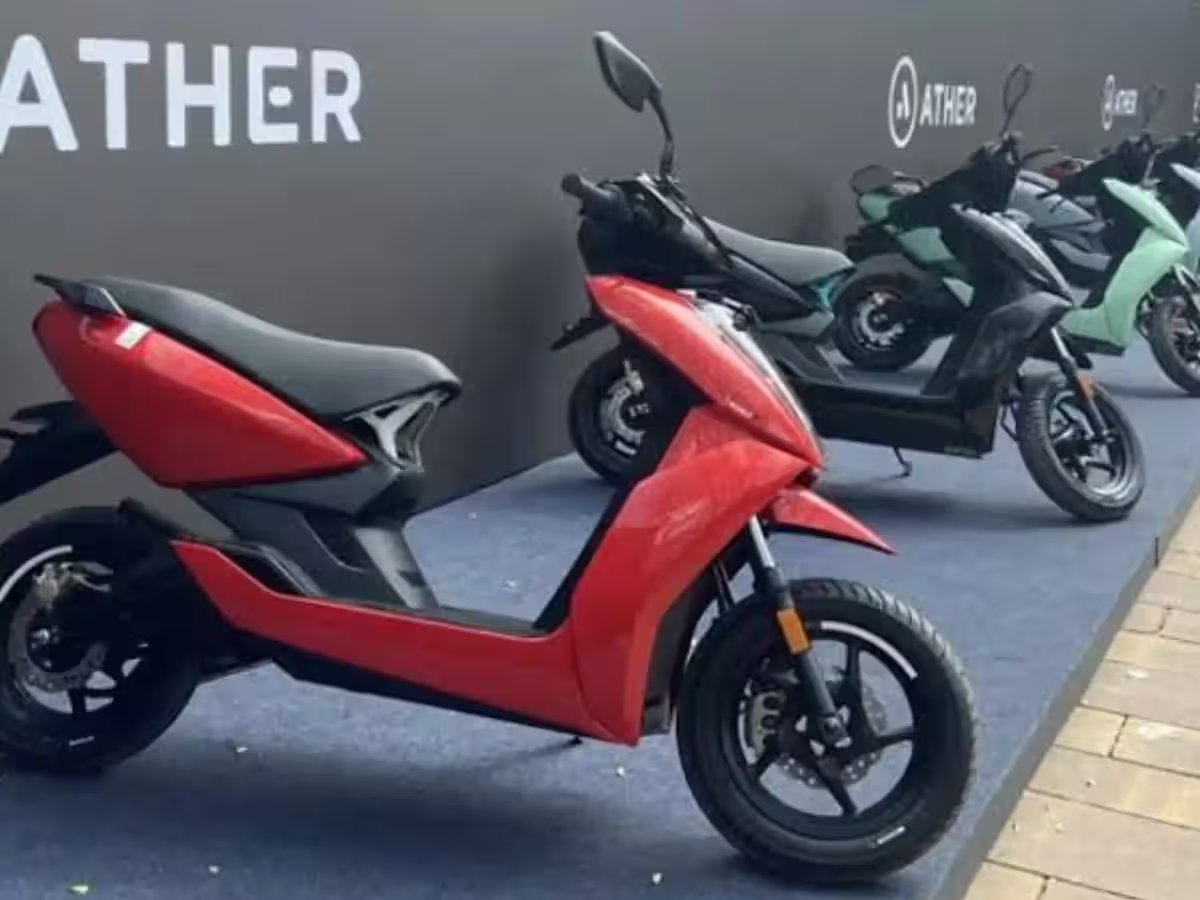
What makes an Ather electric scooter global-ready is its heavy emphasis on vertical integration and smart technology. The company’s flagship 450 series (including the 450X and the performance-oriented 450 Apex) and the newly launched family-centric Rizta scooter are built on rigid aluminum and high-tensile steel chassis, designed to handle rough urban terrain.
Ather’s true differentiator, however, lies in its software and battery management system (BMS). The scooters feature a proprietary battery architecture optimized for thermal safety in high-temperature environments - a crucial selling point for tropical international markets. Furthermore, the 7-inch touchscreen dashboard, integrated with Google Maps, over-the-air (OTA) updates, and ride analytics, offers a connected experience that many traditional ICE competitors and low-cost electric rivals currently lack.
Manufacturing and Supply Strategy
Expanding internationally requires manufacturing scale. Ather currently operates out of its manufacturing facilities in Hosur, Tamil Nadu. However, to meet both surging domestic demand and future export targets, the company is significantly ramping up its industrial footprint.
Ather recently confirmed a massive investment in a new manufacturing facility in the Aurangabad Industrial City (AURIC) in Maharashtra. Once fully operational, this new plant will have the capacity to produce up to one million electric two-wheelers and battery packs annually. This expanded capacity is the logistical backbone of Ather's global ambitions, ensuring that the company can reliably supply its international distributor networks without creating stock shortages in its primary Indian market.
Global Electric Scooter Demand
The timing of this expansion aligns with a distinct shift in the global electric scooter market. Several macroeconomic factors are driving this transition. Fluctuating global fuel prices and the rising total cost of ownership for petrol-powered scooters are pushing middle-class commuters toward electric alternatives.
Additionally, governments across Southeast Asia and Latin America are introducing aggressive clean-air mandates and consumer subsidies to curb urban pollution. Electric mobility India has already demonstrated how rapidly a two-wheeler market can electrify when the right combination of product quality and total cost of ownership is achieved. Ather is banking on this same consumer psychology taking hold in Jakarta, Bogota, and beyond.
Competition and Market Opportunity
Entering the global arena pits Ather against formidable competition. The international electric scooter space is fiercely contested by well-capitalized Chinese giants like Yadea and NIU, which have historically dominated low-cost exports. In premium segments, Taiwanese powerhouse Gogoro, with its established battery-swapping ecosystem, remains a heavy hitter.
Furthermore, Ather must compete against legacy Japanese manufacturers - such as Honda and Yamaha - who are accelerating their own electric two-wheeler programs. Ather’s strategy in this crowded field is to position itself in the premium-yet-accessible tier, offering superior build quality, software reliability, and thermal safety compared to cheaper imports, while remaining more affordable than high-end European electric motorcycles.
Challenges of International Expansion
Despite the favorable market conditions, overseas expansion carries inherent risks. Every new country requires strict compliance with local homologation and safety standards. Tariffs and import duties can quickly erode profit margins unless companies eventually commit to local assembly (Completely Knocked Down, or CKD, operations).
Another significant hurdle is charging infrastructure. In India, the Ather Grid is a major competitive advantage. Replicating this proprietary network internationally requires immense capital and time. Alternatively, relying on existing third-party public charging infrastructure introduces variables in user experience that Ather cannot directly control. Finally, building brand trust from scratch in markets where consumers have relied on legacy ICE brands for decades demands sustained marketing and flawless after-sales service execution.
Ather Executive and Industry Views
Ather’s leadership has been vocal about the necessity of looking outward. Tarun Mehta, CEO and Co-founder of Ather Energy, has frequently emphasized that the company’s vehicles are engineered to global standards. Commenting on the recent international forays, Mehta noted that the brand's focus on quality, safety, and connected features resonates well beyond the Indian border.
Industry analysts tracking Ather latest news suggest that export markets will be vital for improving the company's economies of scale and moving toward sustained profitability. "For Indian EV startups, the domestic market offers volume, but international markets offer the margins and brand equity necessary to survive long-term," notes a recent automotive industry report on cross-border mobility trends.
What Comes Next
In the immediate future, Ather will focus on successfully executing its planned IPO to secure the capital required for its Maharashtra plant and future R&D. Simultaneously, the company is expected to evaluate distributor partnerships in a handful of new international territories, carefully pacing its rollout to ensure supply chain stability. The performance of the family-oriented Rizta scooter in these new markets will be a critical metric, as it caters to a broader, more practical demographic than the sporty 450 series.
Conclusion
Ather Energy’s overseas expansion represents a coming-of-age moment not just for the company, but for India’s electric vehicle manufacturing sector. By taking its proven, software-rich scooters to the global EV market, Ather is transitioning from a domestic disruptor into an international challenger. While the road ahead is fraught with regulatory, logistical, and competitive hurdles, the company's measured distributor-led approach, backed by expanding manufacturing capacity, positions it to capitalize on the worldwide shift toward sustainable urban mobility.
Further reading and useful links
Reader questions
Frequently asked questions
What is Ather Energy's overseas expansion strategy?
Ather Energy is expanding its international footprint by partnering with local distributors in international markets such as Nepal, Sri Lanka, Southeast Asia, and Latin America.
Which international markets has Ather entered so far?
Ather officially entered Nepal in late 2023 and expanded into Sri Lanka in 2024, with broader plans targeting Southeast Asian and Latin American economies.
How is Ather supporting its increased manufacturing demand?
Ather is setting up a major manufacturing facility in Aurangabad Industrial City (AURIC), Maharashtra, which will have a capacity of up to one million electric two-wheelers and battery packs annually.
What distinguishes Ather's electric scooters for international markets?
Ather's scooters feature robust vertical integration, proprietary battery management systems optimized for tropical climates, smart 7-inch touchscreen dashboards, and over-the-air update capabilities.
Nexuswild welcomes factual corrections. Email [email protected] with evidence and the article URL.