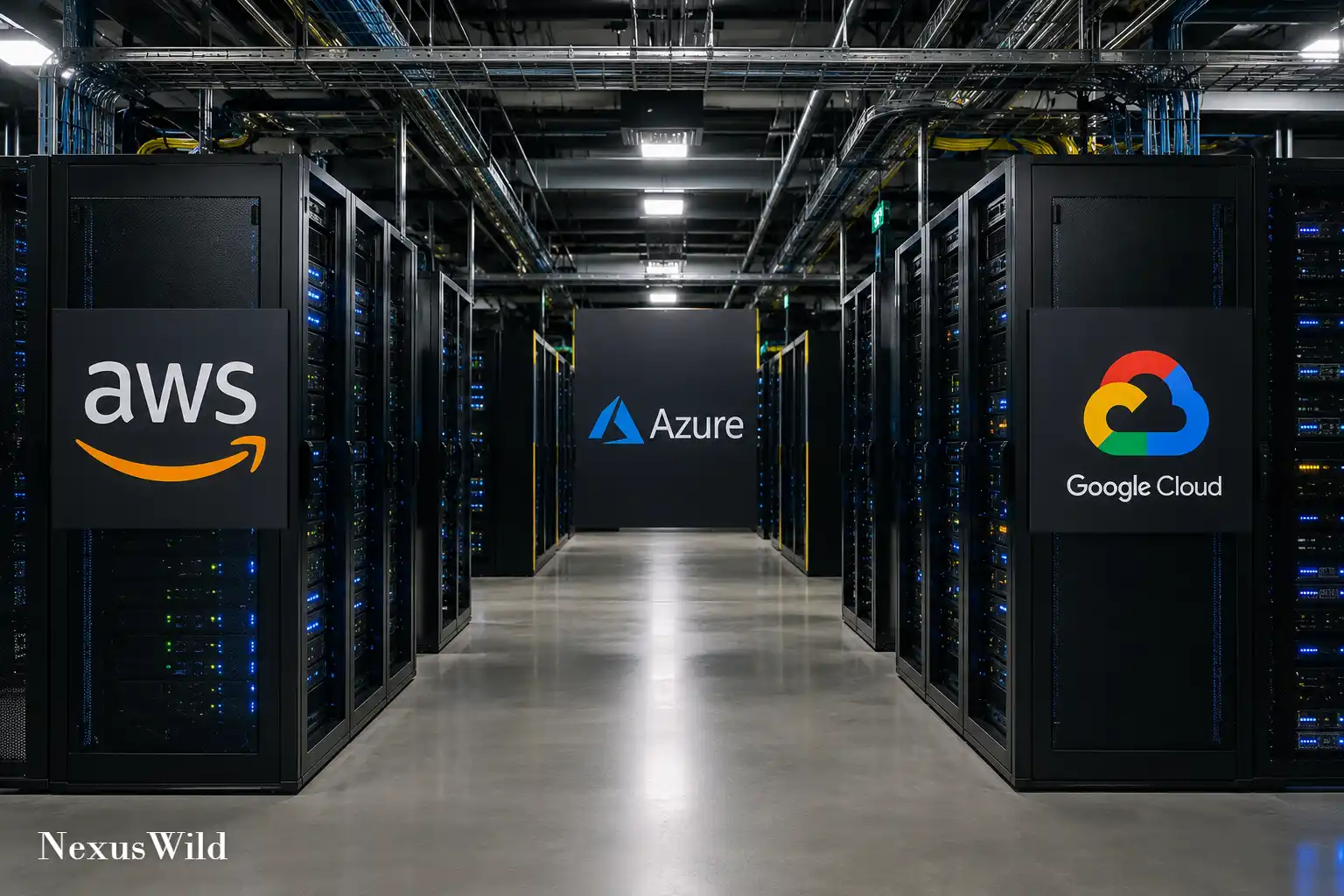

Enterprise cloud computing in 2026 is no longer primarily about replacing physical servers with virtual machines. The largest cloud projects now combine managed databases, Kubernetes, serverless applications, data platforms, generative AI, custom accelerators, sovereign infrastructure and on-premises systems.
Amazon Web Services, Microsoft Azure and Google Cloud can all support large production environments. The practical difference lies in how well each platform fits an organisation’s existing technology, geographic requirements, engineering skills, data strategy and AI workloads.
- AWS continues to offer exceptional service breadth, mature infrastructure and extensive deployment options.
- Azure makes a particularly strong case for enterprises already invested in Microsoft software, identity and business applications.
- Google Cloud stands out in data analytics, Kubernetes and integrated AI infrastructure.
There is no universal winner. The correct decision depends on the workload.
Infrastructure and product information in this article was verified on August 26, 2026. Availability must still be checked for the intended region because services, accelerators and foundation models are not offered everywhere.
The Enterprise Cloud Market in 2026
Artificial intelligence has become one of the largest sources of cloud infrastructure demand, but conventional enterprise workloads remain central to the market. Organisations continue to migrate databases, SAP environments, Windows applications, customer platforms, analytics systems and internal development infrastructure.
According to Synergy Research Group, worldwide spending on cloud infrastructure services reached approximately $143 billion in the second quarter of 2026. Synergy estimated market shares of 28 percent for AWS, 20 percent for Microsoft and 15 percent for Google. Its definition covers IaaS, PaaS and managed or hosted private cloud services, including generative AI offerings.
Market share indicates commercial scale, not technical suitability. A smaller platform can still be the better choice for a particular data, AI, Kubernetes or regional workload.
AWS Overview
Amazon Web Services (AWS) remains the broadest general-purpose cloud platform. Its core portfolio includes Amazon EC2 for virtual machines, Amazon S3 for object storage, Amazon RDS and Aurora for relational databases, DynamoDB for NoSQL workloads, Amazon EKS and ECS for containers, AWS Lambda for serverless computing and Amazon Redshift for data warehousing.
Its main enterprise advantages are a large service portfolio, extensive infrastructure and edge coverage, wide database selection, strong ecosystem support, and multiple deployment models (Regions, Local Zones, Outposts). The trade-off is complexity, requiring strong architecture standards and FinOps controls to manage expenditure.
Microsoft Azure Overview
Microsoft Azure combines public cloud infrastructure with Microsoft’s enterprise software, identity, security and business-application ecosystem.
Important services include Azure Virtual Machines, Blob Storage, Azure SQL, Azure Cosmos DB, Azure Kubernetes Service (AKS), Microsoft Fabric, Microsoft Foundry and Azure Machine Learning.
Azure is particularly attractive when an organisation already uses Windows Server, SQL Server, Microsoft Entra ID, Microsoft 365, Dynamics 365, GitHub, or Azure DevOps. Existing licensing agreements and Azure Hybrid Benefit can materially lower costs.
Google Cloud Overview
Google Cloud’s strongest areas include data analytics, Kubernetes, global networking and AI infrastructure.
Its core services include Compute Engine, Cloud Storage, Cloud SQL, AlloyDB, Spanner, Bigtable, Google Kubernetes Engine (GKE), Cloud Run, BigQuery, Looker and Google’s AI platform.
A major 2026 transition: Google now presents Gemini Enterprise Agent Platform as the successor to much of Vertex AI, describing it as the environment for building, deploying, governing and optimising enterprise agents.
Global Infrastructure Comparison
Infrastructure figures require careful interpretation. AWS counts Regions and Availability Zones. Google counts regions and zones. Microsoft publishes regional and datacentre figures but does not maintain a directly comparable public total for all Availability Zones.
- AWS: As of August 26, 2026, AWS listed 39 launched geographic Regions, 124 Availability Zones, and more than 750 CloudFront points of presence.
- Azure: Microsoft listed more than 80 Azure regions and over 500 datacentres. Availability Zones exist in supported regions, but presence must be checked locally.
- Google Cloud: Listed 43 regions and 130 zones, with a global network connecting more than 200 countries via ~10 million kilometres of fibre.
Compute, Storage and Databases
- Compute: AWS offers extensive EC2 instance families (Intel, AMD, Graviton, GPUs, Trainium, Inferentia) backed by the Nitro System. Azure covers SAP, HPC, and GPU workloads, offering strong licensing advantages for Windows. Google offers predefined/custom machine types, Axion Arm processors, and TPU infrastructure.
- Storage & Databases: AWS provides the widest selection (S3, RDS, Aurora, DynamoDB). Azure is exceptionally strong for SQL Server modernisation and managed PostgreSQL. Google Cloud excels with globally distributed relational workloads (Spanner) and performance workloads (AlloyDB).
Containers, Kubernetes and Serverless Computing
All three offer mature managed Kubernetes:
- AWS: Amazon EKS
- Azure: Azure Kubernetes Service (AKS)
- Google Cloud: Google Kubernetes Engine (GKE)
GKE benefits from Google’s long Kubernetes history. EKS integrates deeply with AWS networking and IAM. AKS fits seamlessly into Microsoft identity, GitHub, and Windows container setups.
For serverless, AWS Lambda has a mature event-integration ecosystem, Azure Functions aligns with Microsoft dev tools, and Cloud Run (Google) is highly effective for deploying stateless containers.
Hybrid Cloud, Edge and Multi-Cloud
- Azure: Offers the strongest unified management proposition for conventional enterprises via Azure Arc (projecting servers and clusters into Azure Resource Manager) and Azure Local.
- AWS: Provides Outposts for on-premises infrastructure, Local Zones for metropolitan latency requirements, and Wavelength for telecom edge workloads.
- Google Cloud: Google Distributed Cloud supports connected and air-gapped environments (crucial for classified workloads), while GKE Enterprise manages clusters across environments.
Data Analytics and Data Warehousing
- AWS: Provides a broad modular choice (Redshift, Athena, Glue, EMR, Kinesis) requiring architectural integration.
- Azure: Increasingly centres analytics on Microsoft Fabric and OneLake, connecting data engineering, BI, and data science seamlessly with Microsoft 365.
- Google Cloud: Remains highly attractive for serverless analytics with BigQuery at the centre, complemented by Dataflow and Looker.
Enterprise AI in 2026
Choosing a cloud solely for access to a particular AI model is risky; models and prices change quickly.
AWS
Amazon Bedrock provides managed access to AWS and third-party models, including Knowledge Bases for RAG and Bedrock AgentCore for production agents. SageMaker AI is used for deeper model training and MLOps. Infrastructure includes NVIDIA GPUs, plus AWS-designed Trainium and Inferentia chips.
Microsoft Azure
Microsoft Foundry unifies models, agents, and development tools under common Azure RBAC, networking, and tracing. It integrates Azure OpenAI, third-party models, and Foundry IQ for knowledge retrieval across SharePoint and OneLake. Infrastructure includes NVIDIA GPUs, AMD options, and Microsoft's custom Maia accelerators.
Google Cloud
Centred on the Gemini Enterprise Agent Platform and Model Garden (featuring Gemini, Gemma, Imagen, and open models). Google integrates AI tightly with BigQuery, GKE, and Cloud Storage. Its distinct advantage is hardware: TPUs (like the TPU7x Ironwood) operating alongside NVIDIA GPUs.
Security, Identity and Compliance
- Azure has a natural advantage where Microsoft Entra ID is the central identity system.
- AWS provides highly granular IAM policy controls but requires careful design to prevent permission sprawl.
- Google Cloud’s organisation, folder, and project hierarchy provides clean central governance.
Which Platform Fits Different Organisations?
- Large global enterprises: AWS offers infrastructure breadth and mature operations. Azure is strong if the estate is Microsoft-dominated.
- Microsoft-heavy enterprises: Azure presents the clearest integration path for Windows Server, SQL, Entra ID, and Microsoft 365.
- AI-first companies: Google Cloud is compelling for Gemini, TPUs, and BigQuery. AWS offers broad model choice and Trainium. Azure is strong for OpenAI apps connecting to Microsoft enterprise data.
- Startups: AWS has a vast talent ecosystem. Google Cloud is highly productive for Cloud Run and Firebase-adjacent architectures.
- Data-intensive businesses: Google Cloud makes a strong case via BigQuery. Azure is competitive when Fabric/Power BI are strategic. AWS suits modular architectures.
The best cloud platform in 2026 is not the provider with the most services, regions or models. It is the platform whose infrastructure, data services, security controls, AI capabilities and commercial terms most closely match the organisation’s actual requirements.
Further reading and useful links
Reader questions
Frequently asked questions
Which cloud provider has the largest market share in 2026?
According to Synergy Research Group estimates for Q2 2026, AWS led with approximately 28% market share, followed by Microsoft Azure at 20%, and Google Cloud at 15%.
What is the difference between AWS Bedrock and Microsoft Foundry?
AWS Bedrock is a managed service providing access to Amazon and third-party foundation models with tools like Knowledge Bases. Microsoft Foundry unifies Azure OpenAI, third-party models, and agents under Azure's security umbrella, integrating tightly with Microsoft 365 and Fabric.
Which cloud platform is best for Kubernetes?
Google Kubernetes Engine (GKE) is widely considered the leading platform due to Google's history creating Kubernetes. However, Amazon EKS is deeply integrated with AWS services, and Azure Kubernetes Service (AKS) is the natural choice for Microsoft-centered environments.
How are custom AI accelerators used across the clouds in 2026?
Alongside NVIDIA GPUs, AWS offers its custom Trainium and Inferentia chips. Microsoft Azure offers its custom Maia accelerators. Google Cloud relies heavily on its proprietary Tensor Processing Units (TPUs), such as the TPU7x Ironwood.
Nexuswild welcomes factual corrections. Email contact@nexuswild.com with evidence and the article URL.