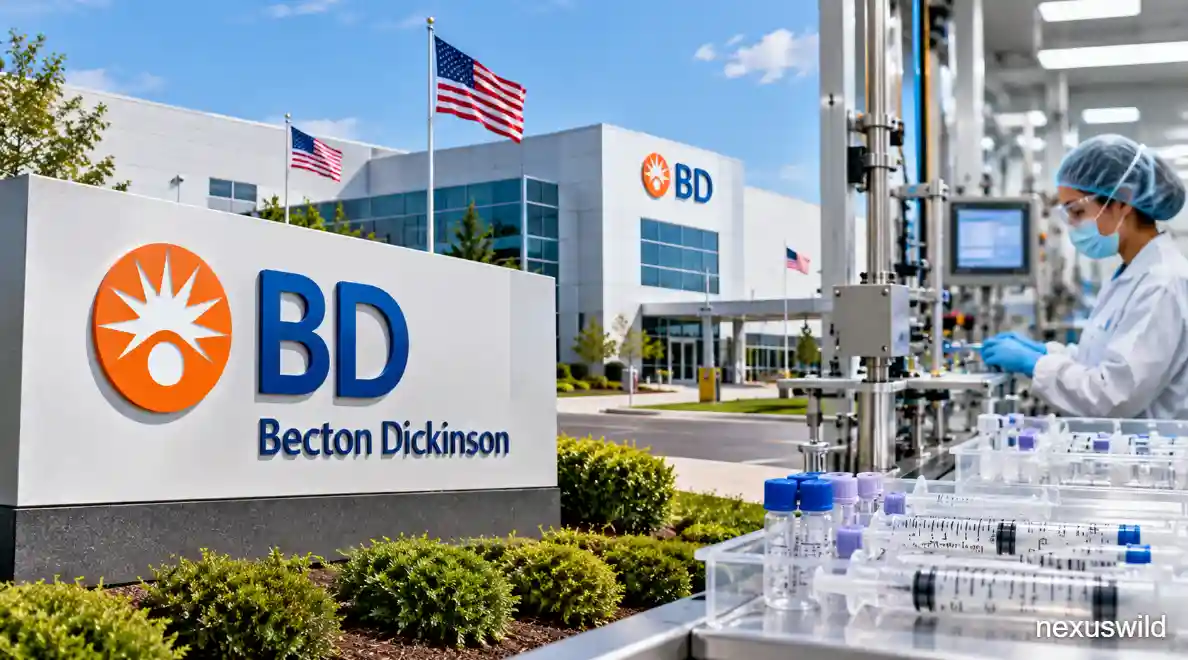

Becton, Dickinson and Company plans to invest $3 billion to expand U.S. manufacturing capacity for essential medical products, part of a broader $19 billion domestic investment commitment aimed at increasing local production and reducing supply-chain exposure.
The medical-technology company, commonly known as BD, announced the agreement with the U.S. government on October 6.
BD said the $19 billion commitment will cover capital investment, operations and supply-chain spending over several years, with $3 billion specifically directed toward manufacturing expansion at strategic U.S. production sites.
The company expects the manufacturing program to increase end-to-end U.S. output by approximately 5 billion essential medical consumables a year and raise the proportion of those products supplied domestically to roughly 80%.
$3 Billion Is Part of a Larger $19 Billion Commitment
The manufacturing plan is one component of a significantly larger U.S. investment package.
BD said it intends to invest $19 billion in the United States over several years, including capital expenditures, operational spending and supply-chain investments.
Of that total, $3 billion is earmarked for direct expansion of manufacturing capacity.
The distinction matters because the $19 billion figure is not a single factory-construction budget.
It includes a wider range of spending associated with BD’s U.S. operations, while the $3 billion figure refers specifically to expanded domestic production.
BD Plans 5 Billion More U.S.-Made Medical Consumables Annually
BD said the expansion is intended to add approximately 5 billion units of annual U.S. production across essential medical consumables.
The company expects that increase to lift the share of its essential medical products supplied from U.S. production to approximately 80%.
BD manufactures products used broadly across hospitals and healthcare facilities, including syringes, needles, catheters and other routine medical devices.
The company said its essential consumables are used in roughly 90% of U.S. hospital visits, illustrating why continuity of supply has become a major part of its manufacturing strategy.
That is a company statement about product reach rather than an independent estimate of market share.
All BD Needles Used in the U.S. Will Be Made Domestically
One of the most specific commitments involves needle manufacturing.
BD said it intends to manufacture 100% of the needles it supplies for use in the United States domestically, using American-made steel.
That commitment extends beyond final assembly.
By specifying U.S.-made steel, BD is also seeking to localize a critical input used in the production of the devices.
The company has not disclosed in its announcement how much additional annual needle capacity this change will create.
More Than $1 Billion Is Expected to Go to Nebraska
President Donald Trump said more than $1 billion of the $3 billion manufacturing investment will be directed to Nebraska.
Reuters reported that the spending will support increased production of medical products, including needles made from U.S. steel.
The White House separately confirmed a $110 million expansion of prefillable syringe production in Columbus, Nebraska, which it said is expected to create about 120 jobs. That project follows an earlier $35 million investment at the same location.
BD’s October 6 company announcement did not provide a complete state-by-state breakdown of the full $3 billion program.
The Nebraska figure therefore comes from the administration’s announcement, while the nationwide $3 billion commitment is confirmed directly by BD.
BD Already Has a Large U.S. Manufacturing Network
The company operates manufacturing sites across several states and Puerto Rico.
BD identified major facilities in Columbus and Broken Bow, Nebraska; Canaan, Connecticut; Añasco, Puerto Rico; Sandy, Utah; El Paso, Texas; Covington, Georgia; and Sumter, South Carolina.
Those existing sites give the company a substantial domestic base from which to expand production.
Its Canaan facility, for example, has manufactured syringes for decades and is now the largest syringe manufacturing operation in the United States, according to BD.
Its Sandy, Utah, plant employs more than 1,000 people and produces peripheral intravenous catheters.
The Strategy Builds on an Earlier $2.5 Billion Plan
The latest commitment expands on investment plans BD had already disclosed.
In May 2025, the company said it intended to invest $2.5 billion in U.S. manufacturing capacity over five years to strengthen domestic healthcare supply chains.
The new $3 billion manufacturing commitment is therefore part of a longer-term push toward greater U.S. production rather than a sudden shift initiated in October 2026.
BD has not detailed how much of the earlier $2.5 billion commitment overlaps with the new $3 billion figure.
That means the two numbers should not automatically be added together as separate investment programs.
Tariff Relief Is Part of the Agreement
The agreement also has a trade-policy component.
BD said it will receive relief from future tariffs imposed under Section 232 on covered products and inputs, subject to the final design of any future tariff measures and the company meeting agreed investment milestones.
Section 232 of U.S. trade law allows the government to impose tariffs or other restrictions when imports are determined to affect national security.
BD said the arrangement could provide greater certainty for long-term manufacturing and supply-chain planning.
The company has not quantified the financial impact of the tariff relief because the final tariff rates, covered products and implementation timing have not yet been determined.
Tariffs Have Already Affected BD’s Costs
Trade policy has become a material operating issue for the company.
In its latest quarterly filing, BD said tariffs had adversely affected operating expenses and could continue to influence costs depending on future trade measures, product exemptions and supply-chain changes.
The company also warned that tariffs, sanctions and other trade barriers could affect supply-chain costs, demand and its ability to source components.
Those disclosures help explain the commercial value of greater domestic manufacturing and tariff certainty.
They do not mean tariffs are the sole reason for the expansion.
Supply-Chain Resilience Is a Central Part of the Plan
BD has framed the manufacturing investment around healthcare resilience.
Medical products such as syringes, needles and IV devices are used in large volumes and are difficult for hospitals to substitute quickly during shortages.
Recent pandemic-era disruptions and broader geopolitical stress have made healthcare supply-chain resilience a larger strategic concern for both governments and medical-device manufacturers.
BD’s SEC filings also identify transportation disruptions, international conflict, tariffs and raw-material availability as risks to its global operations.
Expanding local production could reduce exposure to some cross-border disruptions.
That is the company’s strategic expectation, rather than a guarantee that supply shortages or logistics problems will be eliminated.
Domestic Manufacturing Does Not Remove All Supply Risks
Even with greater U.S. production, BD will remain exposed to a range of external factors.
Manufacturing depends on raw materials, energy, specialized components, freight networks and labor availability.
Domestic facilities can also experience operational disruptions.
BD itself has warned investors that geopolitical conflict, changes in oil prices, trade restrictions and sourcing constraints can affect costs and product availability.
The $3 billion investment therefore reduces some geographic supply exposure but does not eliminate supply-chain risk altogether.
Broader Portfolio Changes Are Occurring at the Same Time
The manufacturing expansion comes while BD is reshaping its broader business portfolio.
The company has been simplifying its operating structure and focusing on medical essentials, connected care, biopharma systems and interventional technologies.
Its domestic manufacturing strategy is particularly important for high-volume products that hospitals use every day, where consistent supply can matter as much as product innovation.
That makes the latest investment both an industrial expansion and a supply-chain strategy.
Conclusion
Becton Dickinson plans to direct $3 billion toward expanding U.S. manufacturing capacity as part of a wider $19 billion domestic investment commitment over several years.
The company expects the manufacturing program to add approximately 5 billion essential medical consumables to annual U.S. production, increasing its domestically supplied share to roughly 80%.
BD also intends to manufacture all needles used by U.S. customers domestically using American-made steel.
More than $1 billion of the manufacturing investment is expected to go to Nebraska, while the company’s broader U.S. production network spans multiple states and Puerto Rico.
The agreement also provides conditional relief from future Section 232 tariffs on covered BD products and inputs.
The confirmed investment strengthens BD’s domestic manufacturing footprint. The longer-term effects on supply resilience, costs and profitability will depend on execution, future trade policy and broader supply-chain conditions.
Nexuswild welcomes factual corrections. Email contact@nexuswild.com with evidence and the article URL.