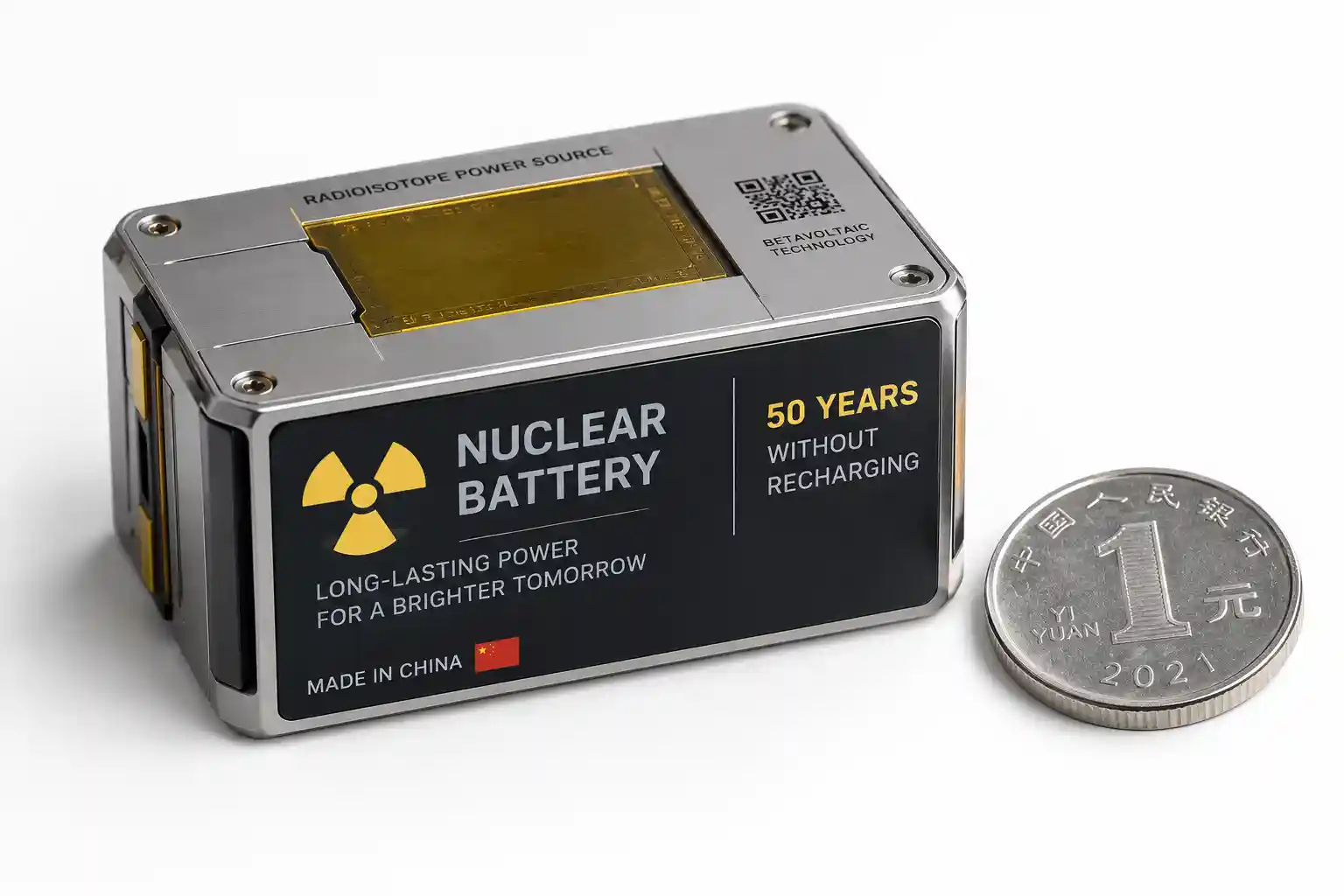

BEIJING — Chinese company Betavolt has developed a miniature nuclear battery, the BV100, that it says can generate electricity for 50 years without charging or maintenance. Betavolt, based in Beijing, first announced the battery in January 2024, and it remains the company's flagship product as of 2026.
Coin-Sized Power
The BV100 measures just 15 by 15 by 5 millimeters, smaller than a coin, and outputs 100 microwatts of power at 3 volts. That figure comes directly from Betavolt and has not been independently tested by a third party in published results reviewed for this article.
Inside the battery, a thin layer of radioactive nickel-63 is sandwiched between two layers of diamond semiconductor material, each about 10 microns thick. As the nickel-63 decays, it releases electrons in a process called beta decay. The diamond layers capture these electrons and convert them directly into an electrical current, a method known as the betavoltaic effect. This is different from how lithium-ion batteries work: a lithium-ion battery stores energy through a reversible chemical reaction and needs to be recharged, while the BV100 generates electricity continuously from radioactive decay and does not need charging, though its output cannot be switched off or increased on demand.
Production and Use Cases
Betavolt describes the BV100 as the world's first mass-produced nuclear battery, and said in its 2024 announcement that the product had entered pilot production ahead of a wider rollout. Independent reporting since then has generally described the battery as still in a limited or pilot stage rather than in widespread commercial distribution, and Betavolt has not published clear evidence of large-scale consumer sales as of September 2026.
Betavolt has said the BV100 is intended for applications such as medical devices, including pacemakers and cochlear implants, aerospace equipment, intelligent sensors, small drones and micro-robots, where a tiny but constant power source matters more than raw output. Multiple BV100 units can reportedly be combined in series or parallel to increase total power for a given device.
The company has also said it plans to develop a more powerful 1-watt version of its atomic battery, originally targeted for 2025. As of this writing, there is no confirmed evidence that this higher-output battery has launched as an available product; it remains a stated goal rather than a released item.
Safety and Practical Limitations
On safety, Betavolt has said the BV100 produces no external radiation, will not catch fire or explode even if punctured or shot, and can operate in temperatures ranging from minus 60 to 120 degrees Celsius. The company also says that as the nickel-63 decays, it eventually becomes a stable, non-radioactive form of copper. These are claims made by Betavolt; they have not been independently verified by outside regulators or researchers in publicly available assessments.
Nuclear batteries themselves are not a new invention. Radioisotope power technology dates back decades and has been used in applications such as spacecraft power systems and some early cardiac pacemakers. What Betavolt says is new is the miniaturization of the technology using diamond semiconductors, allowing the battery to be built at a much smaller scale than earlier designs.
The BV100's biggest limitation is its extremely low power output. At 100 microwatts, it produces roughly a millionth of the power a smartphone needs to operate, and it cannot currently run a phone, laptop or any device requiring a steady stream of watts rather than microwatts. Its value lies elsewhere: for sensors, implants or remote equipment that need only a tiny trickle of power but must run reliably for decades without a battery swap, a device like the BV100 could remove the need for maintenance entirely, even though it is not a replacement for conventional batteries in high-power devices.
Further reading and useful links
Reader questions
Frequently asked questions
Can the Betavolt BV100 nuclear battery charge my smartphone?
No. The BV100 produces only 100 microwatts of power, which is roughly a millionth of what a standard smartphone requires to operate. It is designed for ultra-low power devices like medical implants or remote sensors.
How does the Betavolt nuclear battery work?
The BV100 utilizes the betavoltaic effect. It sandwiches a thin layer of radioactive nickel-63 between two layers of diamond semiconductor material, which captures the electrons released during decay and converts them into an electrical current.
Is the Betavolt battery safe for consumer use?
Betavolt claims the battery is absolutely safe, emits no external radiation, and will not catch fire or explode even if damaged. Furthermore, the company states the nickel-63 isotope decays into non-radioactive copper. However, these claims have not yet been independently verified by outside regulators.
Nexuswild welcomes factual corrections. Email contact@nexuswild.com with evidence and the article URL.