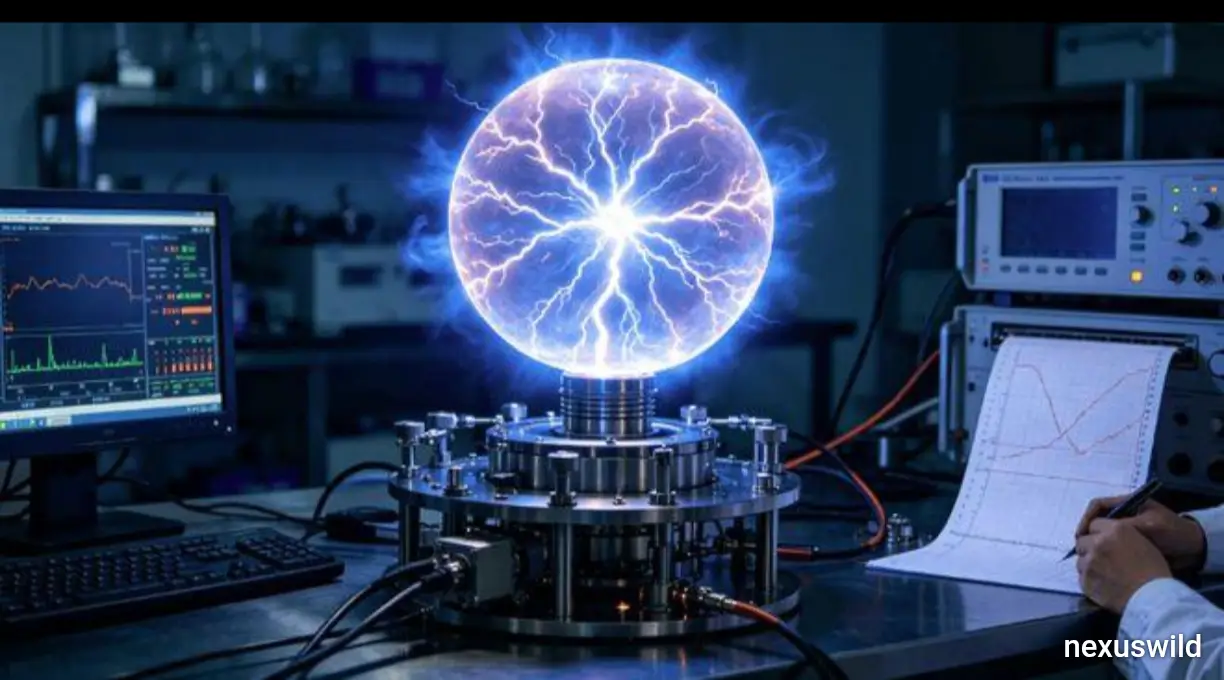

Scientists Recreate Ball-Lightning-Like Plasma Sphere in Laboratory
Scientists in China have made a bright sphere of plasma inside a lab. This gives scientists a way to study the physics of ball lightning. Ball lightning has been reported by witnesses for hundreds of years. It is hard to study because it is unpredictable and rarely seen in a setting where detailed data can be taken.
The experiment, which appeared in Nature Photonics on April 16 2026 made a structure that looks like ball lightning in many ways. The scientists watched how the structure formed grew and gave off light. Then they compared those observations with theory. Their results point to a type of electromagnetic wave called a soliton that might keep the sphere alive.
This is a laboratory analogue. It does not prove that scientists have recreated every aspect of ball lightning.
How the researchers created the glowing sphere
The team used a short laser pulse aimed at a fine tungsten tip. This created an electromagnetic field right at the tip producing terahertz energy that could pull electrons away from nearby argon atoms.
When atoms lose electrons the gas turns into gas or plasma. In this experiment that process made a bright sphere that the scientists could watch with fast cameras and spectral tools.
The sphere started at 80 micrometers in size and grew to a few hundred micrometers within 100 nanoseconds. A micrometer is one-millionth of a meter so the sphere was much smaller than the balls that people sometimes describe in real ball lightning stories.
Even though the sphere was tiny and short‑lived it lasted longer than the laser pulse that started it. This allowed the scientists to study what kept the plasma bright and still as it grew.
Why the soliton explanation matters
A soliton is a wave that can keep its shape while moving or changing because different physical forces balance each other. Scientists study solitons in fields, such as light, fluid flow and plasma.
Some theories about ball lightning say that electromagnetic energy stays trapped inside or around a plasma. If that trapping can keep a sphere it might explain why some reports say the ball keeps its shape instead of spreading out right away.
In this experiment the scientists compared how the sphere grew with what theory predicts. Their analysis matched a terahertz electromagnetic soliton. The ongoing light also suggested that electromagnetic energy stayed trapped as the sphere grew and cooled.
The scientists also compared the observations with computer models of hot plasma spreading. In those models the plasma spread faster than the sphere seen in the experiment. That difference supports the idea that electromagnetic trapping was key.
Matching a lab result to a theory does not prove that the same mechanism explains every real ball lightning event. Reports differ in size, length, motion and look. Scientists have not found one single explanation that fits all of them.
What the experiment tells us about natural ball lightning
Ball lightning is strange because it does not act like the branching bolt of normal lightning. People have described round objects that show up during storms or near electric activity. Some stories talk about movement, light changes or quick vanishing.
Because these events happen randomly scientists have chances to take direct data. Lab tests give a way: researchers can build similar structures change the setup and watch their actions with special tools.
This new work gives a controlled setting to study how strong electromagnetic fields touch gas. It also gives scientists data that can be matched with computer models and later experiments.
The difference between a lab copy and real ball lightning matters. The sphere was made with gear a tungsten tip, a short laser pulse and argon gas in a controlled setting. Real ball lightning if reported correctly appears in a different air environment.
Thus the researchers’ results offer a way to understand ball lightning, not a final answer to the mystery.
Could the research have applications?
This work also helps research on how electromagnetic waves meet matter in extreme settings. Knowing how energy can stay packed in a plasma could help scientists study nonlinear wave behaviour and other processes, in high‑field physics.
I think the paper shows the experiment as a platform for work on soliton physics, energy confinement and the longstanding question of ball lightning. These are research directions, not established applications. Any practical use would need investigation into stability, control, energy requirements and repeatability.
The team also used modelling to explore how similar structures might behave at scales and frequencies. These calculations can guide experiments but predicted behaviour at larger scales should not be confused with a demonstrated ability to create a metre‑wide long‑lasting sphere in the laboratory.
The next steps will involve testing the model under conditions and determining which observed features can be reproduced consistently. Independent experiments will also be important for evaluating how broadly the proposed mechanism applies.
A useful step, not an answer.
The team’s experiment adds measurable evidence to a field where direct observation has long been difficult. By producing and tracking a luminous plasma sphere the researchers were able to compare its behaviour with a physical model rather than relying only on descriptions of natural events.
The work does not settle the origin of ball lightning. It does however give scientists an experimental system, for investigating how terahertz electromagnetic fields, plasma and soliton-like structures interact.
For now the main achievement is a way to study a persistent scientific puzzle. Whether the same mechanism operates in natural ball lightning remains a question.
Nexuswild welcomes factual corrections. Email contact@nexuswild.com with evidence and the article URL.