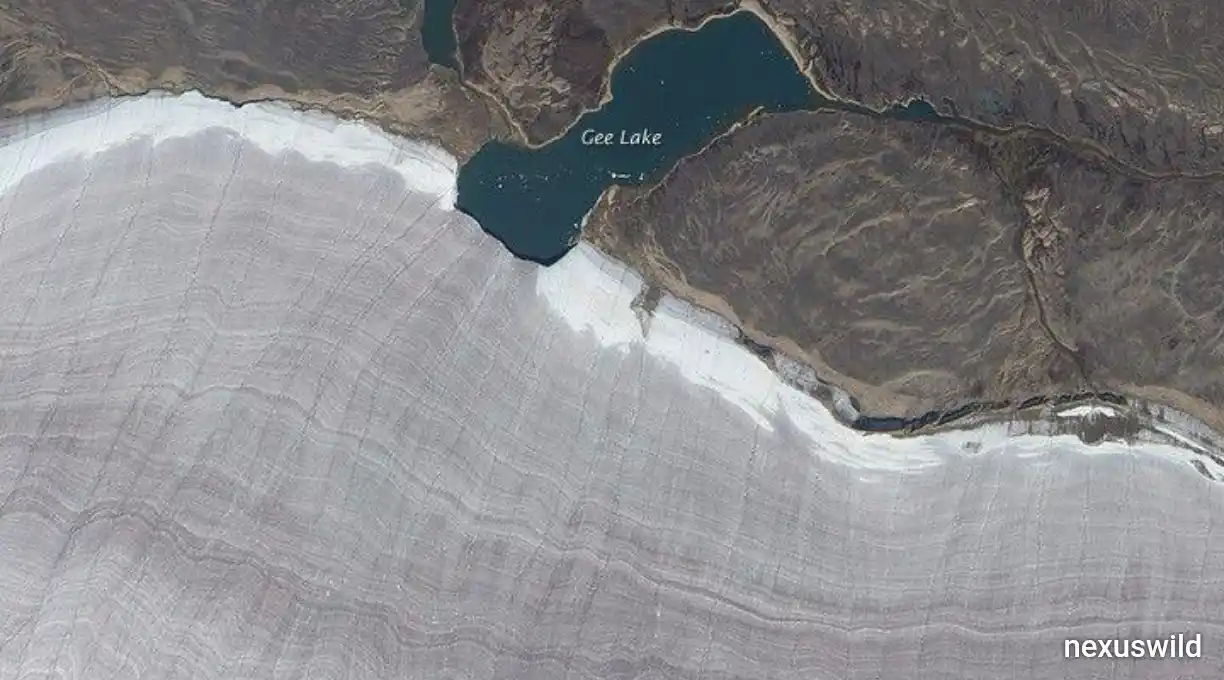

A remnant of the enormous ice sheet that once covered much of northern North America carries evidence of a long period of ice growth that began roughly 2,000 years ago and reversed during the twentieth century. A study published in Science in October 2026 reconstructs this history using ancient vegetation preserved beneath the Barnes Ice Cap on Baffin Island, in Canada’s Arctic territory of Nunavut. The findings offer researchers a rare record of how an ice margin advanced over centuries before retreating as the climate warmed. The study’s authors argue that this renewed growth marked the early stages of another glacial period. The research does not mean that a new ice age had already spread across North America; it presents evidence of an initial process that, under different conditions, could have continued for thousands of years. A surviving remnant of a vast ice sheet The Laurentide Ice Sheet was one of the largest ice masses of the most recent glacial period. At its maximum, it covered extensive areas of what are now Canada and the northern United States. As the climate warmed after the last glacial period, the ice sheet retreated over thousands of years. The Barnes Ice Cap, located on central Baffin Island, is considered its last surviving remnant. Although far smaller than the original ice sheet, it preserves a valuable record of the changing Arctic environment. Scientists wanted to understand whether the Laurentide Ice Sheet had reached a particularly small size before beginning to grow again. Answering that question is difficult because advancing glaciers can erase or disturb the geological evidence left behind by earlier ice movements. The Barnes Ice Cap offers an unusual opportunity. Its cold-based ice is frozen to the underlying ground rather than sliding freely across it. As a result, vegetation that grew before the ice advanced can remain preserved beneath the ice for long periods. Ancient plants provide a timeline The research team examined plant remains exposed along the ice cap’s retreating margins. These remains include vegetation that was alive before advancing ice covered and preserved it. Radiocarbon dating allows scientists to estimate when the plants died. By comparing dates from samples collected at different locations, researchers can reconstruct when the ice margin reached those areas. The team combined evidence from the Barnes Ice Cap with information from smaller ice caps in the surrounding region. The resulting timeline suggests that the Laurentide Ice Sheet reached its minimum interglacial dimensions approximately 3,600 years ago and began expanding again around 2,000 years ago. This distinction matters: the evidence for the precise beginning of the advance is assembled from a regional geological record, rather than from a single plant sample directly marking the start of growth at the Barnes Ice Cap. The study provides physical evidence that complements earlier reconstructions based on indirect climate records. It also illustrates how seemingly small remnants of ancient ecosystems can help scientists investigate changes that unfolded over thousands of years. Why the researchers connect the advance to a glacial period Glacial periods are associated with the growth and expansion of large ice sheets. Their development is influenced by long-term changes in Earth’s orbit and rotation, which alter the distribution of sunlight reaching different regions and seasons. In the Arctic, changes in summer sunlight can affect how much snow and ice survives the warmer months. When conditions favour accumulation over melting for long enough, ice masses can grow and potentially contribute to wider glaciation. The researchers interpret the renewed growth of the Laurentide remnant as the beginning of another glacial period. Under their definition, the initial re-expansion of ice is an important milestone, even if the development of a large continental ice sheet would take many thousands of years. That is a significant interpretation, but it should not be confused with a prediction that a full ice age was about to arrive in the near future. The timing and extent of future glaciation depend on several interacting factors, including greenhouse gas concentrations and long-term natural climate cycles. Why the expansion stopped around 1960 The study reports that the renewed ice advance reached its maximum extent around 1960. After that point, warmer summer conditions caused the Barnes Ice Cap to lose more ice than it gained through seasonal snow accumulation. Human-caused greenhouse gas emissions have increased the amount of heat retained in Earth’s climate system. In the Arctic, warming can lengthen the melt season, reduce snow cover and expose darker ice or rock that absorbs more solar energy. These changes can reinforce melting. The Barnes Ice Cap’s history therefore records a major change in direction: a long period of expansion gave way to sustained retreat. The study’s authors attribute the reversal to anthropogenic summer warming, despite the continued decline in summer sunlight that had previously favoured ice growth. The research is consistent with the wider evidence that human-caused warming is changing Arctic ice conditions. It also demonstrates why natural climate cycles alone cannot explain the ice cap’s recent behaviour. What the findings mean for climate research The study provides a longer historical perspective for researchers investigating how glaciers respond to changing climate conditions. Direct evidence of past ice movement can help scientists evaluate reconstructions and improve understanding of the processes that control glacial growth and retreat. The findings may also matter for future studies of glaciation. The Laurentide Ice Sheet acted as a starting point for ice expansion during earlier cold periods. If it eventually disappears, future glacial development could unfold differently, although scientists cannot determine precisely when another glacial period might occur under a climate with elevated greenhouse gas concentrations. The research should not be treated as a direct forecast of future sea-level change. The Barnes Ice Cap is one ice mass, and projections of global sea level require evidence from glaciers and ice sheets around the world. Nevertheless, understanding how Arctic ice responds to warming is relevant to wider assessments of long-term environmental change. A small ice cap with a much larger history The Barnes Ice Cap offers a rare view of how a remnant of a vanished continental ice sheet changed over millennia. By combining radiocarbon-dated vegetation with other geological evidence, researchers have reconstructed an advance that began around 2,000 years ago and reversed around 1960. The study’s broader argument—that this growth represented the beginning of another glacial period—will contribute to discussion about how scientists define the earliest stages of glaciation. What the evidence establishes more directly is that the ice margin advanced for a long period before modern warming helped turn the trend around. The next questions concern how quickly the Barnes Ice Cap will continue to retreat, how its remaining ice responds to future Arctic temperatures, and what its record can reveal about the conditions needed for large ice sheets to form again.
Nexuswild welcomes factual corrections. Email contact@nexuswild.com with evidence and the article URL.